80 Results for "

α-synuclein aggregation

" in MedChemExpress (MCE) Product Catalog:
Products (80)

80 Results for "α-synuclein aggregation" in MCE Product Catalog:

Cat. No.: HY-121252S
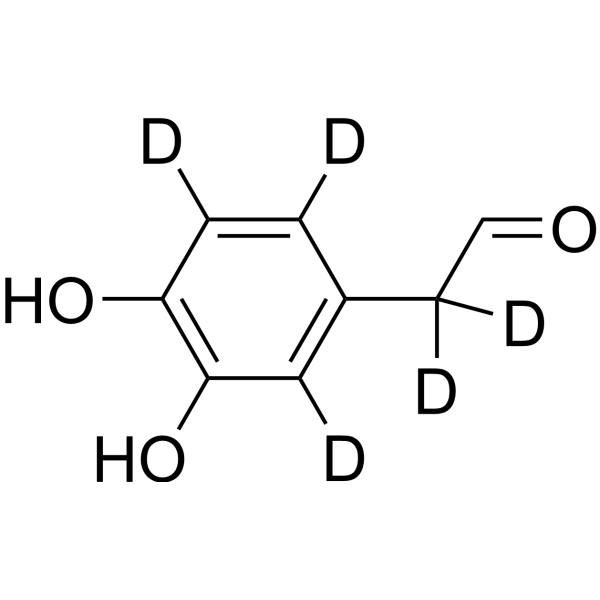
Dopal-d5 is the deuterium labeled Dopal (HY-121252). Dopal is a metabolite and aldehyde neurotoxin of Dopamine (HY-B0451). Dopal exhibits cytotoxicity, induces α-synuclein oligomerization and aggregation, and is closely associated with the pathogenesis of Parkinson's disease. Dopal can be used in research related to Parkinson's disease .
loading...
    loading...
Cat. No.: HY-159945
Target:  

α-synuclein

Research Areas:  

Neurological Disease

Tau Protein/α-synuclein-IN-2 (Compound 14T) is a blood-brain barrier penetrating tau and α-syn inhibitor. Through its thiourea linker structure, Tau Protein/α-synuclein-IN-2 dose-dependently reduces α-syn oligomerization. In biosensor cells, Tau Protein/α-synuclein-IN-2 prevents the seeding effect of tau aggregation. In the M17D neuroblastoma model, Tau Protein/α-synuclein-IN-2 exhibits anti-inclusion effects. Additionally, Tau Protein/α-synuclein-IN-2 reduces Aβ plaque formation. Tau Protein/α-synuclein-IN-2 holds promise for Alzheimer's disease and Parkinson's disease research.
loading...
    loading...
Cat. No.: HY-W010041R
CAS No.: 488-59-5
Scyllo-Inositol is an inhibitor that targets the aggregation of misfolded proteins (such as α-synuclein and Amyloid-β), is orally effective, and can cross the blood-brain barrier. Scyllo-Inositol can selectively bind to and stabilize non-toxic oligomers, preventing them from converting into toxic fibers, exerting protein homeostasis regulation and neuroprotective activity. Scyllo-Inositol binds to the hydrophobic region of pathogenic proteins, inhibits protein aggregation, and promotes lysosome- and proteasome-mediated degradation pathways, thereby reducing neurotoxicity. Scyllo-Inositol can be used in the study of neurodegenerative diseases such as Parkinson's disease, Alzheimer's disease, and Huntington's disease .
loading...
    loading...
Cat. No.: HY-W707693
CAS No.: 115268-26-3
Scyllo-Inositol-d6 is the deuterium labeled Scyllo-Inositol (HY-W010041). Scyllo-Inositol is an inhibitor that targets the aggregation of misfolded proteins (such as α-synuclein and Amyloid-β), is orally effective, and can cross the blood-brain barrier. Scyllo-Inositol can selectively bind to and stabilize non-toxic oligomers, preventing them from converting into toxic fibers, exerting protein homeostasis regulation and neuroprotective activity. Scyllo-Inositol binds to the hydrophobic region of pathogenic proteins, inhibits protein aggregation, and promotes lysosome- and proteasome-mediated degradation pathways, thereby reducing neurotoxicity. Scyllo-Inositol can be used in the study of neurodegenerative diseases such as Parkinson's disease, Alzheimer's disease, and Huntington's disease .
loading...
    loading...
Cat. No.: HY-D0914A
CAS No.: 25738-40-3
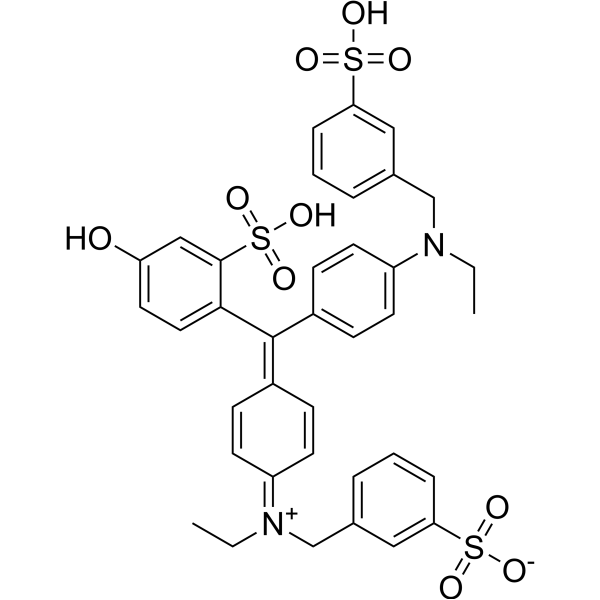
Fast green FCF free acid is a dye that is acid-resistant. Fast Green FCF free acid inhibits α-synuclein aggregation, as well as Aβ, P2X4 receptor and TLR4/Myd88/NF-κB. Fast Green FCF free acid is widely used as a staining agent like quantitative stain for histones at alkaline pH after acid extraction of DNA, and as a protein stain in electrophoresis. Fast Green FCF free acid improves cognitive impairment, depression, relieves pain allergies, and promotes reproductive function .
loading...
    loading...
Cat. No.: HY-186234
CAS No.: 2648041-95-4
Target:  

α-synuclein

Research Areas:  

Neurological Disease

α-Synuclein aggregate binder 3 is a probe for α-synuclein aggregates. The Ki value of α-Synuclein aggregate binder 3 for binding to sonicated α-synuclein fibrils is 0.8 nM. α-Synuclein aggregate binder 3 can be used for α-synuclein imaging, as well as for detecting disorders associated with α-synuclein aggregation, such as Parkinson's disease, dementia with Lewy bodies, and multiple system atrophy .
loading...
    loading...
Cat. No.: HY-W017370R
CAS No.: 99-48-9
Carveol (Standard) is the analytical standard of Carveol. This product is intended for research and analytical applications. Carveol is an orally active monoterpenoid alcohol with neuroprotective, antioxidant, anti-inflammatory, anticonvulsant, antidiabetic, hypolipidemic and hepatoprotective activities. Carveol upregulates the expression of Bcl2, downregulates the expression of caspase-3, TNF-α, IL1β and IL6, activates the Nrf2/HO-1 antioxidant signaling pathway, inhibits the RAGE/NF-κB signaling pathway, and suppresses neuroinflammation and neuronal apoptosis. Carveol inhibits α-synuclein aggregation, improves cognitive ability, and inhibits α-amylase activity. Carveol exerts neuroprotective effects in a rat model of Parkinson's disease. Carveol exhibits antidiabetic effects in alloxan-induced diabetic rats. Carveol alleviates PTZ-induced seizures in rats. Carveol can be used in research related to Parkinson's disease, epilepsy, diabetes and ischemic stroke .
loading...
    loading...
Cat. No.: HY-184816
CAS No.: 2883627-65-2
α-Synuclein-IN-21 is an α-synuclein (α-Syn) aggregation inhibitor with an IC50 of 1.6 μM. α-Synuclein-IN-21 stabilizes the secondary conformation of α-synuclein monomers, inhibits β-sheet formation, reduces oligonucleation during the aggregation lag phase, dissociates preformed aggregates, and blocks re-aggregation. α-Synuclein-IN-21 reduces α-synuclein inclusions in neuronal cells and scavenges ROS. α-Synuclein-IN-21 can be used for the research of Parkinson's disease .
loading...
    loading...
Cat. No.: HY-178276
CAS No.: 1394328-54-1
Target:  

α-synuclein

Research Areas:  

Neurological Disease

α-Synuclein-IN-18 (Compound Mol D) is an inhibitor of the autocatalytic proliferation of α-Synuclein aggregate. α-Synuclein-IN-18 can specifically bind to the conserved binding pocket on the surface of α-synuclein fibrils. α-Synuclein-IN-18 can delay the aggregation process of α-synuclein, extend the aggregation T1/2 by three times. α-Synuclein-IN-18 can reduce the generation flux of α-synuclein toxic oligomers, thereby alleviating the neurotoxicity. α-Synuclein-IN-18 can be used for research of Parkinson’sdisease .
loading...
    loading...
Cat. No.: HY-184819
CAS No.: 2883627-56-1
α-Synuclein-IN-24 is an α-synuclein (α-Syn) aggregation inhibitor with an IC50 of 4.0 μM. α-Synuclein-IN-24 stabilizes the secondary conformation of α-synuclein monomers, inhibits β-sheet formation, reduces oligonucleation during the aggregation lag phase, dissociates preformed aggregates, and blocks reaggregation. α-Synuclein-IN-24 reduces α-synuclein inclusions in neuronal cells and scavenges ROS. α-Synuclein-IN-24 can be used for the research of Parkinson's disease .
loading...
    loading...
Cat. No.: HY-184782
CAS No.: 1026937-99-4
Target:  

α-synuclein

Research Areas:  

Neurological Disease

α-Synuclein-IN-19 is a polyphenolic acid monoamide derivative and an inhibitor of α-synuclein (α-Syn) aggregation. α-Synuclein-IN-19 can be used in Parkinson's disease-related research .
loading...
    loading...
Cat. No.: HY-W007551
CAS No.: 34698-41-4
Synonyms: 1-Indanamine; 2,3-Dihydro-1H-inden-1-amine
Research Areas:  

Neurological Disease

1-Aminoindan (1-Indanamine; 2,3-Dihydro-1H-inden-1-amine) is an α-synuclein (α-synuclein) binder. By binding to α-synuclein, 1-Aminoindan promotes the formation of its neuroprotective "cyclic" conformation, thereby reducing the misfolding and aggregation of α-synuclein. 1-Aminoindan is a metabolite of Rasagiline (HY-14605A). 1-Aminoindan can be used in research related to Parkinson's disease .
loading...
    loading...
Cat. No.: HY-184847
CAS No.: 2883627-66-3
Target:  

α-synuclein

Research Areas:  

Neurological Disease

α-Synuclein-IN-25 is a quinone-acid hybrid and also an α-synuclein aggregation inhibitor with an IC50 of 3.0 μM. α-Synuclein-IN-25 dissociates preformed α-Syn aggregates, inhibits their re-aggregation, scavenges reactive oxygen species, and reduces the formation of α-Syn inclusions in neuronal cells. α-Synuclein-IN-25 can be used in the research of Parkinson's disease .
loading...
    loading...
Cat. No.: HY-184815
CAS No.: 2883627-67-4
Research Areas:  

Neurological Disease

α-Synuclein-IN-20 is an inhibitor of α-synuclein (α-Synuclein) with an IC50 of 4.1 μM against human α-Syn. α-Synuclein-IN-20 exerts anti-aggregation effects by stabilizing the native conformation of α-Syn, inhibiting the formation of β-sheet aggregates and inclusion bodies, and dissociating mature fibrils into functional monomers. α-Synuclein-IN-20 scavenges ROS, protects and repairs dopaminergic neurons, ameliorates Parkinson's disease-like symptoms, and shows low cytotoxicity. α-Synuclein-IN-20 can be used for research related to Parkinson's disease .
loading...
    loading...
Cat. No.: HY-184817
CAS No.: 2883627-63-0
α-Synuclein-IN-22 is an α-Synuclein inhibitor with an IC50 of 2.7 μM against human α-Syn. α-Synuclein-IN-22 exerts anti-aggregation effects by stabilizing the native conformation of α-Syn, inhibiting the formation of β-sheet aggregates and inclusion bodies, and dissociating mature fibrils into functional monomers. α-Synuclein-IN-22 scavenges ROS and shows low cytotoxicity. α-Synuclein-IN-22 can be used in research related to Parkinson's disease .
loading...
    loading...
Cat. No.: HY-182304
CAS No.: 1338489-62-5
CLR01 sodium is a blood-brain barrier-permeable anti-aggregation agent. CLR01 sodium inhibits the de novo aggregation of Amyloid-β 40/42, α-synuclein, IAPP, tau protein and SOD1. CLR01 sodium reduces amyloid plaque burden in the cortex of triple-transgenic mice and improves the memory and motor abilities of these mice. CLR01 sodium can be used in research related to Alzheimer's disease, Parkinson's disease, and amyotrophic lateral sclerosis (ALS) .
loading...
    loading...
Cat. No.: HY-101855R
CAS No.: 882697-00-9
Synonyms: Anle138b (Standard)
Research Areas:  

Neurological Disease

Emrusolmin (Standard) (Anle138b (Standard)) is the analytical standard of Emrusolmin (HY-101855). This product is intended for research and analytical applications. Emrusolmin (Anle138b), an oligomeric aggregation inhibitor, blocks the formation of pathological aggregates of prion protein (PrPSc) and of α-synuclein (α-syn). Emrusolmin strongly inhibits oligomer accumulation, neuronal degeneration, and disease progression in vivo. Emrusolmin has low toxicity and an excellent oral bioavailability and blood-brain-barrier penetration. Emrusolmin blocks Aβ channels and rescues disease phenotypes in a mouse model for amyloid pathology .
loading...
    loading...
Cat. No.: HY-182893
CAS No.: 1919889-97-6
SK-129 is a blood-brain barrier-permeable inhibitor of α-synuclein (αS) oligomers with a Kd of 221 nM. SK-129 preferentially binds to neurotoxic αS oligomers over physiological αS monomers, inhibits αS aggregation, blocks the interaction and co-aggregation of αS with tau protein, and prevents the maturation of αS-tau condensates into amyloid aggregates. SK-129 reduces ROS production, rescues dopaminergic neuron degeneration, improves motor function, restores endogenous dopamine synthesis, increases the number of Tyrosine Hydroxylase-positive neurons, prevents brain histopathological changes, alleviates neuroinflammation, and improves survival rates in relevant models. SK-129 can be used in research related to Parkinson's disease (PD) and Lewy body dementia (LBD) .
loading...
    loading...
Cat. No.: HY-114118C
CAS No.: 2924330-56-1
Semaglutide sodium is a long-acting, selective, competitive GLP-1R agonist that can penetrate the blood-brain barrier. After activating GLP-1R, Semaglutide sodium promotes insulin secretion, inhibits gastric emptying and appetite, and at the same time enhances autophagy, inhibits oxidative stress and apoptosis. Semaglutide sodium also regulates mitochondrial function and lipid metabolism (such as reducing de novo lipogenesis in the liver). Semaglutide sodium has activities such as lowering blood sugar, reducing weight, neuroprotection (such as improving motor function in Parkinson's disease models, reducing α-synuclein aggregation) and improving hepatic steatosis. Semaglutide sodium can be used for the study of neurodegenerative diseases and liver diseases such as type 2 diabetes, obesity, Parkinson's disease, metabolic associated fatty liver disease (MASLD), and cancer .
loading...
    loading...
Cat. No.: HY-153169R
CAS No.: 2754428-18-5
6PPD-Q (Standard) is the analytical standard of 6PPD-Q (HY-153169). This product is intended for research and analytical applications. 6PPD-Q (6PPD-Quinone) is an environmental pollutant that can be detected in human urine and is widely present in the environment. 6PPD-Q targets and binds to CNR2, CNR1, AA2AR, LCAT, and TRPA1, with CNR2 exhibiting the highest binding affinity, potentially acting as a CNR2 receptor agonist to activate cannabinoid receptors. 6PPD-Q induces intestinal inflammation and barrier damage by disrupting mitochondrial function, reducing neuronal glycolysis metabolites and TCA cycle intermediates, and exacerbating α-synuclein (α-syn) aggregation. 6PPD-Q is applicable in research on environmental toxicology, neurodegenerative diseases, and inflammation-related disorders .
loading...
    loading...

