

20 Results for "

acidic lysosomes

" in MedChemExpress (MCE) Product Catalog:
Products (20)

20 Results for "acidic lysosomes" in MCE Product Catalog:

3
3 Cited Publications
Cat. No.: HY-128144
CAS No.: 1234569-09-5
Purity:  99.87%
Target:  

Lipase

Research Areas:  

Metabolic Disease

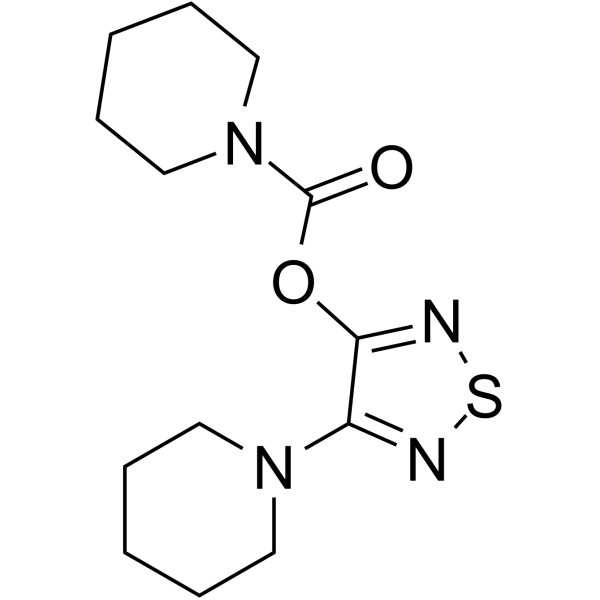
Lalistat 2 is an inhibitor of many lipases especially Lysosomal acid lipase (LAL, IC50 = 152 nM), which is a key enzyme that degrades neutral lipids at an acidic pH in lysosomes. Lalistat 2 is commonly used to investigate the cell-specific functions of LAL and LAL deficiency in vitro, as well as specifically measure LAL activity in human blood samples or cells .
loading...
    loading...
3
3 Cited Publications
Cat. No.: HY-D1296
CAS No.: 220524-71-0
Green DND-26 is a green fluorescently labeled lysosomal probe with a maximum excitation/emission wavelength of 504/511 nm. The structure is composed of a fluorescein group and linked weak bases, which can freely cross the cell membrane and generally gather on spherical organelles. Green DND-26 is suitable for observing the internal biosynthesis and related pathogenesis of lysosomes .
loading...
    loading...
2
2 Cited Publications
Cat. No.: HY-14929A
CAS No.: 75172-81-5
Purity:  99.70%
Synonyms: GR181413A
Target:  

Glycosidase

Research Areas:  

Others

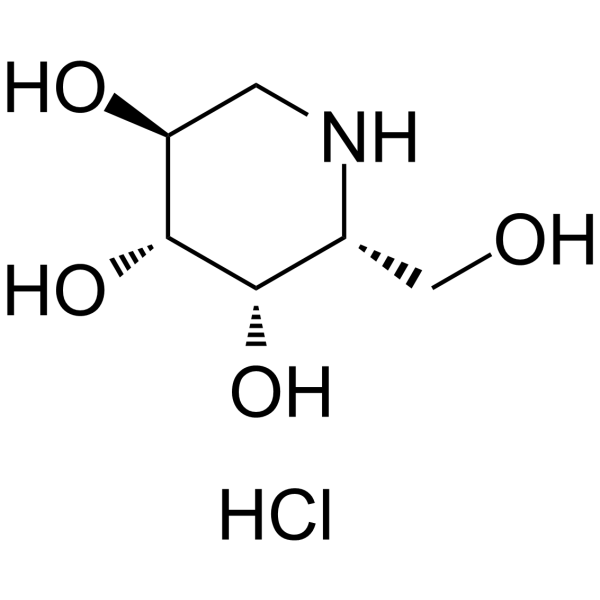
Migalastat (GR181413A free base) hydrochloride is an orally active α-galactosidase A molecular chaperone, with an IC50 value of 0.04 μM for human α-Gal A. Migalastat binds to the active site of certain unstable mutant forms of α-galactosidase A, facilitating their transport to the lysosome. After dissociation in the acidic environment, Migalastat enables the mutant α-galactosidase A to exhibit biological activity .
loading...
    loading...
1
1 Cited Publications
Cat. No.: HY-D1445
PDMPO, a lysosome pH indicator, is an excellent fluorescent acidotropic reagent for fluorescence imaging. PDMPO is a potent tool with which to study acidic organelles of live cells. PDMPO exhibits pH-dependent dual-excitation and dual-emission spectral peaks. PDMPO produces a blue fluorescence in weakly acidic organelles and shifts to yellow in more acidic lysosomes. (Abs=329 nm; Em=440/540 nm) .
loading...
    loading...
1
1 Cited Publications
Cat. No.: HY-N16011
CAS No.: 1246303-12-7
Synonyms: 18:1 LBPA (S,S)
Research Areas:  

Inflammation/Immunology

18:1 BMP (S,S) ammonium (18:1 LBPA (S,S)) is a monounsaturated fatty acid phospholipid. 18:1 BMP (S,S) ammonium reduces lysosomal lipid peroxidation and inhibits the ionizing radiation-induced elevation of intracellular labile ferrous ion (Fe 2+) levels. 18:1 BMP (S,S) ammonium can be used in studies related to ionizing radiation-induced intestinal injury .
loading...
    loading...
Cat. No.: HY-103317A
Target:  

Calcium Channel

Research Areas:  

Cardiovascular Disease Cancer

NAADP tetrasodium is a second messenger. NAADP tetrasodium releases Ca 2+ from acidic endosomes and lysosomes. NAADP tetrasodium can be used to study cancer (such as oral squamous cell carcinoma, malignant melanoma) and angiogenesis-related diseases .
loading...
    loading...
Cat. No.: HY-14929
CAS No.: 108147-54-2
Synonyms: GR181413A free base; 1-Deoxygalactonojirimycin
Target:  

Glycosidase

Research Areas:  

Others

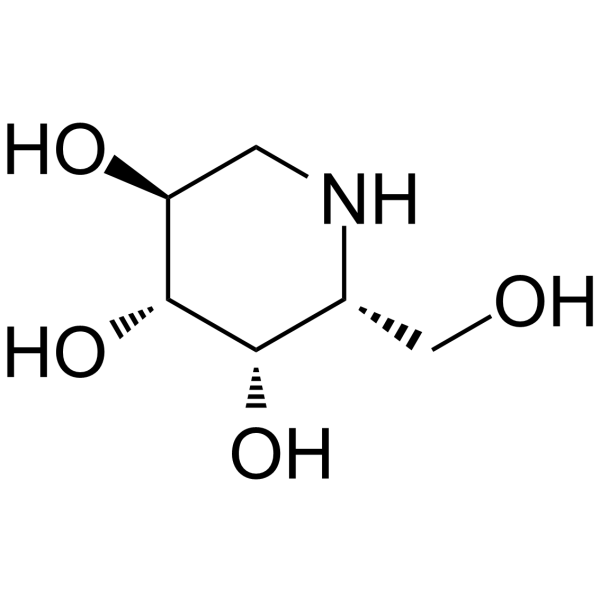
Migalastat (GR181413A free base) is an orally active α-galactosidase A molecular chaperone, with an IC50 value of 0.04 μM for human α-Gal A. Migalastat binds to the active site of certain unstable mutant forms of α-galactosidase A, facilitating their transport to the lysosome. After dissociation in the acidic environment, Migalastat enables the mutant α-galactosidase A to exhibit biological activity .
loading...
    loading...
Cat. No.: HY-N16306
CAS No.: 3091879-73-8
Category:  

Lipids

Target:  

Fluorescent Dye

Lyso-laurdan, a derivative of Laurdan (HY-D0080), is a fluorescent probe. Lyso-Laurdan accumulates in the lysosome via a morpholine group that is entrapped in lysosome via protonation to its cationic form in the acidic compartment. Lyso-laurdan is localized to lysosomes, allowing for the study of lysosomal membranes .
loading...
    loading...
Cat. No.: HY-108828
CAS No.: 420784-05-0
Synonyms: rhGAA
Target:  

Glycosidase

Research Areas:  

Metabolic Disease

Alglucosidase alfa (rhGAA) is a recombinant human acid α-glucosidase. Alglucosidase alfa is taken up by cells via the cation-independent mannose-6-phosphate receptor (CI-MPR) pathway and transported to lysosomes, where GAA degrades glycogen in the acidic lysosomal environment. Alglucosidase alfa is applicable to research related to lysosomal glycogen metabolism and glycogen storage diseases .
loading...
    loading...
Cat. No.: HY-W728096
Synonyms: GR181413A-d5 free base
Migalastat-d5 (GR181413A-d5 (free base)) is deuterium labeled Migalastat. Migalastat (GR181413A free base) is an orally active α-galactosidase A molecular chaperone, with an IC50 value of 0.04 μM for human α-Gal A. Migalastat binds to the active site of certain unstable mutant forms of α-galactosidase A, facilitating their transport to the lysosome. After dissociation in the acidic environment, Migalastat enables the mutant α-galactosidase A to exhibit biological activity .
loading...
    loading...
Cat. No.: HY-W740650
CAS No.: 1219134-37-8
Synonyms: GR181413A-15N
Migalastat hydrochloride- 15N (GR181413A- 15N) is the 15N-labeled Migalastat hydrochloride (HY-14929A). Migalastat (GR181413A free base) hydrochloride is an orally active α-galactosidase A molecular chaperone, with an IC50 value of 0.04 μM for human α-Gal A. Migalastat binds to the active site of certain unstable mutant forms of α-galactosidase A, facilitating their transport to the lysosome. After dissociation in the acidic environment, Migalastat enables the mutant α-galactosidase A to exhibit biological activity .
loading...
    loading...
Cat. No.: HY-D3131
CAS No.: 2243068-74-6
Target:  

Fluorescent Dye

Research Areas:  

Others

Lyso-MPCB is a two-photon fluorescent probe used for lysosomal pH detection and autophagy monitoring. Lyso-MPCB integrates a benzimidazole pH-responsive group and a morpholine lysosome-targeting group, enabling specific localization to lysosomes. The fluorescence properties of Lyso-MPCB change with protonation, exhibiting blue fluorescence under alkaline conditions and green fluorescence under acidic conditions .
loading...
    loading...
Cat. No.: HY-W339816
CAS No.: 325466-03-3
Research Areas:  

Others

(S,R)-Bis(monomyristoylglycero)phosphate ammonium actively contributes to cargo sorting by promoting the degradation and sorting of lipids, and it plays a critical role in the sorting of polyunsaturated fatty acids (PUFAs) within acidic organelles. This phospholipid features two phosphate-linked glycerol molecules arranged in a unique sn-1 glycerophospho-sn-1′ glycerol stereoconformation, with each glycerol molecule esterified to a myristic acid. Typically, it is found in the intraluminal vesicles (ILVs) of late endosomes and lysosomes.
loading...
    loading...
Cat. No.: HY-DY1082
CAS No.: 220524-71-0
Green DND-26 (solution) is a green fluorescently labeled lysosomal probe with a maximum excitation/emission wavelength of 504/511 nm. The structure is composed of a fluorescein group and linked weak bases, which can freely cross the cell membrane and generally gather on spherical organelles. Green DND-26 is suitable for observing the internal biosynthesis and related pathogenesis of lysosomes .
Solvent and concentration: DMSO: 2 mM
loading...
    loading...
Cat. No.: HY-14929S
Synonyms: GR181413A-d2
Migalastat-d2 hydrochloride (GR181413A-d2) is the deuterium labeled Migalastat hydrochloride (HY-14929A). Migalastat (GR181413A free base) is an orally active α-galactosidase A molecular chaperone, with an IC50 value of 0.04 μM for human α-Gal A. Migalastat binds to the active site of certain unstable mutant forms of α-galactosidase A, facilitating their transport to the lysosome. After dissociation in the acidic environment, Migalastat enables the mutant α-galactosidase A to exhibit biological activity .
loading...
    loading...
Cat. No.: HY-D2998
CAS No.: 2567068-39-5
ONOO-LysopH is a new Rhodamine-based near-infrared fluorescent probe. ONOO-LysopH is acid-sensitive, exhibiting rapid near-infrared fluorescence enhancement around 686 nm under acidic pH conditions. ONOO-LysopH also displays a rapid NIR turn-on fluorescence around 678 nm for ONOO− at physiological pH. ONOO-LysopH can target lysosomes to track lysosomal pH changes and image endogenous/exogenous ONOO− in live cells. ONOO-LysopH is applicable for cell imaging ONOO− and tracking lysosomal pH changes .
loading...
    loading...
Cat. No.: HY-D3163
Target:  

Fluorescent Dye

Research Areas:  

Others

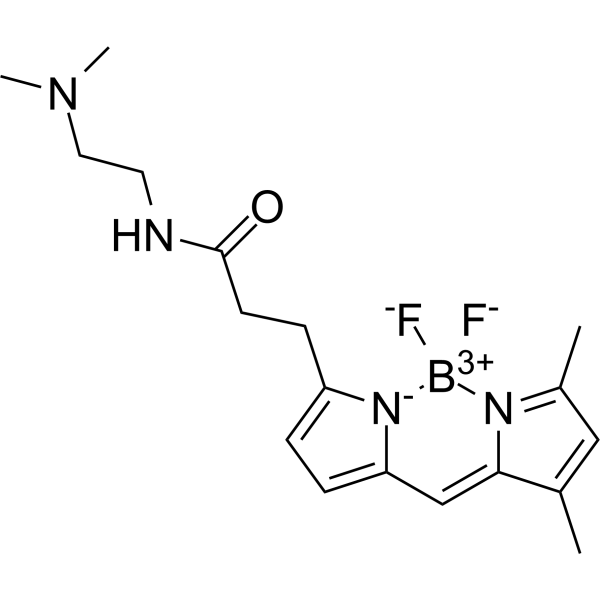
Endo-pH is a cell-permeable, pH-responsive fluorescent probe based on BODIPY, with a pKa of 5.08. When pH decreases from 7.32 to 4.97, Endo-pH undergoes protonation under acidic conditions, resulting in a 79-fold increase in fluorescence intensity at 786 nm. The detection wavelengths of its protonated form are Ex/Em=688/786 nm, while the absorption wavelength of its non-protonated form is 745 nm. Endo-pH can be used for staining late endosomes in live cells and determining the fusion time of late endosomes and lysosomes .
loading...
    loading...
Cat. No.: HY-D3207
CAS No.: 3037311-41-1
DHUCu-1 is a lysosome-targeted NIR divalent copper ion probe with high water solubility. DHUCu-1 serves as a tool for investigating the physiological functions of Cu 2+ and related diseases, such as Menke syndrome, Wilson's disease, and Alzheimer's disease .
loading...
    loading...
Cat. No.: HY-D3097
Target:  

Fluorescent Dye

Research Areas:  

Others

Lyso-VR1 is a fluorescent probe for lysosomal viscosity detection. The detection mechanism of Lyso-VR1 relies on intramolecular rotation restriction. Due to the protonation of its indole moiety in lysosomes, this probe can specifically target lysosomes, thereby localizing to this suborganelle for viscosity monitoring. Its excitation wavelength ranges from 400-500 nm, and its emission peak under excitation at 488 nm is located at ~550 nm to ~560 nm .
loading...
    loading...
Cat. No.: HY-184404
CAS No.: 71357-99-8
Research Areas:  

Cancer

(S)-1,2-Dipalmitoyl-sn-glycero-3-phosphoethanolamine is a phosphatidylethanolamine lipid with palmitoyl fatty acid chains. (S)-1,2-Dipalmitoyl-sn-glycero-3-phosphoethanolamine serves as a substrate for glycosylation reactions and a component of biocompatible pH-sensitive hydrophobic copolymer nanoparticles. (S)-1,2-Dipalmitoyl-sn-glycero-3-phosphoethanolamine exhibits pH-sensitive drug release properties, enabling faster drug release in acidic environments. (S)-1,2-Dipalmitoyl-sn-glycero-3-phosphoethanolamine can be used in studies related to cancer drug delivery .
loading...
    loading...
  • 1

