



Tris(2-chloroethyl) phosphate
Based on 6 publication(s) in Google Scholar
Tris(2-chloroethyl) phosphate (TCEP) is a widely used organic phosphorus flame retardant, mainly used as a plasticizer. Tris(2-chloroethyl) phosphate has orally active hepatotoxicity, inducing an increase in reactive oxygen species (ROS) and calcium ions (Ca2+) influx, a decrease in mitochondrial membrane potential (△Ψm), and causing DNA damage and cell apoptosis. Tris(2-chloroethyl) phosphate directly binds to FXR, inducing obesity and the formation of fatty liver in mice. Chloroethyl) phosphate activates the TLR4/NF-κB pathway, triggering liver inflammation.
For research use only. We do not sell to patients.
- Purity : 97.07%
- CAS No.: 115-96-8
- Formula: C6H12Cl3O4P
- Molecular Weight:285.49
-
Storage:
Store at room temperature 3 years.
In solvent -80°C, 2 years , -20°C, 1 year


To place orders, for customer services and technical support, please contact: MedChemExpress USA
Tel: 609-228-6898 E-mail: [email protected] [email protected]


-
 Biological Activity
-
Chemical Information
-
Solvent & Solubility
- Purity & Documentation
- References
-
 Help & FAQs


-
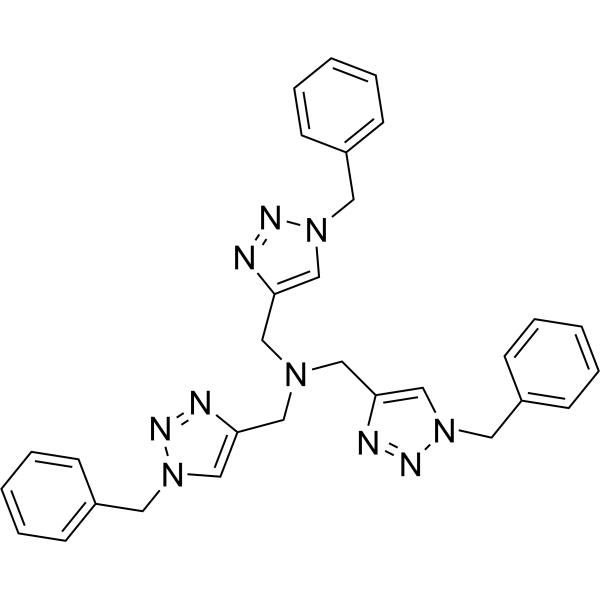
HY-116677
Tris(benzyltriazolylmethyl)amineBiochemical Tool -

HY-Y1322
Triphenyl phosphateEndocrine Disruptor -

HY-W016414
Triethyl phosphateSmooth Muscle Relaxant -
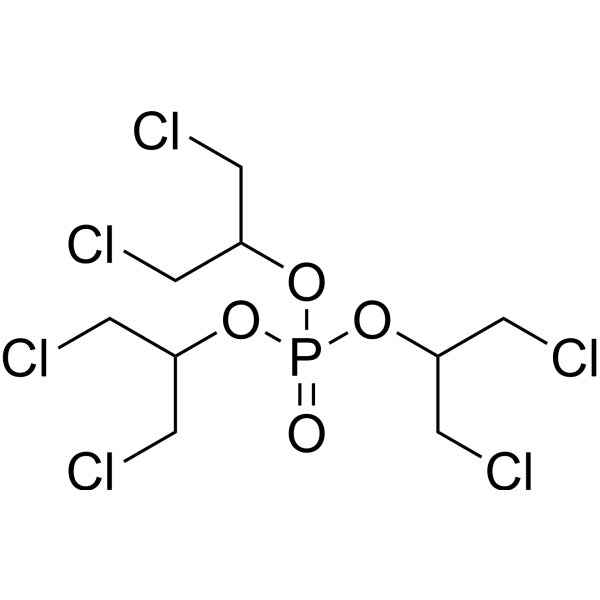
HY-108712
TDCPPFlame Retardant -

HY-W011086
Tri-O-tolyl phosphateBiochemical Reagent -

HY-Y1878
Copper(Ⅱ) sulfateBiochemical Reagent -

HY-108712R
TDCPP (Standard)Flame Retardant -
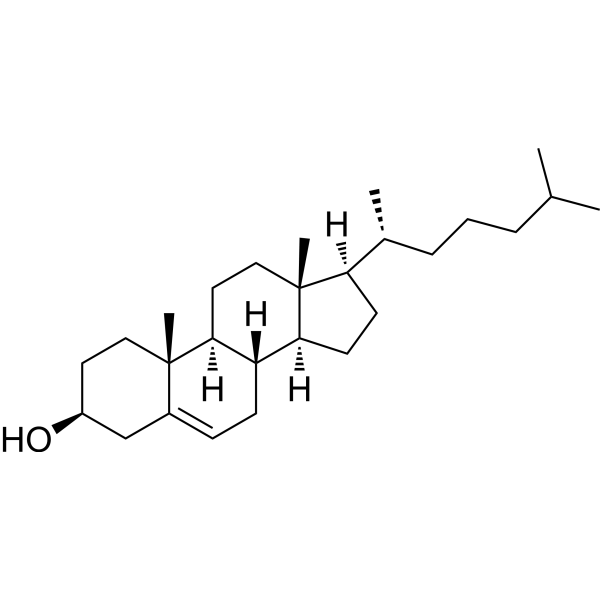
HY-N0322
Cholesterol (from animal)ERRα Agonist -

HY-W250743
Cresyl diphenyl phosphate -
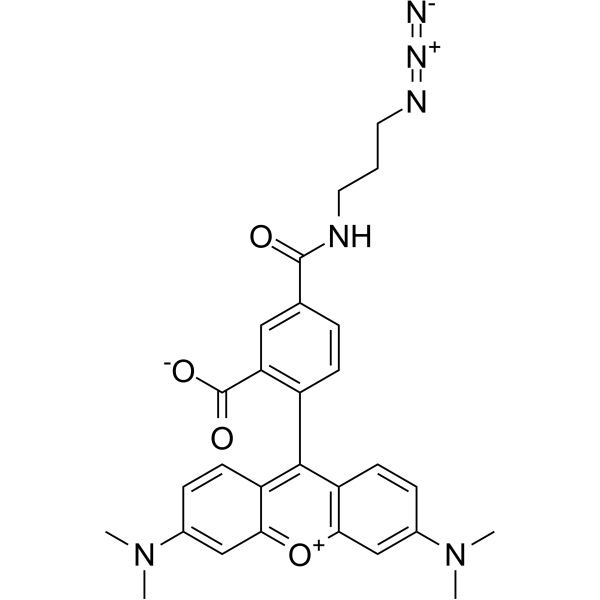
HY-151857
TAMRA azide, 5-isomerAzide Compound -
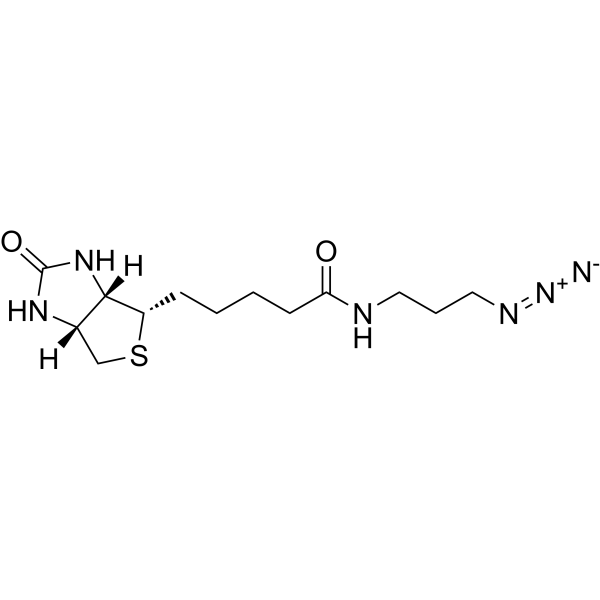
HY-129832
Biotin-azideClick Chemical Reagent -
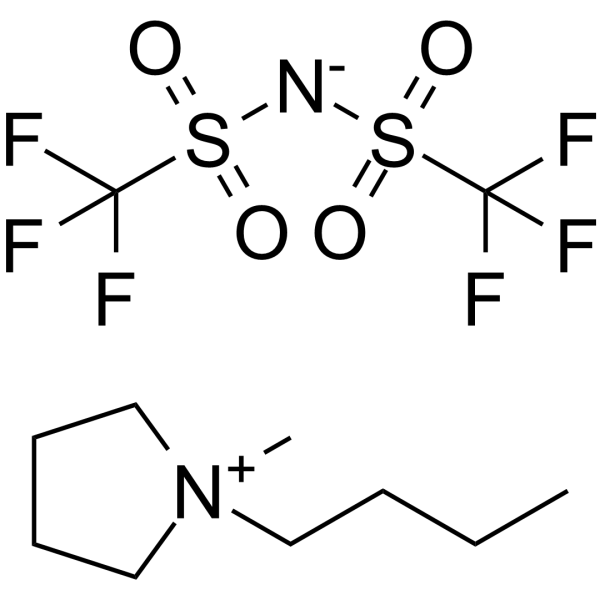
HY-W010929
PYR14-TFSIBiochemical Assay Reagent
Publications Citing Use of MedChemExpress (MCE) Tris(2-chloroethyl) phosphate
MoreAll DNA/RNA Synthesis Isoforms
MoreAll Calcium Channel Isoforms
More

Biological Activity
Description
In Vitro
Tris(2-chloroethyl) phosphate (100-400 μM, 3 days) induces the death of HepG2 cells by disrupting mitochondrial function and the integrity of lysosomal membranes[3].
Tris(2-chloroethyl) phosphate (100-400 μM, 3 days) causes dose-dependent DNA strand breaks, induces ROS/NO bursts, Ca²⁺ influx and △Ψm collapse in HepG2 cells, and triggers apoptosis[3].
Tris(2-chloroethyl) phosphate (100 μM, 3 days) upregulates oncogenes such as IGFBP5 and STMN1, and downregulates tumor suppressor genes such as SNAI1 in HepG2 cells[3].
MedChemExpress (MCE) has not independently confirmed the accuracy of these methods. They are for reference only.
-
Cell Line:HepG2 cells
-
Concentration:100, 200 and 400 μM
-
Incubation Time:3 d
-
Result:Significantly induced apoptosis, the proportion of the SubG1 peak reached 65.96% in the 400 μM group.
In Vivo
Tris(2-chloroethyl) phosphate (20-60 mg/kg, i.g., once daily for 9 weeks) induces obesity and hepatic steatosis in mice through the FXR signaling pathway[2].
MedChemExpress (MCE) has not independently confirmed the accuracy of these methods. They are for reference only.
-
Animal Model:Toxicity test models model established in male CD-1 mice (4-6 weeks old, 20-25 g)[2]
-
Dosage:20 and 60 mg/kg
-
Administration:Oral gavage (i.g.), once daily for 9 weeks
-
Result:Promoted weight gain, expansion of adipose tissue and elevation of serum lipids. Directly combined and inhibited FXR, thereby down-regulating SHP, activating the SREBP1c/PPARγ lipogenesis pathway, and inhibiting fatty acid oxidation mediated by PPARα.
Clinical Trial
| NCT Number | Sponsor | Condition | Start Date |
Phase

|
|---|---|---|---|---|
| NCT01329991 | Plexxikon| | 2011-05 | PHASE1 |


Chemical Information
-
CAS No. 115-96-8
-
Appearance Liquid (Density: 1.425 g/cm3)
-
Molecular Weight 285.49
-
Formula C6H12Cl3O4P
-
Color Colorless to light yellow
-
SMILES
O=P(OCCCl)(OCCCl)OCCCl
-
Synonyms
TCEP
-
Shipping
Room temperature in continental US; may vary elsewhere.
-
Storage
Store at room temperature 3 years
In solvent -80°C 2 years -20°C 1 year


Publications (6)
-
Journal Impact Factor
-
Most Recent
-
-
Adv Healthc Mater
Oral Administration of Trifluoroacetyl Chitosan-Encapsulated Redshifted Immunofluorophore for NIR-II Bioimaging of Colorectal Metastases. [Abstract]2025 Oct 15:e01877. PMID: 41097850 -
Int J Biol Macromol
Bacterial cellulose membrane integrating phase-transited lysozyme nanofilm loaded with biguanides for dressing treatment of atopic dermatitis. [Abstract]2025 Aug 21;323(Pt 1):147047. PMID: 40848785 -
Neural Regen Res
2025 Oct 30. PMID: 41169225 -
Commun Chem
Stepped collisional energy improves protein acylation identification by eliminating positional bias of cyclic immonium ions. [Abstract]2025 Dec 9. PMID: 41366033 -


Solvent & Solubility
In Vitro:
DMSO : 200 mg/mL (700.55 mM; Need ultrasonic; Hygroscopic DMSO has a significant impact on the solubility of product, please use newly opened DMSO)
Please refer to the solubility information to select the appropriate solvent. Once prepared, please aliquot and store the solution to prevent product inactivation from repeated freeze-thaw cycles.
Storage method and period of stock solution: -80°C, 2 years; -20°C, 1 year. When stored at -80°C, please use it within 2 years. When stored at -20°C, please use it within 1 year.
Please refer to the solubility information to select the appropriate solvent. Once prepared, please aliquot and store the solution to prevent product inactivation from repeated freeze-thaw cycles.
Storage method and period of stock solution: -80°C, 2 years; -20°C, 1 year. When stored at -80°C, please use it within 2 years. When stored at -20°C, please use it within 1 year.
Concentration (start) × Volume (start) = Concentration (final) × Volume (final)


Purity & Documentation
-
Data Sheet (284 KB)
-
SDS (557 KB)
- English - EN (557 KB)
- Français - FR (557 KB)
- Deutsch - DE (557 KB)
- Norwegian - NO (557 KB)
- Español - ES (557 KB)
- Swedish - SV (557 KB)
- Italian - IT (557 KB)
- Korean - KR (557 KB)
- Portuguese - PT (557 KB)
-
Handling Instructions (2659 KB)
References
[1]. Tian D, et al. Tris(2-chloroethyl) Phosphate Exerts Hepatotoxic Impacts on Zebrafish by Disrupting Hypothalamic-Pituitary-Thyroid and Gut-Liver Axes. Environ Sci Technol. 2023 Jun 20;57(24):9043-9054. [Content Brief]
[2]. Yang D, et al. Tris (2-chloroethyl) phosphate (TCEP) induces obesity and hepatic steatosis via FXR-mediated lipid accumulation in mice: Long-term exposure as a potential risk for metabolic diseases. Chem Biol Interact. 2022 Aug 25;363:110027. [Content Brief]


Complete Stock Solution Preparation Table
Please refer to the solubility information to select the appropriate solvent. Once prepared, please aliquot and store the solution to prevent product inactivation from repeated freeze-thaw cycles.
Storage method and period of stock solution: -80°C, 2 years; -20°C, 1 year. When stored at -80°C, please use it within 2 years. When stored at -20°C, please use it within 1 year.
| Optional Solvent | Concentration Solvent Mass | 1 mg | 5 mg | 10 mg | 25 mg |
|---|---|---|---|---|---|
| DMSO | 1 mM | 3.5027 mL | 17.5137 mL | 35.0275 mL | 87.5687 mL |
| 5 mM | 0.7005 mL | 3.5027 mL | 7.0055 mL | 17.5137 mL | |
| 10 mM | 0.3503 mL | 1.7514 mL | 3.5027 mL | 8.7569 mL | |
| 15 mM | 0.2335 mL | 1.1676 mL | 2.3352 mL | 5.8379 mL | |
| 20 mM | 0.1751 mL | 0.8757 mL | 1.7514 mL | 4.3784 mL | |
| 25 mM | 0.1401 mL | 0.7005 mL | 1.4011 mL | 3.5027 mL | |
| 30 mM | 0.1168 mL | 0.5838 mL | 1.1676 mL | 2.9190 mL | |
| 40 mM | 0.0876 mL | 0.4378 mL | 0.8757 mL | 2.1892 mL | |
| 50 mM | 0.0701 mL | 0.3503 mL | 0.7005 mL | 1.7514 mL | |
| 60 mM | 0.0584 mL | 0.2919 mL | 0.5838 mL | 1.4595 mL | |
| 80 mM | 0.0438 mL | 0.2189 mL | 0.4378 mL | 1.0946 mL | |
| 100 mM | 0.0350 mL | 0.1751 mL | 0.3503 mL | 0.8757 mL |


Tris(2-chloroethyl) phosphate Related Classifications
HY-107859 Related Classifications
 Powered by Bioz