



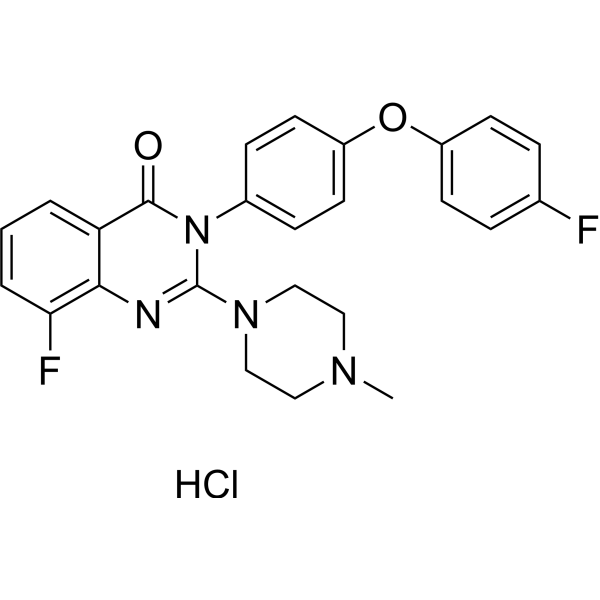
TRPV4 agonist-1
TRPV4 agonist-1 is a transient receptor potential vanilloid 4 (TRPV4) agonist with an EC50 of 60 nM in the hTRPV4 Ca2+ assay[1].
Nur für Forschungszwecke. Wir verkaufen nicht an Patienten.
- CAS. Nr.: 2314467-60-0
- Formel: C25H23ClF2N4O2
- Molecular Weight:484.93
-
Speicherung:
Please store the product under the recommended conditions in the Certificate of Analysis.

To place orders, for customer services and technical support, please contact: MedChemExpress USA
Tel: 609-228-6898 E-mail: [email protected] [email protected]


-
 Biologische Aktivität
-
Chemical Information
- Protokoll
- Reinheit & Dokumentation
- Verweise
-
 Help & FAQs




Biologische Aktivität
Beschreibung
IC50 & Target
EC50: 60 nM (hTRPV4 hTRPV4 Ca2+)[1]
In Vitro
TRPV4 agonist-1 (Compound 36) exhibits significantly increased potency (ECmax: 20 nM in the SOX9 reporter assay). TRPV4 agonist-1 is inactive against TRPV1 channels[1].
MedChemExpress (MCE) has not independently confirmed the accuracy of these methods. They are for reference only.


Chemical Information
-
CAS. Nr. 2314467-60-0
-
Molecular Weight 484.93
-
Formel C25H23ClF2N4O2
-
SMILES
O=C1N(C2=CC=C(OC3=CC=C(F)C=C3)C=C2)C(N4CCN(C)CC4)=NC5=C(F)C=CC=C51.Cl
-
Versand
Room temperature in continental US; may vary elsewhere.
-
Speicherung
Please store the product under the recommended conditions in the Certificate of Analysis.


Reinheit & Dokumentation
Verweise
[1]. Atobe M, et al. Discovery of Novel Transient Receptor Potential Vanilloid 4 (TRPV4) Agonists as Regulators of Chondrogenic Differentiation: Identification of Quinazolin-4(3 H)-ones and in Vivo Studies on a Surgically Induced Rat Model of Osteoarthritis. J Med Chem. 2019 Feb 14;62(3):1468-1483. [Content Brief]

Calculators
Konzentration (Stammlösung) × Volumen (Stammlösung) = Konzentration (Ziellösung) × Volumen (Ziellösung)


TRPV4 agonist-1 Related Classifications
HY-114400A Related Classifications
 Powered by Bioz