



Unifiram

Based on 1 Customer Validation
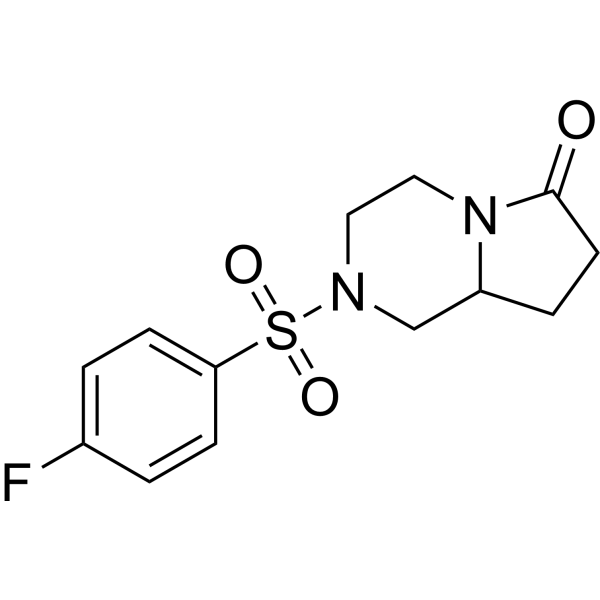
Unifiram (DM232) is a AMPA receptor activator and cognitive enhancer. Unifiram activates the AMPA-mediated neurotransmission system. Unifiram reverses NBQX-induced amnesia in the passive avoidance test in mice. Unifiram reverses the antagonistic effect of kynurenic acid on NMDA-mediated [3H]NA release in rat hippocampal slices. Unifiram enhances excitatory synaptic transmission in the rat hippocampus in vitro. Unifiram can be used in studies related to amnesia and cognitive dysfunction, including age-related memory decline, neurodegenerative diseases such as Alzheimer's disease or Parkinson's disease, multiple sclerosis, schizophrenia, and attention deficit hyperactivity disorder.
Nur für Forschungszwecke. Wir verkaufen nicht an Patienten.
- Reinheit : 99.68%
- CAS. Nr.: 272786-64-8
- Formel: C13H15FN2O3S
- Molecular Weight:298.34
-
Speicherung:
4°C, protect from light
* In solvent : -80°C, 6 months; -20°C, 1 month (protect from light)

To place orders, for customer services and technical support, please contact: MedChemExpress USA
Tel: 609-228-6898 E-mail: [email protected] [email protected]


-
 Biologische Aktivität
-
Chemical Information
-
Lösungsmittel & Löslichkeit
- Protokoll
- Reinheit & Dokumentation
- Verweise
-
 Help & FAQs


Alle iGluR Isoform-spezifische Produkte anzeigen
More

Biologische Aktivität
Beschreibung
IC50 & Target
[1]|
AMPA Receptor |
NMDA Receptor |
In Vitro
Unifiram (0-1 µM; 30-95 min of superfusion) reverses the inhibitory effect of Kynurenic acid (HY-100806) on NMDA-evoked [3H]NA release in rat hippocampal slices via an AMPA receptor-dependent mechanism, with an EC50 ≤ 0.1 µM[1].
Unifiram (10 nM-1 µM; 15 min per concentration in a cumulative sequence) induces a persistent, concentration-dependent increase in fEPSP amplitude in the CA1 region of rat hippocampal slices, with an EC50 of 27 nM[1].
MedChemExpress (MCE) has not independently confirmed the accuracy of these methods. They are for reference only.
In Vivo
MedChemExpress (MCE) has not independently confirmed the accuracy of these methods. They are for reference only.
-
Animal Model:Swiss albino mice (male, 23-30 g)[1]
-
Dosage:0.01 mg/kg; 0.1 mg/kg; 10 mg/kg
-
Administration:i.p.; single dose
-
Result:Restored entrance latency in the retention test to levels comparable to saline-treated control mice at 0.1 mg/kg.
Showed no effect on NBQX-induced amnesia at 0.01 mg/kg.
Did not modify endurance time on the rota rod test at 0.1 mg/kg and 10 mg/kg.
Did not alter spontaneous motility or inspection activity in the hole board test at 0.1 mg/kg and 10 mg/kg.
Did not enhance entrance latency in unamnesic mice.


Chemical Information
-
CAS. Nr. 272786-64-8
-
Appearance Solid
-
Molecular Weight 298.34
-
Formel C13H15FN2O3S
-
Color White to off-white
-
SMILES
O=C1CCC2CN(S(=O)(C3=CC=C(F)C=C3)=O)CCN21
-
Synonyms
DM232
-
Versand
Room temperature in continental US; may vary elsewhere.
-
Speicherung
4°C, protect from light
* In solvent : -80°C, 6 months; -20°C, 1 month (protect from light)


Lösungsmittel & Löslichkeit
In Vitro:
DMSO : 50 mg/mL (167.59 mM; Need ultrasonic; Hygroscopic DMSO has a significant impact on the solubility of product, please use newly opened DMSO)
Please refer to the solubility information to select the appropriate solvent. Once prepared, please aliquot and store the solution to prevent product inactivation from repeated freeze-thaw cycles.
Storage method and period of stock solution: -80°C, 6 months; -20°C, 1 month (protect from light). When stored at -80°C, please use it within 6 months. When stored at -20°C, please use it within 1 month.
Please refer to the solubility information to select the appropriate solvent. Once prepared, please aliquot and store the solution to prevent product inactivation from repeated freeze-thaw cycles.
Storage method and period of stock solution: -80°C, 6 months; -20°C, 1 month (protect from light). When stored at -80°C, please use it within 6 months. When stored at -20°C, please use it within 1 month.
Konzentration (Stammlösung) × Volumen (Stammlösung) = Konzentration (Ziellösung) × Volumen (Ziellösung)
In Vivo:
Select the appropriate dissolution method based on your experimental animal and administration route.
- For the following dissolution methods, please ensure to first prepare a clear stock solution using an In Vitro approach and then sequentially add co-solvents:
- To ensure reliable experimental results, the clarified stock solution can be appropriately stored based on storage conditions. As for the working solution for In Vivo experiments, it is recommended to prepare freshly and use it on the same day.
- The percentages shown for the solvents indicate their volumetric ratio in the final prepared solution. If precipitation or phase separation occurs during preparation, heat and/or sonication can be used to aid dissolution.
Add each solvent one by one: 10% DMSO 40% PEG300 5% Tween-80 45% Saline
Solubility: ≥ 2.5 mg/mL (8.38 mM); Clear solution
This protocol yields a clear solution of ≥ 2.5 mg/mL (saturation unknown).
Taking 1 mL working solution as an example, add 100 μL DMSO stock solution (25.0 mg/mL) to 400 μL PEG300, and mix evenly; then add 50 μL Tween-80 and mix evenly; then add 450 μL Saline to adjust the volume to 1 mL.
Preparation of Saline: Dissolve 0.9 g sodium chloride in ddH₂O and dilute to 100 mL to obtain a clear Saline solution.
Add each solvent one by one: 10% DMSO 90% (20% SBE-β-CD in Saline)
Solubility: ≥ 2.5 mg/mL (8.38 mM); Clear solution
This protocol yields a clear solution of ≥ 2.5 mg/mL (saturation unknown).
Taking 1 mL working solution as an example, add 100 μL DMSO stock solution (25.0 mg/mL) to 900 μL 20% SBE-β-CD in Saline, and mix evenly.
Preparation of 20% SBE-β-CD in Saline (4°C, storage for one week): 2 g SBE-β-CD powder is dissolved in 10 mL Saline, completely dissolve until clear.
In Vivo Dissolution Calculator
Please enter the basic information of animal experiments:
-
-
-
-
Recommended: Prepare an additional quantity of animals to account for potential losses during experiments.
Please enter your animal formula composition:
-
%DMSO +
Recommended: Keep the proportion of DMSO in working solution below 2% if your animal is weak.
-
%+
-
+%Tween-80 + +
-
%Saline +
The co-solvents required include: DMSO, . All of co-solvents are available by MedChemExpress (MCE). , Tween 80. All of co-solvents are available by MedChemExpress (MCE).
Working solution concentration: 0.22 mg/mL
Method for preparing stock solution: mg drug dissolved in μL DMSO. Stock solution concentration: mg/mL. * In solvent : -80°C, 6 months; -20°C, 1 month (protect from light)
1. Take μL DMSO stock solution;
2. Add μL .
μL , mix evenly;
3. Then add μL Tween 80, mix evenly;
4. Then add μL
Please ensure that the stock solution in the first step is dissolved to a clear state, and add co-solvents in sequence. You can use ultrasonic heating (ultrasonic cleaner, recommended frequency 20-40 kHz), vortexing, etc. to assist dissolution.


Reinheit & Dokumentation
-
Data Sheet (276 KB)
-
SDS (394 KB)
- English - EN (394 KB)
- Français - FR (394 KB)
- Deutsch - DE (394 KB)
- Norwegian - NO (394 KB)
- Español - ES (394 KB)
- Swedish - SV (394 KB)
- Italian - IT (394 KB)
- Korean - KR (394 KB)
- Portuguese - PT (394 KB)
-
Handling Instructions (2659 KB)
Verweise
[1]. Galeotti N, et al. AMPA-receptor activation is involved in the antiamnesic effect of DM 232 (unifiram) and DM 235 (sunifiram). Naunyn Schmiedebergs Arch Pharmacol. 2003;368(6):538-545. [Content Brief]
[2]. Martini E, et al. Design, synthesis and preliminary pharmacological evaluation of new analogues of DM232 (unifiram) and DM235 (sunifiram) as cognition modulators. Bioorg Med Chem. 2008;16(23):10034-10042. [Content Brief]


Complete Stock Solution Preparation Table
Please refer to the solubility information to select the appropriate solvent. Once prepared, please aliquot and store the solution to prevent product inactivation from repeated freeze-thaw cycles.
Storage method and period of stock solution: -80°C, 6 months; -20°C, 1 month (protect from light). When stored at -80°C, please use it within 6 months. When stored at -20°C, please use it within 1 month.
| Optional Solvent | Concentration Solvent Mass | 1 mg | 5 mg | 10 mg | 25 mg |
|---|---|---|---|---|---|
| DMSO | 1 mM | 3.3519 mL | 16.7594 mL | 33.5188 mL | 83.7970 mL |
| 5 mM | 0.6704 mL | 3.3519 mL | 6.7038 mL | 16.7594 mL | |
| 10 mM | 0.3352 mL | 1.6759 mL | 3.3519 mL | 8.3797 mL | |
| 15 mM | 0.2235 mL | 1.1173 mL | 2.2346 mL | 5.5865 mL | |
| 20 mM | 0.1676 mL | 0.8380 mL | 1.6759 mL | 4.1899 mL | |
| 25 mM | 0.1341 mL | 0.6704 mL | 1.3408 mL | 3.3519 mL | |
| 30 mM | 0.1117 mL | 0.5586 mL | 1.1173 mL | 2.7932 mL | |
| 40 mM | 0.0838 mL | 0.4190 mL | 0.8380 mL | 2.0949 mL | |
| 50 mM | 0.0670 mL | 0.3352 mL | 0.6704 mL | 1.6759 mL | |
| 60 mM | 0.0559 mL | 0.2793 mL | 0.5586 mL | 1.3966 mL | |
| 80 mM | 0.0419 mL | 0.2095 mL | 0.4190 mL | 1.0475 mL | |
| 100 mM | 0.0335 mL | 0.1676 mL | 0.3352 mL | 0.8380 mL |


Unifiram Related Classifications
HY-125931 Related Classifications
 Powered by Bioz