



AS-99
Based on 2 publication(s) in Google Scholar
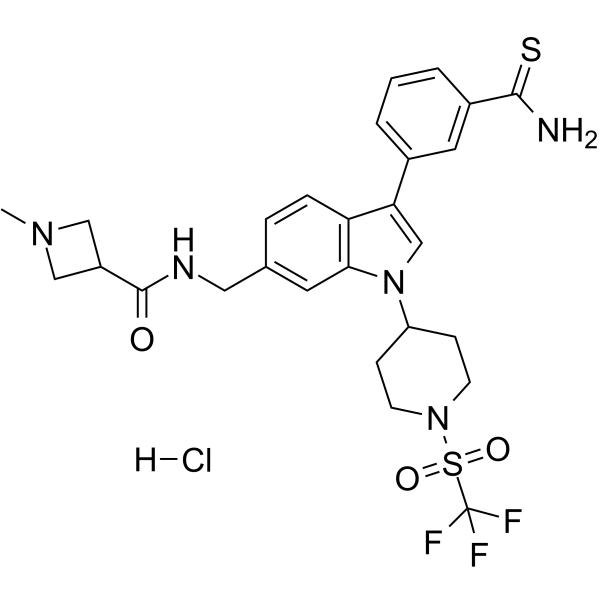
AS-99 is a first-in-class, potent, and selective ASH1L histone methyltransferase inhibitor (IC50= 0.79 μM, Kd= 0.89 μM) with anti-leukemic activity. AS-99 blocks cell proliferation, induces apoptosis and differentiation, downregulates MLL fusion target genes, and reduces the leukemia burden in vivo.
For research use only. We do not sell to patients.
- Formula: C27H31ClF3N5O3S2
- Molecular Weight:630.14
-
Storage:
Please store the product under the recommended conditions in the Certificate of Analysis.

To place orders, for customer services and technical support, please contact: MedChemExpress USA
Tel: 609-228-6898 E-mail: [email protected] [email protected]


-
 Biological Activity
-
Chemical Information
- Protocols
- Purity & Documentation
- References
-
 Help & FAQs


Publications Citing Use of MedChemExpress (MCE) AS-99
More Customer Validation & Images

-
In Vivo Efficacy Study
-
IHC
-
In Vivo Imaging
All Histone Methyltransferase Isoforms
More

Biological Activity
Description
IC50 & Target
|
ASH1L/KMT2H |
In Vitro
AS-99 is tested against a panel of 20 histone methyltransferases, including NSD1, NSD2, NSD3, and SETD2. NO significant inhibition is observed at 50 μM of AS-99 on any of the tested histone methyltransferases, indicating over 100-fold selectivity towards ASH1L[1].
AS-99 shows a several fold weaker effect on the proliferation of leukemia cells without MLL1 translocations, such as SET2 and K562, with no or limited effects at 10 μM or higher concentrations[1].
AS-99 (1-8 μM; 7 days) also induces apoptosis in the MLL leukemia cells, but not in the K562 cells, as assessed by the quantification of the Annexin V positive cells[1].
AS-99 suppresses MLL fusion driven transcriptional programs[1].
AS-99 results in a reduced number of H3K36me2 peaks when compared to the DMSO-treated cells[1].
MedChemExpress (MCE) has not independently confirmed the accuracy of these methods. They are for reference only.
-
Cell Line:MOLM13 cells
-
Concentration:2-6 µM
-
Incubation Time:7 days
-
Result:Led to a dose-dependent downregulation of canonical MLL fusion target genes required for leukemogenesis including MEF2C, DLX2, FLT3, and HOXA9.
In Vivo
AS-99 is used for in vivo studies in mice, which reveals favorable exposure in plasma upon i.v. and i.p. administration (AUC = 9701 hr* ng/mL and 10,699 hr* ng/mL, respectively), suitable half-life (~5-6 h) and Cmax > 10 μM[1].
MedChemExpress (MCE) has not independently confirmed the accuracy of these methods. They are for reference only.
-
Animal Model:8- to 10-week old female NSG mice (bearing MV4;11 cells)[1]
-
Dosage:30 mg/kg
-
Administration:I.p.; q.d., treated for 14 consecutive days
-
Result:Reduced the leukemia burden in the xenotransplantation mouse model of MLL leukemia without affecting blood counts in normal mice.
- Annexin V plus membrane-impermeant dye apoptosis staining
- BrdU Incorporation Assay
- Somatic Cell Culture
- CFSE Dye Dilution Proliferation Assay
- Dye-dilution cell tracking and proliferation staining
- CCK-8/WST-8 Cell Proliferation Assay
- Protocol for Cell Cycle
- Cell Counting-Based Growth Curve Assay
- Colony Formation (Clonogenic) Assay
- Cell Viability Determination by MTT Colorimetric Assay
- EdU Incorporation Assay (Click Chemistry-Based DNA Synthesis Measurement)
- Ki-67 Immunostaining Proliferation Assay
- Detection of Apoptosis
- TUNEL staining for apoptotic DNA fragmentation
- PCNA Immunodetection Proliferation Assay
- Protocol for Cell Counting and Cell Density Analysis
- Apoptosis Solutions
- MTT Cell Proliferation Assay


Chemical Information
-
Molecular Weight 630.14
-
Formula C27H31ClF3N5O3S2
-
SMILES
O=C(C1CN(C)C1)NCC2=CC3=C(C=C2)C(C4=CC=CC(C(N)=S)=C4)=CN3C5CCN(S(=O)(C(F)(F)F)=O)CC5.[H]Cl
-
Shipping
Room temperature in continental US; may vary elsewhere.
-
Storage
Please store the product under the recommended conditions in the Certificate of Analysis.


Publications (2)
-
Journal Impact Factor
-
Most Recent
-
Nat Commun
Histone methyltransferase ASH1L primes metastases and metabolic reprogramming of macrophages in the bone niche. [Abstract]2025 May 20;16(1):4681. PMID: 40394007
AS-99 purchased from MedChemExpress. Usage Cited in: Nat Commun. 2025 May 20;16(1):4681. [Abstract]
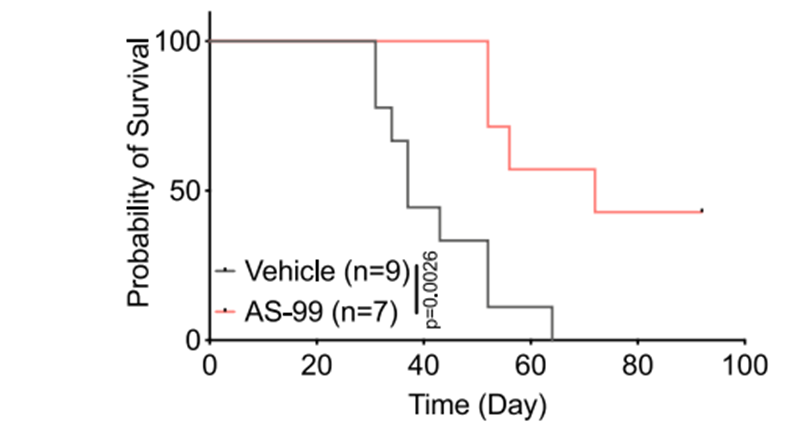
AS-99 (25 mg/kg, i.p.) treatment significantly suppressed metastases to bone and prolonged the overall survival of mice.
AS-99 purchased from MedChemExpress. Usage Cited in: Nat Commun. 2025 May 20;16(1):4681. [Abstract]
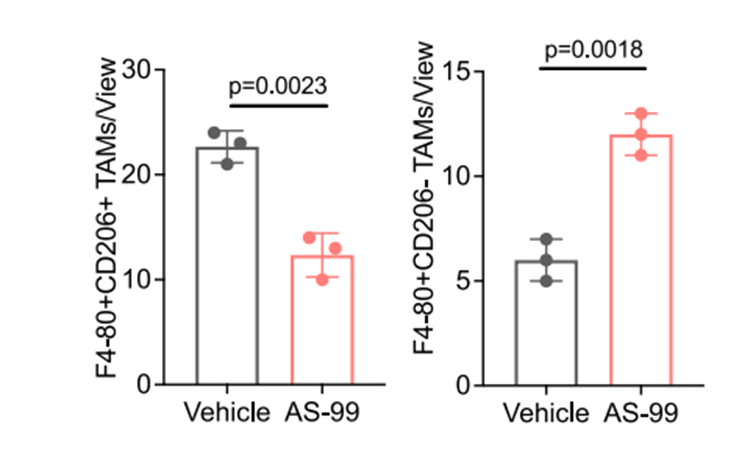
Multiplex IHC staining of TAMs in bone tumors treated with AS-99 (i.p., 25 mg/kg).
AS-99 purchased from MedChemExpress. Usage Cited in: Nat Commun. 2025 May 20;16(1):4681. [Abstract]
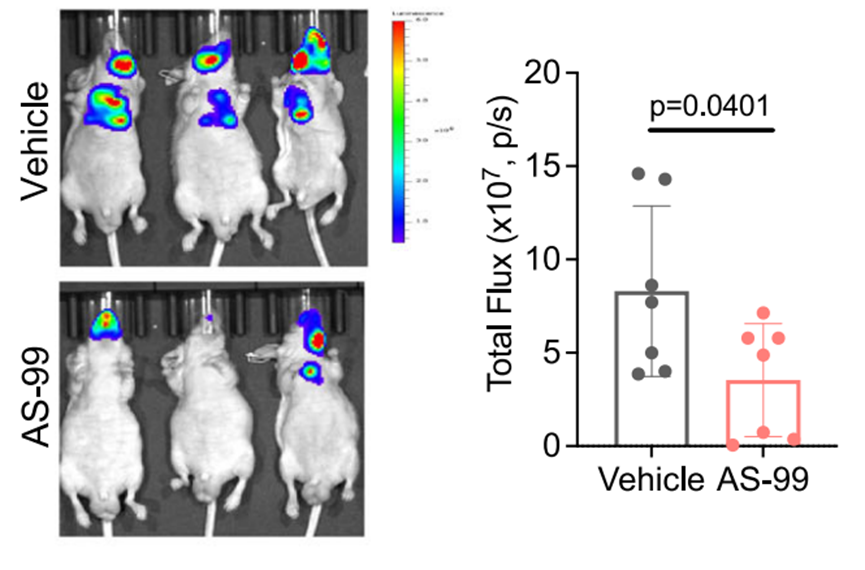
2 × 10⁶ PC-3M cells were intracardiac injected into male nude mice, followed by treatment of vehicle or ASH1L inhibitor AS-99 (i.p., 25 mg/kg). Bioluminescent imaging and intensity quantification of metastatic tumors on Day 34 are presented.
-
Adv Sci (Weinh)
ASH1L in Hepatoma Cells and Hepatic Stellate Cells Promotes Fibrosis-Associated Hepatocellular Carcinoma by Modulating Tumor-Associated Macrophages. [Abstract]2024 Dec;11(45):e2404756. PMID: 39377228


Purity & Documentation
References

Calculators
Concentration (start) × Volume (start) = Concentration (final) × Volume (final)


AS-99 Related Classifications
HY-141429C Related Classifications
 Powered by Bioz