



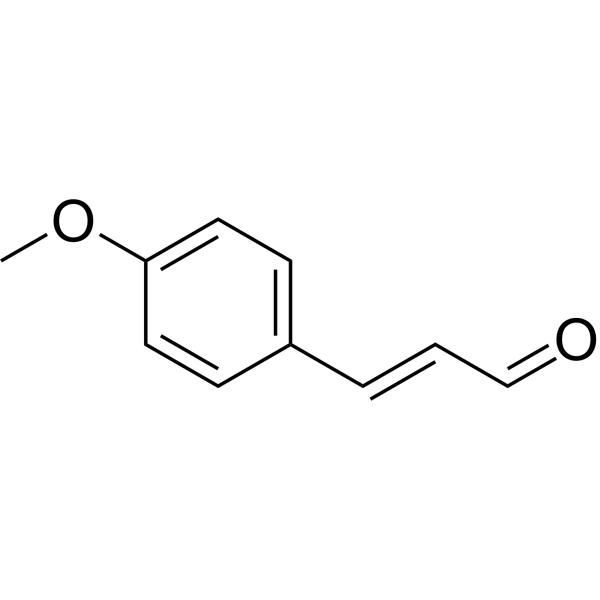
4-Methoxycinnamaldehyde
Based on 2 publication(s) in Google Scholar
4-Methoxycinnamaldehyde (p-Methoxycinnamaldehyde) is an active ingredient isolated from Agastache rugosa, possessing anti-respiratory syncytial virus (RSV) and antifungal activities. 4-Methoxycinnamaldehyde directly interferes with the adsorption and internalization of RSV by host cells in an interferon pathway-independent manner to block viral entry; it disrupts the energy metabolism of Penicillium digitatum by damaging the integrity of its mycelial cell membrane and inhibiting reducing sugar synthesis. 4-Methoxycinnamaldehyde can be used in research on RSV infection and citrus green mold.
연구목적의 판매만을 진행합니다. 환자를 대상으로 한 판매는 하지 않습니다.
- Purity : 99.89%
- CAS No.: 1963-36-6
- 화학식: C10H10O2
- 분자량:162.19
-
보관:
4°C, stored under nitrogen
* In solvent : -80°C, 6 months; -20°C, 1 month (stored under nitrogen)

To place orders, for customer services and technical support, please contact: MedChemExpress USA
Tel: 609-228-6898 E-mail: [email protected] [email protected]


-
 Biological Activity
-
Chemical Information
-
용액&용해도
- Protocol
- 순도&문서
- References
-
 Help & FAQs




Biological Activity
제품 설명
Cellular Effect
|
Cell Line

|
Type | Value | Description | References |
|---|---|---|---|---|
| HEp-2 | CC50 |
49.4 mg/mL
|
Cytotoxicity against human HEp-2 larynx epidermoid carcinoma cells assessed as viability reduction incubated 72 hrs by XTT assay.
Cytotoxicity against human HEp-2 larynx epidermoid carcinoma cells assessed as viability reduction incubated 72 hrs by XTT assay.
|
19303275 |
| HEp-2 | IC50 |
0.055 μg/mL
|
Antiviral cytoprotective activity against RSV Long strain-infected HEp-2 human larynx epidermoid carcinoma cells assessed as inhibition of viral cytopathic effect incubated 72 hrs by XTT assay.
Antiviral cytoprotective activity against RSV Long strain-infected HEp-2 human larynx epidermoid carcinoma cells assessed as inhibition of viral cytopathic effect incubated 72 hrs by XTT assay.
|
19303275 |
| HEp-2 | IC50 |
0.06 μg/mL
|
Inhibition of RSV Long strain attachment to HEp-2 human larynx epidermoid carcinoma cells assessed as cytopathic effect reduction after 4°C adsorption for 3 hrs and 72 hrs incubation by XTT assay.
Inhibition of RSV Long strain attachment to HEp-2 human larynx epidermoid carcinoma cells assessed as cytopathic effect reduction after 4°C adsorption for 3 hrs and 72 hrs incubation by XTT assay.
|
19303275 |
| HEp-2 | IC50 |
0.01 mg/mL
|
Inhibition of RSV Long strain internalization in HEp-2 human larynx epidermoid carcinoma cells assessed as cytopathic effect reduction after 37°C incubation for 72 hrs by XTT assay.
Inhibition of RSV Long strain internalization in HEp-2 human larynx epidermoid carcinoma cells assessed as cytopathic effect reduction after 37°C incubation for 72 hrs by XTT assay.
|
19303275 |
In Vitro
4-Methoxycinnamaldehyde (15.6-500 μg/mL; 2-6 d) inhibits Penicillium digitatum mycelial growth, with an MIC of 31.3 μg/mL and an MFC of 125 μg/mL[2].
4-Methoxycinnamaldehyde (15.6-250 μg/mL; 12 h) inhibits Penicillium digitatum spore germination, with an EC50 of 39 μg/mL and an EC95 of 391 μg/mL[2].
4-Methoxycinnamaldehyde (31.3-125 μg/mL) damages Penicillium digitatum hyphae, causing irregular swelling at the MIC and hyphal cell vacuolation at the MFC[2].
4-Methoxycinnamaldehyde (15.65-125 μg/mL; 30-120 min) increases the conductivity of Penicillium digitatum suspensions, reaching 645.3 μs/cm at 125 μg/mL at 120 min[2].
4-Methoxycinnamaldehyde (0.03-10 µg/mL; added from 2 h before to 2 h after RSV inoculation and incubated continuously for 72 h) inhibits RSV-induced cytopathic effects in HEp-2 cells whether added before or after virus inoculation[1].
4-Methoxycinnamaldehyde (0.03-30 µg/mL; co-incubated with RSV for 3 h, free virus washed off, followed by 72 h of culture) significantly blocks RSV adsorption in a dose-dependent manner, with a minimum effective concentration of 0.03 µg/mL and an IC50 of 0.06 µg/mL[1].
4-Methoxycinnamaldehyde (0.03-10 µg/mL) inhibits RSV internalization in HEp-2 cells, with an IC50 of 0.01 mg/mL[1].
4-Methoxycinnamaldehyde (1-30 mg/mL; 72 h) significantly increases basal IFN-β secretion in uninfected HEp-2 cells (approximately 25 pg/mL at 1 μg/mL), but does not alter RSV infection-induced IFN production, confirming that its anti-RSV cytoprotective effect is not mediated by interferon[1].
4-Methoxycinnamaldehyde (20 μM; 4 h pre-exposure; 4 days of infection) reduces GFP expression by only 1.78% in rVHSV-EGFP-infected FHM cells and shows no activity in antiviral screening[3].
4-Methoxycinnamaldehyde (2.5-100 μM; 4 days) shows no cytotoxicity in FHM cells up to 20 μM, and 20 μM is determined as the non-cytotoxic concentration for antiviral testing[3].
MedChemExpress (MCE) has not independently confirmed the accuracy of these methods. They are for reference only.
-
Cell Line:RSV Long strain-infected HEp-2 human larynx epidermoid carcinoma cells
-
Concentration:1, 3, 10, and 30 μg/mL
-
Incubation Time:72 h
-
Result:Significantly increased basal IFN-β secretion in uninfected HEp-2 cells without altering RSV-induced IFN production, excluding an IFN-mediated mechanism.
-
Cell Line:FHM cells
-
Concentration:2.5, 5, 10, 20, 40, 60, 80, and 100 μM
-
Incubation Time:4 days
-
Result:No significant difference in cell viability was observed compared with the untreated control at concentrations ≤20 μM.
The 20 μM concentration was selected for subsequent antiviral assays.


Product Details
-
Structure Classification
-
Initial Source


Chemical Information
-
CAS No. 1963-36-6
-
Appearance Solid
-
분자량 162.19
-
화학식 C10H10O2
-
Color Light yellow to yellow
-
SMILES
O=C/C=C/C1=CC=C(OC)C=C1
-
Synonyms
p-Methoxycinnamaldehyde
-
선적
Room temperature in continental US; may vary elsewhere.
-
보관
4°C, stored under nitrogen
* In solvent : -80°C, 6 months; -20°C, 1 month (stored under nitrogen)


Publications (2)
-
Journal Impact Factor
-
Most Recent
-
Virol Sin
Development of the reverse genetics system for viral hemorrhagic septicemia virus genotype IVa and its application in antiviral compound screening. [Abstract]2025 Dec 27:S1995-820X(25)00177-4. PMID: 41461367 -
Vet Microbiol
The Chinese medicine monomer Schisandrin C inhibits PRRSV infection by regulating the OGT-PI3K/AKT/mTOR signaling pathway. [Abstract]2026 May:316:110992. PMID: 41865607


용액&용해도
In Vitro:
DMSO : ≥ 100 mg/mL (616.56 mM; Hygroscopic DMSO has a significant impact on the solubility of product, please use newly opened DMSO)
H2O : < 0.1 mg/mL (insoluble)
* "≥" means soluble, but saturation unknown.
Please refer to the solubility information to select the appropriate solvent. Once prepared, please aliquot and store the solution to prevent product inactivation from repeated freeze-thaw cycles.
Storage method and period of stock solution: -80°C, 6 months; -20°C, 1 month (stored under nitrogen). When stored at -80°C, please use it within 6 months. When stored at -20°C, please use it within 1 month.
Concentration (start) × Volume (start) = Concentration (final) × Volume (final)
In Vivo:
Select the appropriate dissolution method based on your experimental animal and administration route.
- For the following dissolution methods, please ensure to first prepare a clear stock solution using an In Vitro approach and then sequentially add co-solvents:
- To ensure reliable experimental results, the clarified stock solution can be appropriately stored based on storage conditions. As for the working solution for In Vivo experiments, it is recommended to prepare freshly and use it on the same day.
- The percentages shown for the solvents indicate their volumetric ratio in the final prepared solution. If precipitation or phase separation occurs during preparation, heat and/or sonication can be used to aid dissolution.
Add each solvent one by one: 10% DMSO 40% PEG300 5% Tween-80 45% Saline
Solubility: ≥ 5 mg/mL (30.83 mM); Clear solution
This protocol yields a clear solution of ≥ 5 mg/mL (saturation unknown).
Taking 1 mL working solution as an example, add 100 μL DMSO stock solution (50.0 mg/mL) to 400 μL PEG300, and mix evenly; then add 50 μL Tween-80 and mix evenly; then add 450 μL Saline to adjust the volume to 1 mL.
Preparation of Saline: Dissolve 0.9 g sodium chloride in ddH₂O and dilute to 100 mL to obtain a clear Saline solution.
Add each solvent one by one: 10% DMSO 90% (20% SBE-β-CD in Saline)
Solubility: ≥ 5 mg/mL (30.83 mM); Clear solution
This protocol yields a clear solution of ≥ 5 mg/mL (saturation unknown).
Taking 1 mL working solution as an example, add 100 μL DMSO stock solution (50.0 mg/mL) to 900 μL 20% SBE-β-CD in Saline, and mix evenly.
Preparation of 20% SBE-β-CD in Saline (4°C, storage for one week): 2 g SBE-β-CD powder is dissolved in 10 mL Saline, completely dissolve until clear.
In Vivo Dissolution Calculator
Please enter the basic information of animal experiments:
-
-
-
-
Recommended: Prepare an additional quantity of animals to account for potential losses during experiments.
Please enter your animal formula composition:
-
%DMSO +
Recommended: Keep the proportion of DMSO in working solution below 2% if your animal is weak.
-
%+
-
+%Tween-80 + +
-
%Saline +
The co-solvents required include: DMSO, . All of co-solvents are available by MedChemExpress (MCE). , Tween 80. All of co-solvents are available by MedChemExpress (MCE).
Working solution concentration: 0.22 mg/mL
Method for preparing stock solution: mg drug dissolved in μL DMSO. Stock solution concentration: mg/mL. * In solvent : -80°C, 6 months; -20°C, 1 month (stored under nitrogen)
1. Take μL DMSO stock solution;
2. Add μL .
μL , mix evenly;
3. Then add μL Tween 80, mix evenly;
4. Then add μL
Please ensure that the stock solution in the first step is dissolved to a clear state, and add co-solvents in sequence. You can use ultrasonic heating (ultrasonic cleaner, recommended frequency 20-40 kHz), vortexing, etc. to assist dissolution.
순도&문서


References
[1]. Wang KC, et al. 4-Methoxycinnamaldehyde inhibited human respiratory syncytial virus in a human larynx carcinoma cell line. Phytomedicine : international journal of phytotherapy and phytopharmacology. 2009 Sep;16(9):882-6. [Content Brief]
[3]. Huang H, et al. Development of the reverse genetics system for viral hemorrhagic septicemia virus genotype IVa and its application in antiviral compound screening. Virol Sin. 2026 Feb;41(1):107-118. [Content Brief]

Complete Stock Solution Preparation Table
Please refer to the solubility information to select the appropriate solvent. Once prepared, please aliquot and store the solution to prevent product inactivation from repeated freeze-thaw cycles.
Storage method and period of stock solution: -80°C, 6 months; -20°C, 1 month (stored under nitrogen). When stored at -80°C, please use it within 6 months. When stored at -20°C, please use it within 1 month.
| Optional Solvent | Concentration Solvent Mass | 1 mg | 5 mg | 10 mg | 25 mg |
|---|---|---|---|---|---|
| DMSO | 1 mM | 6.1656 mL | 30.8280 mL | 61.6561 mL | 154.1402 mL |
| 5 mM | 1.2331 mL | 6.1656 mL | 12.3312 mL | 30.8280 mL | |
| 10 mM | 0.6166 mL | 3.0828 mL | 6.1656 mL | 15.4140 mL | |
| 15 mM | 0.4110 mL | 2.0552 mL | 4.1104 mL | 10.2760 mL | |
| 20 mM | 0.3083 mL | 1.5414 mL | 3.0828 mL | 7.7070 mL | |
| 25 mM | 0.2466 mL | 1.2331 mL | 2.4662 mL | 6.1656 mL | |
| 30 mM | 0.2055 mL | 1.0276 mL | 2.0552 mL | 5.1380 mL | |
| 40 mM | 0.1541 mL | 0.7707 mL | 1.5414 mL | 3.8535 mL | |
| 50 mM | 0.1233 mL | 0.6166 mL | 1.2331 mL | 3.0828 mL | |
| 60 mM | 0.1028 mL | 0.5138 mL | 1.0276 mL | 2.5690 mL | |
| 80 mM | 0.0771 mL | 0.3854 mL | 0.7707 mL | 1.9268 mL | |
| 100 mM | 0.0617 mL | 0.3083 mL | 0.6166 mL | 1.5414 mL |


4-Methoxycinnamaldehyde Related Classifications
HY-W013605A Related Classifications
 Powered by Bioz