



Cancer Targeted Therapy
Cancer targeted therapy is the foundation of precision medicine; it uses drugs or other substances to target specific genes and proteins that control cancer cells’ growth, division and spreading. Compared to traditional chemotherapy drugs, targeted-drugs can specifically act on cancer cells with high efficacy without damaging normal cells. Drugs used in cancer targeted therapy mainly includes small molecules and macromolecules (e.g., monoclonal antibodies), which can target cancer cells and constituents in the tumor microenvironment to activate the immune system. Anti-angiogenesis drugs, such as those targeting vascular endothelial growth factor (VEGF), epidermal growth factor receptor (EGFR), transforming growth factor (TGF)-α, TGF-β, Tumor necrosis factor (TNF)-α, and platelet-derived endothelial growth factor (PDGFR) inhibit the proliferation and metastasis of cancer cells. In recent years, the proportion of antibody drugs in cancer treatment has gradually become prominent. Antibody-drug conjugates (ADCs) are a new type of targeted drugs that are composed of monoclonal antibody, cytotoxic drug and linker. ADCs can deliver drugs to tumor cells and minimize the toxicity to normal tissues. Proteolysis-targeting chimera (PROTAC) is a useful technology for targeted protein degradation. PROTAC exploits the ubiquitin-proteasome system and forms a ternary complex with a hijacked E3 ubiquitin ligase and target protein, leading to polyubiquitination and degradation of the target protein.
Targeted therapy is a useful strategy in treatment of cancer either alone or in combination with standard chemotherapy. At present, targeted therapy has proved significant clinical success in the treatment of many types of cancer, including breast cancer, colorectal cancer, leukemia, ovarian cancer and lung cancer.
-
CDK9-IN-46
 0 ImagesCat. No.: HY-181569CAS No.: 2620706-60-5
-
Scutellarein (Standard)
 0 ImagesSynonyms: 6-Hydroxyapigenin (Standard); 4',5,6,7-Tetrahydroxyflavone (Standard)
Scutellarein (Standard) is the analytical standard of Scutellarein. This product is intended for research and analytical applications. Scutellarein is a natural flavonoid compound with anti-inflammatory effects.
-
Physalin H
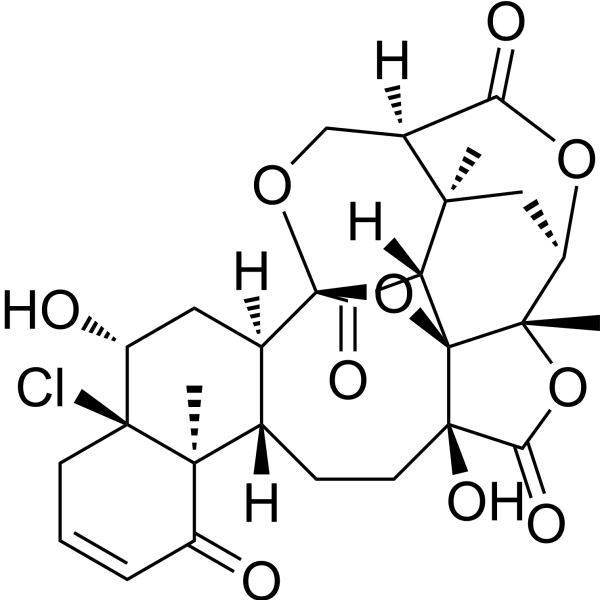 0 ImagesCat. No.: HY-N8270CAS No.: 70241-09-7
Physalin H is a natural product that can be isolated from Solanum nigrum. Physalin H is an inhibitor of Hedgehog (Hh) signaling and it disrupts GLI1-DNA-complex formation. Physalin H inhibits GLI1 transcription with an IC50 value of 0.7 μM. Physalin H shows cytotoxicity to PANC1 and DU145 cells with IC50 values of 5.7 and 6.8 μM, respectively.
-
hsa-miR-8065 inhibitor
 0 ImagesCat. No.: HY-RI02457
hsa-miR-8065 inhibitors are chemically-modified oligonucleotides that hybridize with mature miRNAs. The miRNA inhibitors have full-length nucleotide 2'-methoxy modification. The miRNA inhibitors strongly compete with mature miRNAs to prevent the complementary pairing of miRNAs and their target genes, thereby inhibiting miRNAs from functioning.
-
mmu-miR-1668 inhibitor
 0 ImagesCat. No.: HY-RI02694
mmu-miR-1668 inhibitors are chemically-modified oligonucleotides that hybridize with mature miRNAs. The miRNA inhibitors have full-length nucleotide 2'-methoxy modification. The miRNA inhibitors strongly compete with mature miRNAs to prevent the complementary pairing of miRNAs and their target genes, thereby inhibiting miRNAs from functioning.
-
mmu-miR-5623-5p antagomir
 0 ImagesCat. No.: HY-RI03315A
mmu-miR-5623-5p antagomirs are chemically-modified oligonucleotides that hybridize with mature miRNAs. The miRNA antagomirs have 2 phosphorothioates at the 5' end, 4 phosphorothioates at the 3' end, 1 cholesterol group at the 3' end, and full-length nucleotide 2'-methoxy modification. The miRNA antagomirs strongly compete with mature miRNAs to prevent the complementary pairing of miRNAs and their target genes, thereby inhibiting miRNAs from functioning. Stability of miRNA antagomirs appears to be significantly higher than miRNA inhibitors, they exhibits enhanced cellular uptake, stability and regulatory activity in vivo.
-
mmu-miR-7116-3p inhibitor
 0 ImagesCat. No.: HY-RI03941
mmu-miR-7116-3p inhibitors are chemically-modified oligonucleotides that hybridize with mature miRNAs. The miRNA inhibitors have full-length nucleotide 2'-methoxy modification. The miRNA inhibitors strongly compete with mature miRNAs to prevent the complementary pairing of miRNAs and their target genes, thereby inhibiting miRNAs from functioning.
-
PROTAC PDIA1 degrader 1
 0 ImagesCat. No.: HY-178118CAS No.: 3024292-21-2
PROTAC PDIA1 degrader 1 is a PDIA1 PROTAC degrader with a DC50 of 29.71 μM. PROTAC PDIA1 degrader 1 induces proteasome-dependent PDIA1 degradation via recruiting E3 ligase, ubiquitination and proteasomal degradation processes. PROTAC PDIA1 degrader 1 exhibits anticancer activity against breast cancer and epidermoid carcinoma. PROTAC PDIA1 degrader 1 can be used for the research of breast cancer and epidermoid carcinoma.
-
ERα ligand 6
 0 ImagesCat. No.: HY-187621
ERα ligand 6 is an amino intermediate derived from OBHSA, and also serves as a precursor for the synthesis of ERα-targeted hydrophobic tag degraders, such as the ERα ligand moiety of ERα/RAD51 degrader 1 (HY-187096).
-
Azido-PEG7-alcohol
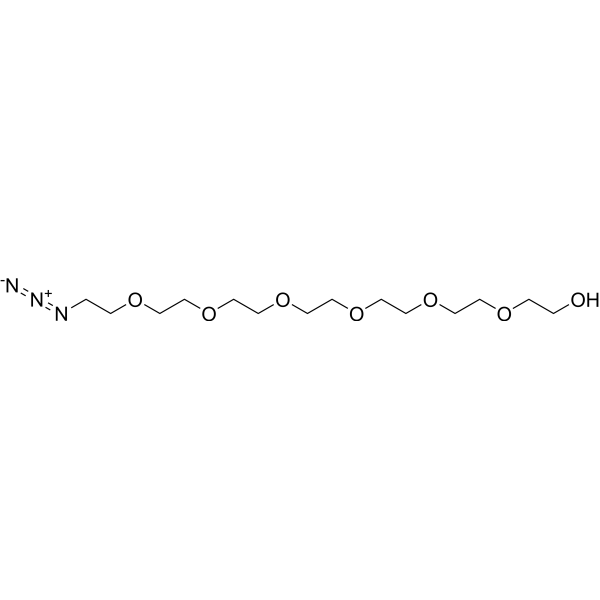 0 ImagesCat. No.: HY-140798CAS No.: 1274892-60-2
Azido-PEG7-alcohol is a PEG-based PROTAC linker that can be used in the synthesis of PROTACs. Azido-PEG7-alcohol is a click chemistry reagent, it contains an Azide group and can undergo copper-catalyzed azide-alkyne cycloaddition reaction (CuAAc) with molecules containing Alkyne groups. It can also undergo strain-promoted alkyne-azide cycloaddition (SPAAC) reactions with molecules containing DBCO or BCN groups.
-
4’-Azido-3’-O-benzoyl-5’-O-(m-chlorobenzoyl)-2’-deoxy-2’-fluoro-beta-D-arabinouridine
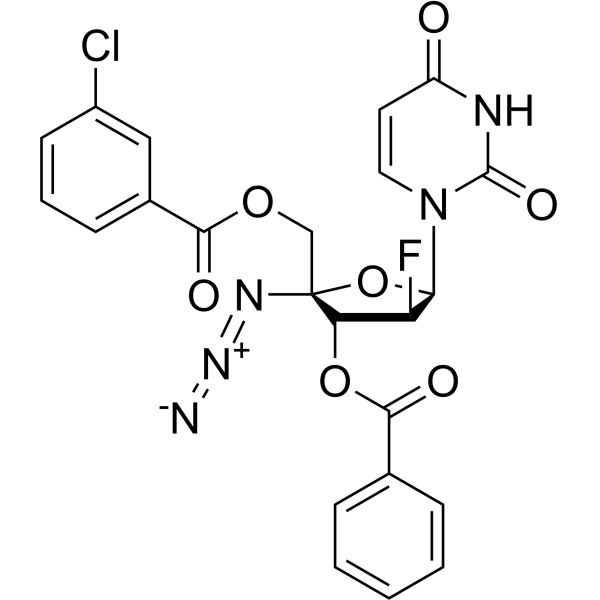 0 ImagesCat. No.: HY-154678CAS No.: 1333126-30-9
4’-Azido-3’-O-benzoyl-5’-O-(m-chlorobenzoyl)-2’-deoxy-2’-fluoro-beta-D-arabinouridine is a purine nucleoside analog. Purine nucleoside analogs have broad antitumor activity targeting indolent lymphoid malignancies. Anticancer mechanisms in this process rely on inhibition of DNA synthesis, induction of apoptosis, etc. 4’-Azido-3’-O-benzoyl-5’-O-(m-chlorobenzoyl)-2’-deoxy-2’-fluoro-beta-D-arabinouridine is a click chemistry reagent, it contains an Azide group and can undergo copper-catalyzed azide-alkyne cycloaddition reaction (CuAAc) with molecules containing Alkyne groups. It can also undergo strain-promoted alkyne-azide cycloaddition (SPAAC) reactions with molecules containing DBCO or BCN groups.

-
THP(Bz)3-NH2 TFA
 0 ImagesCat. No.: HY-164591A
THP(Bz)3-NH2 TFA is a bifunctional chelator that can be conjugated with radionuclides to prepare radionuclide conjugates (RDCs).
-
PKM2-IN-8
 0 ImagesCat. No.: HY-170577CAS No.: 3115004-02-6
PKM2-IN-8 (Compound 9b) is a pyruvate kinase M2 (PKM2) inhibitor (IC50 = 0.31 μM). PKM2-IN-8 has potent antiproliferative activity against U87MG glioma cells. PKM2-IN-8 can induce early apoptosis and reduce lactate levels. PKM2-IN-8 can be used for the research of glioblastoma.
-
CA-II/Dkk1-IN-1
 0 ImagesCat. No.: HY-175219
CA-II/Dkk1-IN-1 (Compound 5d) is a dual-functional inhibitor of CA-II and Dkk1 with a IC50 of 6.90 nM for CA-II. CA-II/Dkk1-IN-1 has significantly antioxidant activity and superior DNA binding capacity. CA-II/Dkk1-IN-1 can be used for cancers research, such as esophageal, renal, and lung cancer.
-
HDAC6-IN-82
 0 ImagesCat. No.: HY-183560CAS No.: 1228571-33-2
HDAC6-IN-82 is a selective HDAC6 inhibitor with an IC50 of 4.9 nM against HDAC6. HDAC6-IN-82 inhibits HDAC1 (112 nM), HDAC2 (737 nM), HDAC3 (623 nM), HDAC8 (1140 nM), HDAC10 (91.4 nM) and HDAC11 (219 nM). HDAC6-IN-82 reduces cancer cell viability, induces cell cycle arrest, triggers apoptosis, and increases the acetylation levels of H3K9 and α-tubulin. HDAC6-IN-82 can be used in cancer-related research such as leukemia.
-
SHP844
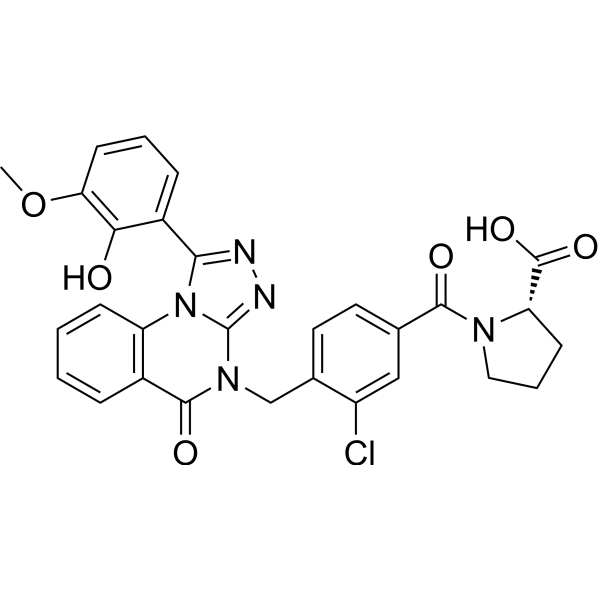 0 ImagesCat. No.: HY-125260CAS No.: 2222280-82-0
SHP844 is a SHP2 inhibitor with the IC50 of 18.9 µM. SHP2 is a protein tyrosine phosphatase (PTP) that regulates tyrosine phosphorylation levels and is involved in cell proliferation, differentiation and survival.
-
hsa-miR-3117-3p inhibitor
 0 ImagesCat. No.: HY-RI00547
hsa-miR-3117-3p inhibitors are chemically-modified oligonucleotides that hybridize with mature miRNAs. The miRNA inhibitors have full-length nucleotide 2'-methoxy modification. The miRNA inhibitors strongly compete with mature miRNAs to prevent the complementary pairing of miRNAs and their target genes, thereby inhibiting miRNAs from functioning.
-
PH-064 (tetra(hydrochloride))
 0 ImagesCat. No.: HY-10499ACAS No.: 2489449-03-6Synonyms: BIM-46187 tetrahydrochloride
PH-064 tetrahydrochloride (BIM-46187 tetrahydrochloride) is an orally active inhibitor of the heterotrimeric G-protein complex. PH-064 tetrahydrochloride inhibits SERT activity and attenuates shear stress-induced Akt phosphorylation. PH-064 tetrahydrochloride has potent anti-hyperalgesia activity. PH-064 tetrahydrochloride inhibits G protein-coupled receptor-dependent tumorigenesis. PH-064 tetrahydrochloride can be used in the study of pain (e.g., inflammatory pain, neuropathic pain), GPCR-dependent tumors, and inflammatory lung injury.
-
hsa-miR-4540 inhibitor
 0 ImagesCat. No.: HY-RI01168
hsa-miR-4540 inhibitors are chemically-modified oligonucleotides that hybridize with mature miRNAs. The miRNA inhibitors have full-length nucleotide 2'-methoxy modification. The miRNA inhibitors strongly compete with mature miRNAs to prevent the complementary pairing of miRNAs and their target genes, thereby inhibiting miRNAs from functioning.



