Infection
-
Infection Related Products (18904)
Related Products (18904)

-
Antibodies (22)
-
Dill apiole
 0 Images
Dill apiole is an aromatic ether, which is an important aroma component in herbs and spices such as dill (Anethum graveolens), parsley (Petroselinum crispum) and basil (Perilla frutescens). Dill apiole exhibits antimicrobial activity against Aspergillus parasiticus and Aedes aegypti.
-
Flusilazole (Standard)
 0 ImagesCat. No.: HY-B2012RCAS No.: 85509-19-9Synonyms: DPX-H6573 (Standard)
Flusilazole (Standard) is the analytical standard of Flusilazole. This product is intended for research and analytical applications. Flusilazole (DPX-H6573), an organosilane fungicide, has broad-spectrum antifungal effect. Flusilazole exhibits curative and preventative activities and is recommended for use in agriculture and horticulture.
-
nAChR-IN-2
 0 ImagesCat. No.: HY-W070884CAS No.: 3000-75-7
nAChR-IN-2 (Compound 2) is an inhibitor of insect nicotinic acetylcholine receptors (nAChR). nAChR-IN-2 inhibits the binding of α-bungarotoxin (HY-P1264) to the ACh site of insect nAChR in honeybee heads, with an IC50 of 360 μM. nAChR-IN-2 also inhibits the binding of Phencyclidine to the NCB/PCP site of insect nAChR in honeybee heads, with an IC50 of 84 μM.
-
Nalidixic acid (Standard)
 0 Images
Nalidixic acid (Standard) is the analytical standard of Nalidixic acid. This product is intended for research and analytical applications. Nalidixic acid, a quinolone antibiotic, is effective against both gram-positive and gram-negative bacteria. Nalidixic acid acts in a bacteriostatic manner in lower concentrations and is bactericidal in higher concentrations. Nalidixic acid inhibits a subunit of DNA gyrase and topoisomerase IV and reversibly blocks DNA replication in susceptible bacteria.
-
Antibacterial compound 2
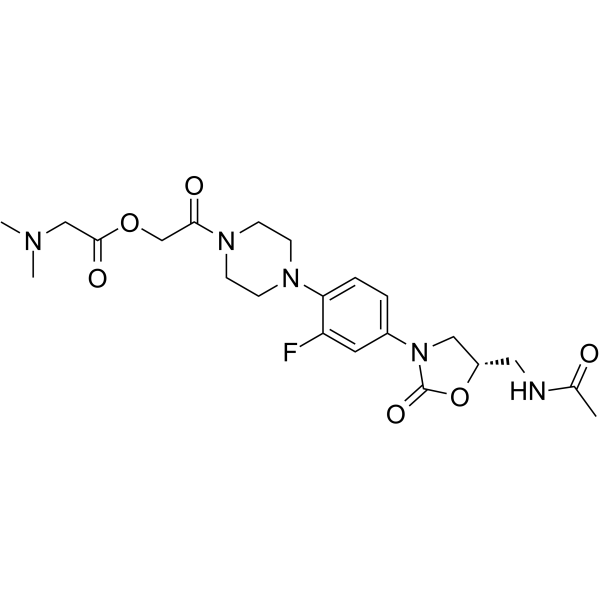 0 ImagesCat. No.: HY-101730CAS No.: 170104-58-2
Antibacterial compound 2 is a useful antibacterial agent extracted from patent US5652238, compound example 9.
-
3-Indolyl-β-D-glucuronide
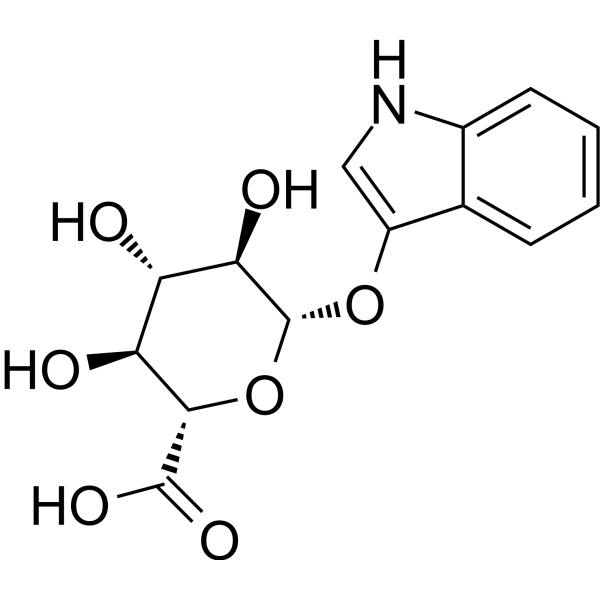 0 ImagesCat. No.: HY-113245CAS No.: 35804-66-1
3-Indolyl-β-D-glucuronide, a chromogenic substrate for β-D-glucuronidase, employs in the detection and enumeration of E. coli, yielding a blue precipitate upon cleavage. 3-Indolyl-β-D-glucuronide in plasma act as a new indicator of renal failure.
-
Ceftibuten
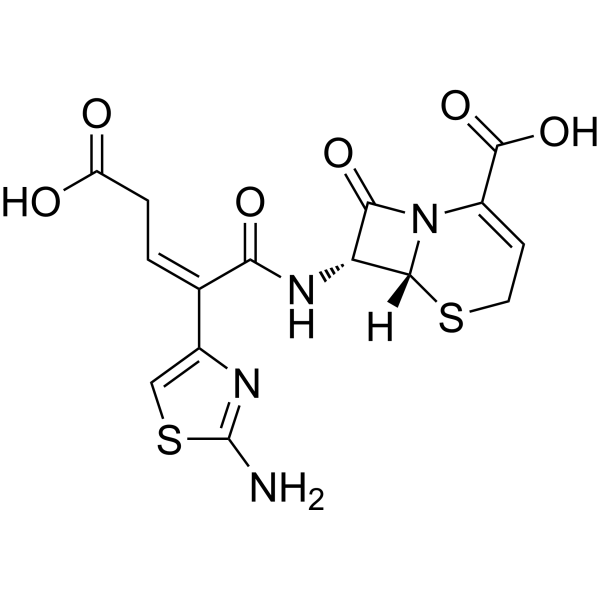 0 ImagesCat. No.: HY-B0698CAS No.: 97519-39-6Synonyms: Sch 39720
Ceftibuten (Sch39720), an antibiotic, is an orally active cephalosporin, possesses potent activity in vitro against a wide range of gram-negative and certain gram-positive pathogens.
-
Permethrin (Standard)
 0 ImagesSynonyms: NRDC-143 (Standard)
Permethrin (Standard) is the analytical standard of Permethrin. This product is intended for research and analytical applications. Permethrin (NRDC-143) is an insecticide, acaricide, and insect repellent; functions as a neurotoxin, affecting neuron membranes by prolonging sodium channel activation.
-
MMV1557817
 0 Images
MMV1557817 is an orally active and potent antimalarial compound. MMV1557817 is a selective, nanomolar inhibitor of both Plasmodium falciparum and Plasmodium vivax aminopeptidases M1 and M17, leading to inhibition of end-stage hemoglobin digestion in asexual parasites.
-
Methyl 3-hydroxydodecanoate
 0 Images
Methyl 3-hydroxydodecanoate is a poly (3-hydroxyalkanoate) monomer. Methyl 3-hydroxydodecanoate can be produced with the involvement of Pseudomonas putida Bet001.
-
Cinchonidine (Standard)
 0 Images
Cinchonidine (Standard) is the analytical standard of Cinchonidine. This product is intended for research and analytical applications. Cinchonidine (α-Quinidine) is a cinchona alkaloid found in Cinchona officinalis and Gongronema latifolium. A building block used in asymmetric synthesis in organic chemistry. Weak inhibitor of serotonin transporter (SERT) with Kis of 330, 4.2, 36, 196, 15 μM for dSERT, hSERT, hSERT I172M, hSERT S438T, hSERT Y95F, respectively. Antimalarial activities.
-
Brequinar (Standard)
 0 ImagesSynonyms: DUP785 (Standard); NSC 368390 (Standard)
Brequinar (Standard) is the analytical standard of Brequinar. This product is intended for research and analytical applications. Brequinar (DUP785) is a potent inhibitor of dihydroorotate dehydrogenase (DHODH) with an IC50 of 5.2 nM for human DHODH. Brequinar has potent activities against a broad spectrum of viruses. Brequinar also has an anti-SARS2 activity.
-
Imidazole-4-pyruvic acid TFA
 0 ImagesCat. No.: HY-180690ACAS No.: 3069873-81-7Synonyms: Imidazolepyruvic acid TFA
Imidazole-4-pyruvic acid TFA (Imidazolepyruvic acid TFA) is a metabolic precursor for histidine synthesis and selective stable isotope labeling of histidine residues. Imidazole-4-pyruvic acid TFA serves as a precursor for selective histidine labeling in overexpressed proteins of Escherichia coli. Imidazole-4-pyruvic acid TFA can be used in studies related to cancer and fungal mold infections.
-
Dihydroanthracene
 0 Images
Dihydroanthracene (9,10-Dihydroanthracene) is a substrate for toluene dioxygenase (TDO) expressed by Pseudomonas putida UV4. Toluene dioxygenase (TDO) expressed by Pseudomonas putida UV4 catalyzes the benzylic monooxygenation of Dihydroanthracene to 9-hydroxy-9,10-DHA as the only product.
-
L-(+)-Ampicillin
 0 ImagesSynonyms: L-(+)-α-Aminobenzylpenicillin
L-(+)-Ampicillin (L-(2S) ampicillin) is the L-isomer of Ampicillin (HY-B0522). Ampicillin is a broad-spectrum beta-lactam antibiotic against a variety of gram-positive and gram-negative bacteria.
-
Azt-pmap
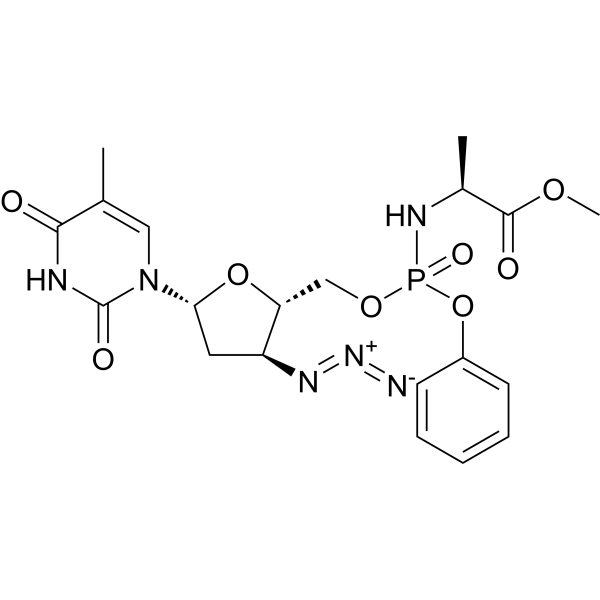 0 Images
Azt-pmap, a nucleoside analogue, is an aryl phosphate derivative of AZT. Azt-pmap shows anti-HIV activity. AZT is a nucleoside reverse transcriptase inhibitor (NRTI) for HIV infection. Azt-pmap is a click chemistry reagent, it contains an Azide group and can undergo copper-catalyzed azide-alkyne cycloaddition reaction (CuAAc) with molecules containing Alkyne groups. It can also undergo strain-promoted alkyne-azide cycloaddition (SPAAC) reactions with molecules containing DBCO or BCN groups.
-
Nafamostat hydrochloride
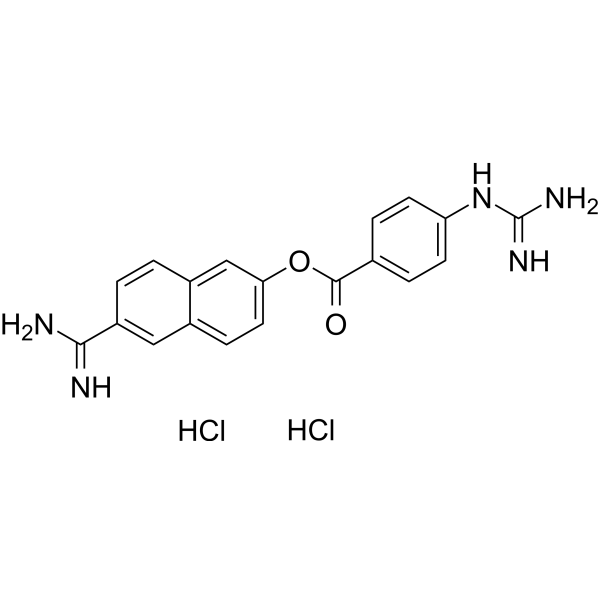 0 ImagesCat. No.: HY-B0190BCAS No.: 80251-32-7
Nafamostat hydrochloride, an anticoagulant, is a synthetic serine protease inhibitor. Nafamostat hydrochloride has anticancer and antivirus effect. Nafamostat hydrochloride induces apoptosis by up-regulating the expression of tumor necrosis factor receptor-1 (TNFR1). Nafamostat hydrochloride can be used in the development of the pathological thickening of the arterial wall.
-
Anti-Mouse CD122/IL-2Rβ Antibody (TM-Beta 1)
 0 ImagesCat. No.: HY-P990808
Anti-Mouse CD122/IL-2Rβ Antibody (TM-Beta 1) is a rat-derived IgG2b κ type antibody inhibito, targeting to mouse CD122/IL-2Rβ. Anti-Mouse CD122/IL-2Rβ Antibody (TM-Beta 1) can block IL-2 and IL-15. Anti-Mouse CD122/IL-2Rβ Antibody (TM-Beta 1) can deplete natural killer (NK) cells and NKT cells. Anti-Mouse CD122/IL-2Rβ Antibody (TM-Beta 1) can be used for the researches of cancer, infection, inflammation, immunology and metabolic disease, such as melanoma, experimental autoimmune encephalomyelitis (EAE) and diabetes.
-
Sifuvirtide acetate
 0 ImagesCat. No.: HY-P10517APurity: 99.82%Synonyms: SFT acetate
Sifuvirtide (SFT) acetate is a potent HIV fusion inhibitor. Sifuvirtide acetate inhibits HIV-1 mediated cell fusion in a dose-dependent manner and is highly potent against infection by primary and laboratory-adapted HIV-1 isolates of multiple genotypes. Sifuvirtide acetate can be used in the research of anti-HIV drugs.
-
Nitroxoline (Standard)
 0 ImagesSynonyms: 8-Hydroxy-5-nitroquinoline (Standard); 5-Nitro-8-quinolinol (Standard)
Nitroxoline (Standard) is the analytical standard of Nitroxoline. This product is intended for research and analytical applications. Nitroxoline (8-Hydroxy-5-nitroquinoline), an antibiotic, is an orally active antibiofilm agent. Nitroxoline reduces the formation and induces the dispersal of Pseudomonas aeruginosa biofilms by chelation of iron and zinc. Nitroxoline can be used for the urinary tract infections and cancer research.