



Ferroptosis
Ferroptosis
Ferroptosis is a non-apoptotic form of regulated cell death. It is distinct from other regulated cell death phenotypes, such as apoptosis and necroptosis. Ferroptosis is characterized by extensive lipid peroxidation, which can be suppressed by iron chelators or lipophilic antioxidants. Mechanistically, Ferroptosis inducers are divided into two classes: (1) inhibitors of cystine import via system xc− (e.g., Erastin), which subsequently causes depletion of glutathione (GSH), and (2) covalent inhibitors (e.g., (1S, 3R)-RSL3) of glutathione peroxidase 4 (GPX4). Since GPX4 reduces lipid hydroperoxides using GSH as a co-substrate, both compound classes ultimately result in loss of GPX4 activity, followed by elevated levels of lipid reactive oxygen species (ROS) and consequent cell death.
Ferroptosis is an iron- and ROS-dependent form of regulated cell death (RCD). Misregulated Ferroptosis has been implicated in multiple physiological and pathological processes, including cancer cell death, neurotoxicity, neurodegenerative diseases, acute renal failure, drug-induced hepatotoxicity, hepatic and heart ischemia/reperfusion injury, and T-cell immunity.
All Product Categories
-
Ferroptosis Verwandte Produkte (769)
Verwandte Produkte (769)

-
Antibodies (6)
-
Related Compound Screening Libraries (1)
-
Ferroptosis Signalweg
-
DL-alpha-Tocopherol-13C3
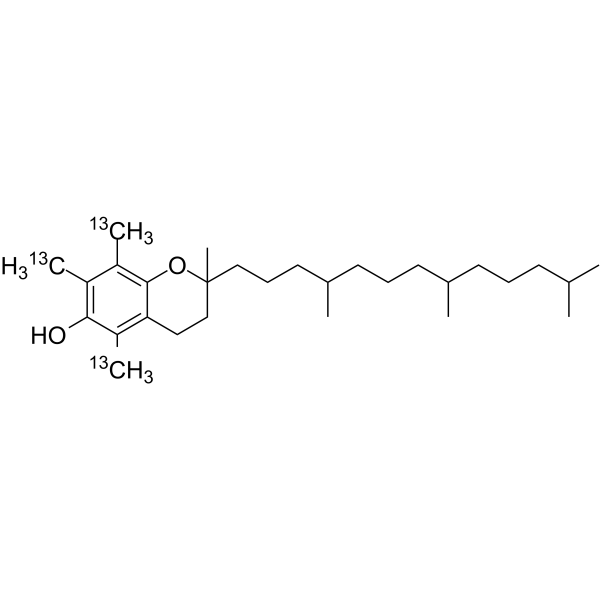 0 ImagesArt. -Nr.: HY-W020044SDL-alpha-Tocopherol-13C3 is the 13C-labeled DL-alpha-Tocopherol. DL-alpha-Tocopherol is a synthetic vitamin E, with antioxidation effect. DL-alpha-Tocopherol protects human skin fibroblasts against the cytotoxic effect of UVB.
-
L-Cystine dihydrochloride (Standard)
 0 ImagesArt. -Nr.: HY-W009203RCAS. Nr.: 30925-07-6L-Cystine (dihydrochloride) (Standard) is the analytical standard of L-Cystine (dihydrochloride) (HY-W009203). This product is intended for research and analytical applications. L-Cystine dihydrochloride is the dihydrochloride salt form of L-Cystine (HY-N0394). L-Cystine dihydrochloride elevates Nrf2 protein expression and activates Nrf2 transcription factor. L-cystine dihydrochloride reduces ROS generation and protects against oxidant- or Doxorubicin (HY-15142A)-induced apoptosis. L-Cystine dihydrochloride combined with L-theanine (HY-15121) enhances the production of antigen-specific IgG by increasing glutathione (GSH) levels and T helper 2 (Th2) mediated responses in mice. L-Cystine dihydrochloride is promising for research of cystinuria and kidney stones
-
RSL3 (Standard)
 0 ImagesSynonyms: (1S,3R)-RSL3 (Standard)RSL3 (Standard) is the analytical standard of RSL3 (HY-100218A). This product is intended for research and analytical applications. RSL3 ((1S,3R)-RSL3) is an inhibitor of glutathione peroxidase 4 (GPX4) (ferroptosis activator), reduces the expression of GPX4 protein, and induces ferroptotic death of head and neck cancer cell. RSL3 increases the expression of p62 and Nrf2 and inactivates Keap1 in HN3-rslR cells.
-
DL-Buthionine-(S,R)-sulfoximine (Standard)
 0 ImagesSynonyms: Buthionine sulfoximine (Standard); BSO (Standard)DL-Buthionine-(S,R)-sulfoximine (Standard) is the analytical standard of DL-Buthionine-(S,R)-sulfoximine. This product is intended for research and analytical applications. DL-Buthionine-(S,R)-sulfoximine is a potent inhibitor of glutamylcysteine synthetase biosynthesis.
-
(-)-Epicatechin-13C3
 0 ImagesArt. -Nr.: HY-N0001S2Synonyms: (-)-Epicatechol-13C3; Epicatechin-13C3; epi-Catechin-13C3
-
Dexpramipexole-d3 dihydrochloride
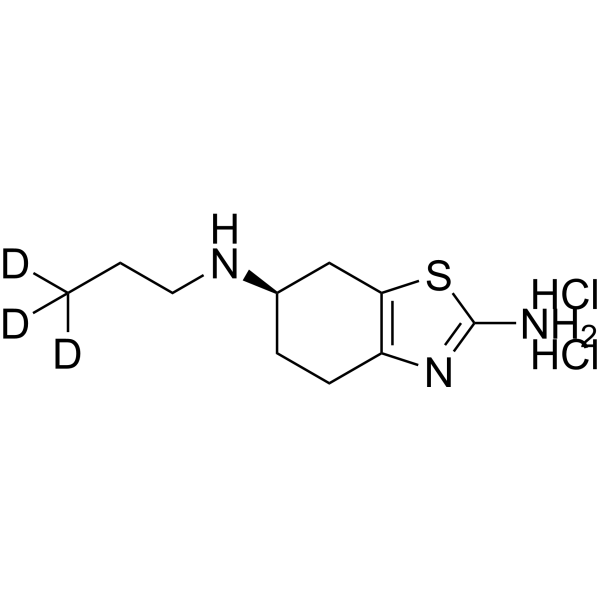 0 ImagesArt. -Nr.: HY-17355BSCAS. Nr.: 1432230-09-5Synonyms: (R)-Pramipexole-d3 dihydrochloride; R-(+)-Pramipexole-d3 dihydrochloride; KNS-760704-d3 dihydrochlorideDexpramipexole-d3 ((R)-Pramipexole-d3) dihydrochloride is the deuterium labeled Dexpramipexole. Dexpramipexole ((R)-Pramipexole) dihydrochloride is an orally active, blood-brain barrier permeable mitochondrial protective agent. Dexpramipexole dihydrochloride upregulates the expression of Parkin, PINK1, GPX4 and FSP1; binds to mitochondrial F1/Fo-ATP synthase; blocks the Nav1.8 sodium channel; and inhibits the activation of the NLRP3 inflammasome. Dexpramipexole dihydrochloride induces mitophagy, inhibits ferroptosis, pyroptosis, apoptosis, neuroinflammation and eosinophilopoiesis; maintains mitochondrial function and redox homeostasis; reduces reactive oxygen species production; and decreases myocardial infarct size. Dexpramipexole dihydrochloride is applicable to studies on eosinophilic asthma, myocardial ischemia/reperfusion injury, sepsis-associated encephalopathy, analgesia, and more.
-
Rosiglitazone hydrochloride (Standard)
 0 ImagesSynonyms: BRL 49653 hydrochloride (Standard)Rosiglitazone (hydrochloride) (Standard) is the analytical standard of Rosiglitazone (hydrochloride). This product is intended for research and analytical applications. Rosiglitazone (BRL 49653) hydrochloride is an orally active selective PPARγ agonist (EC50: 60 nM, Kd: 40 nM). Rosiglitazone hydrochloride is a TRPC5 activator (EC50: 30 μM) and TRPM3 inhibitor. Rosiglitazone hydrochloride can be used in the research of obesity and diabetes, senescence, ovarian cancer.
-
HH2853
 0 ImagesArt. -Nr.: HY-187629CAS. Nr.: 2202678-04-2HH2853 is an orally active EZH1/EZH2 inhibitor, with an IC50 of 9.26 nM for EZH1 and IC50 values ranging from 2.21 to 3.75 nM for both wild-type and mutant EZH2. HH2853 simultaneously inhibits the methyltransferase activities of EZH1 and EZH2, blocks the compensatory pathway that arises following EZH2 inhibition, and reduces H3K27me3 levels. HH2853 upregulates the expression of c-Myc and TfR-1 to induce intracellular iron accumulation, and stabilizes GPX4 via HSPA5 to suppress ferroptosis. HH2853 combined with Erastin (HY-15763) synergistically inhibits EZH2 wild-type DLBCL cell proliferation. HH2853 alone shows weak activity against EZH2 wild-type DLBCL and is well tolerated. HH2853 is applicable for research related to diffuse large B-cell lymphoma, non-Hodgkin's lymphoma, epithelioid sarcoma, and follicular lymphoma.
-
Arteannuin B (Standard)
 0 ImagesArt. -Nr.: HY-N2016RCAS. Nr.: 50906-56-4Arteannuin B, No. 2000 can be jointly submitted with the blue material. Arteannuin B had anti-SARS-CoV-2 activity, EC50=10.28 μM.
-
Vildagliptin (Standard)
 0 ImagesSynonyms: LAF237 (Standard); NVP-LAF 237 (Standard)Vildagliptin (Standard) is the analytical standard of Vildagliptin. This product is intended for research and analytical applications. Vildagliptin (LAF237) is a potent, stable, selective dipeptidyl peptidase IV (DPP-IV) inhibitor with an IC50 of 3.5 nM in human Caco-2 cells. Vildagliptin possesses excellent oral bioavailability and potent antihyperglycemic activity.
-
Epi lovastatin-d3
 0 ImagesArt. -Nr.: HY-N0504SCAS. Nr.: 1330264-51-1Epi Lovastatin-d3 is the deuterium labeled Lovastatin. Lovastatin is a cell-permeable HMG-CoA reductase inhibitor used to lower cholesterol.
-
α-Vitamin E-d11
 0 ImagesArt. -Nr.: HY-N0683S6CAS. Nr.: 2874378-75-1Synonyms: (+)-α-Tocopherol-d11; D-α-Tocopherol-d11α-Vitamin E-d11 ((+)-α-Tocopherol-d11) is the deuterium labeled α-Vitamin E (HY-N0683). α-Vitamin E ((+)-α-Tocopherol), a naturally occurring vitamin E form, is a potent antioxidant.

-
ML-210 (Standard)
 0 ImagesArt. -Nr.: HY-100003RCAS. Nr.: 1360705-96-9ML-210 (Standard) is the analytical standard of ML-210 (HY-100003). This product is intended for research and analytical applications. ML-210 is a selective and covalent glutathione peroxidase 4 (GPX4) inhibitor with an EC50 of 30 nM. ML-210 binds the GPX4 selenocysteine residue. ML-210 has anti-cancer activity.
-
ARV-771 (Standard)
 0 ImagesArt. -Nr.: HY-100972RCAS. Nr.: 1949837-12-0ARV-771 (Standard) is the analytical standard of ARV-771 (HY-100972). This product is intended for research and analytical applications. ARV-771 is a BET PROTAC degrader, with Kd values of 34, 4.7, 8.3, 7.6, 9.6 and 7.6 nM against BRD2 (1), BRD2 (2), BRD3 (1), BRD3 (2), BRD4 (1) and BRD4 (2) , respectively. ARV-771 inhibits the transcription of AR/AR-v7 and its downstream target genes. By degrading BRD4 protein, ARV-771 enhances the sensitivity of prostate cancer cells to ferroptosis, suppresses cancer cell viability, and induces apoptosis. ARV-771 downregulates the levels of BRD4, c-MYC and AR-V7 in tumor tissues and inhibits tumor tissue growth. ARV-771 can be used in prostate cancer-related research.
-
FIN56 (Standard)
 0 ImagesArt. -Nr.: HY-103087RCAS. Nr.: 1083162-61-1FIN56 (Standard) is the analytical standard of FIN56 (HY-103087). This product is intended for research and analytical applications. FIN56 is a specific inducer of ferroptosis. FIN56 induces ferroptosis by inducing degradation of GPX4. FIN56 also binds to and activates squalene synthase.
-
Lapatinib ditosylate monohydrate (Standard)
 0 ImagesSynonyms: GW572016 ditosylate monohydrate (Standard); GW2016 ditosylate monohydrate (Standard)Lapatinib (ditosylate monohydrate) (Standard) is the analytical standard of Lapatinib (ditosylate monohydrate). This product is intended for research and analytical applications. Lapatinib ditosylate monohydrate (GW572016 ditosylate monohydrate) is a potent, orally active inhibitor of the ErbB-2 and EGFR tyrosine kinase domains with IC50 values against purified EGFR and ErbB-2 of 10.2 and 9.8 nM, respectively.
-
5-O-Methylvisammioside (Standard)
 0 ImagesArt. -Nr.: HY-N0442RCAS. Nr.: 84272-85-5Synonyms: 4'-O-β-D-Glucosyl-5-O-methylvisamminol (Standard)5-O-Methylvisammioside (4'-O-β-D-Glucosyl-5-O-methylvisamminol) (Standard) is the analytical standard of 5-O-Methylvisammioside. This product is intended for research and analytical applications. 5-O-Methylvisammioside is an orally active natural chromone glycoside and multiple biological activities. 5-O-Methylvisammioside inhibits ferroptosis by activating the Nrf2/HO-1 signaling axis. 5-O-Methylvisammioside alleviates intestinal barrier damage by inhibiting the ROS/NF-κB/NLRP3 pathway. 5-O-Methylvisammioside exerts a protective effect against acute liver injury by reducing ALT/AST, decreasing inflammatory infiltration, and inhibiting IκB-α phosphorylation and NF-κB nuclear translocation. 5-O-Methylvisammioside blocks the HMGB1/RAGE/MEK/ERK signaling axis to exert anti-tumor and anti-angiogenic effects. 5-O-Methylvisammioside improves depression-like behaviors by inhibiting Src kinase and the NF-κB pathway.
-
Cephaeline (Standard)
 0 ImagesSynonyms: (-)-Cephaeline (Standard); NSC 32944 free base (Standard)Cephaeline ((-)-Cephaeline), a desmethyl analog of Emetine, is a phenolic alkaloid in Indian Ipecac roots isolated from the Cephaelis ipecacuanha. Cephaeline exhibits potent inhibition of both Zika virus (ZIKV) and Ebola virus (EBOV) infections. Cephaeline is an inductor of histone H3 acetylation and an inhibitor of mucoepidermoid carcinoma cancer stem cells (MEC), which promotes ferroptosis by inhibiting NRF2 to exert anti-lung cancer efficacy.
-
Ferrous gluconate (Standard)
 0 ImagesArt. -Nr.: HY-W698249RCAS. Nr.: 299-29-6Ferrous gluconate (Standard) is the analytical standard of Ferrous gluconate. This product is intended for research and analytical applications. Ferrous gluconate is a highly water-soluble iron-containing agent with high bioavailability and bactericidal activity. As a non-heme iron, Ferrous gluconate is used for meat product fortification and improvement of iron deficiency anemia. Ferrous gluconate induces ferroptosis in E. coli through Fe2+ infiltration, reactive oxygen species burst, lipid peroxidation and direct interaction with DNA. Ferrous gluconate also downregulates the SOS responsive transcriptional repressor LexA. In addition, Ferrous gluconate regulates multiple key pathways in E. coli such as fatty acid metabolism, iron-sulfur cluster assembly and pyruvate metabolism, and is applied in studies related to *E. coli* infection and iron deficiency anemia.




