



CD3
Cluster of differentiation 3
CD3 (cluster of differentiation 3) is a protein complex and T cell co-receptor that is involved in activating both the cytotoxic T cell (CD8+ naive T cells) and T helper cells (CD4+ naive T cells). It is composed of four distinct chains. In mammals, the complex contains a CD3γ chain, a CD3δ chain, and two CD3ε chains. These chains associate with the T-cell receptor (TCR) and the CD3-zeta (ζ-chain) to generate an activation signal in T lymphocytes. The TCR, CD3-zeta, and the other CD3 molecules together constitute the TCR complex.
All Product Categories
-
CD3 Related Products (110)
Related Products (110)

-
Antibodies (20)
-
Brenetafusp
 0 ImagesSynonyms: IMC-F106CBrenetafusp is a TCR/anti-CD3 bispecific fusion protein, consisting of a TCR targeting the PRAME peptide and an anti-CD3 scFv effector domain. Brenetafusp redirects CD3+ T cells to kill PRAME+ tumor cells. Brenetafusp can be used in research related to cutaneous melanoma, non-small cell lung cancer, ovarian cancer, endometrial cancer, triple-negative breast cancer, and small cell lung cancer.
-
Anti-GPRC5D Antibody
 0 ImagesCat. No.: HY-P991197Purity: 99.9%Synonyms: LM-305 antibody; AZD-0305 antibody
-
Forimtamig
 0 ImagesSynonyms: RG-6234; RO-7425781Forimtamig (RG-6324) is a GPRC5DxCD3 T-cell-engaging bispecific antibody. Forimtamig has a 2 + 1 format, comprising two high-affinity GPRC5D binding moieties and one CD3 binder. Forimtamig further features a P329G LALA mutated Fc domain that inhibits Fcγ receptor and C1q binding, yet retains binding to the neonatal Fc receptor. The isotype control for Forimtamig can refer to Human IgG1 kappa, Isotype Control (HY-P99001).
-
Ramantamig
 0 ImagesCat. No.: HY-P991155CAS No.: 2988886-91-3Synonyms: JNJ-79635322; JNJ-5322Ramantamig (JNJ-79635322) is a humanized monoclonal antibody targeting human CD3ε, GPRC5D, and TNFRSF17 (BCMA). Ramantamig binds to BCMA and GPRC5D on multiple myeloma cells, binds to CD3ε on T cells, forms immunological synapses, and enables T-cell-mediated cytotoxicity. Ramantamig activates T cells concomitantly with inducing myeloma cell cytotoxicity, with no nonspecific T-cell activation in the absence of target myeloma cells. Ramantamig carries mutations to reduce interaction with Fc receptors and disrupt protein A binding of monomeric and homodimerized chains. Ramantamig can be used for the research of multiple myeloma.
-
Etentamig
 0 ImagesSynonyms: ABBV-383; TNB 383BEtentamig is a BCMA × CD3 bispecific T-cell engager (BiTE) that can inhibit the activity of B-cell maturation antigen (BCMA) and activate the T-cell surface glycoprotein CD3 complex. Etentamig can be used for research in multiple myeloma, immunoglobulin light chain amyloidosis, and cardiovascular diseases.
-
Tepoditamab
 0 ImagesSynonyms: MCLA 117Tepoditamab (MCLA-117) is a full-length human IgG1 bispecific monoclonal antibody that binds to CLEC12A of myeloid cells and CD3 of cytotoxic T cells. Among others, CLEC12A is a myeloid differentiation antigen. Tepoditamab kills AML leukaemia mother cells and AML leukaemia stem cells, induces T cell-mediated proliferative lysis of AML cells. Tepoditamab induces upto 30-fold T-cell expansion. Tepoditamab results in moderate to strong cytokine (IFNγ, IL-6, IL-8, IL-10, and TNFα) and IFNγ release in human whole blood and PBMC, respectively. Tepoditamab can be used in acute myeloid leukaemia (AML) research.
-
Pavurutamab
 0 ImagesSynonyms: AMG-701Pavurutamab (AMG-701) is a bispecific T cell engager molecule that anti-CD3 and anti-B cell maturation antigens (BCMA). Pavurutamab has an extended half-life based on Pacanalotamab (HY-P99798). The Fc of Pavurutamab is coupled to molecules to improve pharmacokinetic parameters. Pavurutamab has potential applications in immune regulation and multiple myeloma (MM).
-
Anti-Mouse TCR gamma/delta Antibody (UC7-13D5)
 0 ImagesCat. No.: HY-P99146Purity: 98.26%Anti-Mouse TCR gamma/delta Antibody (UC7-13D5) is an anti-mouse TCR gamma/delta IgG monoclonal antibody. Anti-Mouse TCR gamma/delta Antibody (UC7-13D5) can enter the blood-brain barrier. Anti-Mouse TCR gamma/delta Antibody (UC7-13D5) effectively depletes γδ T cells and reduces macrophage and neutrophil infiltration. Anti-Mouse TCR gamma/delta Antibody (UC7-13D5) can reduce the immune response of transplants. Anti-Mouse TCR gamma/delta Antibody (UC7-13D5) can be used for researches on inflammation conditions, virus infection and cancer such as arthritis, JHM virus and breast cancer.
-
Clesitamig
 0 ImagesSynonyms: ALPS-12; RG-6524; RO 7616789Clesitamig (ALPS-12) is a trispecific T cell engager with two CD3/CD137 dual-specific Fabs and one DLL3 Fab. Clesitamig engages CD3 and CD137 on T cells to activate and co-stimulate T cells, promoting their proliferation, survival, and antitumor activity. Clesitamig binds to DLL3 on tumor cells for tumor-specific recognition. Clesitamig can be used for the research of small cell lung cancer (SCLC).
-
Flotetuzumab
 0 ImagesSynonyms: MGD006; S80880Flotetuzumab (MGD006; S80880) is an investigational CD123/CD3 bispecific dual-affinity retargeting antibody (DART) molecule. Flotetuzumab reactivates T cells by simultaneously binding to CD123 in target cells and CD3 in effector T cells, leading to T-cell-mediated cytotoxicity in target cells. Flotetuzumab shows inhibitory effect on a mouse model of patient-derived xenograft (PDX) in acute myeloid leukemia (AML).
-
Vepsitamab
 0 ImagesSynonyms: AMG 199Vepsitamab (AMG 199) is a bispecific T-cell engager (HLE BiTE) that binds to MUC17 and CD3. Vepsitamab directs CD3-positive cells to target MUC17-positive cells. Vepsitamab induces cell activation and proliferation. Vepsitamab is applicable to research related to gastric cancer and gastroesophageal junction (g/gej) cancer.
-
Rezetamig
 0 ImagesCat. No.: HY-P990759CAS No.: 2795115-07-8Synonyms: JNJ-75348780
-
Vonsetamig
 0 ImagesCat. No.: HY-P990095CAS No.: 2408319-33-3Synonyms: REGN5459Vonsetamig (REGN5459) is a human bispecific antibody targeting BCMA and CD3. Vonsetamig triggers T-cell activation, induces plasma cell depletion, and triggers low-level cytokine release. Vonsetamig can be used for the research of relapsed/refractory multiple myeloma.
-
GEN-1044
 0 ImagesCat. No.: HY-P991089Purity: 98.83%GEN-1044 is a bispecific CD3 and oncofetal antigen 5T4 antibody. GEN-1044 shows immunomodulating and antineoplastic activities.
-
Plamotamab
 0 ImagesSynonyms: XmAb-13676
-
M701
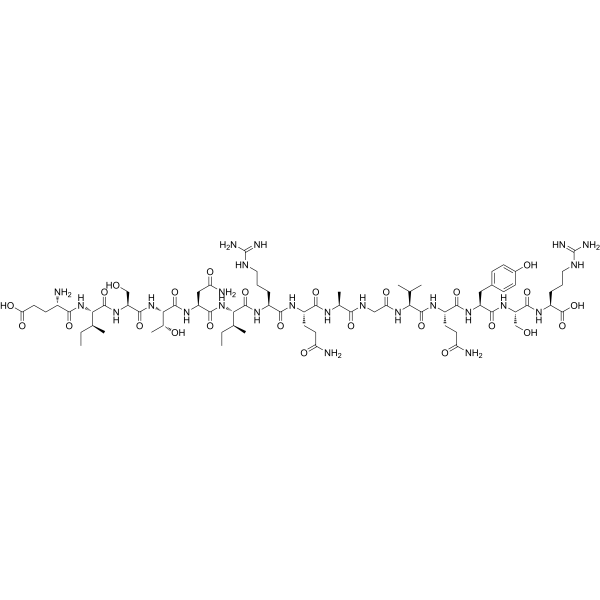
 0 ImagesM701 is a T-cell engager bispecific humanized antibody targeting epithelial cell adhesion molecule (EpCAM) and cluster of differentiation 3 (CD3). M701 binds to EpCAM on tumor cells and CD3 on T cells, thereby linking the two cell populations to achieve targeted cytotoxicity and T cell-mediated cytotoxicity. M701 is applicable to research related to advanced epithelial solid tumors.
-
ISB2001
 0 ImagesCat. No.: HY-P991490Purity: 99.17%ISB2001 is a trispecific antibody targeting CD38, CD3 and BCMA. ISB2001 effectively counteracts tumor immune escape mechanisms caused by antigen downregulation, antigen loss, soluble factor competition and other factors. ISB2001 is applicable to relevant research on multiple myeloma and relapsed/refractory multiple myeloma.
-
Avitotamig
 0 ImagesCat. No.: HY-P990903CAS No.: 2577961-36-3Synonyms: YMS-5AHY-P990903 is an CD3E/CD33-targeting [H-γ1 _ L-κ-scFv heavy -κ]-dimer type bispecific antibody.
-
Etevritamab
 0 ImagesCat. No.: HY-P99948CAS No.: 2329692-74-0Synonyms: AMG-596Etevritamab (AMG-596) is a bispecific T-cell engager that targets EGFRvIII and CD3. Etevritamab simultaneously binds CD3 on T cells and EGFRvIII on glioblastoma multiforme cells, thereby forming a bridge structure. Etevritamab triggers T-cell activation, proliferation, secretion of cytotoxic substances, and tumor cell lysis. Etevritamab extends overall survival and induces tumor regression in mouse models of glioblastoma multiforme. Etevritamab can be used for research related to glioblastoma.




