



Transmembrane Glycoprotein
Transmembrane Glycoprotein
Transmembrane glycoproteins are important components of cell membranes and are characterized by oligosaccharide chains covalently linked to polypeptide chains. Glycosylation sites are mainly located in their extracellular regions, achieved by N-linked glycosylation (linked to asparagine residues) or O-linked glycosylation (linked to serine or threonine residues). Sugar chains not only provide structural stability to proteins but also confer functional specificity. Many transmembrane glycoproteins are receptors, such as G protein-coupled receptors (GPCRs) and receptor tyrosine kinases (RTKs). Most (clusters of differentiation)CD molecules are also transmembrane glycoproteins expressed on the surface of antigen-presenting cells[1][2].
References:
- [1]. L Franco, et al. The transmembrane glycoprotein CD38 is a catalytically active transporter responsible for generation and influx of the second messenger cyclic ADP-ribose across membranes. FASEB J. 1998 Nov;12(14):1507-20. [Content Brief]
- [2]. Kumi Oshima, et al. SHPS-1, a multifunctional transmembrane glycoprotein. FEBS Lett. 2002 May 22;519(1-3):1-7. [Content Brief]
All Product Categories
-
Transmembrane Glycoprotein Inhibitors
(234)
View all products
-
Transmembrane Glycoprotein Agonists
(8)
View all products
-
Transmembrane Glycoprotein Antagonists
(7)
View all products
-
Transmembrane Glycoprotein Activators
(10)
View all products
-
Transmembrane Glycoprotein Modulators
(5)
View all products
-
Transmembrane Glycoprotein Ligands
(16)
View all products
-
Transmembrane Glycoprotein Related Products (380)
Related Products (380)

-
JCAR-023
 0 ImagesCat. No.: HY-P991296JCAR-023 is a human monoclonal antibody (mAb) targeting CAML1/CD171. JCAR-023 can be used in Neuroblastoma research.

-
OI-3
 0 ImagesCat. No.: HY-P992430OI-3 is a monoclonal antibody targeting CD146 (MCAM). OI-3 specifically binds to CD146 on the surface of human mesothelioma cells and undergoes endocytosis; both chimeric (chOI-3) and murine (mOI-3) variants possess this activity. When conjugated with 212Pb to form 212Pb-TCMC-OI-3, OI-3 acts as a cytotoxic agent that delivers α-emitting radionuclides to induce targeted cytotoxicity. OI-3 can be used in research related to malignant peritoneal mesothelioma.
-
DS-1055a
 0 ImagesCat. No.: HY-P992005
-
JS006
 0 ImagesCat. No.: HY-P991620JS006 is a humanized IgG4κ monoclonal antibody inhibitor targeting TIGIT/CD155. JS006 can be used to study advanced and/or metastatic cancers with resistance to PD-1/PD-L1 inhibitor such as non-small cell lung cancer (NSCLC), advanced lymphoma and advanced/metastatic triple negative breast cancer (TNBC) .
-
FC-99
 0 ImagesFC-99 is a Tenascin-C (TN-C) inhibitor with anti-inflammatory effects. FC-99 reduces inflammatory responses in rheumatoid arthritis (RA). FC-99 is promising for research of autoimmune diseases, particularly rheumatoid arthritis.
-
Anti-Rat CD86 Antibody (OX-48)
 0 ImagesCat. No.: HY-P991759
-
cLABL
 0 ImagesCat. No.: HY-P11799CAS No.: 344611-99-0cLABL is a cyclic peptide that specifically binds to ICAM‑1. cLABL mediates targeted enrichment and rapid endocytosis of nanoparticles. cLABL is applicable to researches such as precise drug delivery at inflammatory sites.
-
Anti-Mouse CD318 Antibody (9a2)
 0 ImagesCat. No.: HY-P991817Anti-Mouse CD318 Antibody (9a2) reacts with the mouse that selectively recognized native CD318 protein on both human and mouse cell surfaces in flow cytometry assays.
-
DNP002
 0 ImagesCat. No.: HY-P992344DNP002 is a humanized IgG1 monoclonal antibody targeting tumor-associated CEACAM6. DNP002 binds to CEACAM1, CEACAM5 and CEACAM6, and exhibits antibody-dependent cellular cytotoxicity against tumor cells overexpressing these targets. DNP002 binds to CEACAM6 on the surface of tumor-associated neutrophils (including MDSCs) to reverse the immunosuppressive effect in the tumor microenvironment. DNP002 shows anti-tumor activity in advanced solid tumors. DNP002 can be used for the research of advanced solid tumors. The recommended isotype control is human IgG1 kappa (HY-P99001).
-
Anti-DAG1/Dystroglycan Antibody (DAG-6F4)
 0 ImagesCat. No.: HY-P992223Anti-DAG1/Dystroglycan Antibody (DAG-6F4) is a human monoclonal antibody against DAG1/Dystroglycan. Anti-DAG1/Dystroglycan Antibody (DAG-6F4) can bind specifically to the α and β subunits of the dystroglycan protein complex. Anti-DAG1/Dystroglycan Antibody (DAG-6F4) is applicable to research related to muscular dystrophy.
-
AMG-172 Antibody
 0 ImagesCat. No.: HY-P991661CAS No.: 1607838-85-6
-
SGN-CD48A Antibody
 0 ImagesCat. No.: HY-P991928SGN-CD48A Antibody an anti-human CD48 antibody. SGN-CD48A Antibody can generate antibody drug conjugate (ADC) (SGN-CD48A) with a microtubule inhibitor Monomethyl auristatin E (MMAE) (HY-15162). SGN-CD48A Antibody can be used for the study of multiple myeloma.
-
CD36 Peptide P (139-155), Cys conjugated
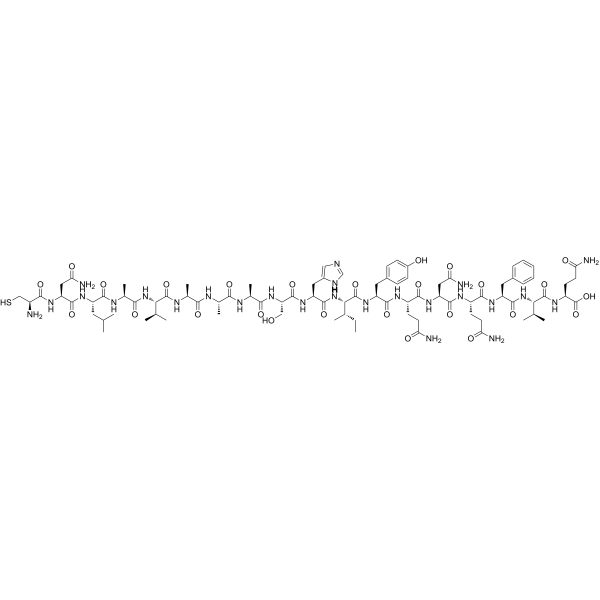 0 ImagesCat. No.: HY-P10183CAS No.: 143257-74-3Synonyms: Cys-CD36(139-155)CD36 Peptide P (139-155), Cys conjugated is a Cys labelled CD36 Peptide, and can inhibit the immunoadsorption of CD36 by OKM5.
-
PSB-18422
 0 ImagesCat. No.: HY-182724CAS No.: 2244978-64-9PSB-18422 is a GPR17 agonist, with an EC50 of 0.0279 μM for humans, 0.47 μM for rats, 0.753 μM for mice, and a human Ki of 1.46 μM. PSB-18422 triggers intracellular calcium mobilization via cross-species activation of GPR17. PSB-18422 can be used in the research of allergic bronchial inflammation.
-
Tumour-associated MUC1 epitope
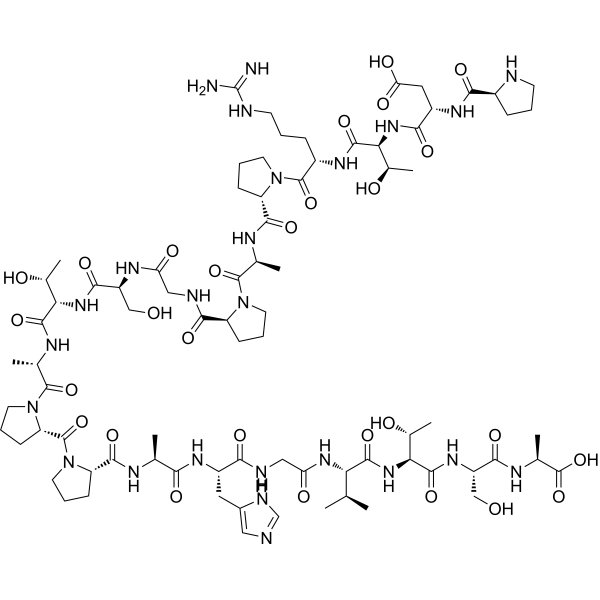 0 ImagesCat. No.: HY-P5472CAS No.: 129437-45-2Tumour-associated MUC1 epitope is a biological active peptide. (This sequence is the hallmark of MUC1 mucin. MUC1 is a highly glycosylated type I transmembrane glycoprotein with a unique extracellular domain consisting of a variable number of tandem repeats (VNTR) of this 20 amino acid peptide. It is overexpressed on the cell surface of many human adenocarcinomas and hematological malignancies, including multiple myeloma and B-cell lymphoma, making MUC1 broadly applicable target for immunotherapeutic strategies.)
-
Tyrosylprotein Sulfotransferase 2
 0 ImagesCat. No.: HY-E70190Synonyms: EC:2.8.2.20; TPST2Tyrosylprotein Sulfotransferase 2 (TPST-2) is a subtype of TPST. Tyrosylprotein Sulfotransferase is a 54- to 50-kDa integral membrane glycoprotein of the trans-Golgi network found in essentially all tissues investigated, catalyzing the tyrosine O-sulfation of soluble and membrane proteins passing through this compartment.
-
MBP (111-129)
 0 ImagesCat. No.: HY-P11127CAS No.: 178328-64-8MBP (111-129) is a polypeptide that constitutes an immunodominant epitope cluster restricted by HLA-DRB1*0401. MBP (111-129) is an antagonist for the clone HD4-1C2 TCR and an agonist for clone MS2-3C8 TCR. MBP (111-129) can be used for on multiple sclerosis and T cell biology.
-
AGEN-1571
 0 ImagesCat. No.: HY-P991305
-
Anti-Mouse TIM-1/CD365 Antibody (RMT1-10)
 0 ImagesCat. No.: HY-P991829Anti-Mouse TIM-1/CD365 Antibody (RMT1-10) reacts with mouse T cell immunoglobulin and mucin domain 1 (TIM-1). Anti-Mouse TIM-1/CD365 Antibody (RMT1-10) is effective in promoting allograft survival through blocking TIM-1. Recommend Isotype Controls: Rat IgG2a kappa, Isotype Control (HY-P990679).



