



Seldegamadlin
Based on 1 publication(s) in Google Scholar
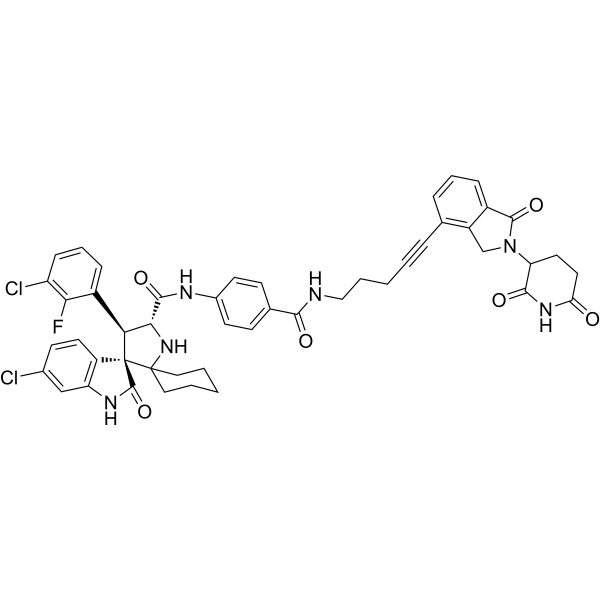
Seldegamadlin (KT-253) is a cereblon-recruiting PROTAC degrader of MDM2, with a DC50 of 0.4 nM. Seldegamadlin catalyzes the ubiquitination and proteasomal degradation of MDM2, disrupts the MDM2/p53 autoregulatory feedback loop, induces apoptosis, caspase activation and p53 target gene expression, and inhibits the growth of wild-type p53 hematologic tumor cells and solid tumor cells. Seldegamadlin is applicable for the research of acute myeloid leukemia, acute lymphoblastic leukemia, diffuse large B-cell lymphoma and wild-type p53 solid tumors.
(Pink: MDM-2/p53 ligand (HY-170452); Blue: Cereblon ligand (HY-163927); Black: linker (HY-W001478)).
Nur für Forschungszwecke. Wir verkaufen nicht an Patienten.
- Reinheit : 98.53%
- CAS. Nr.: 2713618-08-5
- Formel: C48H52Cl2FN7O6
- Molecular Weight:912.87
-
Speicherung:
4°C, protect from light
* In solvent : -80°C, 6 months; -20°C, 1 month (protect from light)


To place orders, for customer services and technical support, please contact: MedChemExpress USA
Tel: 609-228-6898 E-mail: [email protected] [email protected]


-
 Biologische Aktivität
-
Chemical Information
-
Lösungsmittel & Löslichkeit
- Protokoll
- Reinheit & Dokumentation
- Verweise
-
 Help & FAQs


Publications Citing Use of MedChemExpress (MCE) Seldegamadlin
MoreAlle PROTACs Isoform-spezifische Produkte anzeigen
More

Biologische Aktivität
Beschreibung
IC50 & Target
[1]|
MDM2 0.4 nM (DC50) |
Cellular Effect
|
Cell Line

|
Type | Value | Description | References |
|---|---|---|---|---|
| HEK-293T | DC50 |
0.4 nM
|
MDM2 degradation in HEK293T-HiBiT cells stably transfected with C-terminal HiBiT-tagged MDM2, measured via luciferase signal using the Nano-Glo HiBiT lytic detection system after 4 hours of incubation.
MDM2 degradation in HEK293T-HiBiT cells stably transfected with C-terminal HiBiT-tagged MDM2, measured via luciferase signal using the Nano-Glo HiBiT lytic detection system after 4 hours of incubation.
|
39648478 |
| RS4-11 | IC50 |
0.3 nM
|
Cell growth inhibition against human RS4;11 acute lymphoblastic leukemia cells.
Cell growth inhibition against human RS4;11 acute lymphoblastic leukemia cells.
|
39648478 |
| RS4-11 | EC50 |
0.05 nM
|
p53 stabilization in human RS4;11 acute lymphoblastic leukemia cells.
p53 stabilization in human RS4;11 acute lymphoblastic leukemia cells.
|
39648478 |
| RS4-11 | IC50 |
< 0.1 nM
|
Growth inhibition against p53 wild-type RS4;11 (B-cell ALL) cells.
Growth inhibition against p53 wild-type RS4;11 (B-cell ALL) cells.
|
39648478 |
| MV4-11 | IC50 |
0.04 nM
|
Growth inhibition against p53 wild-type MV4;11 (AML) cells.
Growth inhibition against p53 wild-type MV4;11 (AML) cells.
|
39648478 |
| OCI-LY19 | IC50 |
0.5 nM
|
Growth inhibition against p53 wild-type OCI-Ly19 (ABC-DLBCL) cells.
Growth inhibition against p53 wild-type OCI-Ly19 (ABC-DLBCL) cells.
|
39648478 |
| EOL1 | IC50 |
0.6 nM
|
Growth inhibition against p53 wild-type EOL-1 (AML) cells.
Growth inhibition against p53 wild-type EOL-1 (AML) cells.
|
39648478 |
| OCI-AML-5 | IC50 |
1.1 nM
|
Growth inhibition against p53 wild-type OCI-AML-5 (AML) cells.
Growth inhibition against p53 wild-type OCI-AML-5 (AML) cells.
|
39648478 |
| MOLM-13 | IC50 |
1.6 nM
|
Growth inhibition against p53 wild-type MOLM-13 (AML) cells.
Growth inhibition against p53 wild-type MOLM-13 (AML) cells.
|
39648478 |
| OCI-AML2 | IC50 |
> 10 nM
|
Growth inhibition against p53 wild-type OCI-AML-2 (AML) cells.
Growth inhibition against p53 wild-type OCI-AML-2 (AML) cells.
|
39648478 |
| OCI-AML-3 | IC50 |
> 100 nM
|
Growth inhibition against p53 wild-type OCI-AML-3 (AML) cells.
Growth inhibition against p53 wild-type OCI-AML-3 (AML) cells.
|
39648478 |
In Vitro
Seldegamadlin (20 nM; 2-8 h) selectively upregulates p53 and its downstream target proteins in RS4;11 acute lymphoblastic leukemia (ALL) cells without off-target degradation effects[1].
Seldegamadlin (1.8 nM; 2-4 h) degrades MDM2 to undetectable levels in RS4;11 ALL cells within 4 hours[1].
Seldegamadlin (150 nM; 15-60 min) induces an 84% knockdown of MDM2 at 15 minutes and a 91% degradation of MDM2 at 60 minutes in RS4;11 acute lymphoblastic leukemia (ALL) cells[1].
MDM2 inhibitor (0.01-10000 nM; 2 h) stabilizes p53 in RS4;11 acute lymphoblastic leukemia (ALL) cells, with an EC50 of 0.05 nM after 2 hours of treatment[1].
Seldegamadlin (0.1-10000 nM; 8 h) induces a dose-dependent upregulation of mRNA levels of p53 target genes in RS4;11 acute lymphoblastic leukemia (ALL) cells[1].
Seldegamadlin (0.1-10000 nM) exerts no growth inhibitory effect on hematologic tumor cell lines harboring mutant p53 (TMD8, THP-1, Kasumi-1, Kasumi-6, LP-1, MOLP-2)[1].
Seldegamadlin (0.01-1000 nM) inhibits the proliferation of RS4;11 acute lymphoblastic leukemia (ALL) cells, with an IC50 of 0.3 nM[1].
Seldegamadlin (1-1000 nM; 48 h) induces caspase-dependent apoptosis in RS4;11 acute lymphoblastic leukemia (ALL) cells within 48 hours[1].
Seldegamadlin (1-10000 nM; 96 h for growth inhibition; 48 h for apoptosis) induces potent growth inhibition and apoptosis in a variety of p53 wild-type hematologic and solid tumor cell lines[1].
Seldegamadlin (0.01-10 nM), when combined with 1.6 μM Venetoclax (HY-15531), enhances apoptosis of MOLM-13 acute myeloid leukemia (AML) cells and exerts maximal growth inhibition on MOLM-13 acute myeloid leukemia (AML) cells[1].
MedChemExpress (MCE) has not independently confirmed the accuracy of these methods. They are for reference only.
-
Cell Line:RS4;11 acute lymphoblastic leukemia (ALL) cells
-
Concentration:1.8 nM
-
Incubation Time:2, 4 h
-
Result:Reduced MDM2 protein levels to undetectable levels within 4 hours.
-
Cell Line:RS4;11 acute lymphoblastic leukemia (ALL) cells
-
Concentration:1, 10, 100, 1000 nM
-
Incubation Time:4 h
-
Result:Induced dose-dependent caspase 3/7 activation over 48 hours, with higher activation seen at higher concentrations.
-
Cell Line:RS4;11 acute lymphoblastic leukemia (ALL) cells
-
Concentration:0.1, 1, 10, 100, 1000 nM
-
Incubation Time:8 h
-
Result:Induced a dose-dependent increase in relative mRNA levels of p53 target genes (MDM2, GDF15, CDKN1A, GADD45A, TNFRSF10B, FAS, BBC3), with an approximate fourfold increase at 10 nM and eightfold or greater increase at 1000 nM.
-
Cell Line:RS4;11 acute lymphoblastic leukemia (ALL) cells, MV4;11 acute myeloid leukemia (AML) cells
-
Concentration:1, 10, 100, 1000 nM
-
Incubation Time:4 h
-
Result:Reduced S-phase cells to 0.97% in RS4;11 cells and 0.45% in MV4;11 cells.
Increased late apoptotic cells to 75.8% in RS4;11 cells and 62.1% in MV4;11 cells.
Decreased live cells to 17.1% in RS4;11 cells and 23.8% in MV4;11 cells.
-
Cell Line:Panel of p53 wild-type hematologic and solid tumor cell lines, p53 mutant cell lines
-
Concentration:0.1, 1, 10, 100, 1000 nM
-
Incubation Time:96 h (growth inhibition); 48 h (apoptosis)
-
Result:Induced potent growth inhibition (subnanomolar IC50 in multiple lines) and apoptosis in a wide range of p53 wild-type hematologic (AML, T-cell lymphoma, mantle cell lymphoma, diffuse large B-cell lymphoma) and solid tumor (prostate, brain, ovarian, soft tissue sarcoma, neuroblastoma, lung, colorectal) cell lines.
Showed no response in p53 mutant cell lines at concentrations up to 10000 nM.
In Vivo
Seldegamadlin (1-3 mg/kg; intravenous injection; single dose, once weekly for 3 weeks) induces persistent complete remission and prolongs survival in the MV4;11 AML xenograft model by activating the p53 pathway and inducing apoptosis[1].
Seldegamadlin (3 mg/kg; intravenous injection; single administration) induces durable complete remission and prolongs survival in the Venetoclax-resistant MOLM-13 acute myeloid leukemia xenograft model[1].
Seldegamadlin (1 mg/kg; once every 3 weeks; 3 doses total) induces complete remission in 1 of 4 acute myeloid leukemia (AML) patient-derived xenograft models, partial remission in another 2 models, and ultimately achieves significant tumor burden reduction in 3 of the 4 tested models[1].
Seldegamadlin (1-3 mg/kg; intravenous injection; once every 3 weeks) induces complete remission in a p53 wild-type activated B-cell subtype diffuse large B-cell lymphoma OCI-LY10 xenograft model[1].
Seldegamadlin (3 mg/kg; intravenous injection; once every 3 weeks) shows no efficacy in p53-mutant activated B-cell subtype diffuse large B-cell lymphoma TMD8 xenografts[1].
Seldegamadlin (0.3-1 mg/kg; intravenous or intraperitoneal injection; once weekly for 3 weeks, single administration) induces significantly higher expression of p53 target genes (TNFRSF10B, FAS, BBC3) in RS4;11 xenografts under the 1 mg/kg single-administration regimen compared with the exposure-matched 0.3 mg/kg once-weekly regimen for 3 weeks[1].
MedChemExpress (MCE) has not independently confirmed the accuracy of these methods. They are for reference only.
-
Animal Model:NOD-SCID (female, RS4;11 ALL cells implanted subcutaneously, tumors grown to ~400 mm3)[1]
-
Dosage:0.3, 1, 3 mg/kg
-
Administration:i.v.; single dose, once weekly for 3 weeks
-
Result:Induced sustained tumor regression and complete responses (3 mg/kg, 1 mg/kg single doses).
Induced transient stable disease (0.3 mg/kg weekly).
Caused MDM2 degradation in tumors.
-
Animal Model:Balb/c nude (female, MV4;11 AML cells implanted subcutaneously, tumors grown to ~300 mm3)[1]
-
Dosage:1, 3 mg/kg
-
Administration:i.v.; single dose, once weekly for 3 weeks
-
Result:Induced complete responses in 5 of 6 animals, with 4 of 6 remaining tumor-free for 6 months (3 mg/kg single dose).
Extended median survival to > 180 days (3 mg/kg single dose).
Induced transient stable disease (1 mg/kg weekly).
Drove robust upregulation of p53 and induction of cleaved caspase-3 in tumors (3 mg/kg single dose).
-
Animal Model:NOG (female, sublethally irradiated, injected intravenously with 2×10⁶ primary patient-derived AML blast samples)[1]
-
Dosage:1 mg/kg
-
Administration:i.v.; day 0 and day 42
-
Result:Achieved complete response with significant reduction in human CD45+ tumor burden in peripheral blood and bone marrow, and reduction in hCD34+ leukemic blasts in peripheral blood (CTG-2227 model).
Induced partial responses (CTG-2700 and CTG-2240 models).
Showed no response (CTG-2235 model).
-
Animal Model:NOD-SCID (female, MOLM-13 AML cells implanted subcutaneously)[1]
-
Dosage:3 mg/kg
-
Administration:i.v.;single dose
-
Result:Induced transient tumor regression (~7 days) as monotherapy.
Achieved durable complete responses in all 6 animals when combined with Venetoclax.
Extended median survival to > 150 days when combined with 1 week of Venetoclax co-administration.
-
Animal Model:Immunocompromised mice[1]
-
Dosage:1 mg/kg
-
Administration:every three weeks; 3 doses
-
Result:Produced a complete response in the CTG-2227 model.
Produced partial responses in the CTG-2240 and CTG-2700 models.
Showed no response in the CTG-2235 model.
-
Animal Model:Immunocompromised mice[1]
-
Dosage:1, 3 mg/kg
-
Administration:i.v.; every 3 weeks
-
Result:Induced a complete response, with tumor volumes remaining near baseline levels throughout the 35-day observation period.
-
Animal Model:Immunocompromised mice[1]
-
Dosage:3 mg/kg
-
Administration:i.v.; every 3 weeks
-
Result:Showed no efficacy, with tumor volumes progressing similarly to the vehicle control group over the 35-day observation period.
-
Animal Model:Immunocompromised mice[1]
-
Dosage:0.3 mg/kg (weekly regimen); 1 mg/kg (single dose)
-
Administration:i.v. or i.p.; once weekly; 3 weeks (0.3 mg/kg); i.v. or i.p.; single dose (1 mg/kg)
-
Result:Induced robust upregulation of p53 target genes.
Increased TNFRSF10B, FAS, BBC3 mRNA levels.
Induced weaker upregulation of p53 target genes.
Clinical Trial
| NCT Number | Sponsor | Condition | Start Date |
Phase
|
|---|---|---|---|---|
| NCT01329991 | 2011-05 | PHASE1 |


Chemical Information
-
CAS. Nr. 2713618-08-5
-
Appearance Solid
-
Molecular Weight 912.87
-
Formel C48H52Cl2FN7O6
-
Color White to off-white
-
SMILES
ClC1=CC2=C([C@]3(C4(CCCCC4)N[C@@H](C(N[C@H]5CC[C@H](C(N6CCC(C7=CC=C8C(N(C)C(N8C9CCC(NC9=O)=O)=O)=C7)CC6)=O)CC5)=O)[C@@H]3C%10=C(F)C(Cl)=CC=C%10)C(N2)=O)C=C1
-
Synonyms
KT-253
-
Versand
Room temperature in continental US; may vary elsewhere.
-
Speicherung
4°C, protect from light
* In solvent : -80°C, 6 months; -20°C, 1 month (protect from light)


Publications (1)
-
Journal Impact Factor
-
Most Recent
-
bioRxiv
Ferrous Iron Accumulation Is a Hallmark and Therapeutic Vulnerability of Therapy-Induced Senescence. [Abstract]2026 May 23:2026.05.20.726695. PMID: 42239384


Lösungsmittel & Löslichkeit
In Vitro:
DMSO : 95 mg/mL (104.07 mM; Need ultrasonic; Hygroscopic DMSO has a significant impact on the solubility of product, please use newly opened DMSO)
Please refer to the solubility information to select the appropriate solvent. Once prepared, please aliquot and store the solution to prevent product inactivation from repeated freeze-thaw cycles.
Storage method and period of stock solution: -80°C, 6 months; -20°C, 1 month (protect from light). When stored at -80°C, please use it within 6 months. When stored at -20°C, please use it within 1 month.
Please refer to the solubility information to select the appropriate solvent. Once prepared, please aliquot and store the solution to prevent product inactivation from repeated freeze-thaw cycles.
Storage method and period of stock solution: -80°C, 6 months; -20°C, 1 month (protect from light). When stored at -80°C, please use it within 6 months. When stored at -20°C, please use it within 1 month.
Konzentration (Stammlösung) × Volumen (Stammlösung) = Konzentration (Ziellösung) × Volumen (Ziellösung)


Reinheit & Dokumentation
-
Data Sheet (300 KB)
-
SDS (252 KB)
- English - EN (252 KB)
- Français - FR (252 KB)
- Deutsch - DE (252 KB)
- Norwegian - NO (252 KB)
- Español - ES (252 KB)
- Swedish - SV (252 KB)
- Italian - IT (252 KB)
- Korean - KR (252 KB)
- Portuguese - PT (252 KB)
-
Handling Instructions (2659 KB)
Verweise
[1]. Chutake YK, et al. KT-253, a Novel MDM2 Degrader and p53 Stabilizer, Has Superior Potency and Efficacy than MDM2 Small-Molecule Inhibitors. Molecular cancer therapeutics. 2025 Apr 02;24(4):497-510. [Content Brief]
[2]. Ji N, et al. Mdm2 degraders and uses thereof. WO2021188948A1. WIPO. 2021-09-23.


Complete Stock Solution Preparation Table
Please refer to the solubility information to select the appropriate solvent. Once prepared, please aliquot and store the solution to prevent product inactivation from repeated freeze-thaw cycles.
Storage method and period of stock solution: -80°C, 6 months; -20°C, 1 month (protect from light). When stored at -80°C, please use it within 6 months. When stored at -20°C, please use it within 1 month.
| Optional Solvent | Concentration Solvent Mass | 1 mg | 5 mg | 10 mg | 25 mg |
|---|---|---|---|---|---|
| DMSO | 1 mM | 1.0954 mL | 5.4772 mL | 10.9545 mL | 27.3862 mL |
| 5 mM | 0.2191 mL | 1.0954 mL | 2.1909 mL | 5.4772 mL | |
| 10 mM | 0.1095 mL | 0.5477 mL | 1.0954 mL | 2.7386 mL | |
| 15 mM | 0.0730 mL | 0.3651 mL | 0.7303 mL | 1.8257 mL | |
| 20 mM | 0.0548 mL | 0.2739 mL | 0.5477 mL | 1.3693 mL | |
| 25 mM | 0.0438 mL | 0.2191 mL | 0.4382 mL | 1.0954 mL | |
| 30 mM | 0.0365 mL | 0.1826 mL | 0.3651 mL | 0.9129 mL | |
| 40 mM | 0.0274 mL | 0.1369 mL | 0.2739 mL | 0.6847 mL | |
| 50 mM | 0.0219 mL | 0.1095 mL | 0.2191 mL | 0.5477 mL | |
| 60 mM | 0.0183 mL | 0.0913 mL | 0.1826 mL | 0.4564 mL | |
| 80 mM | 0.0137 mL | 0.0685 mL | 0.1369 mL | 0.3423 mL | |
| 100 mM | 0.0110 mL | 0.0548 mL | 0.1095 mL | 0.2739 mL |


Seldegamadlin Related Classifications
HY-170451 Related Classifications
 Powered by Bioz