



Alniditan
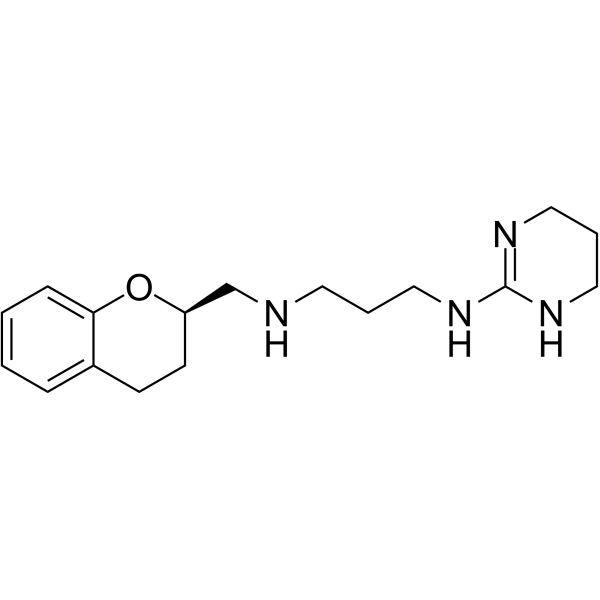
Alniditan (Alnitidan) is a potent 5-HT1B and 5-HT1D receptors agonist, with IC50s of 1.7 nM and 1.3 nM for h5-HT1B and h5-HT1D receptors in HEK293 cells, respectively. Alniditan has migraine-preventive effects.
Nos produits utilisent uniquement pour la recherche. Nous ne vendons pas aux patients.
- CAS No.: 152317-89-0
- Formule: C17H26N4O
- Masse moléculaire:302.41
-
Stockage:
Please store the product under the recommended conditions in the Certificate of Analysis.

To place orders, for customer services and technical support, please contact: MedChemExpress USA
Tel: 609-228-6898 E-mail: [email protected] [email protected]


-
 Activité biologique
-
Chemical Information
- Pureté et documentation
- Références
-
 Help & FAQs


Voir tous les produits spécifiques à Isoform 5-HT Receptor
More

Activité biologique
Description
IC50 & Target
[2]|
human 5-HT1B Receptor 1.7 nM (IC50, in HEK 293 cell) |
human 5-HT1D Receptor 1.3 nM (IC50, in HEK 293 cell) |
5-HT1B Receptor 0.9 nM (Kd) |
5-HT1D Receptor 1.2 nM (Kd) |
In Vitro
In vitro, Alniditan exhibits little vasoconstrictive effects on the rat basilar artery, although at a very high concentration 1 mM, Alniditan causes intensive constriction, most likely through a mechanism independent from 5-HT receptor activation[1].
MedChemExpress (MCE) has not independently confirmed the accuracy of these methods. They are for reference only.
In Vivo
MedChemExpress (MCE) has not independently confirmed the accuracy of these methods. They are for reference only.


Chemical Information
-
CAS No. 152317-89-0
-
Masse moléculaire 302.41
-
Formule C17H26N4O
-
SMILES
C1(NCCCNC[C@H]2CCC3=CC=CC=C3O2)=NCCCN1
-
Synonyms
Alnitidan
-
Livraison
Room temperature in continental US; may vary elsewhere.
-
Stockage
Please store the product under the recommended conditions in the Certificate of Analysis.


Pureté et documentation
Références
[1]. Limmroth V, et al. Effects of alniditan on neurogenic oedema in the rat dura mater and on contraction of rat basilar artery. Eur J Pharmacol. 1999 Oct 8;382(2):103-9. [Content Brief]
[2]. Lesage AS, et al. Agonistic properties of alniditan, sumatriptan and dihydroergotamine on human 5-HT1B and 5-HT1D receptors expressed in various mammalian cell lines. Br J Pharmacol. 1998 Apr;123(8):1655-65. [Content Brief]

Calculators
Concentration (start) × Volume (start) = Concentration (final) × Volume (final)


Alniditan Related Classifications
HY-101698 Related Classifications
 Powered by Bioz