



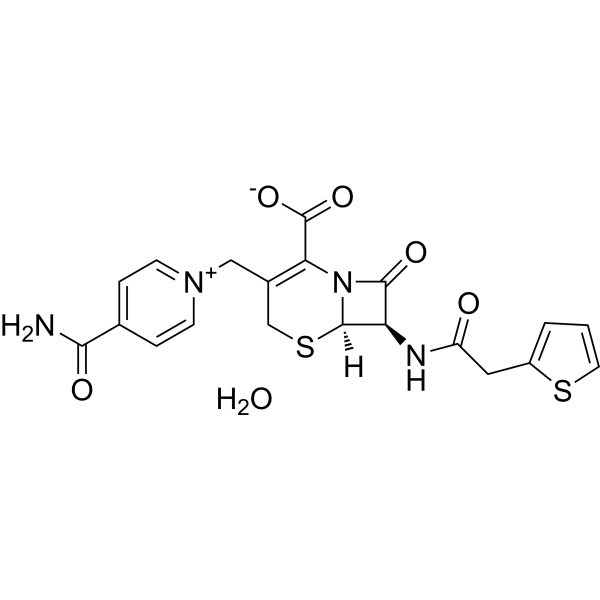
Cefalonium hydrate
Cefalonium hydrate is a first-generation cephalosporin bactericidal antimicrobial agent. Cefalonium hydrate can be used in studies related to bovine mastitis, Staphylococcus aureus-induced mastitis and intramammary infections.
Nur für Forschungszwecke. Wir verkaufen nicht an Patienten.
- CAS. Nr.: 1486466-27-6
- Formel: C20H20N4O6S2
- Molecular Weight:476.53
-
Speicherung:
Please store the product under the recommended conditions in the Certificate of Analysis.

To place orders, for customer services and technical support, please contact: MedChemExpress USA
Tel: 609-228-6898 E-mail: [email protected] [email protected]


-
 Biologische Aktivität
-
Chemical Information
- Protokoll
- Reinheit & Dokumentation
- Verweise
-
 Help & FAQs


Alle Antibiotic Isoform-spezifische Produkte anzeigen
More

Biologische Aktivität
Beschreibung
In Vitro
Cefalonium (0.031-32 µg/mL; 20 h) hydrate inhibits Staphylococcus aureus isolates from bovine mastitis with a mode MIC of 0.125 µg/mL and an epidemiological cut-off value of ≤ 0.5 µg/mL[1].
Cefalonium (10 µg per disk, 30 µg per disk; 18 h) hydrate produces zone diameters that correlate significantly with Cefalonium MIC50s for Staphylococcus aureus isolates from bovine mastitis, with epidemiological cut-off values of ≥ 22 mm and ≥ 29 mm, respectively[1].
Cefalonium (16-20 h) hydrate potently inhibits the bovine mastitis isolate S. aureus Newbould 305 in vitro with an MIC of 0.06 μg/mL, and shows consistent activity against 330 global bovine mastitis S. aureus strains with an MIC50 of 0.08 μg/mL[2].
MedChemExpress (MCE) has not independently confirmed the accuracy of these methods. They are for reference only. Further protocols information, click here.
In Vivo
Cefalonium (single intramammary syringe dose; intramammary infusion; single dose; at drying off) hydrate alone results in a 7.3% incidence of new intramammary infections at calving across all dry period lengths, with efficacy declining to an 11.4% new infection rate at calving for cows with dry periods of 10 weeks or longer; the total incidence of mammary gland inflammation in the first 100 days of lactation is not significantly different from the comparison group[3].
MedChemExpress (MCE) has not independently confirmed the accuracy of these methods. They are for reference only.
-
Animal Model:CD-1 (female, 12-14 days post-offspring birth, ~50 g, lactating, mastitis model induced by intramammary injection of Staphylococcus aureus Newbould 305)[2]
-
Dosage:200 μg/gland; 400 μg/gland; 800 μg/gland
-
Administration:i.mam.; single dose
-
Result:Reduced mean bacterial load to 3.09 log10 CFU/g gland and resulted in 0% of glands cleared at 200 μg/gland.
Reduced mean bacterial load to 3.01 log10 CFU/g gland and resulted in 75% of glands cleared at 400 μg/gland; in a confirmatory study, reduced mean bacterial load to 1.70 log10 CFU/g gland and resulted in 100% of glands cleared at 400 μg/gland.
Reduced mean bacterial load to 3.00 log10 CFU/g gland and resulted in 100% of glands cleared at 800 μg/gland.
Achieved an ED2log10 of 27 μg/gland, ED4log10 of 105 μg/gland, PD50 of 362 μg/gland, and PD100 of 800 μg/gland.
-
Animal Model:Dairy cows (Institute for Animal Health research herd, managed on commercial lines; dried off abruptly at end of lactation, under natural exposure to intramammary infection pathogens)[3]
-
Dosage:single intramammary syringe dose
-
Administration:intramammary infusion; single dose; at drying off
-
Result:Resulted in a 7.3% incidence of new intramammary infections at calving across all dry period lengths.
Resulted in a 6% incidence of new intramammary infections at calving for cows with a dry period of <10 weeks.
Resulted in an 11.4% incidence of new intramammary infections at calving for cows with a dry period of ≥10 weeks.
Was associated with 15 total cases of mammary gland inflammation in the first 100 days of lactation for quarters infected at calving.
Resulted in 36 total cases of mammary gland inflammation in the first 100 days of lactation, with no significant difference compared to the comparison group.


Chemical Information
-
CAS. Nr. 1486466-27-6
-
Molecular Weight 476.53
-
Formel C20H20N4O6S2
-
SMILES
O=C(N[C@H]1[C@@]2([H])SCC(C[N+]3=CC=C(C(N)=O)C=C3)=C(C([O-])=O)N2C1=O)CC4=CC=CS4.O
-
Versand
Room temperature in continental US; may vary elsewhere.
-
Speicherung
Please store the product under the recommended conditions in the Certificate of Analysis.

Protokoll
-
Research Protocol for Infectious Diseases
Infectious-disease experiments test how pathogens interact with host barriers, innate immune receptors, inflammatory signaling, pathogen replication, and tissue injury; pattern-recognition receptors such as TLRs, RIG-I-like receptors, NOD-like receptors, and inflammasomes detect microbial molecules and activate NF-κB, interferon, and cytokine responses. The central hypothesis is that infection severity reflects the balance between pathogen burden and host response: protective inflammation restricts pathogen growth, whereas excessive or mislocalized inflammation contributes to tissue damage and disease phenotype. Unresolved questions include which host pathways are protective versus pathogenic, why some infection models fail to translate to human disease, and which combined readouts best predict clinically relevant infection outcomes.


Reinheit & Dokumentation
Verweise
[1]. Harada K, et al. Assessment of the Usefulness of Cefapirin and Cefalonium Disks for Susceptibility Testing of Staphylococcus aureus Isolates from Bovine Mastitis. Antibiotics (Basel). 2020 Apr 21;9(4):197. [Content Brief]
[2]. Demon D, et al. The intramammary efficacy of first generation cephalosporins against Staphylococcus aureus mastitis in mice. Veterinary microbiology. 2012 Nov 09;160(1-2):141-50. [Content Brief]
[3]. Berry EA, et al. Effect of an intramammary teat seal and dry cow antibiotic in relation to dry period length on postpartum mastitis. Journal of dairy science. 2007 Feb;90(2):760-5. [Content Brief]

Calculators
Konzentration (Stammlösung) × Volumen (Stammlösung) = Konzentration (Ziellösung) × Volumen (Ziellösung)


Cefalonium hydrate Related Classifications
HY-B1252A Related Classifications
 Powered by Bioz