



Osteosarcoma
-
Osteosarcoma (32)

- 1
- 2

- Formula: C41H44N4O14
- Molecular Weight: 816.81
Faridoxorubicin (AVA-6000) is a FAP-activated chemotherapeutic prodrug. Faridoxorubicin undergoes selective hydrolysis by FAP, while it is resistant to cleavage by related mammalian peptidases and members of the DASH subfamily. Faridoxorubicin acts as a tumor growth inhibitor, reducing tumor volume and prolonging survival in in vivo models and PDX models with high FAP expression. Faridoxorubicin can be used in the research of osteosarcoma and sarcoma.

- Formula: C79H105N17O15
- Molecular Weight: 1532.78
Ac-HFKLYWPPFLGS-NH2 is a RMI1/2 heterodimer inhibitor with an IC50 of 99 nM and antiproliferative activity. Ac-HFKLYWPPFLGS-NH2 binds competitively at the FANCM-RMI interaction interface, mimics native FANCM MM2 domain hydrophobic interactions, and adopts a unique binding pose with additional protein interactions. Ac-HFKLYWPPFLGS-NH2 induces antiproliferative effects in ALT-positive osteosarcoma cells. Ac-HFKLYWPPFLGS-NH2 shows limited stability toward α-chymotrypsin-mediated enzymatic degradation in vitro. Ac-HFKLYWPPFLGS-NH2 lacks inherent cell permeability, requiring conjugation to a cell-penetrating peptide for intracellular delivery. Ac-HFKLYWPPFLGS-NH2 can be used for the research of ALT-positive osteosarcoma.

- Formula: C145H199N39O25
- Molecular Weight: 2888.38
tP4-CPP12 is a RMI1/2 heterodimer inhibitor with an IC50 of 110 nM. tP4-CPP12 binds competitively at the FANCM-RMI interaction site and disrupts endogenous FANCM-RMI protein-protein interactions. tP4-CPP12 induces antiproliferative effects in ALT-positive osteosarcoma cells. tP4-CPP12 is applicable for the research of ALT-positive osteosarcoma.

- Formula: C22H22ClFN2O2
- Molecular Weight: 400.87
β-actin-IN-1 is a selective and covalent β-actin polymerization inhibitor. β-actin-IN-1 targets Cys272 of β-actin and shows selectivity over α-actin and γ-actin. β-actin-IN-1 inhibits β-actin polymerization and disrupts the actin cytoskeleton in cancer cells, leading to cell migration inhibition as well as cell death. β-actin-IN-1 can be used for the study of osteosarcoma.

- Formula: C40H56O5
- Molecular Weight: 616.87
Fucoxanthinol, a carotenoid, is a deacetylated Fucoxanthin (HY-N2302) metabolite with oral activity, and inhibits rat pancreatic lipase with an IC50 of 764 nM. Fucoxanthinol reduces expression of Bcl-2, Bcl-xL, survivin, XIAP, cIAP2, cyclin D1, cyclin D2, cyclin E, CDK4, CDK6, β-catenin, JunD, PPARγ, and induces GADD45α expression. Fucoxanthinol activates caspase-3, caspase-8, caspase-9, Nrf2/Keap1/ARE pathway, and inhibits activation of Akt, NF-κB, AP-1, PDPK1, GSK3β phosphorylation. Fucoxanthinol induces apoptosis, G0/G1 cell cycle arrest, inhibits cancer cell viability, proliferation, migration, invasiveness, tumour growth, adipocyte differentiation, oxidative stress, neurotoxicity, triglyceride absorption, angiogenesis, and obesity-induced inflammation. Fucoxanthinol can be used for the research of osteosarcoma, leukemia, lymphoma, adult T-cell leukemia, prostate cancer, colon cancer, breast cancer, hypertriglyceridaemia, Alzheimer’s disease, Parkinson’s disease, obesity, insulin resistance, malignant melanoma, and type II diabetes.

- Formula: C22H24O7
- Molecular Weight: 400.43
GO-Y078 is a curcumin (HY-N0005) analog. GO-Y078 activates p38/JNK1/2. GO-Y078 activates the MAPK pathway, Caspase 3/8/9, PARP, AP-1, DR5, and TP53, while inhibiting cIAP-1, XIAP, and NF-κB. GO-Y078 induces sub-G1/G2/M phase arrest and Apoptosis. GO-Y078 impairs angiogenesis. GO-Y078 can be used in research related to osteosarcoma, cervical cancer, oral squamous cell carcinoma, and peritoneal metastasis of gastric cancer.

- Formula: C20H18Cl2F3N7O2
- Molecular Weight: 516.31
PF-4942847 is an orally active HSP90 inhibitor with an IC50 of approximately 50 nM. PF-4942847 induces apoptosis in osteosarcoma cells, increases the proportion of cells in the sub-G1 phase and PARP cleavage, reduces the expression of Akt, Erk, MYC, c-MET and STAT-3, and regulates HSP expression. PF-4942847 can be used in studies related to osteosarcoma and HSP90.
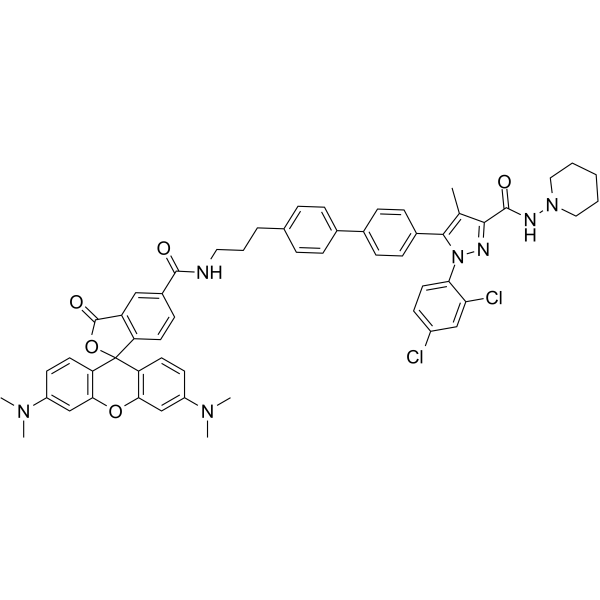
- Formula: C56H53Cl2N7O5
- Molecular Weight: 974.97
Tocrifluor 1117 is a selective GPR55 ligand and fluorescent probe. Tocrifluor 1117 shows extremely low affinity for mouse CB1 receptors (Ki >1000 nM) and only weakly displaces CB1 agonists. Tocrifluor 1117 specifically activates GPR55 to trigger intracellular calcium oscillations, and binds to vascular smooth muscle, endothelial and adventitial cells; all these binding effects are inhibited by pretreatment with unlabeled AM251 or O1602. Tocrifluor 1117 can clearly visualize the distribution of GPR55 in vascular tissues via confocal microscopy, while its uptake in cancer cells is completely dependent on GPR55 expression.

- Formula: C27H28ClN7O2S
- Molecular Weight: 550.07
CX-5461 hydrochloride is a selective, orally active RNA polymerase I inhibitor. CX-5461 hydrochloride disrupts the formation of the SL1-rDNA complex, thereby blocking the transcription initiation of ribosomal RNA without altering the activity of RNA polymerase II, DNA replication, or protein translation processes. CX-5461 hydrochloride upregulates the expression of p21, MDM2, Sestrin1/2, and phosphorylated AMPKα, and reduces the level of phosphorylated Akt. CX-5461 hydrochloride induces G2/G2/M cell cycle arrest, Autophagy, Apoptosis, and cellular senescence, and activates CHK1, CHK2, and RPA. CX-5461 hydrochloride can be used in research related to osteosarcoma, cervical cancer, hematologic malignancies, high-grade serous ovarian cancer, and solid tumors.

- Formula: C₂₇H₂₇N₇O₂S
- Molecular Weight: 513.61
CX-5461 (Standard) is the analytical standard of CX-5461 (HY-13323). This product is intended for research and analytical applications. CX-5461 is a selective, orally active RNA polymerase I inhibitor. CX-5461 disrupts the formation of the SL1-rDNA complex, thereby blocking the transcription initiation of ribosomal RNA without altering the activity of RNA polymerase II, DNA replication, or protein translation processes. CX-5461 upregulates the expression of p21, MDM2, Sestrin1/2, and phosphorylated AMPKα, and reduces the level of phosphorylated Akt. CX-5461 induces G2/G2/M cell cycle arrest, Autophagy, Apoptosis, and cellular senescence, and activates CHK1, CHK2, and RPA. CX-5461 can be used in research related to osteosarcoma, cervical cancer, hematologic malignancies, high-grade serous ovarian cancer, and solid tumors.

- Formula: C18H21Cl2N5O
- Molecular Weight: 394.30
GDC-0425 hydrochloride (RG-7602 hydrochloride) is an orally active, highly selective ChK1 inhibitor. GDC-0425 hydrochloride abrogates cell cycle arrest and inhibits genomic repair. GDC-0425 hydrochloride potently suppresses Gemcitabine (HY-17026)-induced pCDK1/2 expression. GDC-0425 hydrochloride can be used in research related to osteosarcoma, ovarian cancer, basal (triple-negative) breast cancer, and colorectal cancer.

- Formula: C31H29Cl2F2N3O4
- Molecular Weight: 616.48
Idasanutlin (Standard) (RG7388 (Standard)) is the analytical standard of Idasanutlin (HY-15676). This product is intended for research and analytical applications. Idasanutlin (RG7388) is an orally bioavailable MDM2 inhibitor with an IC50 of 6 nM. Idasanutlin disrupts MDM2-p53 binding, stabilizes and activates p53, triggering cell cycle arrest, apoptosis, and reduced cancer cell viability. Idasanutlin reduces EGFR protein expression and phosphorylation, suppresses downstream SHP2, MEK1/2, ERK1/2, AKT, mTOR, p70(S6K1), and S6 signaling. Idasanutlin induces mitochondrial ROS production, drives p38 MAPK phosphorylation, upregulates NOXA, and mediates caspase-3-dependent apoptosis and gasdermin E-mediated pyroptosis. Idasanutlin can be used for the research of TP53-mutant non-small cell lung cancer, T-cell acute lymphoblastic leukemia, colorectal carcinoma, melanoma, diffuse large B-cell lymphoma, mantle cell lymphoma, non-Hodgkin lymphoma, severe fever with thrombocytopenia syndrome, neuroblastoma, acute lymphoblastic leukemia, relapsed or refractory acute myeloid leukemia, osteosarcoma, solid tumors, and hematological tumors.
- 1
- 2



