



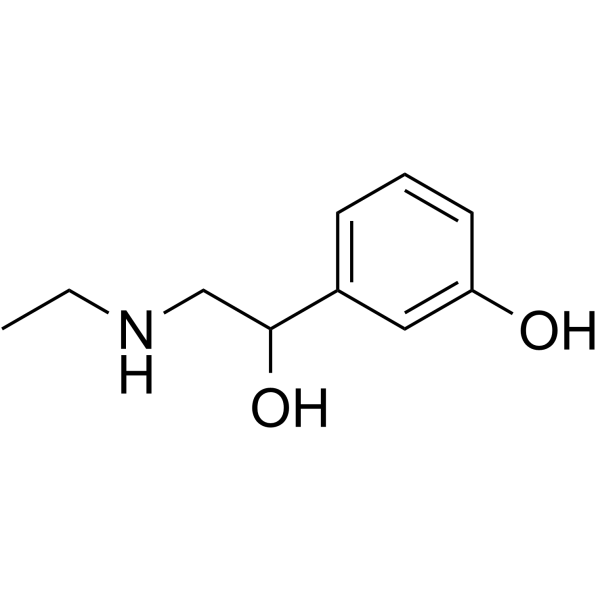
Etilefrine

Based on 1 Customer Validation
Etilefrine is a sympathetic nerve agonist and AMPK activator that selectively targets α1/β1 adrenergic receptors. Etilefrine stimulates α1 adrenergic receptors, leading to contraction of vascular smooth muscle and increased peripheral resistance. Etilefrine also stimulates β1 receptors to enhance myocardial contractility and increase heart rate, thereby increasing blood pressure and improving cardiac output. Etilefrine also bidirectionally regulates the AMPK/Akt pathway and modulates the phosphorylation levels. Etilefrine can be used in cardiovascular research, such as postural hypotension, chylothorax, and improving low cardiac output.
연구목적의 판매만을 진행합니다. 환자를 대상으로 한 판매는 하지 않습니다.
- Purity : 98.80%
- CAS No.: 709-55-7
- 화학식: C10H15NO2
- 분자량:181.23
-
보관:Powder -20°C, 3 years , 4°C, 2 years ; In solvent -80°C, 6 months , -20°C, 1 month

To place orders, for customer services and technical support, please contact: MedChemExpress USA
Tel: 609-228-6898 E-mail: [email protected] [email protected]


-
 Biological Activity
-
Chemical Information
-
용액&용해도
- Protocol
- 순도&문서
- References
-
 Help & FAQs




Biological Activity
제품 설명
IC50 & Target
|
AMPK |
In Vitro
Etilefrine (10 μM; 1-2 h) significantly activates AMPKα (Thr172) phosphorylation and inhibits Akt (Ser473) phosphorylation in PC-3 and 293T cells[1].
MedChemExpress (MCE) has not independently confirmed the accuracy of these methods. They are for reference only.
-
Cell Line:PC-3 (human prostate cancer), 293T (human embryonic kidney)
-
Concentration:5, 10, 50 μM
-
Incubation Time:1 h or 2 h
-
Result:Increased phosphorylated AMPKα (Thr172) by 1.5-2.0 fold and decreased phosphorylated Akt (Ser473) by 0.2-0.4 fold compared to controls, indicating AMPK activation and Akt inhibition in both cell lines.
In Vivo
Etilefrine (50 μg/kg, 200 μg/kg; intravenous injection; single dose) can increase cardiac output, right heart filling pressure and blood pressure at rest and reduce total peripheral resistance in New Zealand white rabbit experimental models. Total peripheral resistance increased at a dose of 200 μg/kg[3].
MedChemExpress (MCE) has not independently confirmed the accuracy of these methods. They are for reference only.
-
Animal Model:New Zealand white rabbits (male, 3.0-4.1 kg), resting cardiovascular function model[3]
-
Dosage:50 μg/kg, 200 μg/kg Etilefrine
-
Administration:Intravenous injection, single dose, acute experiment
-
Result:At 50 μg/kg, increased right heart filling pressure (RHFP), cardiac output (CO), and blood pressure (BP), reduced total peripheral resistance (TPR), and caused bradycardia.
At 200 μg/kg, it increased RHFP, BP, and TPR, while CO showed a minor decrease, indicating mixed α and β adrenoceptor-mediated effects.
-
Animal Model:Anesthetized mongrel dogs (8.5-14 kg), postural hypotension model induced by hexamethonium and 30° tilt[2]
-
Dosage:0.1 mg/kg Etilefrine
-
Administration:Intravenous injection, single dose, acute experiment
-
Result:Significantly increased basal blood pressure (BP) and heart rate (HR). During tilt, it did not attenuate the decrease in systolic, diastolic, or mean BP, but tended to increase cardiac output (CO) without significant attenuation of tilt-induced CO reduction.
Clinical Trial
| NCT Number | Sponsor | Condition | Start Date |
Phase

|
|---|---|---|---|---|
| NCT01329991 | 2011-05 | PHASE1 |


Chemical Information
-
CAS No. 709-55-7
-
Appearance Solid
-
분자량 181.23
-
화학식 C10H15NO2
-
Color Off-white to pink
-
SMILES
OC(CNCC)C1=CC=CC(O)=C1
-
선적
Room temperature in continental US; may vary elsewhere.
-
보관
Powder -20°C 3 years 4°C 2 years In solvent -80°C 6 months -20°C 1 month


용액&용해도
In Vitro:
DMSO : 40 mg/mL (220.71 mM; Need ultrasonic; Hygroscopic DMSO has a significant impact on the solubility of product, please use newly opened DMSO)
Please refer to the solubility information to select the appropriate solvent. Once prepared, please aliquot and store the solution to prevent product inactivation from repeated freeze-thaw cycles.
Storage method and period of stock solution: -80°C, 6 months; -20°C, 1 month. When stored at -80°C, please use it within 6 months. When stored at -20°C, please use it within 1 month.
Please refer to the solubility information to select the appropriate solvent. Once prepared, please aliquot and store the solution to prevent product inactivation from repeated freeze-thaw cycles.
Storage method and period of stock solution: -80°C, 6 months; -20°C, 1 month. When stored at -80°C, please use it within 6 months. When stored at -20°C, please use it within 1 month.
Concentration (start) × Volume (start) = Concentration (final) × Volume (final)
In Vivo:
Select the appropriate dissolution method based on your experimental animal and administration route.
- For the following dissolution methods, please ensure to first prepare a clear stock solution using an In Vitro approach and then sequentially add co-solvents:
- To ensure reliable experimental results, the clarified stock solution can be appropriately stored based on storage conditions. As for the working solution for In Vivo experiments, it is recommended to prepare freshly and use it on the same day.
- The percentages shown for the solvents indicate their volumetric ratio in the final prepared solution. If precipitation or phase separation occurs during preparation, heat and/or sonication can be used to aid dissolution.
Add each solvent one by one: 10% DMSO 40% PEG300 5% Tween-80 45% Saline
Solubility: ≥ 4 mg/mL (22.07 mM); Clear solution
This protocol yields a clear solution of ≥ 4 mg/mL (saturation unknown).
Taking 1 mL working solution as an example, add 100 μL DMSO stock solution (40.0 mg/mL) to 400 μL PEG300, and mix evenly; then add 50 μL Tween-80 and mix evenly; then add 450 μL Saline to adjust the volume to 1 mL.
Preparation of Saline: Dissolve 0.9 g sodium chloride in ddH₂O and dilute to 100 mL to obtain a clear Saline solution.
Add each solvent one by one: 10% DMSO 90% (20% SBE-β-CD in Saline)
Solubility: ≥ 4 mg/mL (22.07 mM); Clear solution
This protocol yields a clear solution of ≥ 4 mg/mL (saturation unknown).
Taking 1 mL working solution as an example, add 100 μL DMSO stock solution (40.0 mg/mL) to 900 μL 20% SBE-β-CD in Saline, and mix evenly.
Preparation of 20% SBE-β-CD in Saline (4°C, storage for one week): 2 g SBE-β-CD powder is dissolved in 10 mL Saline, completely dissolve until clear.
In Vivo Dissolution Calculator
Please enter the basic information of animal experiments:
-
-
-
-
Recommended: Prepare an additional quantity of animals to account for potential losses during experiments.
Please enter your animal formula composition:
-
%DMSO +
Recommended: Keep the proportion of DMSO in working solution below 2% if your animal is weak.
-
%+
-
+%Tween-80 + +
-
%Saline +
The co-solvents required include: DMSO, . All of co-solvents are available by MedChemExpress (MCE). , Tween 80. All of co-solvents are available by MedChemExpress (MCE).
Working solution concentration: 0.22 mg/mL
Method for preparing stock solution: mg drug dissolved in μL DMSO. Stock solution concentration: mg/mL.
1. Take μL DMSO stock solution;
2. Add μL .
μL , mix evenly;
3. Then add μL Tween 80, mix evenly;
4. Then add μL
Please ensure that the stock solution in the first step is dissolved to a clear state, and add co-solvents in sequence. You can use ultrasonic heating (ultrasonic cleaner, recommended frequency 20-40 kHz), vortexing, etc. to assist dissolution.


순도&문서
-
Data Sheet (283 KB)
-
SDS (396 KB)
- English - EN (396 KB)
- Français - FR (396 KB)
- Deutsch - DE (396 KB)
- Norwegian - NO (396 KB)
- Español - ES (396 KB)
- Swedish - SV (396 KB)
- Italian - IT (396 KB)
- Korean - KR (396 KB)
- Portuguese - PT (396 KB)
-
Handling Instructions (2659 KB)
References
[1]. Chi Xu, et al. Accurate Drug Repositioning through Non-tissue-Specific Core Signatures from Cancer Transcriptomes. Cell Rep. 2018 Oct 9;25(2):523-535.e5. [Content Brief]
[2]. R Yamazaki, et al. Effects of dihydroergotamine and Etilefrine on experimentally-induced postural hypotension in dogs. J Pharmacobiodyn. 1990 Sep;13(9):519-24. [Content Brief]
[3]. Adigun SA, et al. A comparison of the effects of salbutamol, etilefrine and dextran during hypotension and low cardiac output states in rabbit. Clin Exp Pharmacol Physiol. 1984 Nov-Dec;11(6):627-43. [Content Brief]


Complete Stock Solution Preparation Table
Please refer to the solubility information to select the appropriate solvent. Once prepared, please aliquot and store the solution to prevent product inactivation from repeated freeze-thaw cycles.
Storage method and period of stock solution: -80°C, 6 months; -20°C, 1 month. When stored at -80°C, please use it within 6 months. When stored at -20°C, please use it within 1 month.
| Optional Solvent | Concentration Solvent Mass | 1 mg | 5 mg | 10 mg | 25 mg |
|---|---|---|---|---|---|
| DMSO | 1 mM | 5.5179 mL | 27.5893 mL | 55.1785 mL | 137.9463 mL |
| 5 mM | 1.1036 mL | 5.5179 mL | 11.0357 mL | 27.5893 mL | |
| 10 mM | 0.5518 mL | 2.7589 mL | 5.5179 mL | 13.7946 mL | |
| 15 mM | 0.3679 mL | 1.8393 mL | 3.6786 mL | 9.1964 mL | |
| 20 mM | 0.2759 mL | 1.3795 mL | 2.7589 mL | 6.8973 mL | |
| 25 mM | 0.2207 mL | 1.1036 mL | 2.2071 mL | 5.5179 mL | |
| 30 mM | 0.1839 mL | 0.9196 mL | 1.8393 mL | 4.5982 mL | |
| 40 mM | 0.1379 mL | 0.6897 mL | 1.3795 mL | 3.4487 mL | |
| 50 mM | 0.1104 mL | 0.5518 mL | 1.1036 mL | 2.7589 mL | |
| 60 mM | 0.0920 mL | 0.4598 mL | 0.9196 mL | 2.2991 mL | |
| 80 mM | 0.0690 mL | 0.3449 mL | 0.6897 mL | 1.7243 mL | |
| 100 mM | 0.0552 mL | 0.2759 mL | 0.5518 mL | 1.3795 mL |


Etilefrine Related Classifications
HY-A0144 Related Classifications
 Powered by Bioz