



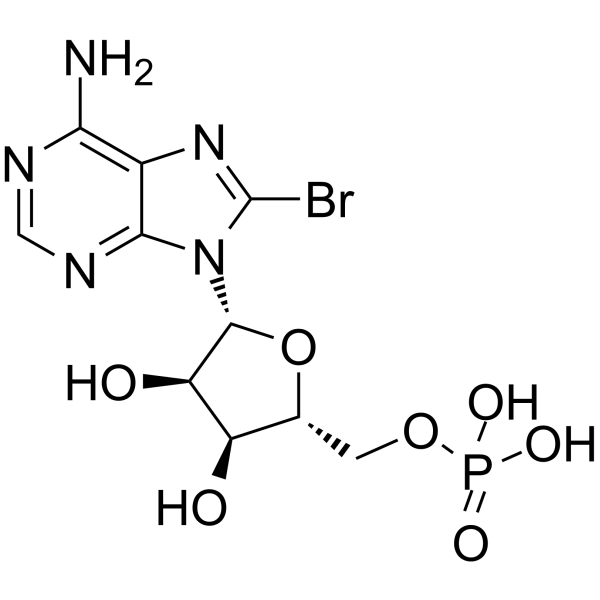
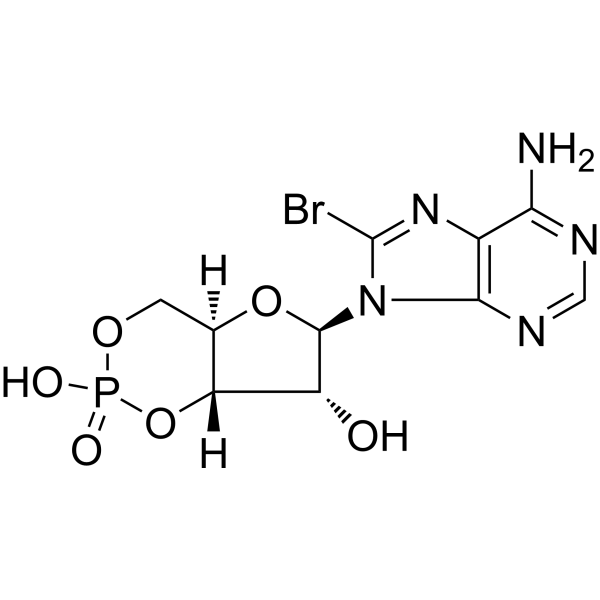
8-Bromo-AMP
Based on 1 publication(s) in Google Scholar
8-Bromo-AMP (8-Bromoadenosine 5'-monophosphate) is an AMP analog. 8-Bromo-AMP inhibits ADP-dependent glucokinase (ADPGK). 8-Bromo-AMP competitively inhibits ADPGK by binding to the nucleotide-binding site, inducing conformational changes, and acting on catalytic residues. 8-Bromo-AMP non-competitively inhibits rat adenylate kinase isozymes AK-M, AK II, and AK III. 8-Bromo-AMP inhibits T cell activation-induced ROS production and ROS-dependent IL-2 and IκB expression. 8-Bromo-AMP is used in research on cancer and myocardial ischemia-reperfusion injury.
商品は「研究用試薬」です。人や動物の医療用・臨床診断用・食品用の製品ではありません。
研究用途以外に使用した場合、当社は一切の責任を負いかねます。
- 純度 : 98.78%
- CAS 番号: 23567-96-6
- 分子式: C10H13BrN5O7P
- 分子量:426.12
-
保管条件:Powder -20°C, 3 years ; In solvent -80°C, 6 months , -20°C, 1 month

To place orders, for customer services and technical support, please contact: MedChemExpress USA
Tel: 609-228-6898 E-mail: [email protected] [email protected]


-
 生物活性
生物活性
-
化学情報
-
溶剤 & 溶解度
- プロトコル
- 純度とドキュメンテーション
- 参考文献
-
 Help & FAQs


MedChemExpress(MCE)の使用を引用している文献 8-Bromo-AMP
MoreAMPK アイソフォーム固有の製品をすべて表示
More

生物活性
製品説明
IC50 & Target
[1]|
ADPGK |
IL-2 |
IκB |
体外実験
8-Bromo-AMP (8-Br-AMP) (1 mM) is a competitive inhibitor of hADPGK with a Ki of 270 μM[1].
8-Bromo-AMP is a competitive inhibitor of phADPGK with a Ki of 160 μM[1].
8-Bromo-AMP binds to wild-type phADPGK, phADPGK F272A, and hADPGK with Kd values of 16.85 μM, 17.44 μM, and 16.55 μM, respectively[1].
8-Bromo-AMP (20 h) enhances β-adrenoceptor acquisition in primary rat hepatocyte cultures with an EC50 of 47 μM[3].
8-Bromo-AMP (30°C) competitively inhibits wheat seedling leaf 5'(3')-ribonucleotide phosphohydrolase with an apparent Ki of 9.1 μM[4].
8-Bromo-AMP (24 h) almost completely inhibits PB-induced PBREM transactivation in the mouse liver[6].
8-Bromo-AMP significantly attenuates PB-induced Cyp2b10 gene expression in the mouse liver[6].
8-Bromo-AMP (8-Br-AMP) (10-100 μM) stimulates tracheary-element differentiation in Zinnia elegans mesophyll cell cultures in the absence of inductive concentrations of cytokinin[9].
8-Bromo-AMP (25-100 μM; 30 min) dose-dependently reduces PMA-triggered ROS generation in Jurkat T cells, with 100 μM decreasing ROS to approximately half of the initial value[1].
8-Bromo-AMP (25-100 μM; 30 min) decreases PMA (Phorbol 12-myristate 13-acetate) (HY-18739)/Ionomycin (HY-13434)-induced expression of IL-2 and IκB in Jurkat T cells[1].
MedChemExpress (MCE) has not independently confirmed the accuracy of these methods. They are for reference only. Further protocols information, click here.
-
Cell Line:Jurkat T cells
-
Concentration:25 μM; 50 μM; 100 μM
-
Incubation Time:30 min
-
Result:Reduced the expression of IL-2 and IκB in PMA/ionomycin-induced Jurkat T cells.
体内実験
MedChemExpress (MCE) has not independently confirmed the accuracy of these methods. They are for reference only.
-
Animal Model:
-
Dosage:20 mg/kg
-
Administration:i.p.; single injection
-
Result:Almost completely inhibited the PB-induced increase in PBREM reporter gene activity.
Significantly attenuated the induction of Cyp2b gene expression by PB.


化学情報
-
CAS 番号 23567-96-6
-
性状 Solid
-
分子量 426.12
-
分子式 C10H13BrN5O7P
-
Color White to off-white
-
SMILES
O=P(O)(OC[C@@H]1[C@H]([C@H]([C@H](N2C(Br)=NC3=C(N=CN=C32)N)O1)O)O)O
-
別名
8-Bromoadenosine 5'-monophosphate; 8-Bromoadenylic acid
-
輸送条件
Room temperature in continental US; may vary elsewhere.
-
保管条件
Powder -20°C 3 years In solvent -80°C 6 months -20°C 1 month


Publications (1)
-
Journal Impact Factor
-
Most Recent
-
Mil Med Res
2023 Dec 12;10(1):64. PMID: 38082365


溶剤 & 溶解度
体外:
H2O : 125 mg/mL (293.34 mM; Need ultrasonic)
Please refer to the solubility information to select the appropriate solvent. Once prepared, please aliquot and store the solution to prevent product inactivation from repeated freeze-thaw cycles.
Storage method and period of stock solution: -80°C, 6 months; -20°C, 1 month. When stored at -80°C, please use it within 6 months. When stored at -20°C, please use it within 1 month.
* Note: If you choose water as the stock solution, please dilute it to the working solution, then filter and sterilize it with a 0.22 μm filter before use.
Please refer to the solubility information to select the appropriate solvent. Once prepared, please aliquot and store the solution to prevent product inactivation from repeated freeze-thaw cycles.
Storage method and period of stock solution: -80°C, 6 months; -20°C, 1 month. When stored at -80°C, please use it within 6 months. When stored at -20°C, please use it within 1 month.
* Note: If you choose water as the stock solution, please dilute it to the working solution, then filter and sterilize it with a 0.22 μm filter before use.
濃度 (開始) × 体積 (開始) = 濃度 (終了) × 体積 (終了)

プロトコル
-
RNA extraction experimental
By lysing cells, releasing RNA, and removing impurities such as proteins and DNA, high-purity RNA products are finally obtained. The commonly used traditional method is the guanidine isothiocyanate/phenol/chloroform method (Trizol), which is suitable for a variety of animal materials including animal tissues, microorganisms, cultured cells, etc., and most plant materials.
-
ROS/oxidative-stress fluorescent staining
ROS/oxidative-stress fluorescent staining uses cell-permeant fluorogenic probes that become fluorescent after oxidation inside cells or tissues; commonly used examples include DCFH-DA/DCFDA for broad cellular oxidant detection, DHE for superoxide-related signal detection, MitoSOX for mitochondrial superoxide-related signal detection, and CellROX probes for oxidative-stress-associated fluorescence readouts. The assay detects probe oxidation rather than a single ROS species unless the probe and analysis method have been chemically validated for that species. DCFH-DA enters cells, is deacetylated by intracellular esterases to DCFH, and produces fluorescent DCF after oxidation, so the readout is used as an operational measure of total cellular oxidative stress rather than a species-specific ROS measurement. DHE and MitoSOX can report superoxide-related oxidation, but red fluorescence alone can include non-specific ethidium-like oxidation products; HPLC or optimized spectral approaches are
-
Research Protocol for Cancer Immunology
Cancer immunology studies how the immune system recognizes, suppresses, edits, or fails to eliminate malignant cells through tumor antigen release, antigen presentation, T-cell priming, immune trafficking, tumor-cell killing, and feedback inhibition in the tumor microenvironment. The cancer-immunity cycle links tumor antigenicity, dendritic-cell priming, CD8+ T-cell infiltration, cytotoxic function, and immune-checkpoint regulation to tumor rejection or immune escape. Immune-checkpoint pathways such as PD-1/PD-L1 and CTLA-4 suppress antitumor T-cell activity and can be therapeutically blocked, but many tumors remain resistant because of poor antigen presentation, weak T-cell infiltration, suppressive myeloid cells, regulatory T cells, and tumor-intrinsic immune-exclusion programs. Unresolved questions include which immune-cell states predict response, how tumor-intrinsic pathways exclude immune cells, how myeloid suppression limits checkpoint blockade, and which combination strategies


純度とドキュメンテーション
-
データシート (300 KB)
-
SDS (252 KB)
- English - EN (252 KB)
- Français - FR (252 KB)
- Deutsch - DE (252 KB)
- Norwegian - NO (252 KB)
- Español - ES (252 KB)
- Swedish - SV (252 KB)
- Italian - IT (252 KB)
- Korean - KR (252 KB)
- Portuguese - PT (252 KB)
-
取扱説明書 (2659 KB)
参考文献


Complete Stock Solution Preparation Table
Please refer to the solubility information to select the appropriate solvent. Once prepared, please aliquot and store the solution to prevent product inactivation from repeated freeze-thaw cycles.
Storage method and period of stock solution: -80°C, 6 months; -20°C, 1 month. When stored at -80°C, please use it within 6 months. When stored at -20°C, please use it within 1 month.
| Optional Solvent | Concentration Solvent Mass | 1 mg | 5 mg | 10 mg | 25 mg |
|---|---|---|---|---|---|
| H2O | 1 mM | 2.3468 mL | 11.7338 mL | 23.4676 mL | 58.6689 mL |
| 5 mM | 0.4694 mL | 2.3468 mL | 4.6935 mL | 11.7338 mL | |
| 10 mM | 0.2347 mL | 1.1734 mL | 2.3468 mL | 5.8669 mL | |
| 15 mM | 0.1565 mL | 0.7823 mL | 1.5645 mL | 3.9113 mL | |
| 20 mM | 0.1173 mL | 0.5867 mL | 1.1734 mL | 2.9334 mL | |
| 25 mM | 0.0939 mL | 0.4694 mL | 0.9387 mL | 2.3468 mL | |
| 30 mM | 0.0782 mL | 0.3911 mL | 0.7823 mL | 1.9556 mL | |
| 40 mM | 0.0587 mL | 0.2933 mL | 0.5867 mL | 1.4667 mL | |
| 50 mM | 0.0469 mL | 0.2347 mL | 0.4694 mL | 1.1734 mL | |
| 60 mM | 0.0391 mL | 0.1956 mL | 0.3911 mL | 0.9778 mL | |
| 80 mM | 0.0293 mL | 0.1467 mL | 0.2933 mL | 0.7334 mL | |
| 100 mM | 0.0235 mL | 0.1173 mL | 0.2347 mL | 0.5867 mL |
* Note: If you choose water as the stock solution, please dilute it to the working solution, then filter and sterilize it with a 0.22 μm filter before use.


8-Bromo-AMP 関連分類
HY-134266 関連分類
 Powered by Bioz
Keywords
- 8-Bromo-AMP
- 23567-96-6
- 8-Bromoadenosine 5'-monophosphate
- 8-Bromoadenylic acid
- AMPK
- Reactive Oxygen Species (ROS)
- Interleukin Related
- IKK
- histidine triad nucleotide-binding protein
- rat adenylate kinase isozymes
- mouse L cell extracts
- Pyrococcus horikoshii
- Zinnia elegans mesophyll cell cultures
- phosphodiesterase 4B
- yeast hexokinase IIIB
- Jurkat T cells
- ADP-dependent glucokinase
- AMPK alpha2
- Inhibitor
- inhibitor
- inhibit