



Decoquinate

Based on 1 Customer Validation
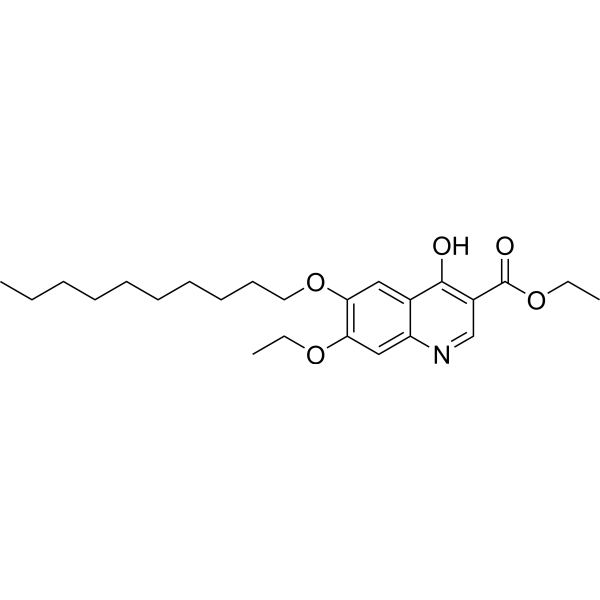
Decoquinate is an orally active, selective inhibitor of the mitochondrial bc1 complex, targeting Eimeria spp. sporozoites and first generation schizonts, and Plasmodium spp. Decoquinate inhibits electron transfer by competitively binding to the mitochondrial cytochrome b system, blocking the parasite's energy metabolism, thereby inhibiting its development and reproduction. Decoquinate has significant anticoccidial activity, preventing intestinal damage and improving host growth performance, and also has inhibitory effects on the liver and blood stages of Plasmodium. Decoquinate is mainly used in veterinary research to prevent and treat coccidiosis in ruminants and poultry.
商品は「研究用試薬」です。人や動物の医療用・臨床診断用・食品用の製品ではありません。
研究用途以外に使用した場合、当社は一切の責任を負いかねます。
- 純度 : 98.80%
- CAS 番号: 18507-89-6
- 分子式: C24H35NO5
- 分子量:417.54
-
保管条件:Powder -20°C, 3 years , 4°C, 2 years ; In solvent -80°C, 2 years , -20°C, 1 year

To place orders, for customer services and technical support, please contact: MedChemExpress USA
Tel: 609-228-6898 E-mail: [email protected] [email protected]


-
 生物活性
生物活性
-
化学情報
-
溶剤 & 溶解度
- 純度とドキュメンテーション
- 参考文献
-
 Help & FAQs



Parasite アイソフォーム固有の製品をすべて表示
More

生物活性
製品説明
IC50 & Target
|
Plasmodium |
Coccidia |
Cellular Effect
|
Cell Line

|
Type | Value | Description | References |
|---|---|---|---|---|
| Hepatocyte | IC50 |
0.0008 ppm
Compound: Decoquinate
|
Inhibitory activity against second generation merozoids of Eimeria tenella in chick hepatocyte assay in the absence of inhibitor; value given as 0.004-0.0008
Inhibitory activity against second generation merozoids of Eimeria tenella in chick hepatocyte assay in the absence of inhibitor; value given as 0.004-0.0008
|
[PMID: 9873375] |
| Hepatocyte | IC50 |
0.0008 ppm
Compound: Decoquinate
|
Inhibitory activity against second generation merozoids of Eimeria tenella in chick hepatocyte assay in the presence of iproniazid; value given as 0.004-0.0008
Inhibitory activity against second generation merozoids of Eimeria tenella in chick hepatocyte assay in the presence of iproniazid; value given as 0.004-0.0008
|
[PMID: 9873375] |
| Hepatocyte | IC50 |
0.0008 ppm
Compound: Decoquinate
|
Inhibitory activity against second generation merozoids of Eimeria tenella in chick hepatocyte assay in the presence of Tranylcypromine; value given as 0.004-0.0008
Inhibitory activity against second generation merozoids of Eimeria tenella in chick hepatocyte assay in the presence of Tranylcypromine; value given as 0.004-0.0008
|
[PMID: 9873375] |
| HepG2 | IC50 |
>100 μM
Compound: 92307901
|
HARVARD: Cytotoxicity in HepG2 cell line
HARVARD: Cytotoxicity in HepG2 cell line
|
[PMID: 22586124] |
| HepG2 | IC50 |
0.0054 μM
Compound: 92307901
|
HARVARD: Inhibition of liver stage Plasmodium berghei infection in HepG2 cells
HARVARD: Inhibition of liver stage Plasmodium berghei infection in HepG2 cells
|
[PMID: 22586124] |
| WI-38 | IC50 |
>100 μM
Compound: 1; DQ
|
Cytotoxicity against human WI38 cells assessed as growth inhibition after 48 hrs by sulforhodamine B assay
Cytotoxicity against human WI38 cells assessed as growth inhibition after 48 hrs by sulforhodamine B assay
|
[PMID: 27210430] |
体外実験
1. In vitro antimalarial experiment: Decoquinate (nanoformulation; 48-72 h) significantly inhibited the growth of Plasmodium falciparum in the liver and blood stages in vitro, with an IC50 of 2.18 ng/mL for the liver stage and 0.05 ng/ml for the blood stage.[2] 2. Derivative activity experiment: Decoquinate derivatives had a strong inhibitory effect on Chloroquine (HY-17589A) sensitive strain NF54 and resistant strains K1 and W2, with an activity 5 times that of Decoquinate, and low toxicity to human fibroblasts.[3]
MedChemExpress (MCE) has not independently confirmed the accuracy of these methods. They are for reference only.
体内実験
Decoquinate (0.5-1 mg/kg; administered in feed; once daily; for at least 28 days) effectively inhibits and prevents coccidiosis in the coccidiosis model of ruminants (calves, lambs, goats), reduces intestinal damage and oocyst excretion, and improves host growth performance. Decoquinate effectively treats and prevents coccidiosis, reduces intestinal damage and oocyst excretion, and improves host growth performance[1].
2. Toxoplasma prevention experiment:
Decoquinate (2 mg/kg; administered in feed; once daily; for 14 weeks) can prevent abortion and perinatal loss caused by Toxoplasma infection in pregnant sheep Toxoplasma infection model, delay febrile reaction and reduce placental damage[1].
3. Antimalarial experiment of nanoformulation:
Decoquinate nanoformulation (1.25 mg/kg; oral; once a day; 3 days) significantly inhibits the growth of liver-stage Plasmodium in a mouse Plasmodium infection model, with an efficacy 15 times that of microparticle formulation[2].
MedChemExpress (MCE) has not independently confirmed the accuracy of these methods. They are for reference only.


化学情報
-
CAS 番号 18507-89-6
-
性状 Solid
-
分子量 417.54
-
分子式 C24H35NO5
-
Color White to off-white
-
SMILES
O=C(C1=C(O)C2=CC(OCCCCCCCCCC)=C(OCC)C=C2N=C1)OCC
-
別名
デコキネート
-
輸送条件
Room temperature in continental US; may vary elsewhere.
-
保管条件
Powder -20°C 3 years 4°C 2 years In solvent -80°C 2 years -20°C 1 year


溶剤 & 溶解度
体外:
H2O : < 0.1 mg/mL (insoluble)
DMSO : < 1 mg/mL (insoluble or slightly soluble)


純度とドキュメンテーション
-
データシート (268 KB)
-
SDS (393 KB)
- English - EN (393 KB)
- Français - FR (393 KB)
- Deutsch - DE (393 KB)
- Norwegian - NO (393 KB)
- Español - ES (393 KB)
- Swedish - SV (393 KB)
- Italian - IT (393 KB)
- Korean - KR (393 KB)
- Portuguese - PT (393 KB)
-
取扱説明書 (2659 KB)
参考文献
[1]. Taylor MA, et, al. The history of decoquinate in the control of coccidial infections in ruminants. J Vet Pharmacol Ther. 2012 Oct;35(5):417-27. [Content Brief]
[2]. Wang H, et al. Nanoparticle formulations of decoquinate increase antimalarial efficacy against liver stage Plasmodium infections in mice. Nanomedicine. 2014 Jan;10(1):57-65. [Content Brief]
[3]. Beteck RM, et al. Straightforward conversion of decoquinate into inexpensive tractable new derivatives with significant antimalarial activities. Bioorg Med Chem Lett. 2016 Jul 1;26(13):3006-3009. [Content Brief]

Calculators
濃度 (開始) × 体積 (開始) = 濃度 (終了) × 体積 (終了)


Decoquinate 関連分類
HY-B1036 関連分類
 Powered by Bioz