



SPR741 TFA
Based on 3 publication(s) in Google Scholar
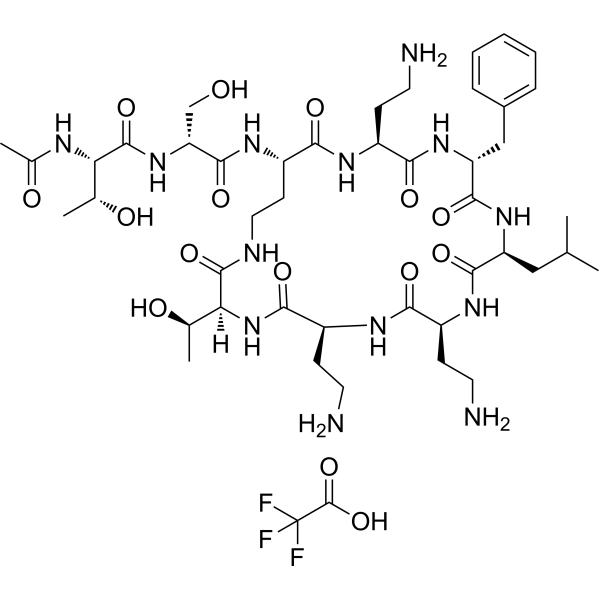
SPR741 TFA (NAB741 TFA) is a cationic peptide derived from polymyxin B and is a potentiator molecule. SPR741 TFA increases the permeability of the outer membrane of Gram-negative bacteria and is used to treat severe Gram-negative bacteria infections. SPR741 TFA inhibits multidrug-resistant Gram-negative bacteria. The spectrum of activity of the antibiotic can be widened when used in combination with SPR741 TFA.
商品は「研究用試薬」です。人や動物の医療用・臨床診断用・食品用の製品ではありません。
研究用途以外に使用した場合、当社は一切の責任を負いかねます。
- 分子式: C46H74F3N13O15
- 分子量:1106.15
-
保管条件:
Please store the product under the recommended conditions in the Certificate of Analysis.

To place orders, for customer services and technical support, please contact: MedChemExpress USA
Tel: 609-228-6898 E-mail: [email protected] [email protected]


-
 生物活性
生物活性
-
化学情報
- プロトコル
- 純度とドキュメンテーション
- 参考文献
-
 Help & FAQs


MedChemExpress(MCE)の使用を引用している文献 SPR741 TFA
MoreAntibiotic アイソフォーム固有の製品をすべて表示
More

生物活性
製品説明
体外実験
SPR741 potentiates antibiotics that are substrates of the AcrAB-TolC efflux pump in E. coli, effectively circumventing the contribution of this pump to intrinsic antibiotic resistance. The intrinsic resistance of E. coli to certain antibiotics that is mediated by both the outer membrane and the AcrAB-TolC efflux system can be overcome, or circumvented, by combining the antibiotic with SPR741 but that potentiation of intrinsic resistance due primarily to efflux may be limited[1].
SPR741 lacks significant antibacterial activity as a stand-alone agent but interacts with the outer membrane of Gram-negative bacteria to increase permeability and thereby improve the accumulation of coadministered antibiotics inside the pathogen[1].
MedChemExpress (MCE) has not independently confirmed the accuracy of these methods. They are for reference only. Further protocols information, click here.
体内実験
MedChemExpress (MCE) has not independently confirmed the accuracy of these methods. They are for reference only.


化学情報
-
分子量 1106.15
-
分子式 C46H74F3N13O15
-
別名
NAB741 TFA
-
輸送条件
Room temperature in continental US; may vary elsewhere.
-
保管条件
Please store the product under the recommended conditions in the Certificate of Analysis.


Publications (3)
-
Journal Impact Factor
-
Most Recent
-
Nature
2022 Apr;604(7906):541-545. PMID: 35388215 -
Int J Antimicrob Agents
The cathelicidin-derived close-to-nature peptide D-11 sensitises Klebsiella pneumoniae to a range of antibiotics in vitro, ex vivo and in vivo. [Abstract]2021 Nov;58(5):106434. PMID: 34525402 -
J Pharm Biomed Anal
Development and validation of a liquid chromatography-tandem mass spectrometry method for the determination of polymixin B1, B2, ile-B1, E1, and E2 in human plasma and its clinical pharmacokinetic application. [Abstract]2024 Nov 15:250:116403. PMID: 39116583

プロトコル
-
Transepithelial/transendothelial electrical resistance assay
TEER measures electrical resistance across epithelial or endothelial monolayers cultured on permeable supports, and the readout reflects ionic conductance through the cell barrier, especially the paracellular pathway regulated by junctional integrity. TEER can be measured without destroying the monolayer and is commonly used before or during transport, permeability, barrier-disruption, and barrier-maturation experiments. TEER values are influenced by biological maturation and technical conditions; reported factors include temperature, medium formulation, passage number, electrode geometry, membrane properties, and junctional length during early monolayer maturation. Therefore, TEER should be interpreted with blank-insert subtraction, area normalization, repeated readings, and, when possible, orthogonal barrier readouts such as FITC-dextran flux or tight-junction staining.
-
Gram Staining of Tissue Sections
Gram staining of tissue sections is a histochemical technique used to differentiate Gram-positive and Gram-negative bacteria within histological specimens based on differences in bacterial cell wall structure and dye retention, adapted from classical bacteriological Gram staining into tissue-compatible “histological Gram stain” variants. In tissue applications, modifications of the Brown-Hopps and Brown-Brenn methods are commonly used to improve differentiation of microorganisms embedded within host connective tissue and to reduce overstaining or loss of Gram-negative signal, which are known limitations of earlier approaches. The principle relies on crystal violet-iodine complex retention in Gram-positive organisms and subsequent decolorization and counterstaining steps that allow contrast visualization of Gram-negative organisms against tissue background.


純度とドキュメンテーション
参考文献
[1]. Corbett D, et al. Potentiation of Antibiotic Activity by a Novel Cationic Peptide: Potency and Spectrum of Activity of SPR741. Antimicrob Agents Chemother. 2017 Jul 25;61(8). pii: e00200-17. [Content Brief]
[2]. Eckburg PB, et al. Safety, Tolerability, Pharmacokinetics, and Drug Interaction Potential of SPR741, an Intravenous Potentiator, after Single and Multiple Ascending Doses and When Combined with β-Lactam Antibiotics in Healthy Subjects. Antimicrob Agents Chemother. 2019 Aug 23;63(9). pii: e00892-19. [Content Brief]

Calculators
濃度 (開始) × 体積 (開始) = 濃度 (終了) × 体積 (終了)


SPR741 TFA 関連分類
HY-P1649A 関連分類
 Powered by Bioz