



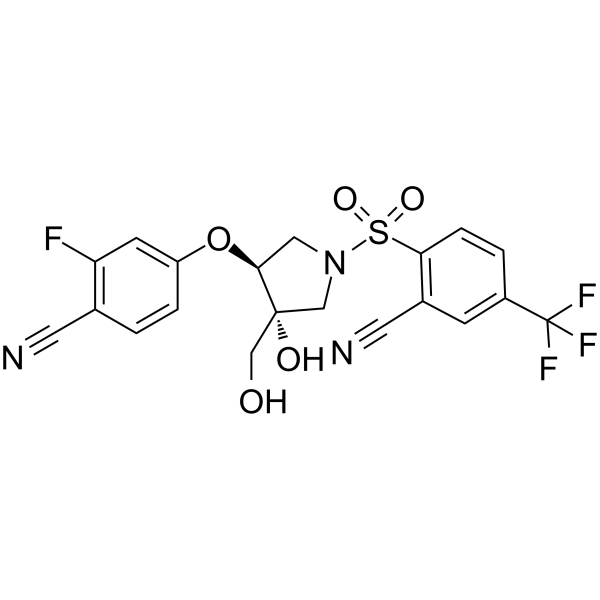
GSK3395879
GSK3395879 is a TRPV4 antagonist that acts on hTRPV4 with an IC50 of 1 nM. GSK3395879 blocks agonist-induced TRPV4-mediated Ca2+ mobilization. GSK3395879 inhibits rat pulmonary edema induced by the TRPV4 agonist GSK1016790A (HY-19608). GSK3395879 can be used in research related to heart failure.
연구목적의 판매만을 진행합니다. 환자를 대상으로 한 판매는 하지 않습니다.
- CAS No.: 2215852-91-6
- 화학식: C20H15F4N3O5S
- 분자량:485.41
-
보관:
Please store the product under the recommended conditions in the Certificate of Analysis.

To place orders, for customer services and technical support, please contact: MedChemExpress USA
Tel: 609-228-6898 E-mail: [email protected] [email protected]


-
 Biological Activity
-
Chemical Information
- Protocol
- 순도&문서
- References
-
 Help & FAQs




Biological Activity
제품 설명
IC50 & Target
[1]|
hTRPV4 1 nM (IC50) |
In Vitro
MedChemExpress (MCE) has not independently confirmed the accuracy of these methods. They are for reference only.
In Vivo
MedChemExpress (MCE) has not independently confirmed the accuracy of these methods. They are for reference only.
-
Animal Model:Sprague-Dawley rats (Male)[1]
-
Dosage:0.03, 0.08, and 0.23 mg/kg (i.v. bolus loading dose); 0.6, 1.7, and 5.1 μg/kg/min (continuous i.v. infusion)
-
Administration:i.v. bolus followed by continuous i.v. infusion; 60 min
-
Result:Inhibited the GSK1016790A-induced decrease in MAP and increase in LW/BW ratio in a dose-dependent manner.
Achieved full inhibition of the GSK1016790A-induced decrease in MAP and increase in LW/BW at an infusion dose of 5.1 μg/kg/min.


Chemical Information
-
CAS No. 2215852-91-6
-
분자량 485.41
-
화학식 C20H15F4N3O5S
-
SMILES
FC1=C(C#N)C=CC(O[C@@H]2[C@@](CO)(O)CN(S(C3=C(C#N)C=C(C(F)(F)F)C=C3)(=O)=O)C2)=C1
-
선적
Room temperature in continental US; may vary elsewhere.
-
보관
Please store the product under the recommended conditions in the Certificate of Analysis.


순도&문서
References
[1]. Brnardic EJ, et al. Discovery of Pyrrolidine Sulfonamides as Selective and Orally Bioavailable Antagonists of Transient Receptor Potential Vanilloid-4 (TRPV4). Journal of medicinal chemistry. 2018 Nov 08;61(21):9738-9755. [Content Brief]
[2]. Nilsson M, et al. TRPV4: A Promising Therapeutic Target Ion Channel─Discovery of Ultrapotent Selective Antagonists. Journal of medicinal chemistry. 2026 Jul 23;69(14):16926-16948. [Content Brief]

Calculators
Concentration (start) × Volume (start) = Concentration (final) × Volume (final)


GSK3395879 Related Classifications
HY-112202 Related Classifications
 Powered by Bioz