



Palmitelaidic acid
Based on 3 publication(s) in Google Scholar
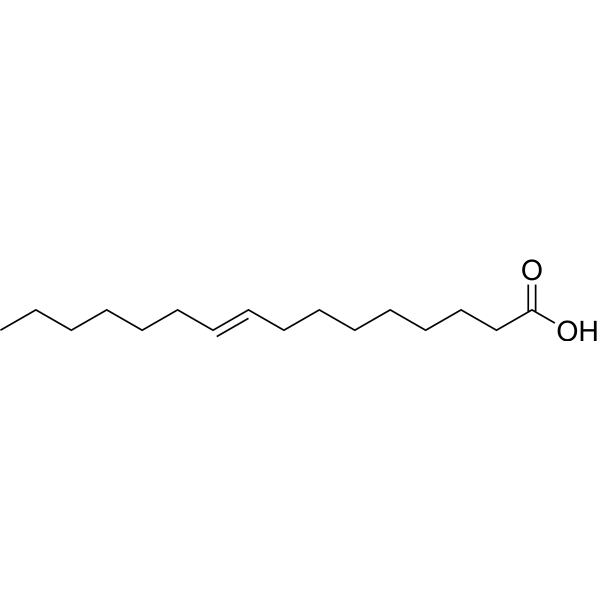
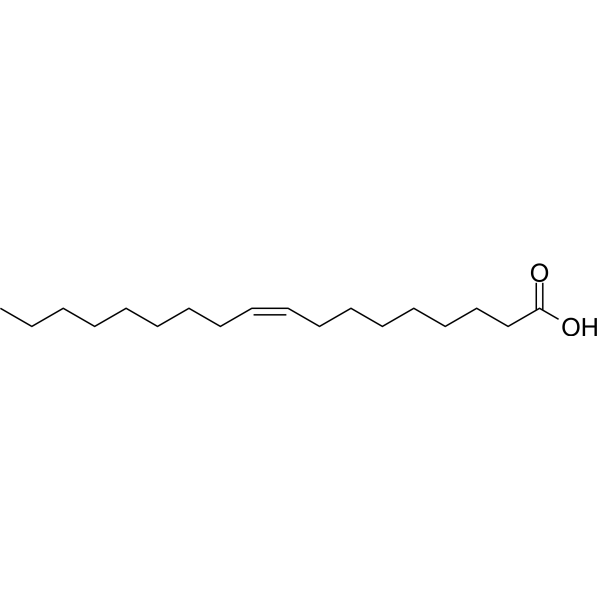
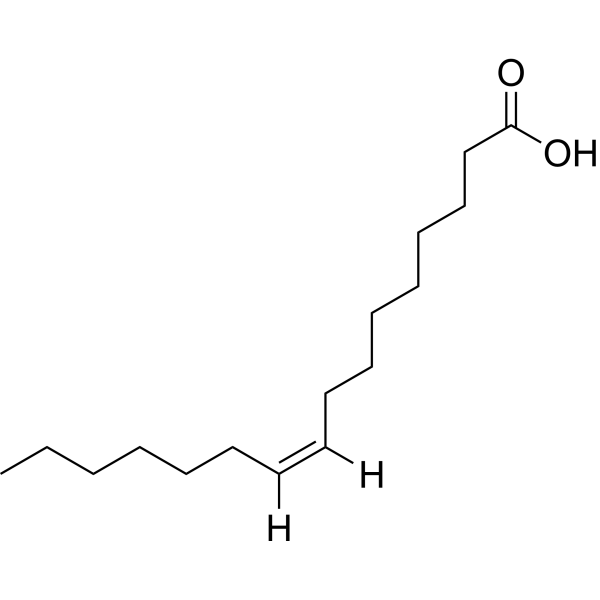
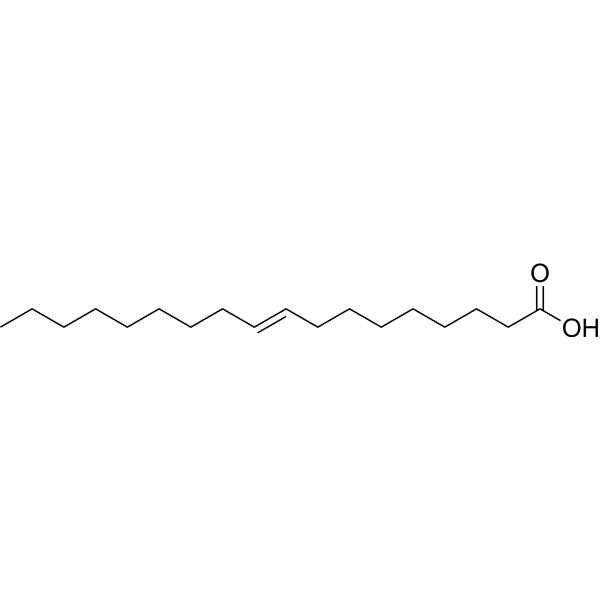
Palmitelaidic acid (9-trans-Hexadecenoic acid) is the trans isomer of palmitoleic acid. Palmitoleic acid is one of the most abundant fatty acids in serum and tissue.
연구목적의 판매만을 진행합니다. 환자를 대상으로 한 판매는 하지 않습니다.
- Purity: 99.4%
- CAS No.: 10030-73-6
- 화학식: C16H30O2
- 분자량:254.41
-
보관:
Solution, -20°C, 2 years

To place orders, for customer services and technical support, please contact: MedChemExpress USA
Tel: 609-228-6898 E-mail: [email protected] [email protected]


-
 Biological Activity
-
Chemical Information
- Protocol
- 순도&문서
- References
-
 Help & FAQs


![[6]-Gingerol](https://file.medchemexpress.com/product_pic/hy-14615.gif)
Publications Citing Use of MedChemExpress (MCE) Palmitelaidic acid
More Customer Validation & Images

-
Bio/Physico-chemical Assay

-
WB

All AMPK Isoforms
More

Biological Activity
제품 설명
IC50 & Target
[2]|
AMPK |
PPARα |
Glucokinase |
In Vitro
The monounsaturated fatty acid palmitoleate (palmitoleic acid) is one of the most abundant fatty acids in serum and tissues, particularly adipose tissue and liver. Its endogenous production by stearoyl-CoA desaturase 1 gives rise to its cis isoform, cis-palmitoleate. Palmitoleic acid has been correlated with multiple cardiometabolic risk factors, including high blood pressure, total cholesterol, TGs, apoA-I, apoB, and endothelial dysfunction[1].
MedChemExpress (MCE) has not independently confirmed the accuracy of these methods. They are for reference only.
In Vivo
MedChemExpress (MCE) has not independently confirmed the accuracy of these methods. They are for reference only.


Chemical Information
-
CAS No. 10030-73-6
-
Appearance Liquid
-
분자량 254.41
-
화학식 C16H30O2
-
Color Colorless to light yellow
-
SMILES
CCCCCC/C=C/CCCCCCCC(O)=O
-
Synonyms
9-trans-Hexadecenoic acid; trans-Palmitoleic acid
-
Structure Classification
-
Initial Source
beef samples
-
선적
Room temperature in continental US; may vary elsewhere.
-
보관
Solution, -20°C, 2 years


Publications (3)
-
Journal Impact Factor
-
Most Recent
-
Nature
2025 Jul;643(8070):192-200. PMID: 39695227 -
Palmitelaidic acid purchased from MedChemExpress. Usage Cited in: Nat Commun. 2022 Nov 28;13(1):7335.
Several well-recognized reproductive associated metabolites, such as β-Nicotinamide Adenine Dinucleotide (NAD+), carnitine and glutathione52 were significantly downregulated in APLN treated Sertoli cells, whereas Palmitelaidic Acid was clearly induced upon APLN treatment.
Palmitelaidic acid purchased from MedChemExpress. Usage Cited in: Nat Commun. 2022 Nov 28;13(1):7335.
Immunoblots of AMPKα1 and p-AMPKα1 in TM4 treated APLN or different concentrations of Palmitelaidic Acid.
-
J Neurosci Res
Enhanced mitochondrial inhibition by 3,4-dihydroxyphenyl-acetaldehyde (DOPAL)-oligomerized α-synuclein. [Abstract]2019 Dec;97(12):1689-1705. PMID: 31420910

Protocol
Animal Administration[2]
Mice: Male C57BL/6J wild type and PPARα-KO mice are fed a high-fat diet or a standard diet for 12 weeks. In the last two weeks, the HF-fed mice are treated daily with oleic acid (300 mg/kg of body weight) or palmitoleic acid (00 mg/kg of body weight) by oral gavage. After 12 weeks, the mice are fasted for 6 h, injected with insulin or PBS vehicle. Blood and liver samples are collected and stored for the further analysis of RNA and protein expression[2].
MedChemExpress (MCE) has not independently confirmed the accuracy of these methods. They are for reference only.


순도&문서
-
Data Sheet (267 KB)
-
SDS (393 KB)
- English - EN (393 KB)
- Français - FR (393 KB)
- Deutsch - DE (393 KB)
- Norwegian - NO (393 KB)
- Español - ES (393 KB)
- Swedish - SV (393 KB)
- Italian - IT (393 KB)
- Korean - KR (393 KB)
- Portuguese - PT (393 KB)
-
Handling Instructions (2659 KB)
References
[1]. Frigolet ME, et al. The Role of the Novel Lipokine Palmitoleic Acid in Health and Disease. [Content Brief]
[2]. de Souza CO, et al. Palmitoleic Acid Improves Metabolic Functions in Fatty Liver by PPARα-Dependent AMPK Activation. J Cell Physiol. 2016 Dec 7. doi: 10.1002/jcp.25715. [Content Brief]
[3]. Yang ZH, et al. Chronic administration of palmitoleic acid reduces insulin resistance and hepatic lipid accumulation in KK-Ay Mice with genetic type 2 diabetes. Lipids Health Dis. 2011 Jul 21;10:120. [Content Brief]

Calculators
Concentration (start) × Volume (start) = Concentration (final) × Volume (final)


Palmitelaidic acid Related Classifications
HY-N2341 Related Classifications
 Powered by Bioz