



SC99

Based on 1 Customer Validation
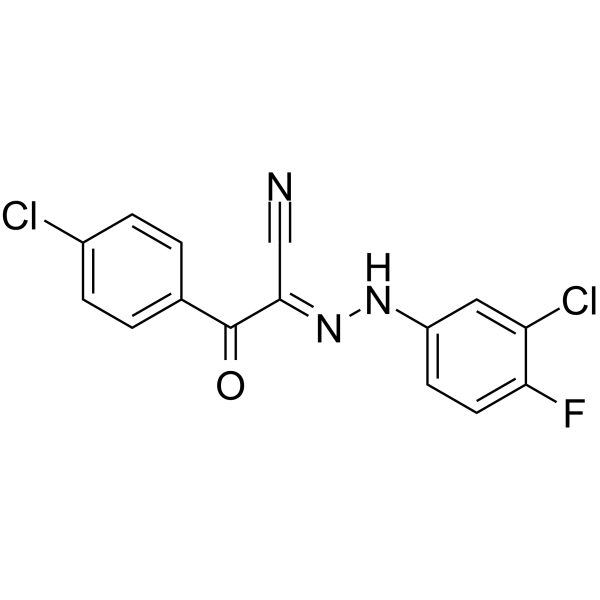
SC99 is an orally active, selective STAT3 inhibitor targeting JAK2-STAT3 pathway. SC99 docks into the ATP-binding pocket of JAK2. SC99 inhibits phosphorylation of JAK2 and STAT3 with no effects on the other kinases associated with STAT3 signaling. SC99 inhibits platelet activation, aggregation and displays potent anti-myeloma, anti-thrombotic activities.
For research use only. We do not sell to patients.
- Purity : 98.90%
- CAS No.: 882290-02-0
- Formula: C15H8Cl2FN3O
- Molecular Weight:336.15
-
Storage:Powder -20°C, 3 years , 4°C, 2 years ; In solvent -80°C, 2 years , -20°C, 1 year

To place orders, for customer services and technical support, please contact: MedChemExpress USA
Tel: 609-228-6898 E-mail: [email protected] [email protected]


-
 Biological Activity
-
Chemical Information
-
Solvent & Solubility
- Protocols
- Purity & Documentation
- References
-
 Help & FAQs




Biological Activity
Description
|
STAT3 |
JAK2 |
In Vitro
SC99 (10 or 30 μM; for 72 hours) induces MM cell death[1].
SC99 (10 μM; 24 hours) decreases the p-STAT3 level but has no effects on total STAT3 expression. SC99 (2.5, 5, 10, 20 μM; for 60 mins) inhibits JAK2 phosphorylation in a concentration-dependent manner but does not inhibit the phosphorylation levels of AKT, ERK, mTOR or c-Src at a concentration up to 20 μM[1].
SC99 (1.25, 2.5, 5 μM; pre-treated for 10 min) inhibits collagen (2 μg/mL) and thrombin (0.02 U/mL) induced phosphorylation of STAT3 in a concentration-dependent manner[2].
SC99 (pre-treated for 2 hours) inhibits IL-6 (50 ng/ml; for 20 min) induced STAT3 nuclear translocation in OPM2 cells[3].
MedChemExpress (MCE) has not independently confirmed the accuracy of these methods. They are for reference only.
-
Cell Line:Six multiple myeloma (MM) cell lines (LP1, JJN3, RPMI-8226, U266, OPM2 and OCI-MY5)
-
Concentration:10 or 30 μM
-
Incubation Time:For 72 hours
-
Result:Induced MM cell death.
-
Cell Line:MM cell lines[1]
-
Concentration:10 μM
-
Incubation Time:24 hours
-
Result:Decreased the p-STAT3 level but had no effects on total STAT3 expression in all cell lines examined.
In Vivo
SC99 (5, 10, 15 mM, 15 μL; ICV) produces an effective inhibitory effect on the phosphorylation of JAK2 and STAT3 in middle cerebral artery occlusion and reperfusion (MCAO/R) model (adult male SD rats; 250-300 g). SC99 ameliorates neuronal apoptosis and degeneration, neurobehavioral deficits, inflammatory response and brain edema[3].
MedChemExpress (MCE) has not independently confirmed the accuracy of these methods. They are for reference only.
-
Animal Model:Nude mice with Human MM cells OPM2 or JJN3[1]
-
Dosage:30 mg/kg
-
Administration:Orally; daily; for continuous 14 or 28 days
-
Result:Delayed myeloma tumor growth in xenograft mice models and suppressed tumor growth more than 40% in 14 days in the OPM2 model.


Chemical Information
-
CAS No. 882290-02-0
-
Appearance Solid
-
Molecular Weight 336.15
-
Formula C15H8Cl2FN3O
-
Color Light yellow to yellow
-
SMILES
N#C/C(C(C1=CC=C(Cl)C=C1)=O)=N\NC2=CC=C(F)C(Cl)=C2
-
Shipping
Room temperature in continental US; may vary elsewhere.
-
Storage
Powder -20°C 3 years 4°C 2 years In solvent -80°C 2 years -20°C 1 year


Solvent & Solubility
In Vitro:
DMSO : 83.33 mg/mL (247.90 mM; Need ultrasonic; Hygroscopic DMSO has a significant impact on the solubility of product, please use newly opened DMSO)
Please refer to the solubility information to select the appropriate solvent. Once prepared, please aliquot and store the solution to prevent product inactivation from repeated freeze-thaw cycles.
Storage method and period of stock solution: -80°C, 2 years; -20°C, 1 year. When stored at -80°C, please use it within 2 years. When stored at -20°C, please use it within 1 year.
Please refer to the solubility information to select the appropriate solvent. Once prepared, please aliquot and store the solution to prevent product inactivation from repeated freeze-thaw cycles.
Storage method and period of stock solution: -80°C, 2 years; -20°C, 1 year. When stored at -80°C, please use it within 2 years. When stored at -20°C, please use it within 1 year.
Concentration (start) × Volume (start) = Concentration (final) × Volume (final)
In Vivo:
Select the appropriate dissolution method based on your experimental animal and administration route.
- For the following dissolution methods, please ensure to first prepare a clear stock solution using an In Vitro approach and then sequentially add co-solvents:
- To ensure reliable experimental results, the clarified stock solution can be appropriately stored based on storage conditions. As for the working solution for In Vivo experiments, it is recommended to prepare freshly and use it on the same day.
- The percentages shown for the solvents indicate their volumetric ratio in the final prepared solution. If precipitation or phase separation occurs during preparation, heat and/or sonication can be used to aid dissolution.
Add each solvent one by one: 10% DMSO 40% PEG300 5% Tween-80 45% Saline
Solubility: 2.08 mg/mL (6.19 mM); Suspended solution; Need ultrasonic
This protocol yields a suspended solution of 2.08 mg/mL. Suspended solution can be used for oral and intraperitoneal injection.
Taking 1 mL working solution as an example, add 100 μL DMSO stock solution (20.8 mg/mL) to 400 μL PEG300, and mix evenly; then add 50 μL Tween-80 and mix evenly; then add 450 μL Saline to adjust the volume to 1 mL.
Preparation of Saline: Dissolve 0.9 g sodium chloride in ddH₂O and dilute to 100 mL to obtain a clear Saline solution.
Add each solvent one by one: 10% DMSO 90% (20% SBE-β-CD in Saline)
Solubility: 2.08 mg/mL (6.19 mM); Suspended solution; Need ultrasonic
This protocol yields a suspended solution of 2.08 mg/mL. Suspended solution can be used for oral and intraperitoneal injection.
Taking 1 mL working solution as an example, add 100 μL DMSO stock solution (20.8 mg/mL) to 900 μL 20% SBE-β-CD in Saline, and mix evenly.
Preparation of 20% SBE-β-CD in Saline (4°C, storage for one week): 2 g SBE-β-CD powder is dissolved in 10 mL Saline, completely dissolve until clear.
In Vivo Dissolution Calculator
Please enter the basic information of animal experiments:
-
-
-
-
Recommended: Prepare an additional quantity of animals to account for potential losses during experiments.
Please enter your animal formula composition:
-
%DMSO +
Recommended: Keep the proportion of DMSO in working solution below 2% if your animal is weak.
-
%+
-
+%Tween-80 + +
-
%Saline +
The co-solvents required include: DMSO, . All of co-solvents are available by MedChemExpress (MCE). , Tween 80. All of co-solvents are available by MedChemExpress (MCE).
Working solution concentration: 0.22 mg/mL
Method for preparing stock solution: mg drug dissolved in μL DMSO. Stock solution concentration: mg/mL.
1. Take μL DMSO stock solution;
2. Add μL .
μL , mix evenly;
3. Then add μL Tween 80, mix evenly;
4. Then add μL
Please ensure that the stock solution in the first step is dissolved to a clear state, and add co-solvents in sequence. You can use ultrasonic heating (ultrasonic cleaner, recommended frequency 20-40 kHz), vortexing, etc. to assist dissolution.


Purity & Documentation
-
Data Sheet (276 KB)
-
SDS (393 KB)
- English - EN (393 KB)
- Français - FR (393 KB)
- Deutsch - DE (393 KB)
- Norwegian - NO (393 KB)
- Español - ES (393 KB)
- Swedish - SV (393 KB)
- Italian - IT (393 KB)
- Korean - KR (393 KB)
- Portuguese - PT (393 KB)
-
Handling Instructions (2659 KB)
References
[1]. Zubin Zhang, et al. A novel small molecule agent displays potent anti-myeloma activity by inhibiting the JAK2-STAT3 signaling pathway. Oncotarget. 2016 Feb 23;7(8):9296-308. [Content Brief]
[2]. Zhuan Xu, et at. A novel STAT3 inhibitor negatively modulates platelet activation and aggregation. Acta Pharmacol Sin. 2017 May;38(5):651-659. [Content Brief]
[3]. Yiping Ding, et al. Effects of SC99 on cerebral ischemia-perfusion injury in rats: Selective modulation of microglia polarization to M2 phenotype via inhibiting JAK2-STAT3 pathway. Neurosci Res. 2019 May;142:58-68. [Content Brief]


Complete Stock Solution Preparation Table
Please refer to the solubility information to select the appropriate solvent. Once prepared, please aliquot and store the solution to prevent product inactivation from repeated freeze-thaw cycles.
Storage method and period of stock solution: -80°C, 2 years; -20°C, 1 year. When stored at -80°C, please use it within 2 years. When stored at -20°C, please use it within 1 year.
| Optional Solvent | Concentration Solvent Mass | 1 mg | 5 mg | 10 mg | 25 mg |
|---|---|---|---|---|---|
| DMSO | 1 mM | 2.9749 mL | 14.8743 mL | 29.7486 mL | 74.3716 mL |
| 5 mM | 0.5950 mL | 2.9749 mL | 5.9497 mL | 14.8743 mL | |
| 10 mM | 0.2975 mL | 1.4874 mL | 2.9749 mL | 7.4372 mL | |
| 15 mM | 0.1983 mL | 0.9916 mL | 1.9832 mL | 4.9581 mL | |
| 20 mM | 0.1487 mL | 0.7437 mL | 1.4874 mL | 3.7186 mL | |
| 25 mM | 0.1190 mL | 0.5950 mL | 1.1899 mL | 2.9749 mL | |
| 30 mM | 0.0992 mL | 0.4958 mL | 0.9916 mL | 2.4791 mL | |
| 40 mM | 0.0744 mL | 0.3719 mL | 0.7437 mL | 1.8593 mL | |
| 50 mM | 0.0595 mL | 0.2975 mL | 0.5950 mL | 1.4874 mL | |
| 60 mM | 0.0496 mL | 0.2479 mL | 0.4958 mL | 1.2395 mL | |
| 80 mM | 0.0372 mL | 0.1859 mL | 0.3719 mL | 0.9296 mL | |
| 100 mM | 0.0297 mL | 0.1487 mL | 0.2975 mL | 0.7437 mL |


SC99 Related Classifications
HY-124858 Related Classifications
 Powered by Bioz