


153 Results for "

primary human

" in MedChemExpress (MCE) Product Catalog:
Products (153)

153 Results for "primary human" in MCE Product Catalog:

Cat. No.: HY-174638
Target:  

mRNA

Research Areas:  

Inflammation/Immunology

Human IL13RA1 mRNA encodes the human interleukin 13 receptor subunit alpha 1 (IL13RA1) protein, a subunit of the interleukin 13 receptor. IL13RA1 serves as a primary IL13-binding subunit of the IL13 receptor, and may also be a component of IL4 receptors. It has been shown to bind tyrosine kinase TYK2, and thus may mediate the signaling processes that lead to the activation of JAK1, STAT3 and STAT6 induced by IL13 and IL4.
loading...
    loading...
Cat. No.: HY-P7669
Purity:  ≥ 95%, as determined by reducing SDS-PAGE.
Synonyms: BMPR2; Bone Morphogenetic Protein Receptor Type-2; Prev. PPH1; BMP Type-2 Receptor; BMPR-II; Type II Receptor For Bone Morphogenetic Protein-4; Bone Morphogenetic Protein Receptor Type II; Type II Activin Receptor-Like Kinase; BRK-3; primary Pulmonary Hyp
Species:  
Human
Source:  
HEK293
loading...
    loading...
Cat. No.: HY-P70212
Purity:  ≥ 95%, as determined by reducing SDS-PAGE.
Synonyms: GADD45B; Growth Arrest And DNA-Damage-Inducible Beta; Prev. MYD118; DKFZP566B133; GADD45BETA; Growth Arrest And DNA-Damage-Inducible, Beta; Growth Arrest And DNA Damage-Inducible Protein GADD45 Beta; Myeloid Differentiation primary Response; Myeloid Diffe
Species:  
Human
Source:  
E. coli
loading...
    loading...
Cat. No.: HY-P703947
Purity:  ≥ 95%, as determined by Bis-Tris PAGE.
Synonyms: BMPR2; Bone Morphogenetic Protein Receptor Type-2; Prev. PPH1; BMP Type-2 Receptor; BMPR-II; Type II Receptor For Bone Morphogenetic Protein-4; Bone Morphogenetic Protein Receptor Type II; Type II Activin Receptor-Like Kinase; BRK-3; primary Pulmonary Hyp
Species:  
Human
Source:  
HEK293
loading...
    loading...
Cat. No.: HY-P11000A
Research Areas:  

Others

INF7TAT acetate is an amphipathic cell-penetrating peptide that mediates intracellular delivery of CRISPR ribonucleoproteins. INF7TAT acetate achieves endosomal escape via the INF7 fragment and cell binding via the TAT fragment. It enables intracellular delivery into primary human T cells and hematopoietic stem and progenitor cells, facilitating gene knockout and AAV-mediated homology-directed repair. INF7TAT acetate can be used for genome editing-related research .
loading...
    loading...
Cat. No.: HY-W319584
CAS No.: 55275-64-4
Target:  

Drug Derivative

Research Areas:  

Cancer

AMP-404 is an Imexon (HY-15385)-derived antitumor agent with dual functions as a cytotoxin and growth inhibitor. AMP-404 exerts significant cytotoxic effects against various sensitive, drug-resistant and primary human tumor cells, including myeloma, breast cancer, melanoma, ovarian cancer and sarcoma cells. AMP-404 effectively inhibits the growth of rat PIE 2-3 sarcoma in vivo and exhibits remarkable in vivo efficacy .
loading...
    loading...
Cat. No.: HY-P72855
Purity:  ≥ 90%, as determined by reducing SDS-PAGE.
Synonyms: BMPR2; Bone Morphogenetic Protein Receptor Type-2; Prev. PPH1; BMP Type-2 Receptor; BMPR-II; Type II Receptor For Bone Morphogenetic Protein-4; Bone Morphogenetic Protein Receptor Type II; Type II Activin Receptor-Like Kinase; BRK-3; primary Pulmonary Hyp
Species:  
Human
Source:  
HEK293
loading...
    loading...
Cat. No.: HY-180898
Research Areas:  

Cancer

AHL-7160 is a molecular glue degrader targeting DGKα, with an IC50 value of 12 nM against the human protein. AHL-7160 rapidly recruits DGKα to the plasma membrane, blocks DGKα-mediated phosphatidic acid production, and induces proteasome-dependent degradation of DGKα with full proteome selectivity. AHL-7160 enhances primary T cell-mediated glioblastoma cell killing. AHL-7160 can be used in related research on glioblastoma .
loading...
    loading...
Cat. No.: HY-P990827

Target:  

TROP2

Research Areas:  

Cancer

Anti-TROP-2 Antibody (Pr1E11) is a kind of mouse IgG1 κ chimeric antibody inhibitor, targeting to human TROP-2. Anti-TROP-2 Antibody (Pr1E11) specifically binds to TROP-2 with high affinity and shows low internalization activitv. Anti-TROP-2 Antibody (Pr1E11) can be used for the research of cancer, such as epithelial cancer and primary pancreatic cancer .
loading...
    loading...
Cat. No.: HY-175780
CAS No.: 1465291-19-3
Research Areas:  

Cancer

CD28-IN-1 (Compound 19MS-5) is a CD28 inhibitor with a KD of 12.48  μM. CD28-IN-1 has a superior binding capacity to CD28 and potently inhibits CD28-B7 interactions. CD28-IN-1 inhibits CD28-driven immune activation and suppresses cytokine (IFN-γ, IL-2 and TNF-α) production in primary human T cells co-cultured with tumor spheroids and human epithelial tissues. CD28-IN-1 can be used for tumor immunity research .
loading...
    loading...
Cat. No.: HY-180131
CAS No.: 1312993-34-2
Synonyms: ASB17061
Target:  

Proteasome

Research Areas:  

Inflammation/Immunology

INVA8001 (ASB17061) is a highly selective and orally active chymase inhibitor with IC50 values for human chymase and mouse mast cell proteinase 4 (mMCP-4) of 0.02 and 0.03 μM, respectively. INVA8001 exhibits IC50 values for bovine α-chymotrypsin and human cathesin G of 3.4 and 32.1 μM, respectively, and it shows over 1000-fold selectivity for other related serine proteases. INVA8001 inhibits mast cells in a mouse primary sclerosing cholangitis (PSC) model, improves bile duct pathology, and alleviates bile stasis, demonstrating anti-inflammatory and anti-fibrotic effects .
loading...
    loading...
Cat. No.: HY-159650
CAS No.: 2724937-55-5
Target:  

Adenosine Receptor

Research Areas:  

Cancer

EOS-984 is a macrocyclic diamine equilibrative nucleoside transporter 1 (ENT1) inhibitor. EOS984 inhibits ENT1 and ENT1-mediated nucleoside transport, restricting adenosine entry into cells via ENT1, thereby attenuating ATP-derived adenosine-mediated T cell immunosuppression and restoring primary human T cell proliferation. EOS984 can be used in research related to ENT1-mediated nucleoside transport, adenosine-related immunosuppression, and tumor immunity .
loading...
    loading...
Cat. No.: HY-D0967
CAS No.: 146368-15-2
Cy5-bifunctional dye is a bifunctional dye used for covalent labeling of primary amines on proteins or oligonucleotides (Ex/Em = 649 nm/670 nm). Cy5-bifunctional dye can label recombinant annexin-V to assess phosphatidylserine exposure on the cell surface via flow cytometry. Cy5-bifunctional dye can label anti-human IgG (H + L) secondary antibodies. Cy5-bifunctional dye is applicable to studies of glanders and melioidosis .
loading...
    loading...
Cat. No.: HY-P11638
Mitochondrial-targeted peptide BP29 is a mitochondria-targeted iron chelator linked to a mitochondria-homing SS-peptide. Mitochondrial-targeted peptide BP29 protects human primary skin fibroblasts against ultraviolet A-induced oxidative damage to mitochondrial membranes, ATP depletion, and necrotic cell death. Mitochondrial-targeted peptide BP29 prevents hydrogen peroxide-induced oxidative stress and cytotoxicity in both healthy and Friedreich's ataxia skin fibroblasts. Mitochondrial-targeted peptide BP29 can be used for the research of Friedreich's ataxia .
loading...
    loading...
Cat. No.: HY-P11638A
Mitochondrial-targeted peptide BP29 acetate is a mitochondria-targeted iron chelator linked to a mitochondria-homing SS-peptide. Mitochondrial-targeted peptide BP29 acetate protects human primary skin fibroblasts against ultraviolet A-induced oxidative damage to mitochondrial membranes, ATP depletion, and necrotic cell death. Mitochondrial-targeted peptide BP29 acetate prevents hydrogen peroxide-induced oxidative stress and cytotoxicity in both healthy and Friedreich's ataxia skin fibroblasts. Mitochondrial-targeted peptide BP29 acetate can be used for the research of Friedreich's ataxia .
loading...
    loading...
Cat. No.: HY-P5307
Synonyms: INF7-A5K-TAT
Research Areas:  

Others

Peptide A5K (INF7-A5K-TAT) is an amphiphilic peptide derived from the HA2-TAT fusion scaffold. Peptide A5K can non-covalently bind to CRISPR ribonucleoproteins and efficiently deliver them to cells, such as primary human T cells, B cells, and NK cells. Peptide A5K enables low-toxicity, precise, and multiplex genome editing, holding great application potential in the field of cell therapy .
loading...
    loading...
Cat. No.: HY-P5307A
Synonyms: INF7-A5K-TAT acetate
Research Areas:  

Others

Peptide A5K (INF7-A5K-TAT) acetate is an amphiphilic peptide derived from the HA2-TAT fusion scaffold. Peptide A5K acetate can non-covalently bind to CRISPR ribonucleoproteins and efficiently deliver them to cells, such as primary human T cells, B cells, and NK cells. Peptide A5K acetate enables low-toxicity, precise, and multiplex genome editing, holding great application potential in the field of cell therapy .
loading...
    loading...
Cat. No.: HY-P99952
CAS No.: 2249927-04-4
Synonyms: SCT400
Ripertamab (SCT400) is a recombinant human-mouse chimeric anti-CD20 IgG1κ monoclonal antibody. As an immunomodulator, ripertamab reduces the levels of pathogenic autoantibodies, alleviates immune complex deposition, and blocks the antigen-presenting function of cells. Ripertamab depletes CD20-positive cells. Ripertamab can induce infusion-related reactions, pulmonary toxicity, neutropenia and thrombocytopenia. Ripertamab is applicable to research related to non-Hodgkin's lymphoma, primary membranous nephropathy and idiopathic membranous nephropathy .
loading...
    loading...
Cat. No.: HY-P705526
Purity:  ≥ 85%, as determined by reducing SDS-PAGE.
Synonyms: PPP1R15A; Myeloid Differentiation primary Response Protein MyD116 Homolog; Protein Phosphatase 1 Regulatory Subunit 15A; Protein Phosphatase 1, Regulatory (Inhibitor) Subunit 15A; GADD34; Growth Arrest And DNA-Damage-Inducible 34; Growth Arrest And DNA Da
Species:  
Human
Source:  
E. coli
loading...
    loading...
Cat. No.: HY-137967
CAS No.: 38482-81-4
Purity:  ≥98.0%
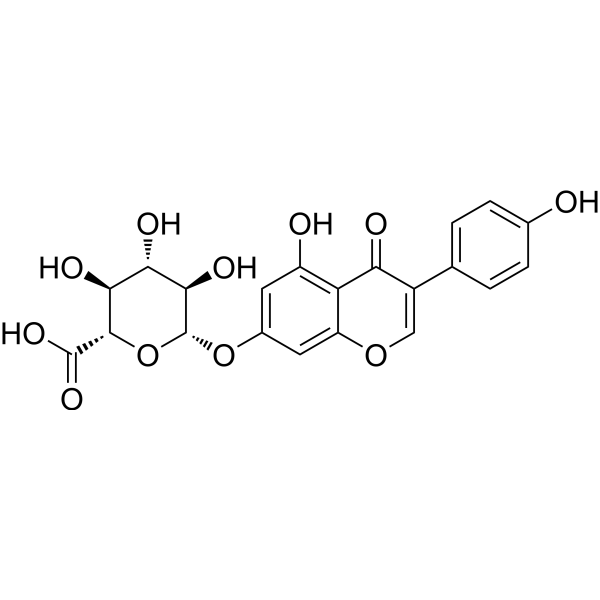
Synonyms: Genistein 7-O-glucuronide
Target:  

Drug Metabolite

Research Areas:  

Metabolic Disease

Genistein 7-β-D-Glucuronide (Genistein 7-O-glucuronide) is the primary phase II metabolite of Genistein (HY-14596) in human and rat hepatocytes. Genistein 7-β-D-Glucuronide undergoes distinct deconjugation in different functional assays. Genistein 7-β-D-Glucuronide is produced via hepatic microsomal glucuronidation and shows a mild age-related increase in intrinsic clearance in male F344 rats. Genistein 7-β-D-Glucuronide can be used for research on metabolism .
loading...
    loading...

