1. Search Result
Search Result
Results for "

AChE and BChE inhibitory activities

" in MedChemExpress (MCE) Product Catalog:

18

Inhibitors & Agonists

1

Biochemical Assay Reagents

7

Natural
Products

Cat. No. Nom du produit Target Áreas de investigación Chemical Structure
  • HY-N2157
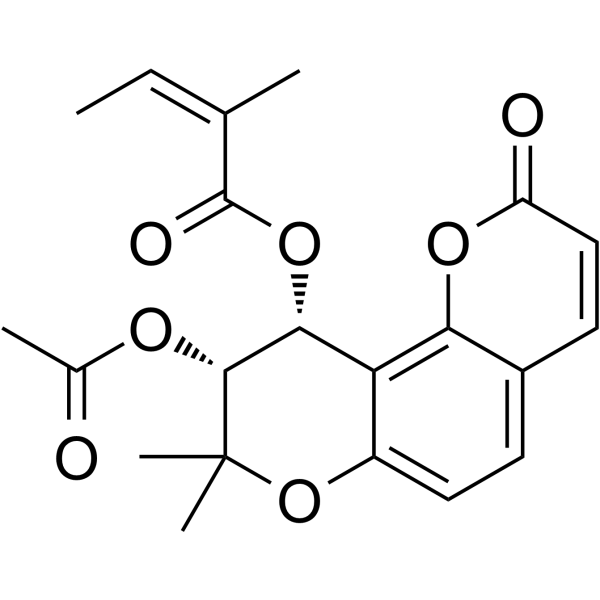
    Pteryxin
    1 Publications Verification

    (+)-Pteryxin

    Cholinesterase (ChE) NF-κB NOD-like Receptor (NLR) Keap1-Nrf2 Reactive Oxygen Species (ROS) Nuclear Factor of activated T Cells (NFAT) p38 MAPK Neurological Disease Metabolic Disease Inflammation/Immunology
    Pteryxin ((+)-Pteryxin) is an orally active multi-target inhibitor that targets NF-κB, MAPK, NLRP3 inflammasome, and Nrf2/ARE pathways. Pteryxin is also a BChE inhibitor (IC50=12.96 μg/mL) with a low inhibitory efficiency on AChE. Pteryxin inhibits the Ca 2+-calcineurin-NFATc1 pathway by blocking NF-κB/MAPK signaling, inhibiting NLRP3 inflammasome activation, and reducing ROS generation, and activates Nrf2-mediated antioxidant enzyme expression. Pteryxin has anti-inflammatory, antioxidant, and osteoclastogenesis inhibitory activities. Pteryxin can be used in the study of inflammatory diseases, osteoporosis, diabetes, and Alzheimer's disease .
    Pteryxin
  • HY-N2284

    Cholinesterase (ChE) Beta-secretase Phosphodiesterase (PDE) Cancer
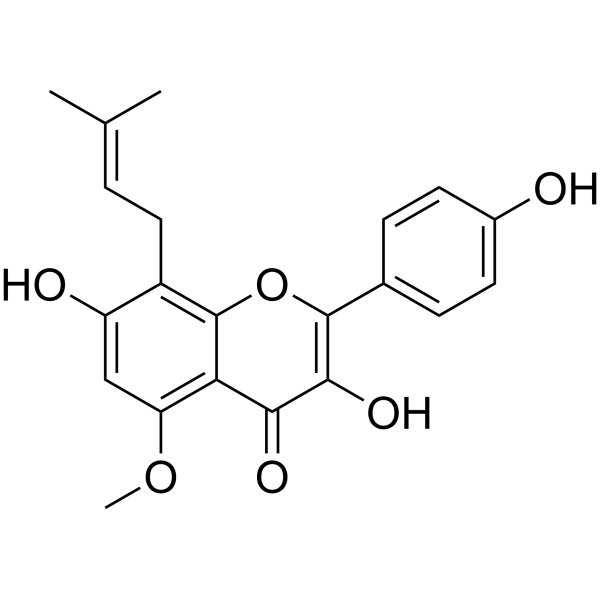
    Sophoflavescenol is a prenylated flavonol, which shows great inhibitory activity with IC50 of 0.013 μM against Phosphodiesterase 5 (PDE5), and also inhibits RLAR, HRAR, AGE, BACE1, AChE and BChE with IC50s of 0.30 μM, 0.17 μM, 17.89 μg/mL, 10.98 μM, 8.37 μM and 8.21 μM, respectively.
    Sophoflavescenol
  • HY-W540232

    4-Methylphenyl ITC

    Cholinesterase (ChE) Neurological Disease
    4-Methoxyphenyl isothiocyanate (4-Methylphenyl ITC) is an antioxidant, with a IC50 value of 1.25 mM for scavenging DPPH radicals. ORAC testing indicates its antioxidant capacity as 11.7 mM TE (indicating that the antioxidant efficacy of this compound is equivalent to 11.7 mmol of Trolox (HY-101445, a standard antioxidant) under the same conditions), and it extends the oxidation process by approximately 9180 seconds in the Briggs–Rauscher reaction. Additionally, 4-Methoxyphenyl isothiocyanate exhibits moderate cholinesterase inhibitory activity, with an inhibition rate of 30.4% against acetylcholinesterase (AChE) and 17.9% against butyrylcholinesterase (BChE). 4-Methoxyphenyl isothiocyanate holds potential for research in the fields of antioxidation and neurological disorders .
    4-Methoxyphenyl isothiocyanate
  • HY-W272207

    Cholinesterase (ChE) Drug Intermediate Neurological Disease Inflammation/Immunology
    AChE/BChE-IN-31 (Compound 3c) is a cholinesterase inhibitor. AChE/BChE-IN-31 exhibits certain inhibitory activity against hAChE and eqBChE. AChE/BChE-IN-31 also possesses antioxidant properties with an IC50 value of 105.04 μM against DPPH. AChE/BChE-IN-31 can be used in the research of diseases such as Alzheimer’s disease .
    AChE/BChE-IN-31
  • HY-N15710

    Cholinesterase (ChE) Neurological Disease Inflammation/Immunology
    Magnotriol B is a cholinesterase inhibitor with IC50 values of 12.63 nM and 14.5 nM against AChE and BChE, respectively. Magnotriol B also exhibits significant NO inhibitory activity with an IC50 of 2.02 μM. Magnotriol B can be used in the research of neurodegenerative and inflammatory diseases .
    Magnotriol B
  • HY-30139

    Biochemical Assay Reagents Others
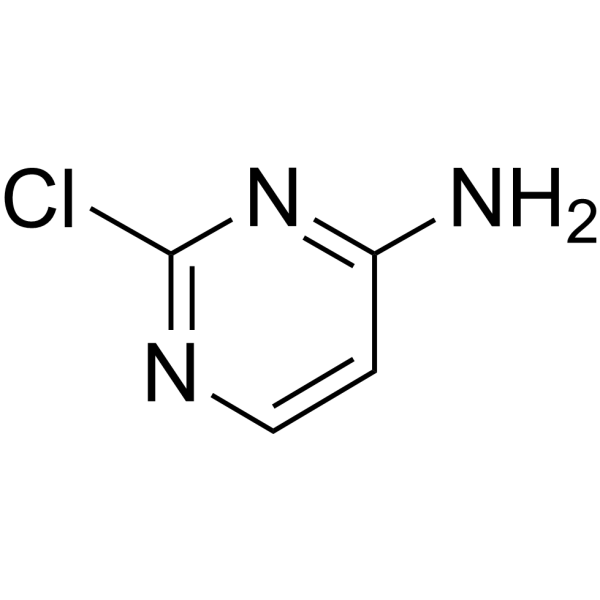
    4-Amino-2-chloropyrimidine is a pyrimidine derivative. 4-Amino-2-chloropyrimidine is a competitive inhibitor for AChE (Ki = 0.18 μM) and BChE (Ki = 1.324 μM). 4-Amino-2-chloropyrimidine fits in the binding pocket of 4BDS. 4-Amino-2-chloropyrimidine has high inhibitory activity on GST enzyme activity (IC50 = 0.037 μM, Ki = 0.047 μM) in vitro .
    4-Amino-2-chloropyrimidine
  • HY-151436

    CDK Cholinesterase (ChE) Apoptosis Cancer
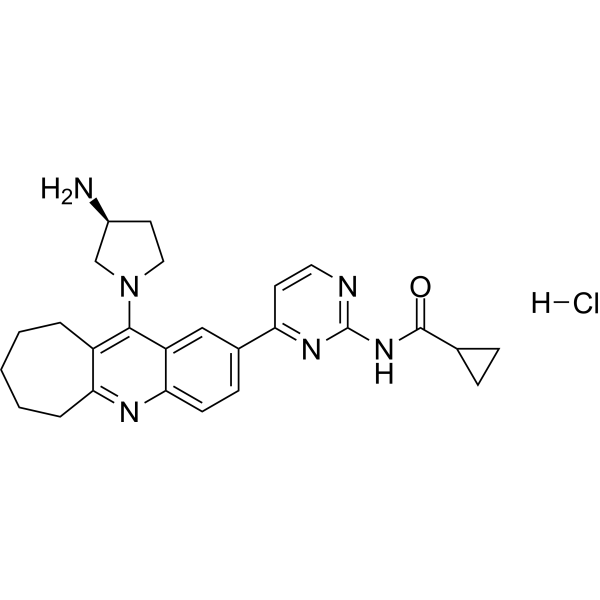
    ZLMT-12 (compound 35), tacrine derivatives, is a potent, orally active CDK2/9 inhibitor with IC50 values of 0.002 and 0.011 μM for CDK9 and CDK2, respectively. ZLMT-12 has a weak inhibitory effect on AChE (IC50=19.023 μM) and BChE (IC50=2.768 μM). ZLMT-12 has low toxicity and antiproliferative activity. ZLMT-12 induces apoptosis and arrests the cell cycle in the S phase and G2/M phase .
    ZLMT-12
  • HY-N8764

    Decaffeoylverbascoside; Verbasoside

    Monoamine Oxidase Cholinesterase (ChE) Neurological Disease Cancer
    Decaffeoylacteoside is an inhibitor of AChE/BChE/LOX with moderate activity .
    Decaffeoylacteoside
  • HY-175658

    Cholinesterase (ChE) Amyloid-β Tau Protein Neurological Disease
    AChE/BChE-IN-29 is an AChE/BChE inhibitor. AChE/BChE-IN-29 exhibits balanced dual cholinesterase inhibitory activity with IC50 values of 2.1 μM for Electrophorus electricus AChE (eeAChE) and 6.3 μM for equine serum butyrylcholinesterase (eqBChE). AChE/BChE-IN-29 effectively inhibits amyloid-β (42) aggregation and tau protein aggregation in E. coli cell models. AChE/BChE-IN-29 can be used for the study of Alzheimer’s disease (AD) .
    AChE/BChE-IN-29
  • HY-172461

    Monoamine Oxidase Cholinesterase (ChE) Neurological Disease
    MAO-IN-6 (Compound 3f) is a BBB permeable and reversible MAO-B inhibitor with an IC50 of 0.09 μM. MAO-IN-6 also exhibits certain inhibitory activities against AChE and BChE, with IC50 values of 4.48 μM and 17.03 μM, respectively. MAO-IN-6 has low cytotoxicity and can be used in the research of Alzheimer's disease .
    MAO-IN-6
  • HY-185347

    Cholinesterase (ChE) Neurological Disease
    AChE-IN-114 is a selective AChE inhibitor and shows weak inhibitory activity for BChE. AChE-IN-114 can be used for the research of alzheimer’s disease .
    AChE-IN-114
  • HY-179121

    Cholinesterase (ChE) Neurological Disease
    AChE-IN-97 (compound 7e) is a cholinesterase inhibitor. AChE-IN-97 exhibits AChE and BChE inhibitory activity through molecular docking. AChE-IN-97 can be used for research on neurological conditions .
    AChE-IN-97
  • HY-181851

    Cholinesterase (ChE) Neurological Disease
    AChE-IN-109 is a potent mixed-type cholinesterase inhibitor with significantly stronger inhibitory activity against AChE than BChE. AChE-IN-109 has IC50 values of 0.55 μM and 12.45 μM against AChE and BChE, respectively. AChE-IN-109 inhibits cholinesterases through a mixed-type mechanism, binds to both the catalytic active site (CAS) and peripheral anionic site (PAS) of AChE. AChE-IN-109 can be used for the study of Alzheimer’s disease (AD) .
    AChE-IN-109
  • HY-N16715

    Cholinesterase (ChE) Neurological Disease
    Monardic acid A is a selective inhibitor of AChE, with an IC50 of 53.1 μM against AChE from electric eel. Monardic acid A shows weak inhibitory activity against human erythrocyte AChE (IC50 >100 μM) and has no significant inhibitory effect on BChE. Monardic acid A reduces acetylcholine breakdown by inhibiting AChE activity, and also exhibits inhibitory activity against histamine release and hyaluronidase, thus exerting anti-inflammatory and neurotransmitter regulatory effects. Monardic acid A can be isolated from lungwort (Pulmonaria officinalis) and thyme (Thymus gobicus), and is mainly used in the development of anti-inflammatory drugs and drugs related to neurodegenerative diseases .
    Monardic acid A
  • HY-182786

    Cholinesterase (ChE) Monoamine Oxidase Beta-secretase COX Amyloid-β Neurological Disease
    MAO-B-IN-56 is a multi-target-directed ligand with AChE, BChE, MAO-B, and BACE1 inhibitory activity, with IC50 values of 0.35 μM, 3.22 μM, 0.14 μM, and 3.85 μM respectively, and shows selectivity for AChE over BChE and MAO-B over MAO-A.MAO-B-IN-56 reduces amyloid-beta production, reduces paw edema, improves spatial memory, and enhances Alzheimer's disease hallmarks and associated histopathological alterations.MAO-B-IN-56 can be used for the research of alzheimer's disease .
    MAO-B-IN-56
  • HY-179621

    Cholinesterase (ChE) Amyloid-β Neurological Disease
    EQ-04 is a highly selective positive allosteric modulator (PAM) of α7 nAChR. EQ-04 has no direct inhibitory activity on AChE and BChE. EQ-04 inhibits aggregation. EQ-04 has safe cytotoxicity and potent neuroprotective activity. EQ-04 can be used for the study of Alzheimer's disease.
    EQ-04
  • HY-N9731

    NF-κB Others
    6-O-p-Hydroxybenzoylglutinoside acts as a selective NF-κB inhibitor that suppresses the transcriptional activity of TNF-α-activated NF-κB (IC50=52.78 μM). 6-O-p-Hydroxybenzoylglutinoside shows no significant inhibitory activity against sEH, AChE, or BChE. 6-O-p-Hydroxybenzoylglutinoside is a caged chlorinated iridoid glycoside identified from the seeds of Catalpa bungei (Manchurian catalpa) .
    6-O-p-Hydroxybenzoylglutinoside
  • HY-N19401

    Cholinesterase (ChE) Carbonic Anhydrase Glycosidase JNK p38 MAPK Metabolic Disease Inflammation/Immunology
    Vescalagin is a hexahydroxyphenol. Vescalagin is isolable from Camu-camu (Myrciaria dubia) and immature wax apple fruits. Vescalagin exhibits inhibitory activity against a variety of enzymes, with a Ki value of 5.87 nM against AChE, 3.89 nM against BChE, 11.75 nM against hCA I, 16.23 nM against hCA II, and 16.08 nM against α-glucosidase. Vescalagin inhibits hCA I, hCA II and α-glucosidase in a non-competitive manner. Vescalagin downregulates JNK/p38 MAPK to protect pancreatic β-cells and improve insulin secretion in methylglyoxal-treated rats. Vescalagin reduces hyperglycemia and hypertriglyceridemia in rats fed a high-fructose diet. Vescalagin possesses anti-inflammatory and antioxidant properties .
    Vescalagin

Demande en ligne

Your information is safe with us. * Required Fields.

Civilité


Country or Region *

Nom du demandeur *


Nom de l'organisation *

Department *


Adresse e-mail *


Nom du produit *

Cat. No.


Requested quantity *

Numéro de téléphone *


Remarques

Demande en ligne

Inquiry Information

Nom du produit:
Cat. No.:
Quantité:
MCE Japan Authorized Agent:

