

1. Search Result
Search Result
Results for "

BP

" in MedChemExpress (MCE) Product Catalog:

268

Inhibitors & Agonists

1

Screening Libraries

37

Fluorescent Dye

13

Biochemical Assay Reagents

23

Peptides

6

MCE Kits

5

Inhibitory Antibodies

15

Natural
Products

104

Recombinant Proteins

10

Isotope-Labeled Compounds

112

Antibodies

6

Click Chemistry

65

Oligonucleotides

Cat. No. Product Name Target Research Areas Chemical Structure
  • HY-N0848
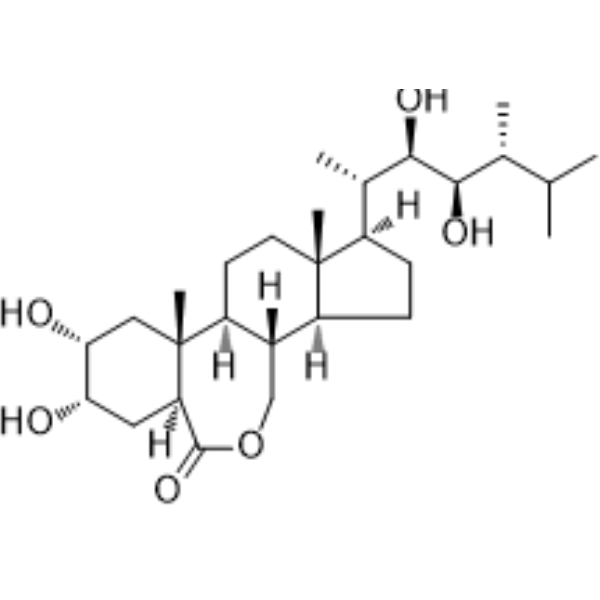
    Epibrassinolide
    Maximum Cited Publications
    16 Publications Verification

    24-Epibrassinolide; B1105; BP55

    Environmental Pollutants Apoptosis Cancer
    Epibrassinolide (24-Epibrassinolide) is a ubiquitously occurring plant growth hormone which shows great potential to alleviate heavy metals and pesticide stress in plants . Epibrassinolide is a potential apoptotic inducer in various cancer cells without affecting the non-tumor cell growth .
    Epibrassinolide
  • HY-100493
    BP-1-102
    10+ Cited Publications

    STAT Cancer
    BP-1-102 is an orally available, small-molecule inhibitor of transcription factor Stat3, with an IC50 of 6.8 μM.
    BP-1-102
  • HY-156110

    Insulin Receptor Cancer
    IGF2BP1-IN-1 (Compound A11) is a IGF2BP1 inhibitor and inhibits downstream signaling. IGF2BP1-IN-1 binds to IGF2BP1 protein with a KD value of 2.88 nM. IGF2BP1-IN-1 inhibits cancer cells proliferation (IC50: 9 nM for A549 cell, 34 nM for HCT116). IGF2BP1-IN-1 induces cancer cell apoptosis. GF2BP1-IN-1 inhibits tumor growth in A549 xenograft mouse model .
    IGF2BP1-IN-1
  • HY-176471

    Insulin Receptor Cancer
    IGF2BP3-IN-1 (Compound I3IN-122) is an IGF2BP3 (a RNA binding protein) inhibitor (IC50: > 50 μM), and can be used for cancer research .
    IGF2BP3-IN-1
  • HY-115997

    PROTACs HSP Cancer
    PROTAC HSP90 degrader BP3 is a potent and selective degradation of HSP90 in a CRBN-dependent fashion. PROTAC HSP90 degrader BP3 has a certain degradation effect on HSP90 protein in MCF-7 cells (DC50=0.99 μM). PROTAC HSP90 degrader BP3 inhibits the growth of breast cancer cell . PROTAC HSP90 degrader BP3 is a click chemistry reagent, it contains an Alkyne group and can undergo copper-catalyzed azide-alkyne cycloaddition (CuAAc) with molecules containing Azide groups.
    PROTAC HSP90 degrader BP3
  • HY-P10131

    Radionuclide-Drug Conjugates (RDCs) FAP Cancer
    3BP-3940 is a highly potent and selective peptide inhibitor of FAP that targets cancer-associated fibroblasts (CAFs) in the tumor microenvironment. 3BP-3940 can be labeled with radionuclides (such as Ga-68) for precise tumor imaging or Lu-177 for the development of targeted anticancer technologies. 3BP-3940 accumulates in tumor lesions and can be used to diagnose and inhibit various solid cancers and CAFs-related diseases .
    3BP-3940
  • HY-19470
    Topilutamide
    1 Publications Verification

    BP766; Fluridil

    Androgen Receptor Cancer
    Topilutamide is a topical nonsteroidal antiandrogen (NSAA).
    Topilutamide
  • HY-P3441A

    FAP Cancer
    3BP-4089 TFA is a highly efficient fibroblast activation protein (FAP) targeting peptide. 3BP-4089 TFA is often conjugated with radionuclides for tumor diagnosis and research .
    3BP-4089 TFA
  • HY-136797

    Dengue Virus Infection
    BP13944 is a potential small molecule inhibitor discovered by high-throughput screening. It can effectively inhibit the expression of dengue virus (DENV) replicons with an EC50 value of 1.03±0.09 μM. BP13944 can inhibit the replication or viral RNA synthesis of all four serotypes of DENV, but is ineffective against Japanese encephalitis virus. BP13944 may target the DENV NS3 protease, and the E66G amino acid substitution in the NS3 protease region will cause the virus to become resistant to BP13944. BP13944 has no obvious cytotoxicity. As there is currently no effective dengue vaccine and treatment, BP13944, as an effective small molecule inhibitor, may become a potential agent for the treatment of dengue in the future.
    BP13944
  • HY-U00035

    Bacterial Infection
    MGB-BP-3 is an antibiotic that has been shown to be active against a broad range of important multi-resistant Gram-positive pathogens.
    MGB-BP-3
  • HY-RS06709

    Small Interfering RNA (siRNA) Others

    IL18BP Human Pre-designed siRNA Set A contains three designed siRNAs for IL18BP gene (Human), as well as a negative control, a positive control, and a FAM-labeled negative control.

    IL18BP Human Pre-designed siRNA Set A
    IL18BP Human Pre-designed siRNA Set A
  • HY-D2751

    Fluorescent Dye Others
    BP Fluor 488 Cadaverine is a carboxyl/carbonyl reactive building block used widely to modify carboxylic groups in the presence of activators (e.g. EDC or DCC) or activated esters (e.g. NHS esters) through a stable amide bond.
    BP Fluor 488 cadaverine
  • HY-153495

    BP1001

    Bcl-2 Family Apoptosis Reactive Oxygen Species (ROS) Cancer
    Prexigebersen (BP1001) is an antisense oligonucleotide targeting Bcl-2 and Grb2. Prexigebersen exhibits antileukemic activity in cell models. Prexigebersen induces apoptosis (apoptosis), cell cycle arrest and ROS production in leukemia cells. Prexigebersen inhibits Grb2 expression, thereby suppressing tumor growth and survival. Prexigebersen can be used in studies related to acute myeloid leukemia .
    Prexigebersen
  • HY-153495A

    BP1001 sodium

    ERK Cancer
    Prexigebersen sodium is an antisense oligonucleotide designed to inhibit protein synthesis of Grb2 (growth factor receptor bound protein 2).
    Prexigebersen sodium
  • HY-P3441

    FAP Cancer
    3BP-4089 is a highly efficient fibroblast activation protein (FAP) targeting peptide. 3BP-4089 is often conjugated with radionuclides for tumor diagnosis and research .
    3BP-4089
  • HY-P11101

    Biochemical Assay Reagents Others
    plCSA-BP is a Placental CSA-binding peptide. plCSA-BP binds specifically to trophoblasts and not to other cell types in the placenta or to CSA-expressing cells in other tissues. plCSA-BP can guide nanoparticles for the targeted delivery of payloads (such as Indocyanine green (ICG) (HY-D0711) and Methotrexate (MTX) (HY-14519)) to the placenta, promising for placenta-specific drug delivery .
    plCSA-BP
  • HY-110087

    nAChR Neurological Disease
    4BP-TQS is a potent allosteric agonist of α7 nAChR. 4BP-TQS activates nAChRs via an allosteric transmembrane site .
    4BP-TQS
  • HY-N0848R

    24-Epibrassinolide (Standard); B1105 (Standard); BP55 (Standard)

    Reference Standards Apoptosis Cancer
    Epibrassinolide (Standard) is the analytical standard of Epibrassinolide. This product is intended for research and analytical applications. Epibrassinolide (24-Epibrassinolide) is a ubiquitously occurring plant growth hormone which shows great potential to alleviate heavy metals and pesticide stress in plants[1]. Epibrassinolide is a potential apoptotic inducer in various cancer cells without affecting the non-tumor cell growth[2].
    Epibrassinolide (Standard)
  • HY-123207

    5-HT Receptor Metabolic Disease
    BP 554 is a selective 5-HT1A receptor agonist and Piperazine derivative. BP 554 leads to hypothermia .
    BP 554
  • HY-W668749

    FAP Cancer
    3BP-3580 is a fibroblast activation protein (FAP) inhibitor (pIC50: 8.6), and can be used for cancer research .
    3BP-3580
  • HY-136778

    PARP Reactive Oxygen Species (ROS) Bcl-2 Family Caspase ERK p38 MAPK Cardiovascular Disease
    INH2BP is a poly(ADP-ribose) polymerase (PARP) inhibitor with antioxidant and anti-apoptotic activities. INH2BP reduces the production of intracellular reactive oxygen species (ROS), modulates the expression of apoptosis-related proteins such as Bax, Bcl-2 and cleaved caspase-3 and enhances cell survival through the activation of the ERK1/2 and p38 MAPK signaling pathways. INH2BP is promising for research of cardiovascular diseases .
    INH2BP
  • HY-D2771

    Fluorescent Dye Others
    BP Fluor 405 NHS Ester is a water-soluble, blue-fluorescent dye that is often used in multi-color applications, including flow cytometry and super-resolution microscopy using STORM. Its excitation is ideally suited for the 407 nm spectral line of the krypton laser or the 408 nm violet laser diode. BP Fluor 405 conjugates are pH-insensitive from pH 4 to pH 10. The NHS ester (or succinimidyl ester) is the most popular amine reactive group for labeling with the primary amines of proteins (Lys), amine-modified oligonucleotides, and other amine-containing molecules. Proteins can be labeled with BP Fluor 405 NHS Ester at high molar ratios without significant self-quenching, leading to brighter conjugates and more sensitive detection. BP Fluor 405 conjugates can also be used for the detection of abundance targets.
    BP Fluor 405 NHS ester
  • HY-W800701

    Biochemical Assay Reagents Others
    BP Fluor 546 DBCO is an azide-reactive probe that can be used for imaging azide-tagged biomolecules via a copper-free click reaction. The DBCO moiety reacts with azides to form a stable triazole and does not require a Cu-catalyst or elevated temperatures. In applications where the presence of copper is a concern, BP Fluor 546 DBCO is an ideal alternative to copper-requiring fluorescent alkynes. BP Fluor 546 is a water-soluble, pH-insensitive (from pH 4-10), orange-fluorescent dye with absorption and emission maxima at 554 and 570 nm, respectively. It can be used with the 488 nm and 532 nm laser lines. BP Fluor 546 dye conjugates to a variety of antibodies, peptides, proteins, tracers, and amplification substrates, which are often used for generating stable signals in imaging and flow cytometry.
    BP Fluor 546 DBCO
  • HY-RS00101

    Small Interfering RNA (siRNA) Others

    ABI3BP Human Pre-designed siRNA Set A contains three designed siRNAs for ABI3BP gene (Human), as well as a negative control, a positive control, and a FAM-labeled negative control.

    ABI3BP Human Pre-designed siRNA Set A
    ABI3BP Human Pre-designed siRNA Set A
  • HY-W781921

    Fluorescent Dye Others
    BP Fluor 488 Alkyne is a popular labeling dye used in Click Chemistry reactions. It will react with the azide group in antibody, proteins, peptides, amino-modified oligos, and other target molecules. The dye has an excitation peak at 499 nm and an emission peak at 520 nm. The conjugates are widely used in microscopy, flow cytometry, and other applications. BP Fluor 488 is a pure 5-sulfonated rhodamine molecule and it eliminates the lot-to-lot variation caused by two isomers ratio differences.
    BP Fluor 488 Alkyne
  • HY-D2760

    Fluorescent Dye Others
    BP Fluor 488 acid is a powerful labeling dye. It will react with the amine group in antibody, proteins, peptides, amino-modified oligos, and other target molecules. The dye has an excitation peak at 499 nm and an emission peak at 520 nm. The conjugates are widely used in microscopy, flow cytometry, and other applications.
    BP Fluor 488 acid
  • HY-D2744

    Fluorescent Dye Others
    BP Fluor 488 TCO reacts with tetrazines to produce a stable, covalent linkage, also referred to as the inverse-electron demand Diels-Alder cycloaddition reaction. This reaction is extremely fast (k > 800 M-1 s-1), selective, biocompatible, and does not require Cu-catalyst or elevated temperatures. Such excellent reaction rate constants are unparalleled by any other bioorthogonal reaction pair described to date.
    BP Fluor 488 TCO
  • HY-137090

    BP 2.94

    Histamine Receptor Neurological Disease
    BP 2-94 (BP 2.94) is an orally active and highly selective prodrug targeting the histamine H3 receptor. BP 2-94 exerts anti-inflammatory, analgesic and antinociceptive effects by inhibiting histamine release and modulating neurogenic inflammation. BP 2-94 is promising for research of asthma, migraines, and inflammatory pain-related disorders .
    BP 2-94
  • HY-125151

    STAT Apoptosis Cancer
    BP-1-108 is a selective inhibitor of STAT5 (Ki=8.3 μM) with anticancer activity. BP-1-108 induces apoptosis of leukemia cells by inhibiting the phosphorylation of STAT5. BP-1-108 can be used in the study of acute myeloid leukemia and prostate cancer .
    BP-1-108
  • HY-176440

    Virus Protease SARS-CoV PROTACs Infection
    BP-198 is an Mpro PROTAC degrader. BP-198 promotes the ubiquitination and degradation of Mpro. BP-198 has antiviral effects against SARS-CoV-2 (IC50: 11.8 μM) and has stronger activity against drug-resistant viruses. (Pink: target protein ligand (HY-176442); blue: E3 ligase ligand (HY-176441); black: linker (HY-W457968); E3 ligase-linker conjugate (HY-176443)) .
    BP-198
  • HY-P11257

    Radionuclide-Drug Conjugates (RDCs) Cancer
    DOTA-BP1 is a DOTA-modified BP1 (BCMA-targeting peptide). DOTA-BP1 can be radiolabeled with [ 68Ga]Ga to produce a BCMA-targeting PET tracer. DOTA-BP1 can be used in the research of detecting BCMA in multiple myeloma .
    DOTA-BP1
  • HY-106660

    Dopamine Receptor Neurological Disease
    BP 897 hydrochloride is a potent and partial dopamine D3 receptor agonist and a weak D2 receptor antagonist. BP 897 hydrochloride displays a high affinity at the dopamine D3 receptor (Ki=0.92 nM) and a 70 times lower affinity at the D2 receptor (Ki=61 nM) .
    BP 897 hydrochloride
  • HY-P6010

    Integrin Cancer
    αvβ6-BP is a selective αvβ6 binding peptide, and can be used for molecular imaging .
    αvβ6-BP
  • HY-170873

    Ligands for Target Protein for PROTAC DNA/RNA Synthesis Cancer
    G3BP1/2-Targeting ligand-1 is the ligand for G3BP1/2 that can be used as target protein ligand for synthesis of G3BP1/2 PROTAC degrader PT-129 (HY-170872) .
    G3BP1/2-Targeting ligand-1
  • HY-P6010A

    Integrin Cancer
    αvβ6-BP TFA is a selective αvβ6 binding peptide, and can be used for research of molecular imaging .
    αvβ6-BP TFA
  • HY-D2745

    Fluorescent Dye Others
    BP Fluor 594 NHS ester is the most popular tool for modifying proteins or antibodies through the primary amines (Lys), amine-modified oligonucleotides, and other amine-containing biomolecules with BP Fluor 594 label. The labeling occurs most efficiently at pH 7-9 and forms a stable, covalent amide bond. BP Fluor 594 dye can be used for proteins labeling at high molar ratios without significant self-quenching, enabling brighter conjugates and more sensitive detection. BP Fluor 594 is bright, water-soluble, and pH-insensitive from pH 4 to pH 10 red-fluorescent dye with absorption and emission maxima at 590 and 617 nm, respectively. It can be used with the 561 nm and 594 nm laser lines. BP Fluor 594 dye conjugated to a variety of antibodies, peptides, proteins, tracers, and amplification substrates often used for generation of stable signal in imaging and flow cytometry.
    BP Fluor 594 NHS ester
  • HY-W800680

    Fluorescent Dye Others
    BP Fluor 488 DBCO is a popular labeling dye used in copper-free Click Chemistry reactions. It will react with the azide group in antibody, proteins, peptides, amino-modified oligos, and other target molecules. The dye has an excitation peak at 499 nm and an emission peak at 520 nm. The conjugates are widely used in microscopy, flow cytometry, and other applications. BP Fluor 488 is a pure 5-sulfonated rhodamine molecule and it eliminates the lot-to-lot variation caused by two isomers ratio differences.
    BP Fluor 488 DBCO
  • HY-172269

    Fluorescent Dye Others
    BP Fluor 488 is a bright, green-fluorescent dye widely used for labeling aldehydes or ketones in polysaccharides or glycoproteins. The dye has an excitation peak at 499 nm and an emission peak at 520 nm. The conjugates are widely used in microscopy, flow cytometry, and other applications.
    BP Fluor 488
  • HY-109743

    Dopamine Receptor Neurological Disease
    BP14979 is a dopamine D3 receptor agonist with activity in the study of neurological diseases. BP14979 can be used to develop ligands with higher selectivity and affinity for D3 receptors. The structural characteristics of BP14979 make it potential in modulating the efficacy of D3 receptors. The design of BP14979 is based on the difference in efficacy with D3R selective antagonists, providing opportunities for optimizing new drug development .
    BP14979
  • HY-D1418

    Fluorescent Dye Others
    CP-BP-SFAC is a luminogenic molecule. CP-BP-SFAC exhibits strong sky-blue delayed fluorescence in neat films .
    CP-BP-SFAC
  • HY-114085

    Dopamine Receptor Neurological Disease
    BP 897 is a potent and partial dopamine D3 receptor agonist and a weak D2 receptor antagonist. BP 897 displays a high affinity at the dopamine D3 receptor (Ki=0.92 nM) and a 70 times lower affinity at the D2 receptor (Ki=61 nM) .
    BP 897
  • HY-D1417

    Fluorescent Dye Others
    P-BP-SFAC is a fluorescence molecule. P-BP-SFAC exhibits an apparent absorption band with a peak at about 377 nm, indicative of a stronger ICT effect .
    P-BP-SFAC
  • HY-P6009

    Integrin Cancer
    Cys-αvβ6-BP is a cysteine-terminated αvβ6 binding peptide .
    Cys-αvβ6-BP
  • HY-P6009A

    Integrin Cancer
    Cys-αvβ6-BP TFA is a cysteine-terminated αvβ6 binding peptide .
    Cys-αvβ6-BP TFA
  • HY-D1419

    Fluorescent Dye Others
    mCP-BP-SFAC is a luminogenic molecule. mCP-BP-SFAC exhibits strong sky-blue delayed fluorescence in neat films, with photoluminescence (PL) peaks at ~483 nm and delayed fluorescence lifetimes of 5.4 to 5.7 μs .
    mCP-BP-SFAC
  • HY-D1420

    Fluorescent Dye Others
    TCP-BP-SFAC is a luminogenic molecule. TCP-BP-SFAC exhibits strong sky-blue delayed fluorescence in neat films, with photoluminescence (PL) peaks at ~483 nm and delayed fluorescence lifetimes of 5.4 to 5.7 μs .
    TCP-BP-SFAC
  • HY-D2754

    Fluorescent Dye Others
    BP Light 550 acid is a vibrant orange-to-red fluorochrome with better performance t han other rhodamine derivatives, including BP Fluor 555, TRITC, and Cy3 dye for fluorescent applications. The high water solubility of BP Light Fluors means that a high dye-to-protein ratio can be attained without causing precipitation of the conjugates.
    BP Light 550 carboxylic acid
  • HY-157850

    Microtubule/Tubulin Cancer
    BP-M345 (compound 5) is a potent, cancer cell-targeting antiproliferative agent that exhibits low toxicity to non-tumor cells. BP-M345 inhibits cancer cell proliferation with a GI50 value ranging from 0.17 to 0.45 μM .
    BP-M345
  • HY-W800704

    Fluorescent Dye Others
    BP Fluor 594 alkyne is a bright, red-fluorescent alkyne-activated probe routinely used for imaging of azide-containing biomolecules. BP Fluor 594 alkyne reacts with azides via a copper-catalyzed click reaction (CuAAC) to form a stable triazole linker.
    BP Fluor 594 alkyne
  • HY-W800698

    Fluorescent Dye Others
    BP Fluor 430 Alkyne is a green-fluorescent alkyne-activated probe routinely used for imaging of moderate to high abundance azide-containing biomolecules. BP Fluor 430 Alkyne reacts with azides via a copper-catalyzed click reaction (CuAAC) to form a stable triazole linker. BP Fluor 430 is a bright, photostable, green-fluorescent probe optimally excited near 430 nm. This probe is water-soluble and its fluorescence is pH independent over a wide pH range.
    BP Fluor 430 alkyne

Inquiry Online

Your information is safe with us. * Required Fields.

Salutation


Country or Region *

Applicant Name *


Organization Name *

Department *


Email Address *


Product Name *

Cat. No.


Requested quantity *

Phone Number *


Remarks

Inquiry Online

Inquiry Information

Product Name:
Cat. No.:
Quantity:
MCE Japan Authorized Agent:

