27 Results for "

fluorescently labeled lectin

" in MedChemExpress (MCE) Product Catalog:
Products (27)

27 Results for "fluorescently labeled lectin" in MCE Product Catalog:

109
109 Cited Publications
Cat. No.: HY-66019
CAS No.: 3326-32-7
Synonyms: Fluorescein 5-isothiocyanate
Target:  

Fluorescent Dye

Research Areas:  

Others

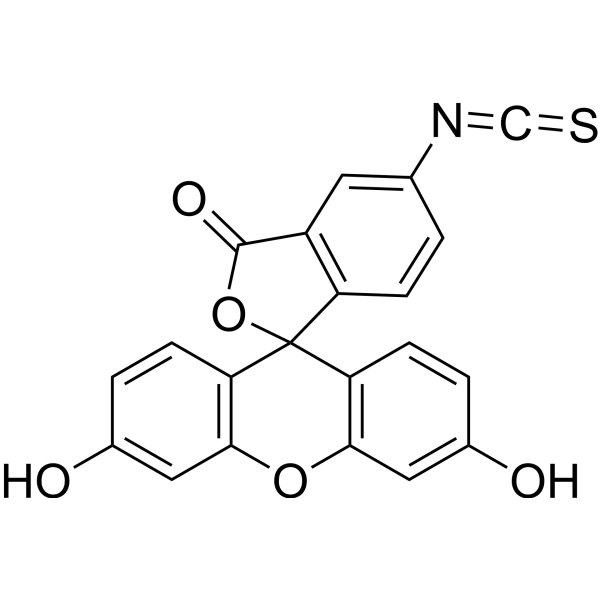
FITC (Fluorescein Isothiocyanate), is one of the green fluorescein derivatives widely used in biology. FITC has the characteristics of high absorptivity and excellent fluorescence quantum yield. The isothiocyanate group of FITC can be combined with amino, sulfhydryl, imidazole, tyrosyl, carbonyl and other groups on the protein, so as to achieve protein labeling including antibodies and lectins. In addition to its use as a protein marker, FITC can also be used as a fluorescent protein tracer to rapidly identify pathogens by labeling antibodies, or for microsequencing of proteins and peptides (HPLC). The maximum excitation wavelength of FITC is 494 nm. Once excited, it fluoresces yellow-green at a maximum emission wavelength of 520 nm. In addition, FITC is also a hapten that can induce contact hypersensitivity (CHS) and induce an atopic dermatitis model .
loading...
    loading...
2
2 Cited Publications
Cat. No.: HY-15941
CAS No.: 27072-45-3
Synonyms: Fluorescein 5(6)-isothiocyanate; Fluorescein isothiocyanate 5- and 6- isomers
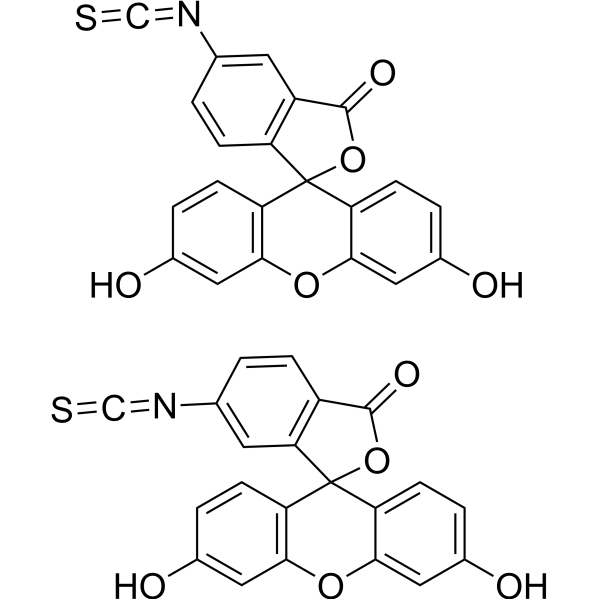
5(6)-FITC (Fluorescein 5(6)-isothiocyanate) is an amine-reactive derivative of a fluorescent dye, characterized by high absorbance and excellent fluorescence quantum yield. The isothiocyanate group of FITC can react with various functional groups on proteins, including amines, thiols, imidazoles, tyrosines and carbonyls, enabling the labeling of proteins such as antibodies and lectins. 5(6)-FITC has a wide range of applications, including flow cytometry, immunofluorescence, protease assays and conjugation. The maximum excitation/emission wavelengths are 492/518 nm .
loading...
    loading...
Cat. No.: HY-DY1007
CAS No.: 3326-32-7
Target:  

Fluorescent Dye

Research Areas:  

Inflammation/Immunology

FITC (Fluorescein Isothiocyanate) (solution) , is one of the green fluorescein derivatives widely used in biology. FITC has the characteristics of high absorptivity and excellent fluorescence quantum yield. The isothiocyanate group of FITC can be combined with amino, sulfhydryl, imidazole, tyrosyl, carbonyl and other groups on the protein, so as to achieve protein labeling including antibodies and lectins. In addition to its use as a protein marker, FITC can also be used as a fluorescent protein tracer to rapidly identify pathogens by labeling antibodies, or for microsequencing of proteins and peptides (HPLC). The maximum excitation wavelength of FITC is 494 nm. Once excited, it fluoresces yellow-green at a maximum emission wavelength of 520 nm. In addition, FITC is also a hapten that can induce contact hypersensitivity (CHS) and induce an atopic dermatitis model .
Solvent and concentration: DMSO: 20 mM
The 1 mL volume is defined as the base specification. All larger sizes correspond to incremental volumes of this base.
loading...
    loading...
Cat. No.: HY-NP0158
Synonyms: UEA I (Rhodamine)
Ulex Europaeus Agglutinin I Rhodamine (UEA I Rhodamine) is a fluorescently labeled lectin. Ulex Europaeus Agglutinin I Rhodamine exhibits specificity for cell surface glycoconjugates containing α-L-fucosyl groups. Ulex Europaeus Agglutinin I Rhodamine can be used in combination with other lectins for double staining .
loading...
    loading...
Cat. No.: HY-NP0138
Synonyms: PNA (Fluorescein)
Peanut Agglutinin (PNA) Fluorescein is a fluorescently labeled lectin that specifically binds to glycosylated cells and Haemonchus contortus. Peanut Agglutinin Fluorescein specifically recognizes and binds to the D-Gal-β(1→3)-D-GalNAc disaccharide sequence and terminal D-galactosyl residues on the cell surface; its binding can be inhibited by D-galactose but is not affected by glucose. Peanut Agglutinin Fluorescein specifically labels cone photoreceptor segments and can also be used to distinguish immature thymocytes from lymphocyte subsets, serving as an effective tool for studying cellular glycosylation status and isolating specific cell populations .
loading...
    loading...
Cat. No.: HY-NP071
Synonyms: LEL
Lycopersicon esculentum (Tomato) Lectin (LEL) specifically recognizes and binds to sugar structures, that combines with fluorescein for fluorescent labeling and imaging of cells and tissues. Lycopersicon esculentum (Tomato) Lectin is used to visualizes the vasculature within transplanted tissues by labeling with fluorescein .
loading...
    loading...
Cat. No.: HY-NP065M
Synonyms: DSL-Rhodamine
Datura Stramonium Lectin-Rhodamine (DSL-Rhodamine) is a datura lectin (DSL) labeled with the Rhodamine fluorescent dye. Datura Stramonium Lectin is a dimeric glycoprotein that specifically recognizes and binds to glycan structures containing N-acetylglucosamine (GlcNAc) oligomers. Datura Stramonium Lectin-Rhodamine can be used for glycosyl studies on cell surfaces (Ex/Em = 544/576 nm).
loading...
    loading...
Cat. No.: HY-NP065A
Synonyms: DSL-AF350
Datura Stramonium Lectin-AF350 (DSL-AF350) is a datura lectin (DSL) labeled with the AF350 fluorescent dye. Datura Stramonium Lectin is a dimeric glycoprotein that specifically recognizes and binds to glycan structures containing N-acetylglucosamine (GlcNAc) oligomers. Datura Stramonium Lectin-AF350 can be used for glycosyl studies on cell surfaces (Ex/Em = 346/445 nm).
loading...
    loading...
Cat. No.: HY-NP065B
Synonyms: DSL-AF405
Datura Stramonium Lectin-AF405 (DSL-AF405) is a datura lectin (DSL) labeled with the AF405 fluorescent dye. Datura Stramonium Lectin is a dimeric glycoprotein that specifically recognizes and binds to glycan structures containing N-acetylglucosamine (GlcNAc) oligomers. Datura Stramonium Lectin-AF405 can be used for glycosyl studies on cell surfaces (Ex/Em = 405/435 nm).
loading...
    loading...
Cat. No.: HY-NP065C
Synonyms: DSL-AF488
Datura Stramonium Lectin-AF488 (DSL-AF488) is a datura lectin (DSL) labeled with the AF488 fluorescent dye. Datura Stramonium Lectin is a dimeric glycoprotein that specifically recognizes and binds to glycan structures containing N-acetylglucosamine (GlcNAc) oligomers. Datura Stramonium Lectin-AF488 can be used for glycosyl studies on cell surfaces (Ex/Em = 470/520 nm).
loading...
    loading...
Cat. No.: HY-NP065D
Synonyms: DSL-AF568
Datura Stramonium Lectin-AF568 (DSL-AF568) is a datura lectin (DSL) labeled with the AF568 fluorescent dye. Datura Stramonium Lectin is a dimeric glycoprotein that specifically recognizes and binds to glycan structures containing N-acetylglucosamine (GlcNAc) oligomers. Datura Stramonium Lectin-AF568 can be used for glycosyl studies on cell surfaces (Ex/Em = 579/603 nm).
loading...
    loading...
Cat. No.: HY-NP065E
Synonyms: DSL-AF594
Datura Stramonium Lectin-AF594 (DSL-AF594) is a datura lectin (DSL) labeled with the AF594 fluorescent dye. Datura Stramonium Lectin is a dimeric glycoprotein that specifically recognizes and binds to glycan structures containing N-acetylglucosamine (GlcNAc) oligomers. Datura Stramonium Lectin-AF594 can be used for glycosyl studies on cell surfaces (Ex/Em = 590/617 nm).
loading...
    loading...
Cat. No.: HY-NP065H
Synonyms: DSL-AF647
Datura Stramonium Lectin-AF647 (DSL-AF647) is a datura lectin (DSL) labeled with the AF647 fluorescent dye. Datura Stramonium Lectin is a dimeric glycoprotein that specifically recognizes and binds to glycan structures containing N-acetylglucosamine (GlcNAc) oligomers. Datura Stramonium Lectin-AF647 can be used for glycosyl studies on cell surfaces (Ex/Em = 650/665 nm).
loading...
    loading...
Cat. No.: HY-NP065I
Synonyms: DSL-AF680
Datura Stramonium Lectin-AF680 (DSL-AF680) is a datura lectin (DSL) labeled with the AF680 fluorescent dye. Datura Stramonium Lectin is a dimeric glycoprotein that specifically recognizes and binds to glycan structures containing N-acetylglucosamine (GlcNAc) oligomers. Datura Stramonium Lectin-AF680 can be used for glycosyl studies on cell surfaces (Ex/Em = 684/707 nm).
loading...
    loading...
Cat. No.: HY-NP065J
Synonyms: DSL-Cy3
Datura Stramonium Lectin-Cy3 (DSL-Cy3) is a datura lectin (DSL) labeled with the Cy3 fluorescent dye. Datura Stramonium Lectin is a dimeric glycoprotein that specifically recognizes and binds to glycan structures containing N-acetylglucosamine (GlcNAc) oligomers. Datura Stramonium Lectin-Cy3 can be used for glycosyl studies on cell surfaces (Ex/Em = 554/568 nm).
loading...
    loading...
Cat. No.: HY-NP065K
Synonyms: DSL-Cy5
Datura Stramonium Lectin-Cy5 (DSL-Cy5) is a datura lectin (DSL) labeled with the Cy5 fluorescent dye. Datura Stramonium Lectin is a dimeric glycoprotein that specifically recognizes and binds to glycan structures containing N-acetylglucosamine (GlcNAc) oligomers. Datura Stramonium Lectin-Cy5 can be used for glycosyl studies on cell surfaces (Ex/Em = 646/664 nm).
loading...
    loading...
Cat. No.: HY-NP065L
Synonyms: DSL-Cy7
Datura Stramonium Lectin-Cy7 (DSL-Cy7) is a datura lectin (DSL) labeled with the Cy7 fluorescent dye. Datura Stramonium Lectin is a dimeric glycoprotein that specifically recognizes and binds to glycan structures containing N-acetylglucosamine (GlcNAc) oligomers. Datura Stramonium Lectin-Cy7 can be used for glycosyl studies on cell surfaces (Ex/Em = 740/770 nm).
loading...
    loading...
Cat. No.: HY-NP071A
Synonyms: LEL-AF350
Lycopersicon esculentum (Tomato) Lectin-AF350 (LEL-AF350) is Lycopersicon esculentum lectin (LEL) labeled with the AF350 fluorescent dye. Lycopersicon esculentum (Tomato) lectin specifically recognizes and binds to glycan structures, primarily targeting N-acetyl-β-D-glucosamine residues. Lycopersicon esculentum (Tomato) Lectin-AF350 can be used to study glycosylation and localize glycan structures on cell surfaces and in tissue sections (Ex/Em = 346/445 nm).
loading...
    loading...
Cat. No.: HY-NP071B
Synonyms: LEL-AF405
Lycopersicon esculentum (Tomato) Lectin-AF405 (LEL-AF405) is Lycopersicon esculentum lectin (LEL) labeled with the AF405 fluorescent dye. Lycopersicon esculentum (Tomato) lectin specifically recognizes and binds to glycan structures, primarily targeting N-acetyl-β-D-glucosamine residues. Lycopersicon esculentum (Tomato) Lectin-AF405 can be used to study glycosylation and localize glycan structures on cell surfaces and in tissue sections (Ex/Em = 405/435 nm).
loading...
    loading...
Cat. No.: HY-NP071C
Synonyms: LEL-AF488
Lycopersicon esculentum (Tomato) Lectin-AF488 (LEL-AF488) is Lycopersicon esculentum lectin (LEL) labeled with the AF488 fluorescent dye. Lycopersicon esculentum (Tomato) lectin specifically recognizes and binds to glycan structures, primarily targeting N-acetyl-β-D-glucosamine residues. Lycopersicon esculentum (Tomato) Lectin-AF488 can be used to study glycosylation and localize glycan structures on cell surfaces and in tissue sections (Ex/Em = 470/520 nm).
loading...
    loading...

