
1. Search Result
Search Result
Results for "

selective binding

" in MedChemExpress (MCE) Product Catalog:

1109

Inhibitors & Agonists

15

Screening Libraries

25

Fluorescent Dye

13

Biochemical Assay Reagents

71

Peptides

1

MCE Kits

26

Inhibitory Antibodies

53

Natural
Products

1

Recombinant Proteins

40

Isotope-Labeled Compounds

9

Click Chemistry

7

Oligonucleotides

Cat. No. Product Name Target Research Areas Chemical Structure
  • HY-101562
    Inavolisib
    5+ Cited Publications

    GDC-0077; RG6114

    PI3K Apoptosis Cancer
    Inavolisib (GDC-0077) is a potent, orally active, and selective PI3Kα inhibitor (IC50=0.038 nM). Inavolisib exerts its activity by binding to the ATP binding site of PI3K, thereby inhibiting the phosphorylation of PIP2 to PIP3. Inavolisib is more selective for mutant versus wild-type PI3Kα. Inavolisib can be used for the study of breast cancer .
    Inavolisib
  • HY-10010
    Ko 143
    45+ Cited Publications

    BCRP Cancer
    Ko 143 is a potent and selective ATP-binding cassette subfamily G member 2 (ABCG2/BCRP) inhibitor. Ko 143 displays >200-fold selectivity over P-gp and MRP-1 transporters .
    Ko 143
  • HY-13956
    Pioglitazone
    45+ Cited Publications

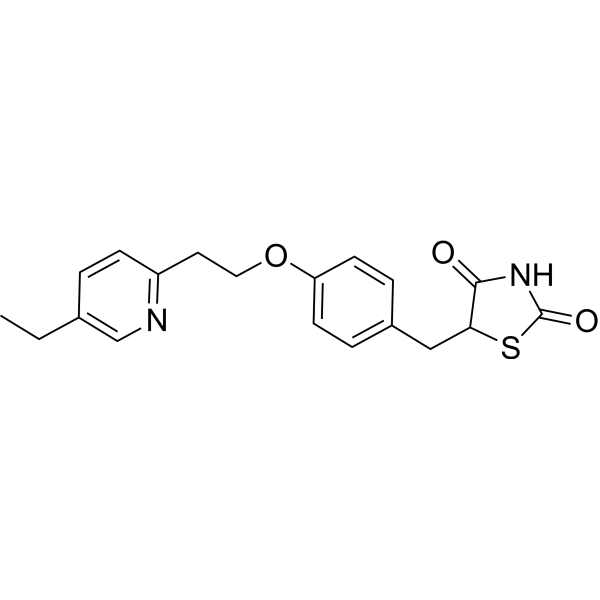
    U 72107

    PPAR Ferroptosis Metabolic Disease Cancer
    Pioglitazone (U 72107) is an orally active and selective PPARγ (peroxisome proliferator-activated receptor) agonist with high affinity binding to the PPARγ ligand-binding domain with EC50 of 0.93 and 0.99 μM for human and mouse PPARγ, respectively. Pioglitazone can be used in diabetes research .
    Pioglitazone
  • HY-15676
    Idasanutlin
    50+ Cited Publications

    RG7388

    MDM-2/p53 E1/E2/E3 Enzyme Cancer
    Idasanutlin (RG7388) is a potent and selective MDM2 antagonist, inhibiting p53-MDM2 binding, with an IC50 of 6 nM.
    Idasanutlin
  • HY-16711
    SB225002
    55+ Cited Publications

    CXCR Inflammation/Immunology Endocrinology Cancer
    SB225002, a potent, selective and non-peptide CXCR2 antagonist, inhibits 125I-IL-8 binding to CXCR2 with an IC50 of 22 nM.
    SB225002
  • HY-100354
    C16-Ceramide (d18:1/16:0)
    5+ Cited Publications

    C16-Ceramide

    MDM-2/p53 Apoptosis Endogenous Metabolite Cancer
    C16-Ceramide (d18:1/16:0) is a natural small molecule activating p53 through the direct and selective binding .
    C16-Ceramide (d18:1/16:0)
  • HY-102080
    SAFit2
    5+ Cited Publications

    FKBP Cancer
    SAFit2, a chemical probe, is a highly potent, highly selective FK506-binding protein 51 (FKBP51) inhibitor with a Ki of 6 nM and also enhances AKT2-AS160 binding .
    SAFit2
  • HY-109176
    Giredestrant
    5 Publications Verification

    GDC-9545; RG6171

    Estrogen Receptor/ERR Cancer
    Giredestrant (GDC-9545), a non-steroidal estrogen receptor (ER) ligand, is an orally active and selective ER antagonist. Giredestrant potently competes with Estradiol for binding and induces a conformational change within the ER ligand binding domain. Giredestrant has anti-tumor activity .
    Giredestrant
  • HY-145817A
    lunresertib
    5+ Cited Publications

    RP-6306

    Wee1 Cancer
    lunresertib (RP-6306) is a potent, selective and orally active PKMYT1 inhibitor with an IC50 of 14 nM. lunresertib shows a high degree of selectivity over other kinases in cellular binding assays. lunresertib shows anticancer effects .
    lunresertib
  • HY-U00451
    ATP-Red 1
    5+ Cited Publications

    Fluorescent Dye Others
    ATP-Red 1 is a multisite-binding switchable fluorescent probe, and can selectively and rapidly responds to intracellular concentrations of ATP in living cells (Ex/Em = 510/590 nm).
    ATP-Red 1
  • HY-111941
    GSK8612
    25+ Cited Publications

    IKK Neurological Disease Inflammation/Immunology Cancer
    GSK8612 is a highly selective and potent Tank-binding Kinase-1 (TBK1) inhibitor, with a pIC50 of 6.8 for recombinant TBK1 .
    GSK8612
  • HY-145010
    SN-011
    10+ Cited Publications

    STING Inflammation/Immunology
    SN-011 is a potent and selective mouse and human STING inhibitor, with an IC50 of 76 nM for STING signaling. SN-011 competes with cyclic dinucleotide (CDN) for the binding pocket of the STING dimer, blocking CDN binding and STING activation. SN-011 can be used for the research of STING-driven autoimmune and inflammatory disease .
    SN-011
  • HY-10074
    TPCA-1
    40+ Cited Publications

    IKK STAT Apoptosis Inflammation/Immunology Cancer
    TPCA-1 is a potent and selective inhibitor of IKK-2 with IC50 of 17.9 nM. TPCA-1 is an effective inhibitor of STAT3 phosphorylation, DNA binding, and transactivation.
    TPCA-1
  • HY-147057
    Rofapitide tetraxetan
    5+ Cited Publications

    FAP-2286

    FAP Cancer
    Rofapitide tetraxetan (FAP-2286) is a potent and selective FAP-binding peptide with a mean IC50 value of 2.7 nM for binding to FAP. Rofapitide tetraxetan can be labeled with radionuclides for diagnostic applications. Rofapitide tetraxetan has antitumor activity .
    Rofapitide tetraxetan
  • HY-108466
    Ro 08-2750
    4 Publications Verification

    Apoptosis Neurological Disease Cancer
    Ro 08-2750 is a non-peptide and reversible nerve growth factor (NGF) inhibitor which binds to NGF, and with an IC50 of ~ 1 μM. Ro 08-2750 inhibits NGF binding to p75 NTR selectively over TRKA . Ro 08-2750 is a selective MSI RNA-binding activity inhibitor, with an IC50 of 2.7 μM .
    Ro 08-2750
  • HY-18628
    UMI-77
    4 Publications Verification

    Bcl-2 Family Cancer
    UMI-77 is a selective Mcl-1 inhibitor, which shows high binding affinity to Mcl-1 (IC50=0.31 μM). UMI-77 binds to the BH3 binding groove of Mcl-1 with Ki of 490 nM, showing selectivity over other members of anti-apoptotic Bcl-2 members.
    UMI-77
  • HY-114384
    Mefluleucine
    5+ Cited Publications

    NV-5138

    mTOR Neurological Disease
    Mefluleucine (NV-5138), a leucine analog, is the first selective and orally active brain mTORC1 activator, binding to Sestrin2. Mefluleucine is used for antidepressant studies .
    Mefluleucine
  • HY-12488
    LY2510924
    10+ Cited Publications

    CXCR Endocrinology Cancer
    LY2510924 is a potent and selective CXCR4 antagonist that blocks SDF-1 binding to CXCR4 with an IC50 of 0.079 nM.
    LY2510924
  • HY-10799
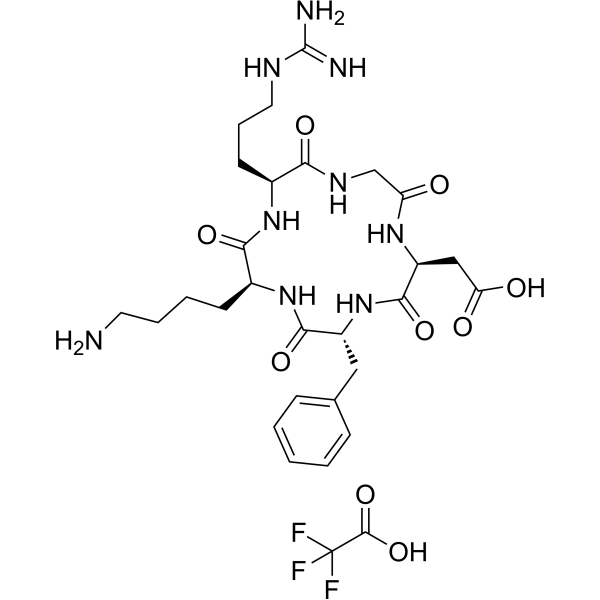
    EG00229 trifluoroacetate
    10+ Cited Publications

    Complement System Cancer
    EG00229 is a neuropilin 1 (NRP1) receptor antagonist. EG00229 selectively inhibits VEGF-A binding to NRP1 b1 domain with an IC50 of 3 μM, but has no effect on VEGFA binding to VEGFR-1 and VEGFR-2 .
    EG00229 trifluoroacetate
  • HY-15894A
    BQ-788
    10+ Cited Publications

    Endothelin Receptor Cardiovascular Disease Endocrinology Cancer
    BQ-788 is a potent, selective ETB receptor antagonist with IC50 of 1.2 nM for inhibition of ET-1 binding to human Girardi heart cells, poorly inhibiting the binding to ETA receptors in human neuroblastoma cell line SK-N-MC cells with IC50 of 1300 nM .
    BQ-788
  • HY-153181
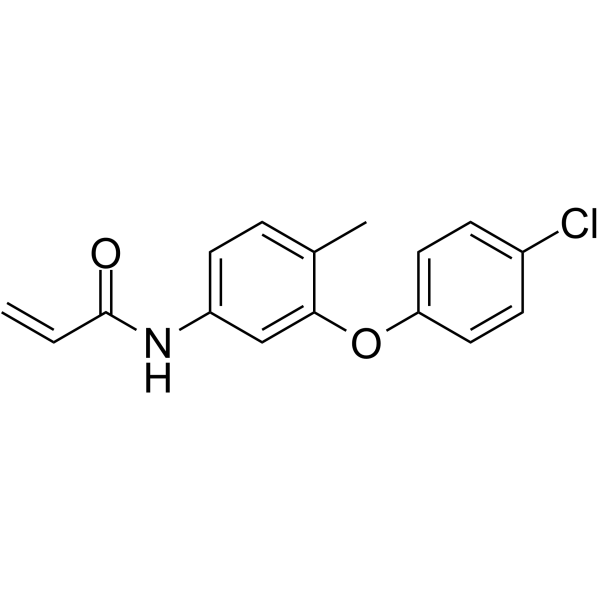
    Trametiglue
    1 Publications Verification

    MEK Cancer
    Trametiglue, a derivative of Trametinib (HY-10999), targets both KSR-MEK and RAF-MEK with unprecedented potency and selectivity via unique interfacial binding interactions .
    Trametiglue
  • HY-122422

    5-HT Receptor Others
    Gepirone is a selective and affinitive 5-HT1A agonist. Gepirone binds selectively to 5-HT1A receptor binding site. Gepirone acts as an antidepressant agent can be used for anxiety and major depressive disorder research .
    Gepirone
  • HY-100815B

    (±)-AMPA

    iGluR Neurological Disease
    (RS)-AMPA ((±)-AMPA) is a glutamate analogue and a potent and selective excitatory neurotransmitter L-glutamic acid agonist. (RS)-AMPA does not interfere with binding sites for kainic acid or NMDA receptors .
    (RS)-AMPA
  • HY-15085

    iGluR Neurological Disease
    MDL 105519 is a potent and selective antagonist of glycine binding to the NMDA receptor.
    MDL 105519
  • HY-138280
    DTHIB
    5+ Cited Publications

    HSP Cancer
    DTHIB is a direct and selective heat shock factor 1 (HSF1) inhibitor with a Kd of 160 nM for DTHIB binding to the HSF1 DNA binding domain (DBD). DTHIB inhibits HSF1 cancer gene signature (HSF1 CaSig) and selectively stimulates degradation of nuclear HSF1. DTHIB has potently anticancer activities and can be used for prostate cancer research .
    DTHIB
  • HY-23999
    BI-0115
    2 Publications Verification

    LOX-1 Cardiovascular Disease
    BI-0115 is a selective inhibitor of LOX-1 (IC50=5.4 μM) that blocks cellular uptake of oxLDL. BI-0115 binding triggers receptor inhibition by formation of dimers of the homodimeric ligand binding domain .
    BI-0115
  • HY-16582A
    Sonidegib
    10+ Cited Publications

    Erismodegib; LDE225; NVP-LDE225

    Smo Cancer
    Sonidegib (Erismodegib) is a potent and selective Smo antagonist with IC50 of 1.3 nM and 2.5 nM for mouse and human Smo in binding assay, respectively .
    Sonidegib
  • HY-13274
    JTC-801
    5+ Cited Publications

    Opioid Receptor Neurological Disease
    JTC-801 is a selective opioid receptor-like1 (ORL1) receptor antagonist, binding to ORL1 receptor with a Ki value of 8.2 nM.
    JTC-801
  • HY-136521

    Epigenetic Reader Domain Cancer
    AZ13824374 is a potent and selective ATAD2 bromodomain inhibitor (pIC50 of 6.9 in HCT116 cells). AZ13824374 disrupts chromatin interactions and gene transcription by binding to the acetyl-lysine binding site of the ATAD2 bromodomain. AZ13824374 has anticancer activity against breast cancer .
    AZ13824374
  • HY-15894
    BQ-788 sodium salt
    10+ Cited Publications

    Endothelin Receptor Cardiovascular Disease Endocrinology Cancer
    BQ-788 sodium salt is a potent and selective ETB receptor antagonist, inhibiting ET-1 binding to ETB receptors with an IC50 of 1.2 nM in human Girrardi heart cells .
    BQ-788 sodium salt
  • HY-16582
    Sonidegib diphosphate
    10+ Cited Publications

    Erismodegib diphosphate; LDE225 diphosphate; NVP-LDE225 diphosphate

    Smo Cancer
    Sonidegib diphosphate (Erismodegib diphosphate) is a potent and selective Smo antagonist with IC50 of 1.3 nM and 2.5 nM for mouse and human Smo in binding assay, respectively .
    Sonidegib diphosphate
  • HY-119323
    7-Azido-4-methylcoumarin
    1 Publications Verification

    Fluorescent Dye Others
    7-Azido-4-methylcoumarin is a selective coumarin-based fluorescent probe for hydrogen sulfide (H2S). In the presence of H2S, the aromatic azido group of 7-Azido-4-methylcoumarin is selectively reduced to produce the fluorescently active 7-amino-4-methylcoumarin (AMC). 7-Azido-4-methylcoumarin binds to the coumarin/phenol-binding site of BSA, the aglycone-binding site of UGT1A6, and the substrate-binding site of SULT1A1, respectively. 7-Azido-4-methylcoumarin retains its fluorescent properties after covalent binding, acts as a fluorescent H2S probe, and does not react with cysteine, homocysteine or glutathione (Ex/Em = 340/445 nm) .
    7-Azido-4-methylcoumarin
  • HY-117690

    PROTACs Epigenetic Reader Domain Cancer
    dBRD9,a PROTAC, can selective degrades BRD9. dBRD9 improves the bromine domain binding profile and reduces the binding activity of the whole BET family .
    dBRD9
  • HY-10013
    Taranabant
    2 Publications Verification

    MK-0364

    Cannabinoid Receptor Metabolic Disease
    Taranabant is a highly potent and selective cannabinoid 1 (CB1) receptor inverse agonist that inhibits the binding and functional activity of various agonists, with a binding Ki of 0.13 nM for the human CB1R in vitro.
    Taranabant
  • HY-136379
    CID44216842
    2 Publications Verification

    Cdc42-IN-1

    Ras Cancer
    CID44216842 (Cdc42-IN-1) is a potent Cdc42-selective guanine nucleotide binding lead inhibitor. The EC50s for Cdc42 WT and Cdc42Q61L mutant are 1.0 and 1.2 μM in GTP binding assay, respectively. The EC50s for Cdc42 WT and Cdc42Q61L mutant are 0.3 and 0.5 μM in GDP binding assay, respectively. Use as a molecular probe .
    CID44216842
  • HY-112895
    UT-155
    2 Publications Verification

    Androgen Receptor Cancer
    UT-155 is a selective and potent androgen receptor (AR) antagonist, with a Ki of 267 nM for UT-155 binding to AR-LBD.
    UT-155
  • HY-103358
    KF38789
    2 Publications Verification

    P-selectin Inflammation/Immunology
    KF38789 is a selective inhibitor of P-selectin-PSGL-1 binding. KF38789 inhibits the binding of U937 cells to immobilized P-selectin immunoglobulin G chimeric protein (P-selectin-Ig) with an IC50 value of 1.97 μM .
    KF38789
  • HY-152231

    Fluorescent Dye Ligands for E3 Ligase Others
    BODIPY FL thalidomide is a high-affinity and selective human cereblon (CRBN)-targeting fluorescent probe with a Kd of 3.6 nM. BODIPY FL thalidomide enables use as a probe in time-resolved fluorescence resonance energy transfer (TR-FRET) binding assays for cereblon ligands. BODIPY FL thalidomide supports development of highly sensitive, selective, stable cereblon TR-FRET binding assays (Ex/Em = 502/510 nm) .
    BODIPY FL thalidomide
  • HY-15653
    Filorexant
    2 Publications Verification

    MK-6096

    Orexin Receptor (OX Receptor) Neurological Disease Endocrinology
    Filorexant (MK-6096) is an orally bioavailable potent and selective reversible antagonist of OX1 and OX2 receptor(<3 nM in binding).
    Filorexant
  • HY-16684

    IRX-5183; VTP-195183; NRX-195183

    RAR/RXR Autophagy Cancer
    AGN-195183 (IRX-5183) is a potent and selective agonist of RARα (Kd=3 nM) with improved binding selectivity relative to AGN 193836. AGN-195183 has no activity on RARβ/γ.
    AGN-195183
  • HY-110286

    DNA/RNA Synthesis Cancer
    6-Hydroxy-DOPA is a selective and effective allosteric inhibitor of the RAD52 ssDNA binding domain. 6-Hydroxy-DOPA can be used for the research of cancer .
    6-Hydroxy-DOPA
  • HY-114384B
    Mefluleucine hydrochloride
    5+ Cited Publications

    NV-5138 hydrochloride

    mTOR Neurological Disease
    Mefluleucine (NV-513) hydrochloride, a leucine analog, is the first selective and orally active brain mTORC1 activator, binding to Sestrin2. Mefluleucine hydrochloride is used for antidepressant studies .
    Mefluleucine hydrochloride
  • HY-112398

    Epigenetic Reader Domain Others
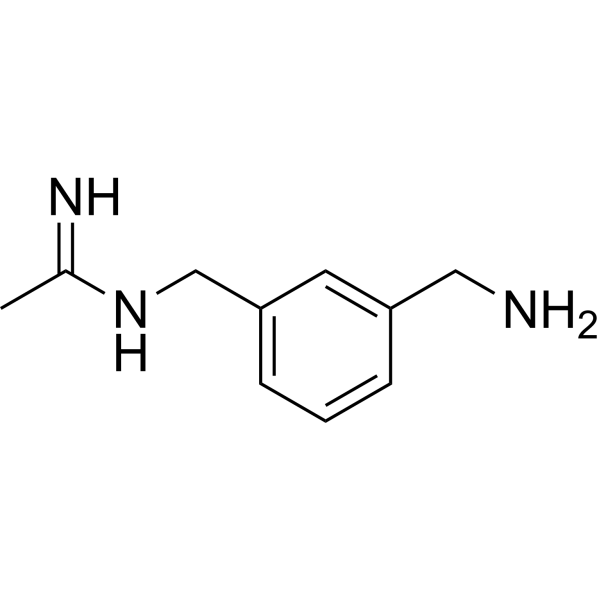
    GSK1379725A is a selective BPTF ligand with a Kd of 2.8 uM, showing no binding activity for Brd4 .
    GSK1379725A
  • HY-107568

    Histamine Receptor Inflammation/Immunology
    Iodophenpropit dihydrobromide is a potent and selective histamine H3 receptor antagonist. The binding of [ 125I]Iodophenpropit is selective, saturable, readily reversible, and of high affinity (KD 0.32 nM) .
    Iodophenpropit dihydrobromide
  • HY-P2271

    Apelin Receptor (APJ) Cancer
    MM 54 (compound 5) is a competitive antagonist at APJ, with an IC50 of 93 nM. MM 54 behaves as a potent and selective inhibitor of apelin binding and APLNR activation .
    MM 54
  • HY-13466
    MK-4256
    3 Publications Verification

    Somatostatin Receptor Metabolic Disease Endocrinology
    MK-4256 is a potent and selective SSTR3 antagonist with IC50s of 0.66 nM and 0.36 nM in human and mouse receptor binding assays, respectively.
    MK-4256
  • HY-W028690
    DNMDP
    4 Publications Verification

    Phosphodiesterase (PDE) Cancer
    DNMDP, a phosphodiesterase 3A (PDE3A) inhibitor, is a potent and selective cancer cell cytotoxic agent. DNMDP binding to PDE3A promotes an interaction between PDE3A and Schlafen 12 (SLFN12). DNMDP shows clear cell-selective cytotoxicity .
    DNMDP
  • HY-19770
    GSK2981278
    4 Publications Verification

    ROR Inflammation/Immunology
    GSK2981278 is a potent and selective RORγ inverse agonist. GSK2981278 inhibits activation of the il17 promoter and interferes RORγ-DNA binding .
    GSK2981278
  • HY-16682
    AGN 196996
    3 Publications Verification

    RAR/RXR Autophagy Cancer
    AGN 196996 is a potent and selective RARα antagonist with Ki value of 2 nM; little binding affinity for RARβ(Ki=1087 nM) and RARγ(Ki=8523 nM).
    AGN 196996
  • HY-P10579
    123B9
    1 Publications Verification

    Ephrin Receptor Cancer
    123B9, a tumor-homing agent, is a potent and selective EphA2 agonist with a Kd value of 4.0 μM. 123B9 selectively targets the EphA2 tyrosine kinase receptor ligand-binding domain. 123B9 does not appreciably inhibit the ligand binding domains of the most closely related EphA3 and EphA4 receptors .
    123B9

Inquiry Online

Your information is safe with us. * Required Fields.

Salutation


Country or Region *

Applicant Name *


Organization Name *

Department *


Email Address *


Product Name *

Cat. No.


Requested quantity *

Phone Number *


Remarks

Inquiry Online

Inquiry Information

Product Name:
Cat. No.:
Quantity:
MCE Japan Authorized Agent:

