



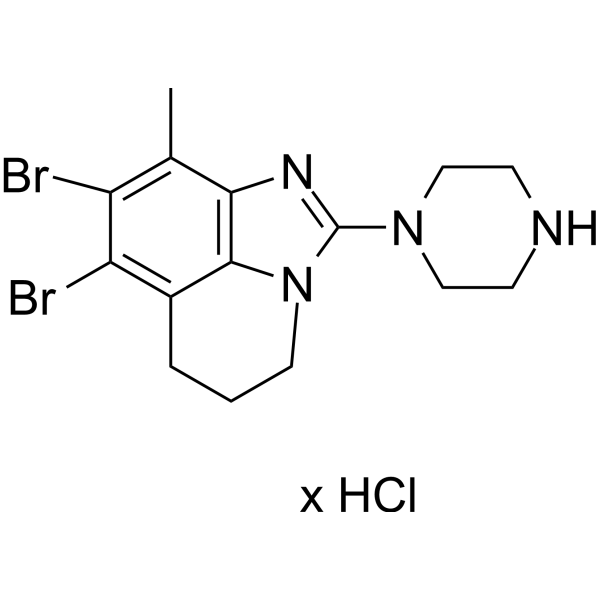
Romaciclib hydrochloride
Based on 8 publication(s) in Google Scholar
SEL120-34A hydrochloride is a potent, selective, orally available, ATP-competitive CDK8 inhibitor, with IC50s of 4.4 nM and 10.4 nM for CDK8/CycC and CDK19/CycC, respectively, with antitumor activity.
For research use only. We do not sell to patients.
- Purity : 99.82%
- CAS No.: 1609452-30-3
- Formula: C15H18Br2N4.xHCl
-
Storage:
4°C, sealed storage, away from moisture
* In solvent : -80°C, 6 months; -20°C, 1 month (sealed storage, away from moisture)

To place orders, for customer services and technical support, please contact: MedChemExpress USA
Tel: 609-228-6898 E-mail: [email protected] [email protected]


-
 Biological Activity
-
Chemical Information
-
Solvent & Solubility
- Purity & Documentation
- References
-
 Help & FAQs


Publications Citing Use of MedChemExpress (MCE) Romaciclib hydrochloride
More- Cell. 2021 Apr 15;184(8):2167-2182.e22. [Abstract]
- Blood. 2026 Feb 24:blood.2025031486. [Abstract]
- Nat Commun. 2024 Mar 19;15(1):2198. [Abstract]
- Nat Commun. 2019 Oct 18;10(1):4741. [Abstract]
- Adv Sci (Weinh). 2025 Nov 19:e18346. [Abstract]
- Int J Mol Sci. 2022 Feb 24;23(5):2493. [Abstract]
- bioRxiv. 2025 January 24.
- Friedrich-Alexander-Universität Erlangen-Nürnberg. 2023 Jun 23.


Biological Activity
Description
IC50 & Target
[1]|
CDK8/CycC 4.4 nM (IC50) |
CDK19/CycC 10.4 nM (IC50) |
CDK9/cycT 1070 nM (IC50) |
In Vitro
SEL120-34A hydrochloride is a selective, ATP-competitive CDK8 inhibitor, with IC50 of 4.4 nM and 10.4 nM for CDK8/CycC and CDK19/CycC, respectively. SEL120-34A hydrochloride shows no obvious inhibition on CDK1, 2, 4, 6, 5, 7, and only weakly suppresses CDK9 (IC50, 1070 nM). SEL120-34A hydrochloride is active against a panel of AML cell lines (GI50<1 μM), such as SKNO-1, KG-1, HEL-60, MOLM-16, MV-4-11, OciAML-2, MOLM-6 and OciAML-3 cells, consistent with the effective inhibition range of STAT1 S727 and STAT5 S726[1].
MedChemExpress (MCE) has not independently confirmed the accuracy of these methods. They are for reference only.
In Vivo
MedChemExpress (MCE) has not independently confirmed the accuracy of these methods. They are for reference only.


Chemical Information
-
CAS No. 1609452-30-3
-
Appearance Solid
-
Formula C15H18Br2N4.xHCl
-
Color White to off-white
-
SMILES
CC1=C(Br)C(Br)=C2C3=C1N=C(N4CCNCC4)N3CCC2.Cl
-
Synonyms
SEL120-34A hydrochloride
-
Shipping
Room temperature in continental US; may vary elsewhere.
-
Storage
4°C, sealed storage, away from moisture
* In solvent : -80°C, 6 months; -20°C, 1 month (sealed storage, away from moisture)


Publications (8)
-
Journal Impact Factor
-
Most Recent
-
Cell
2021 Apr 15;184(8):2167-2182.e22. PMID: 33811809 -
Blood
Overcoming menin inhibitor resistance in AML cells with combinations including BET proteins and a dual BRG1/BRM inhibitor. [Abstract]2026 Feb 24:blood.2025031486. PMID: 41734382 -
Nat Commun
Oncogenic enhancers prime quiescent metastatic cells to escape NK immune surveillance by eliciting transcriptional memory. [Abstract]2024 Mar 19;15(1):2198. PMID: 38503727 -
Nat Commun
2019 Oct 18;10(1):4741. PMID: 31628323 -
Adv Sci (Weinh)
NUDT21-mediated Alternative Polyadenylation of CDK19 Reprograms Cholesterol Biosynthesis to Drive Colorectal Cancer Progression. [Abstract]2025 Nov 19:e18346. PMID: 41255211 -
Int J Mol Sci
Cyclin-Dependent Kinases (CDKs) and the Human Cytomegalovirus-Encoded CDK Ortholog pUL97 Represent Highly Attractive Targets for Synergistic Drug Combinations. [Abstract]2022 Feb 24;23(5):2493. PMID: 35269635 -
-


Solvent & Solubility
In Vitro:
DMSO : 62.5 mg/mL (Need ultrasonic; Hygroscopic DMSO has a significant impact on the solubility of product, please use newly opened DMSO)
In Vivo:
Select the appropriate dissolution method based on your experimental animal and administration route.
- For the following dissolution methods, please ensure to first prepare a clear stock solution using an In Vitro approach and then sequentially add co-solvents:
- To ensure reliable experimental results, the clarified stock solution can be appropriately stored based on storage conditions. As for the working solution for In Vivo experiments, it is recommended to prepare freshly and use it on the same day.
- The percentages shown for the solvents indicate their volumetric ratio in the final prepared solution. If precipitation or phase separation occurs during preparation, heat and/or sonication can be used to aid dissolution.
Add each solvent one by one: 10% DMSO 40% PEG300 5% Tween-80 45% Saline
Solubility: ≥ 2.08 mg/mL; Clear solution
This protocol yields a clear solution of ≥ 2.08 mg/mL (saturation unknown).
Taking 1 mL working solution as an example, add 100 μL DMSO stock solution (20.8 mg/mL) to 400 μL PEG300, and mix evenly; then add 50 μL Tween-80 and mix evenly; then add 450 μL Saline to adjust the volume to 1 mL.
Preparation of Saline: Dissolve 0.9 g sodium chloride in ddH₂O and dilute to 100 mL to obtain a clear Saline solution.
Add each solvent one by one: 10% DMSO 90% (20% SBE-β-CD in Saline)
Solubility: ≥ 2.08 mg/mL; Clear solution
This protocol yields a clear solution of ≥ 2.08 mg/mL (saturation unknown).
Taking 1 mL working solution as an example, add 100 μL DMSO stock solution (20.8 mg/mL) to 900 μL 20% SBE-β-CD in Saline, and mix evenly.
Preparation of 20% SBE-β-CD in Saline (4°C, storage for one week): 2 g SBE-β-CD powder is dissolved in 10 mL Saline, completely dissolve until clear.
In Vivo Dissolution Calculator
Please enter the basic information of animal experiments:
-
-
-
-
Recommended: Prepare an additional quantity of animals to account for potential losses during experiments.
Please enter your animal formula composition:
-
%DMSO +
Recommended: Keep the proportion of DMSO in working solution below 2% if your animal is weak.
-
%+
-
+%Tween-80 + +
-
%Saline +
The co-solvents required include: DMSO, . All of co-solvents are available by MedChemExpress (MCE). , Tween 80. All of co-solvents are available by MedChemExpress (MCE).
Working solution concentration: 0.22 mg/mL
Method for preparing stock solution: mg drug dissolved in μL DMSO. Stock solution concentration: mg/mL. * In solvent : -80°C, 6 months; -20°C, 1 month (sealed storage, away from moisture)
1. Take μL DMSO stock solution;
2. Add μL .
μL , mix evenly;
3. Then add μL Tween 80, mix evenly;
4. Then add μL
Please ensure that the stock solution in the first step is dissolved to a clear state, and add co-solvents in sequence. You can use ultrasonic heating (ultrasonic cleaner, recommended frequency 20-40 kHz), vortexing, etc. to assist dissolution.


Purity & Documentation
-
Data Sheet (274 KB)
-
SDS (393 KB)
- English - EN (393 KB)
- Français - FR (393 KB)
- Deutsch - DE (393 KB)
- Norwegian - NO (393 KB)
- Español - ES (393 KB)
- Swedish - SV (393 KB)
- Italian - IT (393 KB)
- Korean - KR (393 KB)
- Portuguese - PT (393 KB)
-
Handling Instructions (2659 KB)
References

Calculators
Concentration (start) × Volume (start) = Concentration (final) × Volume (final)


Romaciclib hydrochloride Related Classifications
HY-111388B Related Classifications
 Powered by Bioz