Apoptosis
Apoptosis
Apoptosis is a distinctive form of cell death exhibiting specific morphological and biochemical characteristics, including cell membrane blebbing, chromatin condensation, genomic DNA fragmentation, and exposure of specific phagocytosis signaling molecules on the cell surface. Cells undergoing apoptosis differ from those dying through necrosis. Necrotic cells are usually recognized by the immune system as a danger signal and, thus, resulting in inflammation; in contrast, apoptotic death is quiet and orderly.
There are two major pathways of apoptotic cell death induction: The intrinsic pathway, also called the Bcl-2-regulated or mitochondrial pathway, is activated by various developmental cues or cytotoxic insults, such as viral infection, DNA damage and growth-factor deprivation, and is strictly controlled by the BCL-2 family of proteins. The extrinsic or death-receptor pathway is triggered by ligation of death receptors (members of the tumor necrosis factor (TNF) receptor family, such as Fas or TNF receptor-1 (TNFR1)) that contain an intracellular death domain, which can recruit and activate caspase-8 through the adaptor protein Fas-associated death domain (FADD; also known as MORT1) at the cell surface. This recruitment causes subsequent activation of downstream (effector) caspases, such as caspase-3, -6 or -7, without any involvement of the BCL-2 family.
Studies suggest that alterations in cell survival contribute to the pathogenesis of a number of human diseases, including cancer, viral infections, autoimmune diseases, neurodegenerative disorders, and AIDS (acquired immunodeficiency syndrome). Treatments designed to specifically alter the apoptotic threshold may have the potential to change the natural progression of some of these diseases.
All Product Categories
-
Apoptosis Inhibitors
(905)
View all products
-
Apoptosis Agonists
(7)
View all products
-
Apoptosis Antagonists
(9)
View all products
-
Apoptosis Activators
(363)
View all products
-
Apoptosis Modulators
(60)
View all products
-
Apoptosis Inducers
(7928)
View all products
-
Apoptosis Degrader
(1)
View all products
-
Apoptosis Controls
(33)
View all products
-
Apoptosis Related Products (9874)
Related Products (9874)

-
Antibodies (120)
-
Thalidomide-NH-amido-C6-NH2
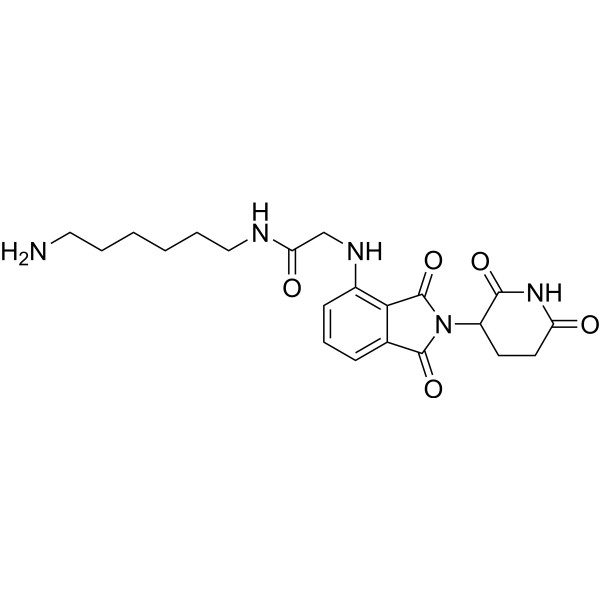 0 ImagesCat. No.: HY-138852CAS No.: 2763827-13-8Thalidomide-NH-amido-C6-NH2 is a synthesized E3 ligase ligand-linker conjugate that incorporates the Thalidomide based cereblon ligand and a linker used in PROTAC technology.
-
PRMT5-targeted fluorescent ligand-1
 0 ImagesCat. No.: HY-170603PRMT5-targeted fluorescent ligand-1 (Compound 7) is a PRMT5-targeted fluorescent ligand, that inhibits PRMT5 with an IC50 of 29.39 nM. PRMT5-targeted fluorescent ligand-1 exhibits cell imaging activity, that exhibits good fluorescence signal in MCF-7 with an IC50 of 29 nM. PRMT5-targeted fluorescent ligand-1 induces apoptosis. PRMT5-targeted fluorescent ligand-1 exhibits a maximal excitation wavelength of 438 nm and a maximal emission wavelength of 550 nm.
-
8-Benzylthio-cAMP
 0 ImagesCat. No.: HY-134283CAS No.: 50655-17-98-Benzylthio-cAMP is a derivative of cyclic adenosine monophosphate (cAMP). 8-Bn-cAMP is a site-selective activator of cAMP-dependent protein kinases. Compared with cyclic adenosine monophosphate, it is more stable to phosphodiesterase (PDE) hydrolysis and has higher membrane permeability. 8-Bn-cAMP can be used to study the role of cAMP in regulating cell proliferation, differentiation and apoptosis.
-
VEGFR-2-IN-81
 0 ImagesCat. No.: HY-181493VEGFR-2-IN-81 is a thiazole-based isoquinolin-1(2H)-one derivative and an VEGFR-2 inhibitor with IC50 of 1.94 μM. VEGFR-2-IN-81 exhibits significant selective cytotoxicity against colorectal cancer cells (IC50 = 7.75 μM). VEGFR-2-IN-81 exerts anti-colorectal cancer effects by inducing apoptosis, elevating intracellular ROS levels and reducing mitochondrial transmembrane potential. VEGFR-2-IN-81 can be used for the research of colorectal cancer, lung cancer, breast cancer, liver cancer.
-
TLBC
 0 ImagesCat. No.: HY-137831CAS No.: 562823-84-1
-
Thalidomide-5-O-C8-NH2 hydrochloride
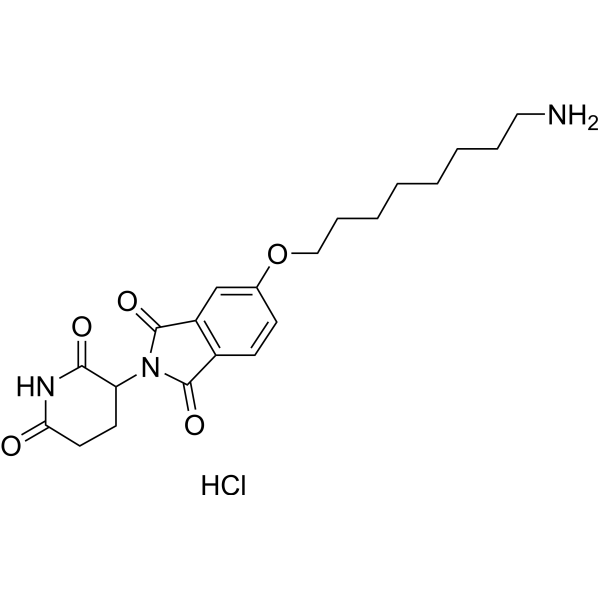 0 ImagesCat. No.: HY-149565Thalidomide-5-O-C8-NH2 hydrochloride is the Thalidomide (HY-10984)-based cereblon ligand used in the recruitment of CRBN protein.Thalidomide-5-O-C8-NH2 hydrochloride can be connected to the ligand for protein by a linker to form PROTACs.
-
Cyproheptadine hydrochloride-d3
 0 ImagesCat. No.: HY-W745430Synonyms: Cyproheptadine HCl-d3Cyproheptadine hydrochloride-d3 (Cyproheptadine HCl-d3) is the d3-labeled Cyproheptadine (hydrochloride) (HY-B0366A). Cyproheptadine hydrochloride (Cyproheptadine HCl) acts as a p38 MAP kinase activator, CHK2 activator, histamine H1 receptor inhibitor and serotonin receptor inhibitor. Cyproheptadine hydrochloride mediates cell cycle arrest via G1 phase arrest, G1/S transition arrest, G0/G1 phase arrest, reduced expression of cyclins D1/D2/D3, upregulated expression of HBP1, p16, p21, p27, and decreased phosphorylation of retinoblastoma protein. Cyproheptadine hydrochloride induces Apoptosis by increasing PARP and cleaved PARP, as well as activating the mitochondrial caspase pathway. Cyproheptadine hydrochloride inhibits tumor growth with extremely low toxicity to normal cells. Cyproheptadine hydrochloride can be used in research related to hepatocellular carcinoma, multiple myeloma and acute myeloid leukemia.
-
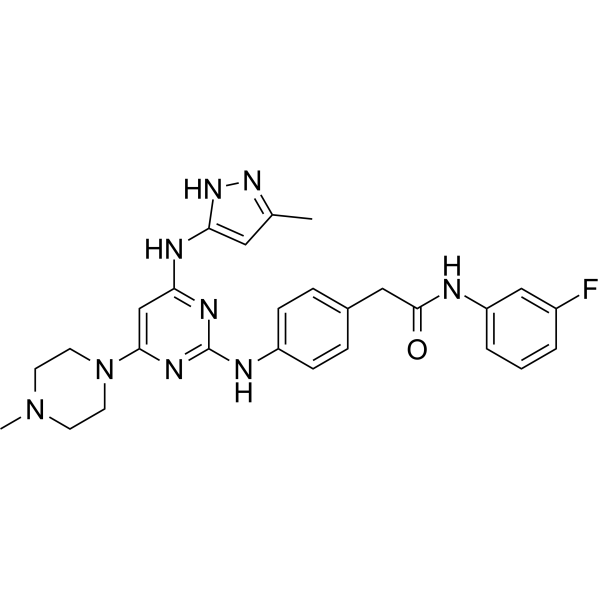
Syk-IN-16
 0 ImagesCat. No.: HY-184655CAS No.: 3102293-90-0Syk-IN-16 is a spleen tyrosine kinase (SYK) inhibitor with an IC50 of 16.0 nM. Syk-IN-16 exerts antiproliferative effects, induces cell apoptosis, inhibits cell migration and increases DNA damage in cancer cells. Syk-IN-16 suppresses tumor growth in xenograft models without obvious toxicity. Syk-IN-16 can be used for the research of triple-negative breast cancer.
-
Thymocartin acetate
 0 ImagesCat. No.: HY-105025BCAS No.: 85503-03-3Synonyms: Thymopoietin II (32-35) acetate; TP 4 acetate
-
Aceglatone
 0 ImagesAceglatone, an antineoplastic agent, is a β-glucuronidase inhibitor. Aceglatone is a compound that inhibits colon carcinogenesis and prevents the induction of colon cancer by inhibiting the hydrolysis of glucuronides. Aceglatone reduces cell proliferation, induces apoptosis and inhibits DNA synthesis in human colon cancer cells.
-
dCBP-30
 0 ImagesCat. No.: HY-184556dCBP-30 is an orally active, selective and dual-acting CBP/p300 PROTAC degrader with DC50 values of 0.05 nM (CBP) and 0.04 nM (p300), respectively. dCBP-30 reduces the acetylation levels of histone substrates H3K27, H3K18, H2BK5 and H2BK20, downregulates multiple myeloma-specific dependency programs, and induces multiple myeloma cell apoptosis. dCBP-30 triggers tumor regression and prolongs survival in multiple myeloma xenograft mouse models, and exhibits synergistic antiproliferative activity with dexamethasone. dCBP-30 can be used for the research of multiple myeloma.
-
PDE4B/D-IN-5
 0 ImagesCat. No.: HY-182060CAS No.: 3064814-26-9PDE4B/D-IN-5 (Compound P32) is a peripherally restricted, oral active inhibitor of PDE4B and PDE4D with extremely low blood-brain barrier penetration, with IC50 values of 3.4 nM and 2.2 nM, respectively. PDE4B-IN-8 inhibits the production of TNF-α. PDE4B/D-IN-5 significantly reduces the Bax/Bcl2 ratio, and alleviates oxidative stress by decreasing MPO activity and NO levels. PDE4B/D-IN-5 exhibits anti-inflammatory, antioxidant, and anti-apoptotic activities. PDE4B/D-IN-5 can be used for the research of acute lung injury.
-
Ferroptosis/apoptosis inducer-3
 0 ImagesCat. No.: HY-179016Ferroptosis/apoptosis inducer-3 (Compound 34) is a Ferroptosis and Apoptosis inducer. Ferroptosis/apoptosis inducer-3 induces both Ferroptosis and Apoptosis by causing G2/M phase cell cycle arrest, disrupting mitochondrial membrane potentials, promoting lipid peroxidation, and increasing the levels of Ca2+ and Fe2+ through the activation of calcium/calmodulin signaling. Ferraplasm/apoptosis inducer-3 shows anticancer effects against cervical cancer, adenocarcinoma, breast cancer, colon cancer, and colorectal carcinoma.
-
Afatinib dimaleate (Standard)
 0 ImagesSynonyms: BIBW 2992MA2 (Standard)Afatinib (dimaleate) (Standard) is the analytical standard of Afatinib (dimaleate). This product is intended for research and analytical applications. Afatinib (BIBW 2992) dimaleate is an orally active, potent and irreversible dual specificity inhibitor of ErbB family (EGFR and HER2), with IC50 values of 0.5 nM, 0.4 nM, 10 nM and 14 nM for EGFRwt, EGFRL858R, EGFRL858R/T790M and HER2, respectively. Afatinib dimaleate can be used for the research of esophageal squamous cell carcinoma (ESCC), non-small cell lung cancer (NSCLC) and gastric cancer.
-
Berzosertib hydrochloride
 0 ImagesSynonyms: VE-822 hydrochloride; VX-970 hydrochloride; M6620 hydrochlorideBerzosertib (VE-822) hydrochloride is an orally active, CNS-penetrant, and selective ATR kinase inhibitor. Berzosertib hydrochloride blocks ATR kinase activity, abrogates G2/M cell cycle checkpoint, impairs DNA damage repair. Berzosertib hydrochloride induces apoptosis, inhibnits conlony migration, inhibits cell proliferation, and activates cGAS-STING axes in cancer cells. Berzosertib hydrochloride can be used for the research of cancers, such as head and neck squamous cell carcinoma, and colorectal cancer.
-
Thalidomide-4-C3-NH2 hydrochloride
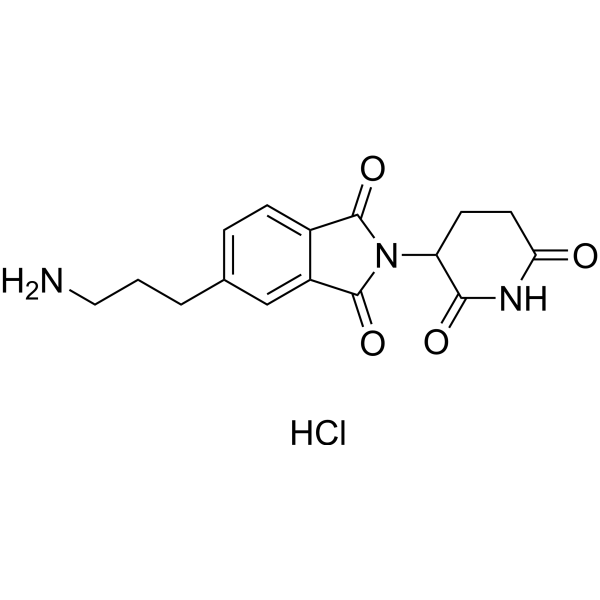 0 ImagesCat. No.: HY-139545CAS No.: 2357110-84-8Thalidomide-4-C3-NH2 hydrochloride is the Thalidomide-based cereblon ligand used in the recruitment of CRBN protein. Thalidomide-4-C3-NH2 hydrochloride can be connected to the ligand for protein by a linker to form PROTACs.
-
PROTAC RET Degrader 2
 0 ImagesCat. No.: HY-183783PROTAC RET Degrader 2 is a RET degrader with a target IC50 of 0.36 nM. PROTAC RET Degrader 2 is mainly composed of RET-IN-34 (HY-183729) and Thalidomide (HY-14658). PROTAC RET Degrader 2 mediates RET degradation via the ubiquitin-proteasome system. PROTAC RET Degrader 2 induces apoptosis, inhibits colony-forming ability, and exhibits antiproliferative activity in cancer cells. PROTAC RET Degrader 2 suppresses tumor growth in xenograft models. PROTAC RET Degrader 2 can be used in research related to medullary thyroid carcinoma, papillary thyroid carcinoma, and RET fusion-positive lung adenocarcinoma.
-
Osimertinib (GMP Like)
 0 ImagesCat. No.: HY-15772GLCAS No.: 1421373-65-0Synonyms: AZD-9291 (GMP Like); Mereletinib (GMP Like)Osimertinib (AZD-9291; Mereletinib) GMP Like is the GMP Like level of Osimertinib (HY-15772). GMP Like small molecules works appropriately as an auxiliary reagent for cell research manufacture. Osimertinib GMP Like is an inhibitor that selectively targets EGFRT790M and activated EGFR mutants. Osimertinib GMP Like exerts multiple anti-tumor mechanisms, including radiosensitization, induction of apoptosis and ferroptosis, as well as inhibition of cancer stemness. Osimertinib GMP Like suppresses EGFR nuclear translocation and downstream survival signaling pathways, significantly reduces cell viability and lipid droplet content, and also exerts synergistic effects with radiotherapy or specific targeted agents to effectively overcome drug resistance and radioresistance. Formulations of Osimertinib GMP Like modified with liposomes or iRGD enable sustained release, tumor-specific accumulation, and breakthrough of the blood-brain barrier limitation. Osimertinib GMP Like can be used in research related to radioresistant glioblastoma and non-small cell lung cancer.