



Apoptosis
Apoptosis
Apoptosis is a distinctive form of cell death exhibiting specific morphological and biochemical characteristics, including cell membrane blebbing, chromatin condensation, genomic DNA fragmentation, and exposure of specific phagocytosis signaling molecules on the cell surface. Cells undergoing apoptosis differ from those dying through necrosis. Necrotic cells are usually recognized by the immune system as a danger signal and, thus, resulting in inflammation; in contrast, apoptotic death is quiet and orderly.
There are two major pathways of apoptotic cell death induction: The intrinsic pathway, also called the Bcl-2-regulated or mitochondrial pathway, is activated by various developmental cues or cytotoxic insults, such as viral infection, DNA damage and growth-factor deprivation, and is strictly controlled by the BCL-2 family of proteins. The extrinsic or death-receptor pathway is triggered by ligation of death receptors (members of the tumor necrosis factor (TNF) receptor family, such as Fas or TNF receptor-1 (TNFR1)) that contain an intracellular death domain, which can recruit and activate caspase-8 through the adaptor protein Fas-associated death domain (FADD; also known as MORT1) at the cell surface. This recruitment causes subsequent activation of downstream (effector) caspases, such as caspase-3, -6 or -7, without any involvement of the BCL-2 family.
Studies suggest that alterations in cell survival contribute to the pathogenesis of a number of human diseases, including cancer, viral infections, autoimmune diseases, neurodegenerative disorders, and AIDS (acquired immunodeficiency syndrome). Treatments designed to specifically alter the apoptotic threshold may have the potential to change the natural progression of some of these diseases.
All Product Categories
-
Apoptosis Inhibitors
(905)
View all products
-
Apoptosis Agonists
(7)
View all products
-
Apoptosis Antagonists
(9)
View all products
-
Apoptosis Activators
(363)
View all products
-
Apoptosis Modulators
(60)
View all products
-
Apoptosis Inducers
(7928)
View all products
-
Apoptosis Degrader
(1)
View all products
-
Apoptosis Controls
(33)
View all products
-
Apoptosis Related Products (9874)
Related Products (9874)

-
Antibodies (120)
-
C8-Ceramide (Standard)
 0 ImagesCat. No.: HY-108391RCAS No.: 74713-59-0Synonyms: N-Octanoyl-D-erythro-sphingosine (Standard)C8-Ceramide (Standard) is the analytical standard of C8-Ceramide (HY-108391). This product is intended for research and analytical applications. C8-Ceramide (N-Octanoyl-D-erythro-sphingosine) is a cell-permeable analog of naturally occurring ceramides. C8-Ceramide has anti-proliferation properties and acts as a potent chemotherapeutic agent. C8-Ceramide stimulates dendritic cells to promote T cell responses upon virus infections. C8-Ceramide induces slight activation of protein Kinase (PKC) in vitro.
-
Sirtinol (Standard)
 0 ImagesCat. No.: HY-13515RCAS No.: 410536-97-9Sirtinol (Standard) is the analytical standard of Sirtinol. This product is intended for research and analytical applications. Sirtinol is a sirtuin (SIRT) inhibitor, with IC50s of 48 μM, 57.7 μM and 131 μM for ySir2, hSIRT2 and hSIRT2, respectively.
-
19-epi-Scholaricine
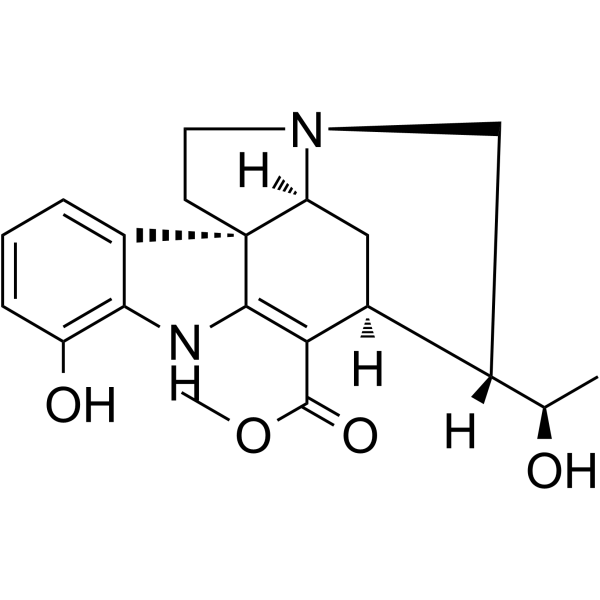 0 Images19-epi-Scholaricine is an orally active indole alkaloid. 19-epi-Scholaricine downregulates the expression of profibrotic/apoptotic proteins (HRAS, HSP90AA1, KDR) and upregulates the expression of cell cycle-related protein (CDK2). 19-epi-Scholaricine suppresses ROS production and reduces the release of inflammatory mediators, thereby attenuating podocyte apoptosis, renal inflammation and oxidative stress by inhibiting AKT/mTOR. 19-epi-Scholaricine can be used in the research of chronic glomerulonephritis and membranous nephropathy.
-
MIRA-1 (Standard)
 0 ImagesCat. No.: HY-108639RCAS No.: 72835-26-8Synonyms: NSC 19630 (Standard)MIRA-1 (Standard) is the analytical standard of MIRA-1 (HY-108639). This product is intended for research and analytical applications. MIRA-1 is a maleimide analogue. MIRA-1 can induce apoptosis in mutant p53 cells via restoration of p53-dependent transcriptional transactivation. MIRA-1 has anticancer activity.
-
Azilsartan (Standard)
 0 ImagesSynonyms: TAK-536 (Standard)Azilsartan (Standard) is the analytical standard of Azilsartan. This product is intended for research and analytical applications. Azilsartan (TAK-536) is an orally active, potent, selective and specific angiotensin II type 1 receptor (AT1) antagonist. Azilsartan induces ROS formation and apoptosis in HepG2 cells. Azilsartan shows neuroprotective and anticancer activity. Azilsartan can be used for hypertension and stroke research.
-
Formoxanthone A
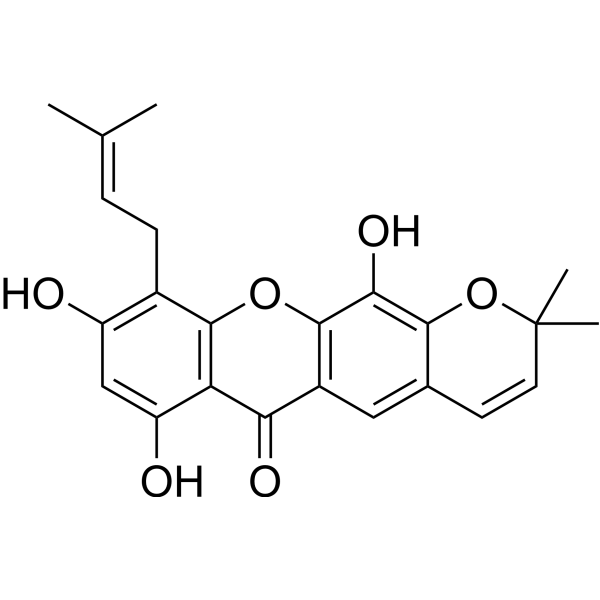 0 ImagesCat. No.: HY-137949CAS No.: 869880-32-0Formoxanthone A is an apoptosis inducing compound that can significantly reduce the viability of HeLa cells at 25 μM.
-
BTT-3033 (Standard)
 0 ImagesCat. No.: HY-110112RCAS No.: 1259028-99-3BTT-3033 (Standard) is the analytical standard of BTT-3033 (HY-110112). This product is intended for research and analytical applications. BTT-3033 is an orally active conformation-selective inhibitor of α2β1 (EC50: 130 nM) by binding to the α2I domain. BTT-3033 inhibits platelet binding to collagen I and cell proliferation, and induces cell apoptosis. BTT-3033 can be used in the research of prostate cancer, inflammation and cardiovascular disease.
-
GO-Y078
 0 ImagesCat. No.: HY-137059CAS No.: 1217503-60-0GO-Y078 is a curcumin (HY-N0005) analog. GO-Y078 activates p38/JNK1/2. GO-Y078 activates the MAPK pathway, Caspase 3/8/9, PARP, AP-1, DR5, and TP53, while inhibiting cIAP-1, XIAP, and NF-κB. GO-Y078 induces sub-G1/G2/M phase arrest and Apoptosis. GO-Y078 impairs angiogenesis. GO-Y078 can be used in research related to osteosarcoma, cervical cancer, oral squamous cell carcinoma, and peritoneal metastasis of gastric cancer.
-
Tolinapant (Standard)
 0 ImagesCat. No.: HY-109565RCAS No.: 1799328-86-1Synonyms: ASTX660 (Standard)Tolinapant (Standard) is the analytical standard of Tolinapant (HY-109565). This product is intended for research and analytical applications. Tolinapant (ASTX660) is an orally bioavailable dual antagonist of cellular inhibitor of apoptosis protein (cIAP) and X-linked inhibitor of apoptosis protein (XIAP).
-
1-Oleoyl-2-acetylglycerol
 0 ImagesCat. No.: HY-W724097CAS No.: 84746-00-91-Oleoyl-2-acetylglycerol is a membrane-permeable diacylglycerol analog and PKC activator. 1-Oleoyl-2-acetylglycerol activates TRPC3 channels. 1-Oleoyl-2-acetylglycerol attenuates D609 (HY-70072)-induced Apoptosis. 1-Oleoyl-2-acetylglycerol effectively stimulates insulin secretion. 1-Oleoyl-2-acetylglycerol can be used in research on monocytic leukemia.
-
Aminopurvalanol A (Standard)
 0 ImagesCat. No.: HY-104013RCAS No.: 220792-57-4Aminopurvalanol A (Standard) is the analytical standard of Aminopurvalanol A (HY-104013). This product is intended for research and analytical applications. Aminopurvalanol A is a potent, selective, and cell permeable inhibitor of Cyclins/Cdk complexes. Aminopurvalanol A preferentially targets the G2/M-phase transition inhibiting cancer cell differentiation. Aminopurvalanol A causes the inhibition of sperm fertilizing ability via the inhibition of physiological capacitation-dependent actin polymerization.
-
Bisindolylmaleimide VIII
 0 ImagesCat. No.: HY-129624CAS No.: 125313-65-7Synonyms: Ro 31-7549; Bis VIIIBisindolylmaleimide VIII (Ro 31-7549) is a potent and selective protein kinase C (PKC) inhibitor with an IC50 of 158 nM for rat brain PKC. Bisindolylmaleimide VIII has IC50s of 53, 195, 163, 213, and 175 nM for PKC-α, PKC-βI, PKC-βII, PKC-γ, PKC-ε, respectively. Bisindolylmaleimide VIII facilitates Fas-mediated apoptosis and inhibits T cell-mediated autoimmune diseases.
-
SIRT2-IN-18
 0 ImagesCat. No.: HY-178773CAS No.: 858032-59-4SIRT2-IN-18 (Compound 8) is a SIRT2 inhibitor with IC50s of 5.3 and 12.3 μM for SmSIRT2 and hSIRT2, respectively. SIRT2-IN-18 shows potent antischistosomal activities against both Liberian and Puerto Rican strains of Schistosoma mansoni and reduces schistosomula and adult worm pair viability, pairing, and egg production, with low cytotoxicity in mammalian cells. SIRT2-IN-18 increases histone H3 hyperacetylation and induces cytochrome c-mediated apoptosis.
-
PTC-028 (Standard)
 0 ImagesCat. No.: HY-103696RCAS No.: 1782970-28-8PTC-028 (Standard) is the analytical standard of PTC-028 (HY-103696). This product is intended for research and analytical applications. PTC-028 is an orally bioavailable inhibitor of stem cell factor BMI-1 in ovarian cancer. PTC-028 selectively inhibits cancer cells whereas normal cells remain unaffected. PTC-028 downregulates BMI-1, inducing caspase-mediated apoptosis.
-
Cyclamic acid-d11 sodium
 0 ImagesCat. No.: HY-W014839SSynonyms: Sodium cyclamate-d11; Cyclohexylsulfamic acid-d11 sodiumCyclamic acid-d11 (Sodium cyclamate-d11) sodiumis deuterium labeled Cyclamic acid (sodium). Cyclamic acid sodium (Sodium cyclamate) is a commonly used sweetener. Cyclamic acid sodium is toxic to osteoblasts and can inhibit cell proliferation, induce apoptosis and reduce cell mineralization. Cyclamic acid sodium causes focal necrosis of bladder organs in rats in vitro, which can promote bladder cancer, but some studies have shown that low doses of Cyclamic acid sodium have no carcinogenic effect. In addition, Cyclamic acid sodium has no effect on insulin and glucagon secretion induced by arginine.
-
Lawsone (Standard)
 0 ImagesLawsone is an orally active naphthoquinone dye that can be isolated from the leaves of Lawsonia inermis. Lawsone can induce apoptosis. Lawsone has antibacterial, antitumor and antioxidant activities. Lawsone can be used in anti-tumor drug research.
-
Ispinesib (Standard)
 0 ImagesCat. No.: HY-50759RCAS No.: 336113-53-2Synonyms: SB-715992 (Standard); CK-0238273 (Standard)Ispinesib (Standard) is the analytical standard of Ispinesib. This product is intended for research and analytical applications. Ispinesib is a specific inhibitor of kinesin spindle protein (KSP), with a Ki app of 1.7 nM.
-
Hydroxytyrosol acetate (Standard)
 0 ImagesCat. No.: HY-N6043RCAS No.: 69039-02-7Hydroxytyrosol acetate (Standard) is the analytical standard of Hydroxytyrosol (HY-N0570). This product is intended for research and analytical applications. Hydroxytyrosol acetate is an orally active, blood-brain barrier-permeable multi-active compound with multiple effects including antibacterial, antioxidant, anti-platelet aggregation, and neuroprotective activities. Hydroxytyrosol acetate not only inhibits the growth of Vibrio by increasing bacterial membrane permeability, but also interacts with DNA and mediates supercoiled DNA relaxation. Meanwhile, Hydroxytyrosol acetate effectively reduces thrombosis and inhibits lipid oxidation by inhibiting COX activity and promoting vascular nitric oxide production. In terms of neuroprotection, Hydroxytyrosol acetate significantly alleviates neuronal apoptosis and inflammatory responses by up-regulating the expression level of ERβ, thereby improving cognitive function in Alzheimer's disease models. Hydroxytyrosol acetate has been widely used in scientific research related to Vibrio infection, arterial thrombosis, Alzheimer's disease and other related fields.
-
3-AP-Me
 0 ImagesCat. No.: HY-138844CAS No.: 1184391-57-83-AP-Me is a dimethyl derivative of the nucleotide reductase inhibitor 3-AP (SML0568). 3-AP-Me can activate the endoplasmic reticulum (ER) stress pathway by promoting the phosphorylation of eIF2α and increasing the gene expression of transcription factors ATF4 and ATF6, leading to cell apoptosis. Additionally, 3-AP-Me can activate the stress kinases c-Jun N-terminal kinase (JNK) and p38 mitogen-activated protein kinases. 3-AP-Me also leads to the upregulation of the spliced mRNA variant XBP1, can be used in cancer research.
-
UA62784
 0 ImagesCat. No.: HY-110090CAS No.: 313367-92-9UA62784 is a microtubule polymerization inhibitor that interacts with tubulin dimers. UA62784 is a novel specific inhibitor of centromere protein E (CENP-E) kinesin. UA62784 can be used for the study of pancreatic cancer.




