



Caspase
Caspase is a family of cysteine proteases that play essential roles in apoptosis (programmed cell death), necrosis, and inflammation. There are two types of apoptotic caspases: initiator (apical) caspases and effector (executioner) caspases. Initiator caspases (e.g., CASP2, CASP8, CASP9, and CASP10) cleave inactive pro-forms of effector caspases, thereby activating them. Effector caspases (e.g., CASP3, CASP6, CASP7) in turn cleave other protein substrates within the cell, to trigger the apoptotic process. The initiation of this cascade reaction is regulated by caspase inhibitors. CASP4 and CASP5, which are overexpressed in some cases of vitiligo and associated autoimmune diseases caused by NALP1 variants, are not currently classified as initiator or effector in MeSH, because they are inflammatory enzymes that, in concert with CASP1, are involved in T-cell maturation.
Caspase Isoform Specific Products
-
Caspase 1
(79)
View all products
-
Caspase 2
(11)
View all products
-
Caspase 3
(547)
View all products
-
Caspase 4
(11)
View all products
-
Caspase 5
(5)
View all products
-
Caspase 6
(12)
View all products
-
Caspase 7
(108)
View all products
-
Caspase 8
(111)
View all products
-
Caspase 9
(197)
View all products
-
Caspase 10
(6)
View all products
-
Caspase 12
(3)
View all products
-
Caspase
(599)
View all products
-
Caspase 11
(2)
View all products
-
Caspase-13
(1)
View all products
All Product Categories
-
Caspase Inhibitors
(449)
View all products
-
Caspase Agonists
(41)
View all products
-
Caspase Activators
(627)
View all products
-
Caspase Modulators
(48)
View all products
-
Caspase Chemicals
(4)
View all products
-
Caspase MDM2 Inhibitor
(1)
View all products
-
Caspase Inducers
(49)
View all products
-
Caspase Degrader
(1)
View all products
-
Caspase Control
(1)
View all products
-
Caspase Substrates
(4)
View all products
-
Caspase Proteins
(10)
View all products
-
Caspase-1 Proteins
(3)
View all products
-
Caspase-3 Proteins
(3)
View all products
-
Caspase 7 Proteins
(1)
View all products
-
Caspase-8 Proteins
(1)
View all products
-
Caspase-10 Proteins
(1)
View all products
-
Caspase Related Products (1404)
Related Products (1404)

-
Recombinant Proteins (10)
-
Antibodies (35)
-
Caspase Signaling Pathway
-
Caspase Isoform Comparison
-
Z-DEVD-FMK (Standard)
 0 ImagesCat. No.: HY-12466RCAS No.: 210344-95-9Z-DEVD-FMK (Standard) is the analytical standard of Z-DEVD-FMK (HY-12466). This product is intended for research and analytical applications. Z-DEVD-FMK is a specific and irreversible caspase-3 inhibitor with an IC50 of 18 μM.
-
Caspase-3-IN-2
 0 ImagesCat. No.: HY-W415273CAS No.: 62252-25-9
-
Fenbufen-d9
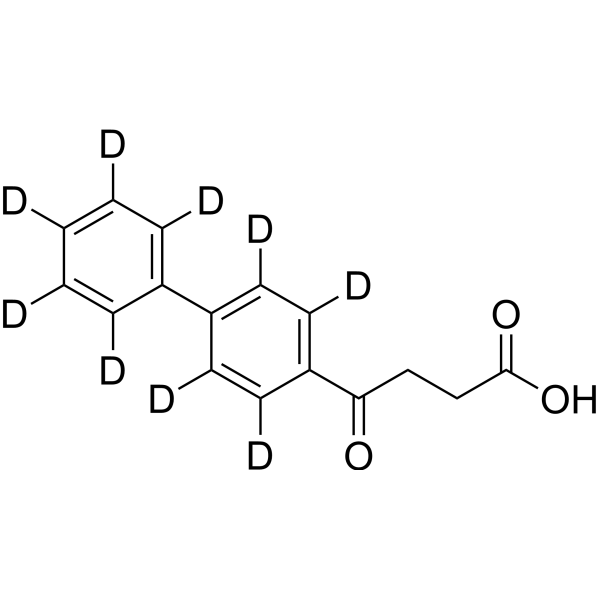 0 ImagesCat. No.: HY-B1138SCAS No.: 1189940-96-2Fenbufen-d9 (CL-82204-d9) is the deuterium labeled Fenbufen. Fenbufen (CL-82204) is an orally active non-steroidal anti-inflammatory drug (NSAID), with antipyretic effects. Fenbufen has potent activity in a variety of animal model, including carageenin edema, UV erythema and adjuvant arthritis. Fenbufen has inhibitory activities against COX-1 and COX-2 with IC50s of 3.9 μM and 8.1 μM, respectively. Fenbufen is a caspases (caspase-1, 3, 4, 5, 9) inhibitor.

-
Z-VAD-FMK (Standard)
 0 ImagesCat. No.: HY-16658BRCAS No.: 161401-82-7Synonyms: Z-VAD(OH)-FMK (Standard)Z-VAD-FMK (Standard) is the analytical standard of Z-VAD-FMK (HY-16658B). This product is intended for research and analytical applications. Z-VAD-FMK is a pan-caspase inhibitor and also an ICE-like protease inhibitor, which inhibits apoptosis by preventing the processing of CPP32 to its active form. Z-VAD-FMK sensitivity varies primarily due to differential expression of receptor-interacting protein 1 (RIP1). Z-VAD-FMK limits the cryopreservation-induced apoptosis by reducing caspase-3 activity of in vitro produced bovine embryos. Z-VAD-FMK is immunosuppressive in vitro and inhibits T cell proliferation without blocKing the processing of caspase-8 and caspase-3. Z-VAD-FMK leads to a decrease in intracellular glutathione (GSH) with a concomitant increase in reactive oxygen species (ROS) levels in activated T cells. Z-VAD-FMK is due to oxidative stress via the depletion of GSH. Z-VAD-FMK can be used for the study of acute pancreatitis.
-
Vitexin-2"-O-rhamnoside (Standard)
 0 ImagesCat. No.: HY-N0534RCAS No.: 64820-99-1Vitexin-2"-O-rhamnoside (Standard) is the analytical standard of Vitexin-2"-O-rhamnoside (HY-N0534). This product is intended for research and analytical applications. Vitexin-2"-O-rhamnoside is an orally active flavonoid glycoside. Vitexin-2"-O-rhamnoside inhibits Apoptosis, increases the phosphorylation levels of PI3K/Akt, inhibits caspase-3, SOD activity, and promotes cytokine (IL-2, IL-6, and IL-12) secretion. Vitexin-2"-O-rhamnoside strongly inhibits DNA synthesis in MCF-7 cells with an IC50 of 17.5 μM. Vitexin-2"-O-rhamnoside enhances immune function and improves the absorption of active compounds. Vitexin-2"-O-rhamnoside has antioxidant activity. Vitexin-2"-O-rhamnoside is used in the study of cardiovascular disease and immune-related diseases.
-
Methazolamide (Standard)
 0 ImagesMethazolamide (Standard) is the analytical standard of Methazolamide. This product is intended for research and analytical applications. Methazolamide (L584601) is a BBB-penetrable and orally active carbonic anhydrase inhibitor, with a Ki of 14 nM for human carbonic anhydrase II. Methazolamide can reduce intraocular pressure and has a neuroprotective effect, being able to inhibit neuronal apoptosis. Methazolamide can be used in the research of ophthalmic diseases such as glaucoma and cerebrovascular diseases such as subarachnoid hemorrhage.
-
Emricasan (Standard)
 0 ImagesSynonyms: PF 03491390 (Standard); IDN-6556 (Standard)Emricasan (Standard) is the analytical standard of Emricasan. This product is intended for research and analytical applications. Emricasan (PF 03491390) is an orally active and irreversible pan-caspase inhibitor. Emricasan inhibits Zika virus (ZIKV)-induced increases in caspase-3 activity and protected human cortical neural progenitors.
-
ETMTC
 0 ImagesCat. No.: HY-183448CAS No.: 117666-86-1ETMTC is an orally active anti-inflammatory and antioxidant agent. ETMTC inhibits IKK-mediated phosphorylation and degradation of IkBα, blocks nuclear translocation and activation of NF-κB, and reduces the expression of ICAM-1, VCAM-1, E-selectin, Th2 cytokines and eosinophil chemokines. ETMTC abrogates neutrophil adhesion to endothelial monolayers and inhibits TNF-α-induced ROS production. ETMTC activates Nrf2, and enhances the activities of mitochondrial complex I and IV. ETMTC reduces lipid peroxidation levels, oxidative DNA damage, cytochrome c and caspase 9 activity, and decreases goblet cell metaplasia and subepithelial fibrosis. ETMTC can be used for the research of inflammatory diseases and asthma.




