



MDM-2/p53
The p53 tumor suppressor is a principal mediator of growth arrest, senescence, and apoptosis in response to a broad array of cellular damage. p53 is a short-lived protein that is maintained at low, often undetectable, levels in normal cells. Under stress conditions, the p53 protein accumulates in the cell, binds in its tetrameric form to p53-response elements and induces the transcription of various genes.
MDM-2 is transcriptionally activated by p53 and MDM-2, in turn, inhibits p53 activity in several ways. MDM-2 binds to the p53 transactivation domain and thereby inhibits p53-mediated transactivation. MDM-2 also contains a signal sequence that is similar to the nuclear export signal of various viral proteins and, after binding to p53, it induces its nuclear export. As p53 is a transcription factor, it needs to be in the nucleus to be able to access the DNA; its transport to the cytoplasm by MDM-2 prevents this. Finally, MDM-2 is a ubiquitin ligase, so is able to target p53 for degradation by the proteasome.
In many tumors p53 is inactivated by the overexpression of the negative regulators MDM2 and MDM4 or by the loss of activity of the MDM2 inhibitor ARF. The pathway can be reactivated in these tumors by small molecules that inhibit the interaction of MDM2 and/or MDM4 with p53. Such molecules are now in clinical trials.
All Product Categories
-
MDM-2/p53 Inhibitors
(114)
View all products
-
MDM-2/p53 Agonists
(8)
View all products
-
MDM-2/p53 Antagonists
(4)
View all products
-
MDM-2/p53 Activators
(155)
View all products
-
MDM-2/p53 Modulators
(29)
View all products
-
MDM-2/p53 MDM2 Inhibitors
(65)
View all products
-
MDM-2/p53 p53 Activators
(115)
View all products
-
MDM-2/p53 p53 Inhibitors
(16)
View all products
-
MDM-2/p53 Inducers
(17)
View all products
-
MDM-2/p53 Degraders
(8)
View all products
-
MDM-2/p53 Controls
(6)
View all products
-
MDM-2/p53 Ligands
(9)
View all products
-
MDM-2/p53 Verwandte Produkte (626)
Verwandte Produkte (626)

-
Antibodies (17)
-
MDM-2/p53 Signalweg
-
S100A2-p53-IN-1
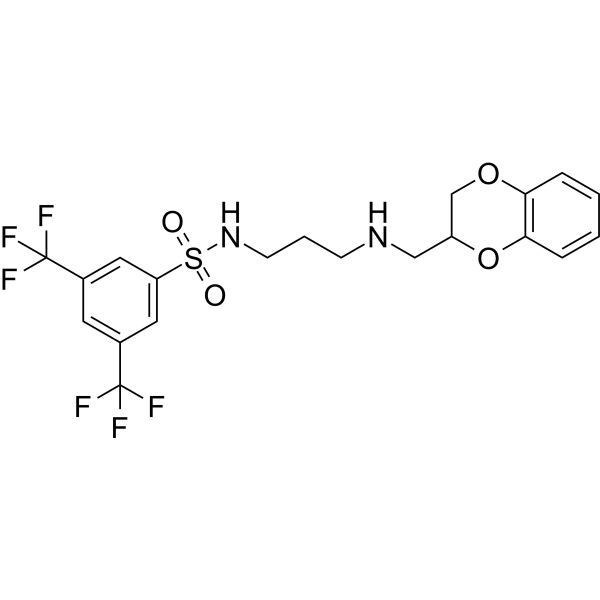 0 ImagesArt. -Nr.: HY-145900CAS. Nr.: 2766609-08-7S100A2-p53-IN-1 (compound 51) is a S100A2-p53 interactions inhibitor. S100A2 is a Ca2+ binding protein with implications in cell signaling and is known to be upregulated in pancreatic cancer. S100A2-p53-IN-1 can inhibit the growth of the MiaPaCa-2 pancreatic cancer cell line (GI50 of 1.2-3.4 μM).
-
CRM1 degrader 1
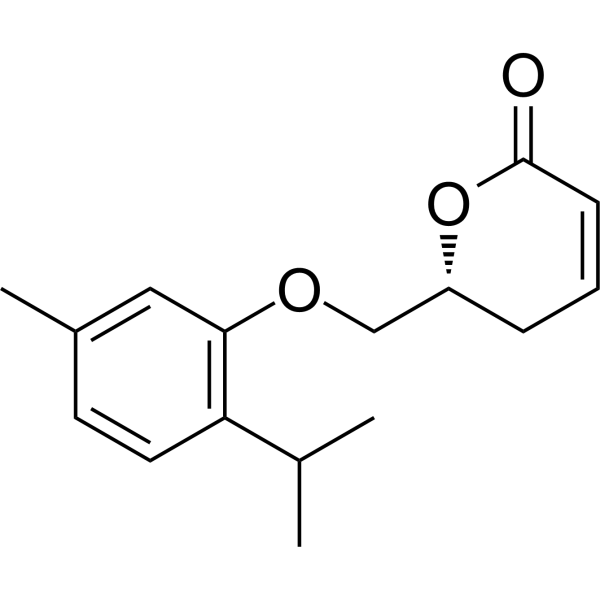 0 ImagesArt. -Nr.: HY-146384CAS. Nr.: 2986647-41-8CRM1 degrader 1 is a CRM1 degrader. CRM1 degrader 1 induces mitochondrial pathway-mediated apoptosis. CRM1 degrader 1 dose-dependently reduces CRM1 protein levels via the ubiquitin-proteasome pathway, promotes nuclear accumulation of p53, and regulates Bcl-2 family proteins and caspase activation. CRM1 degrader 1 is applicable to gastric cancer-related research.
-
NVP-CFC218
 0 ImagesArt. -Nr.: HY-180331CAS. Nr.: 1313363-06-2NVP-CFC218 is a selective TP53-MDM2 inhibitor with a structure and biochemical profile similar to NVP-CGM097 (HY-15954) (IC50 of 1.6 nM: displacing the p53 peptide from the surface of HDM2). It is used to analyze pharmacological sensitivity in cell lines and is also applicable in cancer research [1] .
-
Nrf-2/HMOX-1-IN-1
 0 ImagesArt. -Nr.: HY-184288Nrf-2/HMOX-1-IN-1 is a Nrf-2 and HMOX-1 inhibitor, as well as a Ferroptosis inducer. Nrf-2/HMOX-1-IN-1 inhibits GPX activity and upregulates p53 gene expression. Nrf-2/HMOX-1-IN-1 increases intracellular ROS and MDA levels, reduces GSH content, and elevates intracellular iron levels simultaneously. Nrf-2/HMOX-1-IN-1 exerts selective anticancer effects against breast cancer. Nrf-2/HMOX-1-IN-1 can be used in breast cancer-related research.
-
PI3K/mTOR-IN-17
 0 ImagesArt. -Nr.: HY-174855PI3K/mTOR-IN-17 is a dual PI3K and mTOR inhibitor with IC50 values of 1.21 μM (PI3K), and 0.21 μM (mTOR). PI3K/mTOR-IN-17 induces cells caspase-mediated apoptosis by arresting their growth in the G1-phase. PI3K/mTOR-IN-17 upregulates the levels of caspases-3, 7, 8, and 9, p53 expression and Bax/Bcl-2 ratio. PI3K/mTOR-IN-17 suppresses the PI3K/mTOR signaling pathway. PI3K/mTOR-IN-17 can be used for research of cancer, such as non-small cell lung cancer (NSCLC).
-
P53/TLR2 modulator-1
 0 ImagesArt. -Nr.: HY-173309P53/TLR2 modulator-1 (Compound Z9) is a modulator that targets both the P53 pathway and TLR2 simultaneously, exhibiting anti-radiation activity. P53/TLR2 modulator-1 reduces apoptosis by inhibiting the radiation-induced expression of P53 and Bax. At the same time, it activates the TLR2 pathway, upregulates the expression of downstream proteins MyD88 and P65, and promotes the secretion of cytokines such as IL-6, thus exerting an anti-radiation effect. P53/TLR2 modulator-1 shows significant anti-radiation activity against both AHH-1 cells and HUVECs. It can also increase the survival rate of C57BL/6J mice irradiated with a lethal dose of radiation and reduce the damage to their hematopoietic system, the villous structure of the small intestine, and the spleen caused by radiation. P53/TLR2 modulator-1 can be used in the research of radiation injury-related diseases.
-
HDAC-IN-34
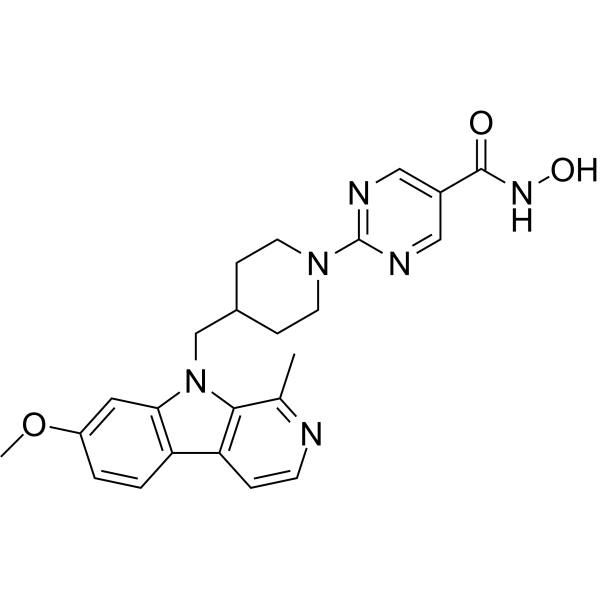 0 ImagesArt. -Nr.: HY-143241CAS. Nr.: 2857097-33-5HDAC-IN-34 (compound 27) is a potent HDAC inhibitor, with IC50 values of 0.022 and 0.45 μM for HDAC1 and HDAC6, respectively. HDAC-IN-34 can bind to DNA and cause DNA damage. HDAC-IN-34 causes cells apoptosis through p53 signaling pathway. HDAC-IN-34 exhibits significant anti-proliferation effect against HCT-116 cells, with an IC50 of 1.41 μM.
-
XSJ151
 0 ImagesArt. -Nr.: HY-179520CAS. Nr.: 1685279-23-5XSJ151 is a topoisomerase I inhibitor, stabilizing the DNA-Topo I covalent complex and inducing DNA double-strand breaks. XSJ151-induces DNA damage activates the p53-p21 signaling pathway, specifically regulating the expression of cyclins, leading to G2/M phase cell cycle arrest and disrupting the dynamic homeostasis of Bcl-2 family proteins, thereby triggering apoptosis in gastric cancer cells. XSJ151 can be used for the study of gastric cancer.
-
CDK2-IN-49
 0 ImagesArt. -Nr.: HY-179161CDK2-IN-49 (Compound 5j) is a CDK2 inhibitor with an IC50 of 0.25 μM. CDK2-IN-49 shows potent activity against CDK7 with an IC50 of 0.14 μM. CDK2-IN-49 induces Apoptosis by raising the levels of p53 and Bax protein expression while reducing the amount of Bcl-2. CDK2-IN-49 inhibits cell division. CDK2-IN-49 can be used in the research of cancer.
-
P53 mutant stabilizer-1
 0 ImagesArt. -Nr.: HY-186101CAS. Nr.: 3107623-69-5P53 mutant stabilizer-1 (compound 274) is a covalent mutant p53 stabilizer. P53 mutant stabilizer-1 can be used for the study of wild-type function of p53 mutants, such as cancers associated with p53 mutation.
-
OM-301
 0 ImagesArt. -Nr.: HY-P992431OM-301 is a human monoclonal antibody that targets MDM2.
-
Anticancer agent 65
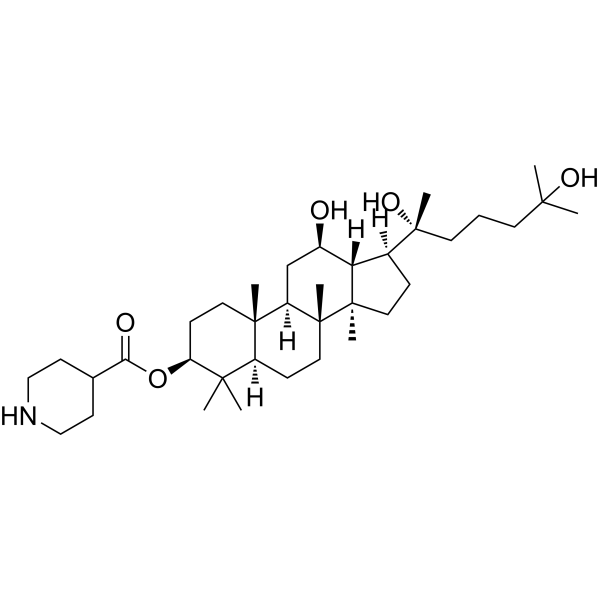 0 ImagesArt. -Nr.: HY-146105CAS. Nr.: 2407861-48-5Anticancer agent 65 (compound 4c) shows excellent activity in cancer cell lines, especially A549 cells, with an IC50 of 1.07 μM. Anticancer agent 65 induces S-phase arrest in A549 cells and increases the expression level of p53 and p21. Anticancer agent 65 causes apoptosis, ROS generation and collapse of MMP in A549 cells.
-
MDM2-IN-27
 0 ImagesArt. -Nr.: HY-180508MDM2-IN-27 (Compound 20k) is an MDM2 inhibitor. MDM2-IN-27 can effectively block the inhibitory effect of MDM2 on p53, thereby activating the p53 pathway. MDM2-IN-27 has a certain topoisomerase I inhibitory activity and has a very weak inhibitory effect on topoisomerase IIα. MDM2-IN-27 exhibits significant anti-proliferative activity against breast cancer, colon cancer, and cutaneous squamous cell carcinoma.
-
XM-U-14
 0 ImagesArt. -Nr.: HY-159175CAS. Nr.: 3098519-83-3XM-U-14 is a selective PROTAC USP7 Degrader (DC50: 0.74 nM in inducing USP7 degradation in RS4;11 cell line). XM-U-14 upregulates the levels of p53 and p21. XM-U-14 also significantly inhibits acute lymphoblastic leukemia (ALL) cell growth (IC50: 0.5 nM and 8.3 nM for RS4;11 cells and Reh cells respectively). XM-U-14 induces apoptosis and cycle arrest. XM-U-14 inhibits tumor growth. (Blue: VHL ligand (HY-159465), Black: linker (HY-W539783); Pink: USP7 inhibitor (HY-159464)).
-
Mutant p53 modulator-2
 0 ImagesArt. -Nr.: HY-176916CAS. Nr.: 2636847-01-1Mutant p53 modulator-2 (Compound 1988) is a mutant p53 modulator. Mutant p53 modulator-2 can be used in the research of cancer.
-
Phage-derived 12/1 peptide
 0 ImagesArt. -Nr.: HY-P10286CAS. Nr.: 186180-20-1Phage-derived 12/1 peptide exhibits antitumor activity by targeting MDM2 and MDMX, an thus disrupt the MDM2-p53 and MDMX-p53 interaction, with IC50 of 0.15 and 1.25 μM.
-
Glycocholic acid sodium (Standard)
 0 ImagesArt. -Nr.: HY-N1423ARCAS. Nr.: 863-57-0Glycocholic acid (sodium) (Standard) is the analytical standard of Glycocholic acid sodium (HY-N1423A). This product is intended for research and analytical applications. Glycocholic acid sodium is a bile acid derivative. Glycocholic acid downregulates MDR1, Bcl-2, MRP1, MRP2 and FXR, upregulates Bax, p53, caspase-9, caspase-3, TGR5 and S1PR2. Glycocholic acid sodium inhibits multidrug resistance and efflux pumps, induces mitochondrial apoptosis, and enhances chemosensitivity. Glycocholic acid sodium modulates related bile acid receptor signaling. Glycocholic acid sodium suppresses growth and conjugation of Enterobacteriaceae and increases their antibiotic susceptibility. Glycocholic acid sodium can be used for the research of colon adenocarcinoma and cholangiocarcinoma (CCA).
-
p53 Activator 8
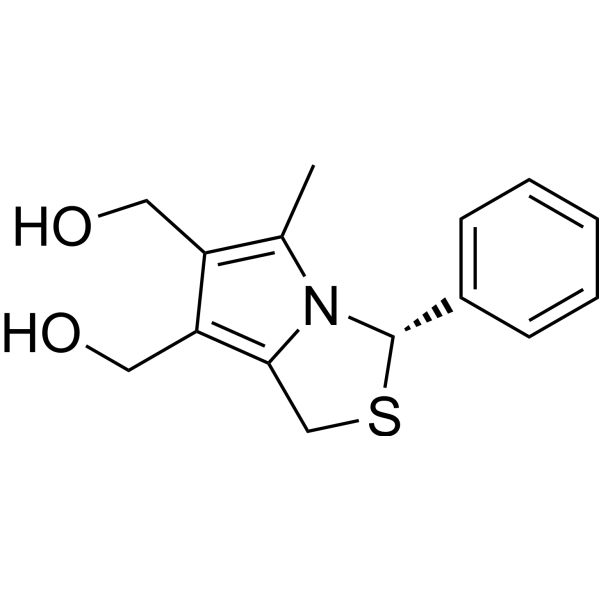 0 ImagesArt. -Nr.: HY-156919CAS. Nr.: 1426937-93-0p53 Activator 8 (compound 5) is a p53 activator. p53 Activator 8 has potent anti-proliferative activity against MCF7 breast cancer cell lines with an IC50 value of 0.5 μM.
-
EGFR-IN-191
 0 ImagesArt. -Nr.: HY-181093EGFR-IN-191 is an anti-tumor agent targeting both EGFR and AKT. EGFR-IN-191 exerts its anti-tumor activity by inducing DNA damage, apoptosis, cell cycle arrest, and inhibition of the PI3K/AKT-EGFR signaling pathway in tumor cells. EGFR-IN-191 can be used in the study of tumors such as triple-negative breast cancer.




