



MDM-2/p53
The p53 tumor suppressor is a principal mediator of growth arrest, senescence, and apoptosis in response to a broad array of cellular damage. p53 is a short-lived protein that is maintained at low, often undetectable, levels in normal cells. Under stress conditions, the p53 protein accumulates in the cell, binds in its tetrameric form to p53-response elements and induces the transcription of various genes.
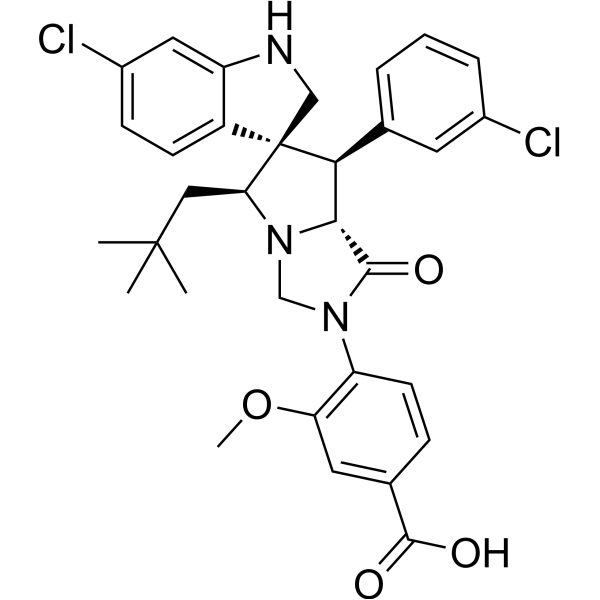
MDM-2 is transcriptionally activated by p53 and MDM-2, in turn, inhibits p53 activity in several ways. MDM-2 binds to the p53 transactivation domain and thereby inhibits p53-mediated transactivation. MDM-2 also contains a signal sequence that is similar to the nuclear export signal of various viral proteins and, after binding to p53, it induces its nuclear export. As p53 is a transcription factor, it needs to be in the nucleus to be able to access the DNA; its transport to the cytoplasm by MDM-2 prevents this. Finally, MDM-2 is a ubiquitin ligase, so is able to target p53 for degradation by the proteasome.
In many tumors p53 is inactivated by the overexpression of the negative regulators MDM2 and MDM4 or by the loss of activity of the MDM2 inhibitor ARF. The pathway can be reactivated in these tumors by small molecules that inhibit the interaction of MDM2 and/or MDM4 with p53. Such molecules are now in clinical trials.
All Product Categories
-
MDM-2/p53 Inhibitors
(116)
View all products
-
MDM-2/p53 Agonists
(8)
View all products
-
MDM-2/p53 Antagonists
(4)
View all products
-
MDM-2/p53 Activators
(166)
View all products
-
MDM-2/p53 Modulators
(29)
View all products
-
MDM-2/p53 MDM2 Inhibitors
(65)
View all products
-
MDM-2/p53 p53 Activators
(115)
View all products
-
MDM-2/p53 p53 Inhibitors
(16)
View all products
-
MDM-2/p53 Inducers
(17)
View all products
-
MDM-2/p53 Degraders
(8)
View all products
-
MDM-2/p53 Controls
(6)
View all products
-
MDM-2/p53 Ligands
(9)
View all products
-
MDM-2/p53 Related Products (639)
Related Products (639)

-
Antibodies (17)
-
MDM-2/p53 Signaling Pathway
-
Anticancer agent 68
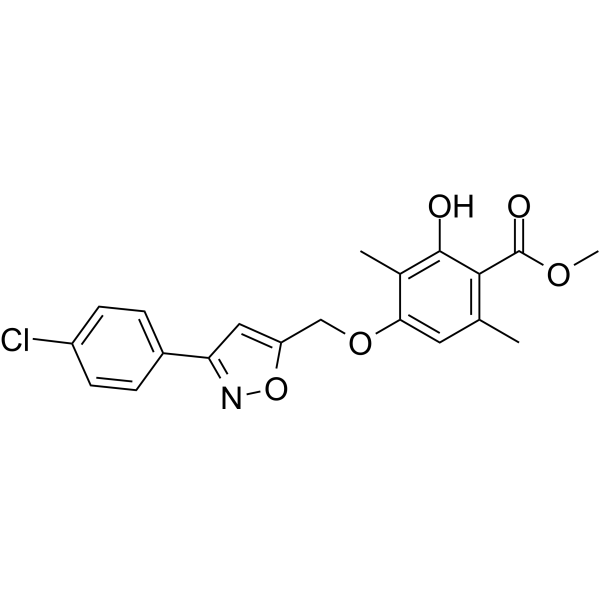 0 ImagesCat. No.: HY-147783CAS No.: 2692652-36-9Anticancer agent 68 is (Compound 12) is an anti-cancer agent. Anticancer agent 68 arrests the cells at the G2/M phase and induces programmed cell death. Anticancer agent 68 induces upregulation of tumor suppression via activation of p53 & PTEN.
-
Rezatapopt analog-1
 0 ImagesCat. No.: HY-164828CAS No.: 2636846-37-0Synonyms: PC14586 analog-1Rezatapopt analog-1 (PC14586 analog-1) (1919) is a Rezatapopt (HY-156633) analog. Rezatapopt binds to a pocket created by the TP53 Y220C mutation. Rezatapopt restores p53 tumor suppressor functions by stabilization of the p53 protein structure.
-
ANDS
 0 ImagesCat. No.: HY-184486CAS No.: 16781-09-2Synonyms: 1-Amino-8-naphthol-2,4-disulfonic acidANDS (1-Amino-8-naphthol-2,4-disulfonic acid) is an orally active inhibitor of CaMKP (IC50 = 6.4 μM; Ki = 3.6 μM) and CaMKP‑N (IC50 = 6.6 μM). ANDS binds unacetylated p53 and restores p53 activity by disrupting ANP32B-p53 interaction. ANDS inhibits chronic myeloid leukemia (CML) cell proliferation, impairs leukemic stem cells (LSC) function and prolongs survival in CML mouse model while sparing normal progenitor cells. ANDS can be used to study the eradication of LSCs and the overcoming of tyrosine kinase inhibitor (TKI) resistance in CML. ANDS can be used to study breast cancer.
-
GPS167
 0 ImagesCat. No.: HY-183831CAS No.: 3034312-19-8GPS167 is a CLK kinase inhibitor that potently and selectively inhibits recombinant human CLK1, CLK2 and CLK4. By inhibiting CLK-mediated phosphorylation of SRSF10, GPS167 upregulates the protein-binding ability of CLK1 and CLK4 with SRSF10, downregulates oncogenic BCLAF1-L and upregulates tumor-suppressive BCLAF1-S, regulates alternative splicing of genes such as MDM2 and MDM4, stabilizes p53 protein and induces DNA damage, ultimately triggering tumor cell apoptosis. GPS167 can block the epithelial-mesenchymal transition process of tumors, activate intracellular double-stranded RNA-mediated antiviral immune responses, and produce synergistic cytotoxicity when combined with microtubule-targeting drugs. GPS167 can be used in research related to various cancers including colorectal cancer.
-
MD-265
 0 ImagesMD-265 is a PROTAC degrader targeting MDM2, which activates p53 in cancer cells carrying wild-type p53. MD-265 induces MDM2 degradation by recruiting the CRL4-CRBN ligase complex via the ubiquitination and proteasomal degradation pathway. MD-265 upregulates p53 target genes, induces apoptosis, reduces Mcl-1 levels, increases caspase-3 cleavage, and inhibits colony formation of wild-type p53 leukemia stem cells. MD-265 can be used in research related to leukemia and acute myeloid leukemia.
-
PinA1
 0 ImagesCat. No.: HY-189201PinA1 is a selective Molecular glue degrader of CK1α with an EC50 of 2.09 µM. PinA1 induces the formation of a stable CRBN-PinA1-CK1α ternary complex to promote the polyubiquitination and subsequent proteasomal degradation of CK1α. PinA1 activates the p53 signaling pathway. PinA1 induces G1 cell cycle arrest. PinA1 induces p53-dependent Apoptosis. PinA1 can be used in studies related to acute myeloid leukemia.
-
cis,trans-Germacrone
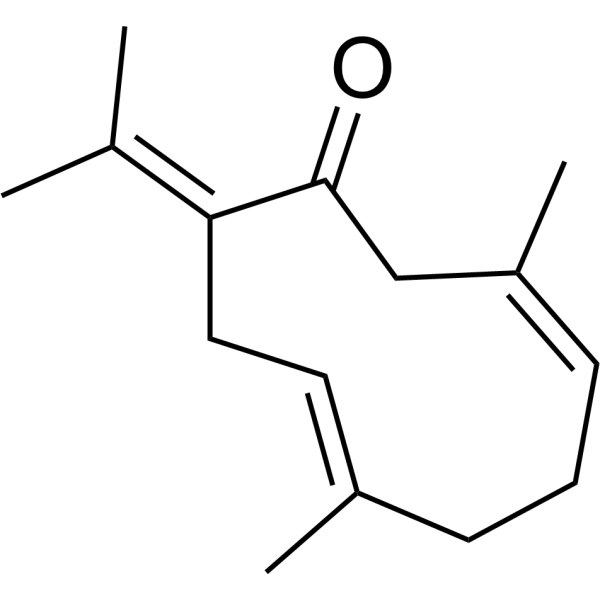 0 ImagesCat. No.: HY-145670CAS No.: 32663-51-7cis,trans-Germacrone is an isomer of Germacrone (HY-N0440) and is present in the stems and leaves of Curcuma wenyujin. Germacrone exhibits a wide range of antitumor, antioxidant, and anti-inflammatory effects. Germacrone inhibits lung cancer cell proliferation and alters Akt/MDM2/p53. Germacrone also induces cell cycle arrest at the G1/S phase. Germacrone is used in lung cancer-related research.
-
(S,R,S)-MI-1061
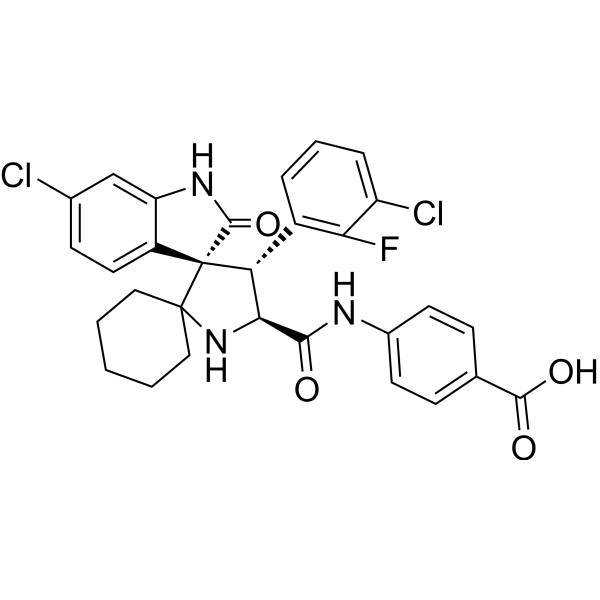 0 ImagesCat. No.: HY-125858BCAS No.: 1410738-90-7(S,R,S)-MI-1061 is the isomer of MI-1061(HY-125858). (S,R,S)-MI-1061 can used to synthesize Antibody-Drug Conjugates (ADCs). MI-1061 is a potent, orally bioavailable, and chemically stable MDM2 (MDM2-p53 interaction) inhibitor (IC50=4.4 nM; Ki=0.16 nM). MI-1061 potently activates p53 and induces apoptosis in the SJSA-1 xenograft tumor tissue in mice. Anti-tumor activity.
-
WB156
 0 ImagesCat. No.: HY-174266CAS No.: 2368944-44-7WB156 is a dual MDM2 and GSPT1 PROTAC degrader with a DC50 of 23 nM against MDM2. WB156 induces the degradation of MDM2 and GSPT1 via the ubiquitin-proteasome system. WB156 upregulates the levels of p53 and p21, and triggers Apoptosis through the cleavage of PARP and Caspase-3. WB156 can be used in leukemia-related research.
-
NSC 850745
 0 ImagesCat. No.: HY-175848NSC 850745 is a selective and potent c-Met/STAT3 inhibitor with IC50 values of 210 and 670 nM. NSC 850745 can inhibit cell proliferation, induce G2/M phase arrest and induce apoptosis. NSC 850745 can downregulate AKT-1, VEGF and Bcl-2 expression and upregulate p53, Bax and caspase expression. NSC 850745 can be used for the research of cancer, such as leukemia and colon cancer.
-
Amifostine sodium
 0 ImagesCat. No.: HY-B0639CCAS No.: 59178-37-9Synonyms: WR2721 sodiumAmifostine sodium (WR2721 sodium) is a phosphorus sulfate with radioprotective activity. Amifostine sodium can cause splenic vasodilation and may block autonomic ganglia. Amifostine sodium is clinically used to prevent cisplatin-induced ototoxicity.
-
RFRP-3 (mouse)
 0 ImagesCat. No.: HY-P10780Purity: 98.82%Synonyms: Neuropeptide NPVF (mouse)RFRP-3 (mouse) is a functional ortholog of avian gonadotropin inhibitory hormone (GnIH), binding to GPR147. RFRP-3 (mouse) reduces Progesterone synthesis by inhibiting FSHR and key enzymes involved in steroidogenesis (P450scc, 3β-HSD, StAR). RFRP-3 (mouse) induces Apoptosis (increase of p53). RFRP-3 (mouse) also suppresses the ERK signaling pathway. RFRP-3 (mouse) can be used for research of follicular development.
-
NU-8165
 0 ImagesCat. No.: HY-122038CAS No.: 849723-20-2NU-8165 is an inhibitor of the MDM2-p53 protein-protein interaction with anti-tumor activity. Optimization of NU-8165 was guided by MDM2 NMR titrations, which indicated key binding interaction regions. NU-8165 activated MDM2 and p21 transcription in cell-based assays and showed modest selectivity for wild-type p53 cell lines.
-
Amifostine thiol dihydrochloride (Standard)
 0 ImagesSynonyms: WR-1065 dihydrochloride (Standard)Amifostine thiol (dihydrochloride) (Standard) is the analytical standard of Amifostine thiol (dihydrochloride). This product is intended for research and analytical applications. Amifostine thiol (WR-1065) dihydrochloride can protect normal tissues from the toxic effects of certain cancer agents and activate p53 through a JNK-dependent signaling pathway.
-
p38α inhibitor 6
 0 ImagesCat. No.: HY-159938p38α inhibitor 6 (compound 19) is a p38α inhibitor with the IC50 of 0.68 μM. p38α inhibitor 6 induces cell apoptosis and arrests cell cycle at G0 and G2/M phase. p38α inhibitor 6 decreases the TNF-α concentration as well as increased the expression of tumor suppressor gene p53, Bax/BCL-2 ratio and caspase 3/7.
-
p53 Stabilizer 2
 0 ImagesCat. No.: HY-172915CAS No.: 2531685-87-5
-
AM-8553
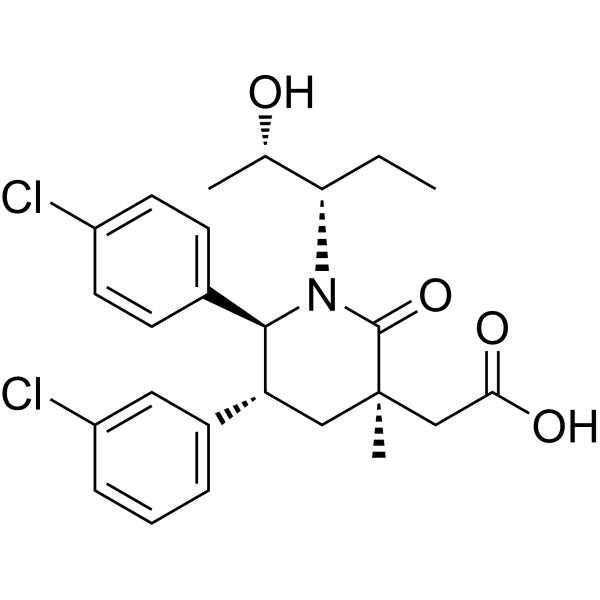 0 ImagesCat. No.: HY-18052CAS No.: 1352064-70-0AM-8553 is a MDM2/p53 inhibitor (KD: 0.4 nM for MDM2). AM-8553 has anti-tumor activity
-
Siremadlin succinate
 0 ImagesCat. No.: HY-18658BCAS No.: 1638193-48-2Synonyms: NVP-HDM201 succinate; HDM201 succinateSiremadlin (NVP-HDM201) succinate is an MDM2 inhibitor and cell cycle regulator. Siremadlin succinate blocks the p53-binding pocket of MDM2, inhibits MDM2-mediated ubiquitination and degradation of p53, thereby activating the p53 pathway in p53 wild-type cells. Siremadlin succinate can be used in the research of cutaneous melanoma.




