



Microtubule/Tubulin
Microtubules are a component of the cytoskeleton, found throughout the cytoplasm. These tubular polymers of tubulin can grow as long as 50 micrometres, with an average length of 25 µm, and are highly dynamic. The outer diameter of a microtubule is about 24 nm while the inner diameter is about 12 nm. Microtubules are found in eukaryotic cells and are formed by the polymerization of a dimer of two globular proteins, alpha and beta tubulin. Tubulin is one of several members of a small family of globular proteins. The tubulin superfamily includes five distinct families, the alpha-, beta-, gamma-, delta-, and epsilon-tubulins and a sixth family which is present only in kinetoplastid protozoa. The most common members of the tubulin family are α-tubulin and β-tubulin, the proteins that make up microtubules. Microtubules are very important in a number of cellular processes. They are involved in maintaining the structure of the cell.
All Product Categories
-
Microtubule/Tubulin Inhibitors
(812)
View all products
-
Microtubule/Tubulin Agonists
(2)
View all products
-
Microtubule/Tubulin Antagonist
(1)
View all products
-
Microtubule/Tubulin Activators
(21)
View all products
-
Microtubule/Tubulin Modulators
(20)
View all products
-
Microtubule/Tubulin Inducers
(5)
View all products
-
Microtubule/Tubulin Degraders
(3)
View all products
-
Microtubule/Tubulin Controls
(19)
View all products
-
Microtubule/Tubulin Ligands
(5)
View all products
-
Microtubule/Tubulin Related Products (1003)
Related Products (1003)

-
Antibodies (69)
-
MAP4343-d4
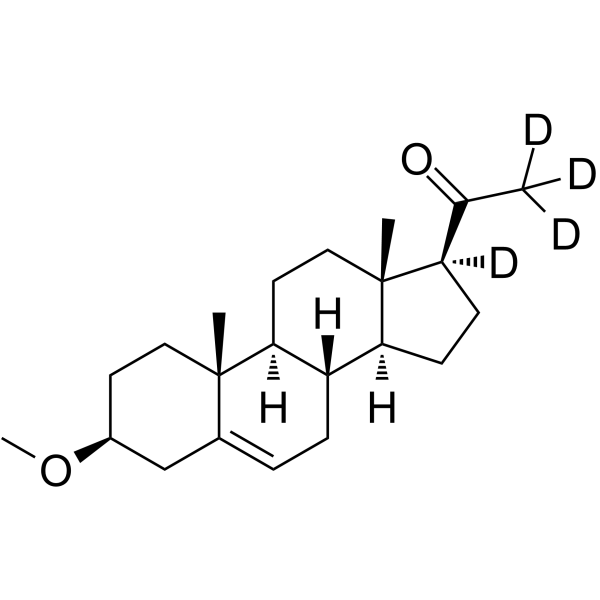 0 ImagesCat. No.: HY-107116SMAP4343-d4 is the deuterium labeled MAP4343. MAP4343 is the 3-methylether derivative of Pregnenolone. MAP4343 binds in vitro to microtubule-associated protein 2 (MAP2), stimulates the polymerization of tubulin, enhances the extension of neurites and protects neurons against neurotoxic agents.
-
MPT0B002
 0 ImagesCat. No.: HY-122151CAS No.: 946077-08-3MPT0B002 is a potent microtubule inhibitor with anticancer activities. MPT0B002 disrupts tubulin polymerization, induces apoptosis, and arrests cell cycle at the G2/M phase.
-
Methylene Blue Staining Solution (1%)
 0 ImagesCat. No.: HY-DY2050Methylene Blue Staining Solution (1%) (Basic Blue 9) is a guanylyl cyclase (sGC), monoamine oxidase A (MAO-A) and NO synthase (NOS) inhibitor. Methylene Blue Staining Solution (1%) is a vasopressor and is often used as a dye in several medical procedures. Methylene Blue Staining Solution (1%) through the nitric oxide syntase/guanylate cyclase signalling pathway to reduce prepulse inhibition. Methylene Blue Staining Solution (1%) is a REDOX cycling compound and able to cross the blood-brain barrier. Methylene Blue Staining Solution (1%) is a Tau aggregation inhibitor. Methylene Blue Staining Solution (1%) is a photosensitizer and redox agent. Methylene Blue Staining Solution (1%) reduces cerebral edema, attenuated microglial activation and reduced neuroinflammation.
-
AXIN2/β-catenin-IN-1
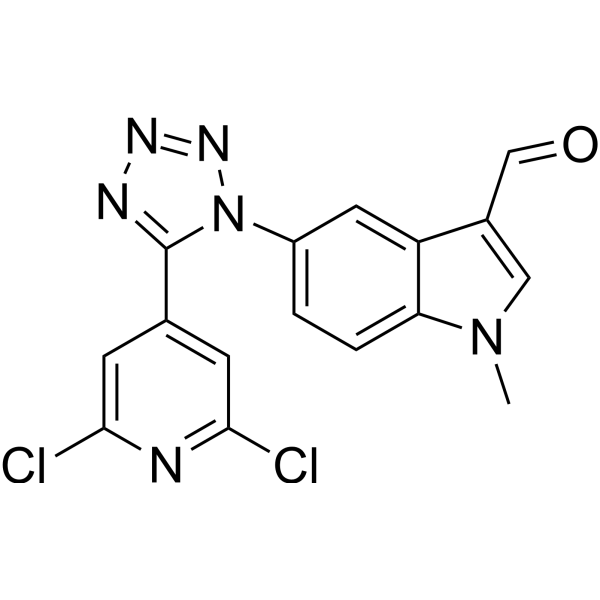
 0 ImagesCat. No.: HY-180449CAS No.: 3004884-16-3Anticancer agent 291 (Compound 2406) is an anti-cancer agent. Anticancer agent 291 interferes with the integrity of the β-tubulin cytoskeleton and inhibits the Wnt/β-catenin signal transduction. Anticancer agent 291 significantly inhibits the invasion, migration and colony formation of tumor cells. Anticancer agent 291 induces the cell cycle of EC-9706 and HT-29 cells to arrest at the G2/M phase and inhibits cell proliferation. Anticancer agent 291 can be used for the study of gastrointestinal cancer.
-
Tubulin/VEGFR-2-IN-2
 0 ImagesCat. No.: HY-180292CAS No.: 2882998-56-1Tubulin/VEGFR-2-IN-2 is an orally active tubulin and VEGFR-2 inhibitor with IC50s of 3.27 and 0.09 μM, respectively. Tubulin/VEGFR-2-IN-2 exerts the antitumor effects through multifaceted pathways, including enhancing reactive oxygen species (ROS) generation, disrupting mitochondrial membrane potential, inducing apoptosis, and arresting the cell cycle. Tubulin/VEGFR-2-IN-2 demonstrates anti-angiogenic properties by significantly impairing endothelial cell migration, invasion, and tube formation in vitro. Tubulin/VEGFR-2-IN-2 suppresses angiogenesis, tumor growth, and metastasis in vivo. Tubulin/VEGFR-2-IN-2 can be used for non-small lung cancer, breast cancer, gastric cancer and lymphoma.
-
Anticancer agent 40
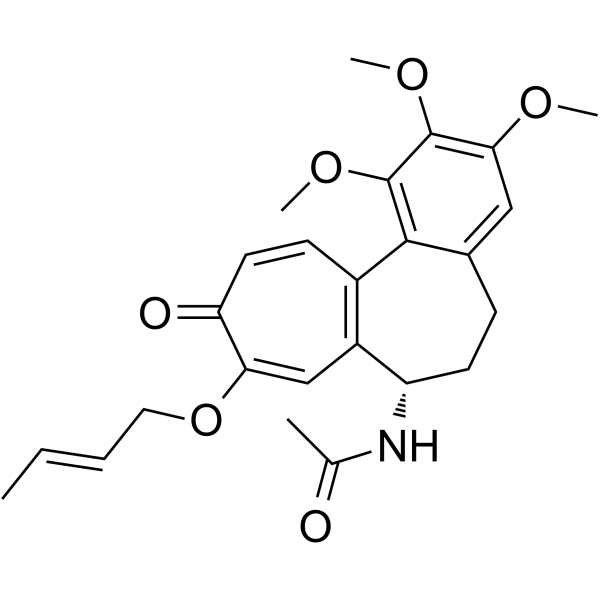 0 ImagesCat. No.: HY-144808CAS No.: 2760658-33-9Anticancer agent 40 (compound 3e) is a potent anticancer agent. Anticancer agent 40 shows anticancer activities with IC50s of 0.94, 0.98, 0.96, 0.95, 2.13 nM for SKBR-3, SKOV-3, PC-3, U-87, HDF cells, respectively.
-
3,4,3'-Tri-O-methylflavellagic acid
 0 ImagesCat. No.: HY-N13795CAS No.: 13756-49-53,4,3'-Tri-O-methylflavellagic acid is a flavonoid inhibitor that targets αβ-tubulin (colchicine binding site) and polo-like kinase-1 (PLK-1), and can be isolated from the roots of Anogeissus leiocarpus. 3,4,3'-Tri-O-methylflavellagic acid interferes with microtubule assembly dynamics and kinase activity, exhibiting anti-cancer cell proliferation and potent anti-nociceptive effects.
-
Tubulin polymerization activator-1
 0 ImagesCat. No.: HY-189447Tubulin polymerization activator-1 is a Tubulin polymerization promoter. Tubulin polymerization activator-1 induces Apoptosis, G2/M phase cell cycle arrest, and mitochondrial membrane potential depolarization. Tubulin polymerization activator-1 inhibits angiogenesis. Tubulin polymerization activator-1 exhibits anticancer activity against prostate cancer, melanoma, and cervical cancer. Tubulin polymerization activator-1 can be used for research on prostate cancer.
-
Anti-CCL2 (Carlumab)-McMMAF
 0 ImagesCat. No.: HY-171682Anti-CCL2 (Carlumab)-McMMAF is an antibody-drug conjugate (ADC) consisting of the humanized anti-CCL2 (chemokine ligand 2) antibody Carlumab (HY-P99188) conjugated to the protective group maleimidocaproyl and the tubulin inhibitor MMAF (HY-15579). The ADC toxic molecule and linker part are McMMAF (HY-15578). Anti-CCL2 (Carlumab)-McMMAF induces apoptosis and can be used in cancer research.
-
ER-076349-d3
 0 ImagesCat. No.: HY-42484SSynonyms: Eribulin intermediate-d3ER-076349-d3 (Eribulin intermediate-d3) is the deuterated-labeled ER-076349 (HY-42484). ER-076349 (Eribulin intermediate) is an inhibitor of tubulin polymerization, induces G2-M cell cycle arrest, and disrupts mitotic spindles. ER-076349 inhibits cancer cell growth, and inhibits tumor growth in several human tumor xenografts. ER-076349 is an analog of Halichondrin B.
-
Mertansine-d3
 0 ImagesCat. No.: HY-19792S2Synonyms: DM1-d3; Maytansinoid DM1-d3Mertansine-d3 (DM1-d3) is the deuterium labeled Mertansine (HY-19792). Mertansine (DM1) is a microtubulin inhibitor and is an antibody-conjugatable maytansinoid that is developed to overcome systemic toxicity associated with maytansine and to enhance tumor-specific delivery. Mertansine can be attached to a monoclonal antibody with a linker to create an antibody-drug conjugate (ADC).
-
Tubulin-IN-52
 0 ImagesCat. No.: HY-177138CAS No.: 2099064-75-0Tubulin-IN-52 is a tubulin inhibitor. Tubulin-IN-52 demonstrates significant cytotoxicity toward a variety of cancer cell types including prostate, lung, and ovarian cancers with strong activity toward highly aggressive cancer lines (IC50 = 0.9-3.8 mM). Tubulin-IN-52 significantly inhibits the growth of established tumors without noticeable toxicity. Tubulin-IN-52 can be used for the study of cancer.
-
Tubulin polymerization-IN-11
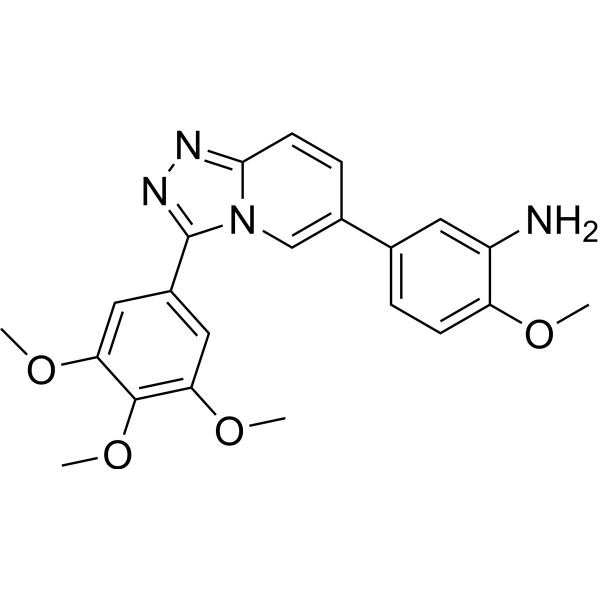 0 ImagesCat. No.: HY-146817CAS No.: 2470063-59-1Tubulin polymerization-IN-11 is a potent tubulin polymerization inhibitor with an IC50 value of 3.4 μM. Tubulin polymerization-IN-11 shows antiproliferative activity. Tubulin polymerization-IN-11 induces Apoptosis and cell cycle arrest at G2/M phase. Tubulin polymerization-IN-11 decreases the expression of cyclin B1, p-cdc2, and Bcl-2 protein levels and increases the expression of cleaved PARP.
-
Milataxel
 0 ImagesCat. No.: HY-13684CAS No.: 393101-41-2Synonyms: MAC-321Milataxel (MAC-321) is an orally active taxane analog of Docetaxel (HY-B0011). Milataxel enhances the rate of tubulin polymerization. Milataxel can be used in the research of colorectal cancer and non-small cell lung cancer.

-
CHM-1-P-Na
 0 ImagesCat. No.: HY-120482CAS No.: 1207854-61-2CHM-1-P-Na is a sodium monophosphate salt of 2-(2-fluorophenyl)-6,7-methylenedioxyquinolin-4-one, which can be converted into CHM-1, a compound with a unique anti-tumor mechanism, in vitro and in vivo, and has excellent anti-tumor activity in tumor models and clear pharmacological effects on related enzymes.
-
TopoII/tubulin-IN-1
 0 ImagesCat. No.: HY-172395TopoII/tubulin-IN-1 (Compound 1B8) is a TopoII/tubulin inhibitor. TopoII/tubulin-IN-1 can inhibit the proliferation and the level of ROS of tumor cells, induce apoptosis and cell cycle arrest of tumor cells, but has no significant cytotoxicity to normal cells. TopoII/tubulin-IN-1 has antitumor activity.
-
Tubulin inhibitor 40
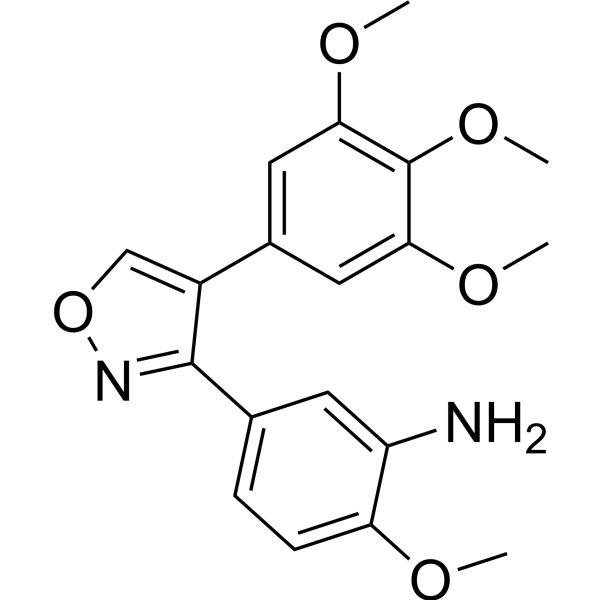 0 ImagesCat. No.: HY-163195CAS No.: 3026839-57-3Tubulin inhibitor 40 (compound 45) is a tubulin inhibitor with IC50 of 1.2 μM. Tubulin inhibitor 40 shows selective cytotoxicity towards cancer cells. Tubulin inhibitor 40 processes antitumor activity .
-
BKS3031A
 0 ImagesCat. No.: HY-170864CAS No.: 1449771-90-7BKS3031A is the inhibitor for αβ-tubulin that binds to the colchicine binding site, and inhibits the microtubule assembly dynamics.




