



Collagen I Inhibitor
- 1
-
Sapanisertib
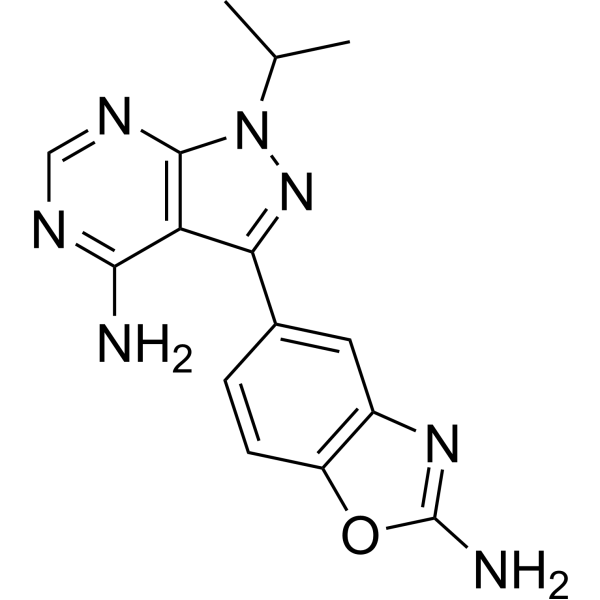 0 ImagesSynonyms: INK-128; MLN0128; TAK-228
Sapanisertib (INK-128; MLN0128; TAK-228) is an orally active dual mTORC1/mTORC2 inhibitor. Sapanisertib directly and simultaneously inhibits mTORC1/2 activity through competitive binding with ATP, thereby comprehensively blocking downstream processes such as protein and lipid synthesis and cytoskeletal reorganization, consequently suppressing tumor cell proliferation and promoting apoptosis. Sapanisertib is applicable to research on melanoma, ovarian cancer, pulmonary fibrosis, and hematological malignancies.
-
Anti-Mouse CD106/VCAM-1 Antibody (M/K-2.7)
 0 ImagesCat. No.: HY-P990294
Anti-Mouse CD106/VCAM-1 Antibody (M/K-2.7) is an anti-mouse CD106/VCAM-1 IgG1 monoclonal antibody. Anti-Mouse CD106/VCAM-1 Antibody (M/K-2.7) reduces inflammatory response and oxidative stress by lowering p-STAT3 and reactive oxygen species (ROS) levels. Anti-Mouse CD106/VCAM-1 Antibody (M/K-2.7) can alleviate cardiac inflammation and fibrosis by reducing the expression of collagen I and collagen III. Anti-Mouse CD106/VCAM-1 Antibody (M/K-2.7) can be used for research on cardiovascular conditions such as hypertensive heart condition and subretinal fibrosis.
-
Methylophiopogonone A
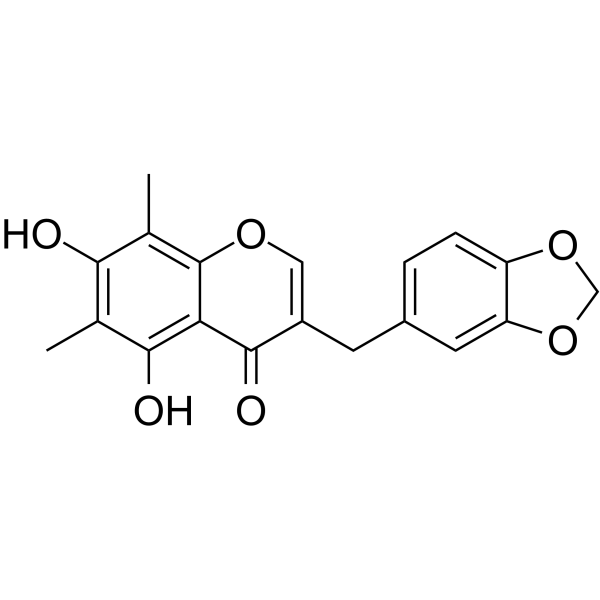 0 Images
Methylophiopogonone A is a homoisoflavonoid compound found in the tuberous roots of Ophiopogon japonicus. Methylophiopogonone A inhibits lipopolysaccharide-induced NO production in mouse microglia with an IC50 of 19.2 μM. Methylophiopogonone A blocks the proliferation of LX-2 hepatic stellate cells and downregulates TGF-β1-induced expressions of type I collagen and α-SMA. Methylophiopogonone A blocks RELA/EGFR-mediated hepatic stellate cell activation, inhibits the MAPK12 pathway to reduce extracellular matrix accumulation, and simultaneously suppresses inflammatory signal transduction. Methylophiopogonone A can be used in studies related to chronic hepatitis B-associated hepatic fibrosis and neuroinflammation.
-
Oxoglaucine
 0 Images
Oxoglaucine (O-Methylatheroline) is a natural product with multiple activities including autophagy activation, anti-inflammation, antibacterial activity, and immunoregulation. Oxoglaucine inhibits the TRPV5/calmodulin/CAMK-II pathway, suppresses TGFβ-induced Smad2 phosphorylation by upregulating Smad7, blocks Ca2+ influx, activates autophagy, alleviates apoptosis and inflammation, inhibits ROS production and the expression of fibrosis markers in hepatocytes, and regulates immune cell populations and responses. Oxoglaucine protects against infections caused by Candida albicans and Klebsiella pneumoniae, and exerts effects on adjuvant-induced arthritis. Oxoglaucine can be used in studies related to arthritis, liver fibrosis, bacterial infections, and fungal infections.

-
Salviamarinic acid A
 0 ImagesCat. No.: HY-N17650CAS No.: 3038746-92-5
Salviamarinic acid A is a water-soluble phenolic acid that can be extracted from Salvia miltiorrhiza with potent anti-pulmonary fibrosis activity. Salviamarinic acid A significantly increases cell viability, cell index, cell motility and E-cadherin expression, and reduces TGF-β1, α-SMA and Collagen I levels. Salviamarinic acid A can be used for pulmonary fibrosis research.
-
Antifibrotic agent 3
 0 ImagesCat. No.: HY-184738CAS No.: 2103516-38-5
Antifibrotic agent 3 is an orally active antifibrotic agent. Antifibrotic agent 3 reduces hepatic stellate cell activation by downregulating the expression of Collagen I and α-SMA. Antifibrotic agent 3 inhibits liver fibrosis in bile duct ligation and carbon tetrachloride-induced liver fibrosis models. Antifibrotic agent 3 can be used for the research of liver fibrosis.
-
GV-001
 0 ImagesCat. No.: HY-182904CAS No.: 3082707-76-1
GV-001 is a selective and orally active HDAC6 inhibitor with an IC50 of 1.18 nM against HDAC6. GV-001 selectively enhances α-tubulin acetylation, reduces sIL-6 and Collagen I levels, suppresses renal cyst growth, and upregulates PC1 expression. GV-001 can be used for the study of autosomal dominant polycystic kidney disease (ADPKD).
-
SB772077B
 0 ImagesCat. No.: HY-123958CAS No.: 785774-34-7
SB772077B is a ROCK inhibitor. SB772077B has an anti-inflammatory activity and enhances aqueous outflow facility (OF) by inactivating RhoA/ROCK signal pathway. SB772077B significantly reduces the mRNA level of β-catenin and protein level of fibrotic markers, such as vinculin, fibronectin, collagen 1 A and vimentin. SB772077B also has vasodialatory activity and decreases pulmonary and systemic blood pressure. SB772077B can be used for glaucoma research and pulmonary hypertensive disorder research.
-
HIPK2-IN-2
 0 ImagesCat. No.: HY-189141
HIPK2-IN-2 is an orally active and selective HIPK2 inhibitor with an IC50 of 0.36 μM against HIPK2. HIPK2-IN-2 reduces HIPK2 protein expression levels. HIPK2-IN-2 inhibits the proliferation and migration of renal interstitial fibroblasts, alleviates renal tubular injury and collagen deposition, and suppresses TGF-β/Smad3-mediated profibrotic signaling pathways as well as TNF-α/NF-κB-mediated inflammatory signaling pathways in renal cells. HIPK2-IN-2 is used for the study of chronic kidney disease-associated renal fibrosis.
-
HIPK2-IN-1
 0 ImagesCat. No.: HY-189140
HIPK2-IN-1 is an orally active and selective HIPK2 inhibitor with an IC50 of 0.56 μM. HIPK2-IN-1 exerts antifibrotic and anti-inflammatory activities. HIPK2-IN-1 binds to HIPK2, inhibits the downstream TGF‑β/Smad3, p53, and TNF‑α/NF‑κB signaling pathways, reduces the expression of fibrotic markers, suppresses cell proliferation and migration, and alleviates renal tubular injury and collagen deposition. HIPK2-IN-1 is used for the study of renal fibrosis associated with chronic kidney disease.
-
LM9
 0 ImagesCat. No.: HY-180336CAS No.: 2249864-11-5
LM9 is a potent, orally active MyD88 inhibitor. LM9 blocks TLR4/MyD88 binding, MyD88 homodimer formation, and TLR4/MyD88/NF-κB signaling pathway activation. LM9 prevents atherosclerosis by regulating inflammatory responses and oxidative stress in macrophages. LM9 efficiently mitigates inflammatory responses and fibrosis in obesity-induced cardiomyopathy. LM9 can be used for fibrosis and atherosclerosis research.
-
2ccPA sodium
 0 ImagesCat. No.: HY-160823CAS No.: 927880-40-8Synonyms: 2ccPA18:1 sodium
2ccPA (2ccPA18:1) sodium is a chemically stable cyclic phosphatidic acid derivative and antifibrotic inhibitor-inducer. 2ccPA sodium increases intracellular cAMP levels in skin fibroblasts, downregulates the expression of extracellular matrix (ECM) components, and promotes the production of antifibrotic factors HGF and PGE2. 2ccPA sodium ameliorates Bleomycin hydrochloride (HY-17565A)-induced skin fibrosis in mice and can be used for research on systemic sclerosis (SSc) and other fibrotic disorders.
-
12-O-Tiglyl-phorbol 13-dodecanoate
 0 ImagesCat. No.: HY-N11736CAS No.: 37394-32-4
12-O-Tiglyl-phorbol 13-dodecanoate (TD13) is a potential inhibitor with anti-hepatic fibrosis activity, and it belongs to a series of derivatives of oral APOL2 inhibitors and anti-hepatic fibrosis agents. It shows no obvious toxicity in preclinical models. Compounds of the 12-O-Tiglyl-phorbol 13-dodecanoate series inhibit the expression of fibronectin, type I collagen and α-smooth muscle actin in hepatic stellate cells. 12-O-Tiglyl-phorbol 13-dodecanoate can be isolated from the Euphorbiaceae plant Euphorbia fischeriana, and it is applicable to the research of hepatic fibrosis.
-
Sapanisertib (Standard)
 0 ImagesSynonyms: INK-128 (Standard); MLN0128 (Standard); TAK-228 (Standard)
Sapanisertib (INK-128; MLN0128; TAK-228) Standard is the analytical standard of Sapanisertib (HY-13328). This product is intended for research and analytical applications. Sapanisertib (INK-128; MLN0128; TAK-228) is an orally active dual mTORC1/mTORC2 inhibitor. Sapanisertib directly and simultaneously inhibits mTORC1/2 activity through competitive binding with ATP, thereby comprehensively blocking downstream processes such as protein and lipid synthesis and cytoskeletal reorganization, consequently suppressing tumor cell proliferation and promoting apoptosis. Sapanisertib is applicable to research on melanoma, ovarian cancer, pulmonary fibrosis, and hematological malignancies.
-
Methylophiopogonone A (Standard)
 0 ImagesCat. No.: HY-N2441RCAS No.: 74805-90-6
Methylophiopogonone A (Standard) is the analytical standard of Methylophiopogonone A (HY-N2441). This product is intended for research and analytical applications. Methylophiopogonone A is a homoisoflavonoid compound found in the tuberous roots of Ophiopogon japonicus. Methylophiopogonone A inhibits lipopolysaccharide-induced NO production in mouse microglia with an IC50 of 19.2 μM. Methylophiopogonone A blocks the proliferation of LX-2 hepatic stellate cells and downregulates TGF-β1-induced expressions of type I collagen and α-SMA. Methylophiopogonone A blocks RELA/EGFR-mediated hepatic stellate cell activation, inhibits the MAPK12 pathway to reduce extracellular matrix accumulation, and simultaneously suppresses inflammatory signal transduction. Methylophiopogonone A can be used in studies related to chronic hepatitis B-associated hepatic fibrosis and neuroinflammation.
-
2ccPA
 0 ImagesCat. No.: HY-167201CAS No.: 633278-53-2Synonyms: 2ccPA18:1
2ccPA (2ccPA18:1) is a metabolically stabilized carba analog of cyclic phosphatidic acid (cPA). 2ccPA inhibits autotaxin (ATX)‑mediated lysophosphatidic acid (LPA) production, suppresses extracellular matrix biosynthesis and elevates intracellular cAMP in fibrogenic skin fibroblasts. 2ccPA protects oligodendrocytes from mitochondrial‑driven apoptosis, suppresses neuroinflammation and demyelination, modulates microglial polarization and promotes rapid‑platelet/fibrin‑dependent hemostasis and subsequent fibrinolytic transition following brain injury.
-
Sapanisertib phosphate
 0 ImagesCat. No.: HY-13328ACAS No.: 1422006-47-0Synonyms: INK-128 phosphate; MLN0128 phosphate; TAK-228 phosphate
Sapanisertib (INK-128; MLN0128; TAK-228) phosphate is an orally active dual mTORC1/mTORC2 inhibitor. Sapanisertib phosphate directly and simultaneously inhibits mTORC1/2 activity through competitive binding with ATP, thereby comprehensively blocking downstream processes such as protein and lipid synthesis and cytoskeletal reorganization, consequently suppressing tumor cell proliferation and promoting apoptosis. Sapanisertib phosphate is applicable to research on melanoma, ovarian cancer, pulmonary fibrosis, and hematological malignancies.
- 1



