



Amoxicillin-clavulanate potassium

Based on 1 Customer Validation
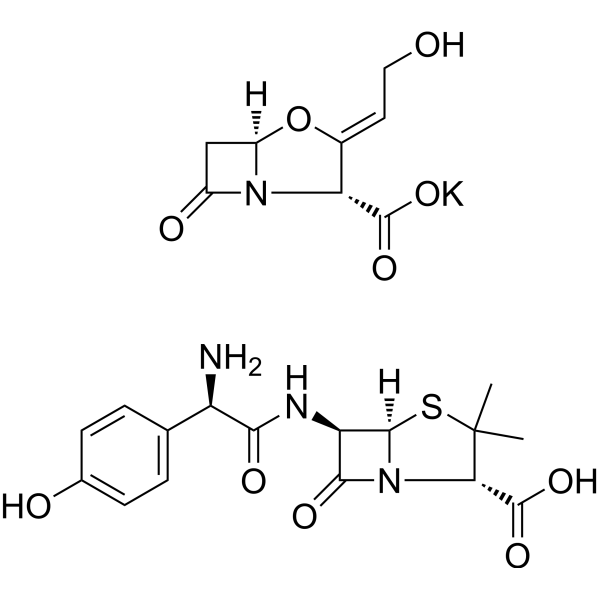
Amoxicillin-clavulanate potassium is an orally active antibacterial composition consisting of Amoxicillin (HY-B0467A) and the β-lactamase inhibitor Clavulanate potassium (HY-A0256A). In Amoxicillin-clavulanate potassium, Amoxicillin binds to bacterial penicillin-binding proteins to inhibit peptidoglycan synthesis and exert a bactericidal effect; Clavulanate potassium protects Amoxicillin from hydrolysis by β-lactamase. Amoxicillin-clavulanate potassium exhibits antibacterial activity against β-lactamase-producing Gram-positive and Gram-negative bacteria. Amoxicillin-clavulanate potassium dose-dependently interferes with the function of ameloblasts at the maturation stage, disrupts the enamel mineralization process, and induces enamel developmental defects. Amoxicillin-clavulanate potassium can be used in research related to bacterial infections.
Nos produits utilisent uniquement pour la recherche. Nous ne vendons pas aux patients.
- Pureté : 93.62%
- CAS No.: 74469-00-4
- Formule: C24H27KN4O10S
- Masse moléculaire:602.66
-
Stockage:
4°C, sealed storage, away from moisture and light
* In solvent : -80°C, 6 months; -20°C, 1 month (sealed storage, away from moisture and light)

To place orders, for customer services and technical support, please contact: MedChemExpress USA
Tel: 609-228-6898 E-mail: [email protected] [email protected]


-
 Activité biologique
-
Chemical Information
-
Solvant et solubilité
- Protocole
- Pureté et documentation
- Références
-
 Help & FAQs


Voir tous les produits spécifiques à Isoform Antibiotic
MoreVoir tous les produits spécifiques à Isoform Beta-lactamase
More

Activité biologique
Description
In Vitro
Amoxicillin-clavulanate potassium retains activity against S. pneumoniae (including penicillin-nonsusceptible strains) as well as β-lactamase-producing H. influenzae and M. catarrhalis[3].
Amoxicillin‑clavulanate potassium (extended‑release formulation, amoxicillin‑clavulanate ER) achieves elevated and sustained plasma Amoxicillin (HY-B0467A) concentrations; it enhances antibacterial efficacy against penicillin‑nonsusceptible Streptococcus pneumoniae while retaining antibacterial activity against β‑lactamase‑producing pathogens[3].
MedChemExpress (MCE) has not independently confirmed the accuracy of these methods. They are for reference only. Further protocols information, click here.
In Vivo
Amoxicillin-clavulanate potassium (Amoxicillin-clavulanate) (7 mg/kg Amoxicillin (HY-B0467A) + 1.75 mg/kg Clavulanate potassium (HY-A0256A); subcutaneous injection; once every 8 h for 4 days) produces a significant bactericidal effect against Streptococcus pneumoniae strains with MIC ≤2 mg/L in a Cyclophosphamide (HY-17420)-induced neutropenic mouse thigh infection model; for isolates with MIC ≥4 mg/L, animal mortality increases significantly[2].
Amoxicillin-clavulanate potassium (7 mg/kg Amoxicillin + 1.75 mg/kg Clavulanate potassium; subcutaneous injection; once every 8 h for 24 h) exhibits in vivo bactericidal efficacy against multiple Streptococcus pneumoniae strains similar to that of Amoxicillin alone in a neutropenic mouse thigh infection model[2].
MedChemExpress (MCE) has not independently confirmed the accuracy of these methods. They are for reference only.
-
Animal Model:C57BL/6 (adult male, 8-10 weeks old)[1]
-
Dosage:50-150 mg/kg
-
Administration:s.c.; once daily; 60 days
-
Result:Induced dose-dependent enamel defects.
At 50 mg/kg, caused irregular scratched enamel and superficial pits.
At 100 mg/kg, resulted in larger defects, demineralized areas, and disorganized transitional ameloblasts with cyst-like lesions.
At 150 mg/kg, produced the most severe microstructural modifications, including a rough, foamy appearance and cracked eggshell appearance.
EDX analysis showed increased F at 50 mg/kg (1.00 wt%) vs control (0.59 wt%), and increased P (14.33 wt%) and Ca (28.93 wt%) at 100 mg/kg compared to the 50 mg/kg group (13.49 wt% and 25.88 wt%, respectively).
Histology revealed disorganized maturation ameloblasts and detachment from the enamel matrix at 100 and 150 mg/kg.
-
Animal Model:ICR/Swiss (six-week-old, female, 23-27 g, neutropenic, renal impairment, S. pneumoniae thigh infection)[2]
-
Dosage:7 mg/kg Amoxicillin plus 1.75 mg/kg Clavulanic acid (Clavulanate potassium)
-
Administration:s.c.; every 8 h
24 h for bactericidal assessment
4 days (12 doses) for survival -
Result:Killed 1.6 to 4.1 log10 CFU/thigh at 24 h against strains with amoxicillin MICs ≤2 mg/liter.
Grew 0.6 to 2.3 logs at 24 h against strains with MICs >4 mg/liter.
Achieved 0% mortality for strains with MICs ≤2 mg/liter.
Achieved 80 to 100% mortality for strains with MICs ≥4 mg/liter.
Demonstrated maximum in vivo killing with time above MIC of 50 to 60% of the 8-h dosing interval.


Chemical Information
-
CAS No. 74469-00-4
-
Appearance Solid
-
Masse moléculaire 602.66
-
Formule C24H27KN4O10S
-
Color White to light yellow
-
SMILES
O=C([C@@H]1N2[C@](CC2=O)([H])O/C1=C\CO)O[K].OC([C@@H]3N4[C@]([C@H](NC([C@@H](C5=CC=C(O)C=C5)N)=O)C4=O)([H])SC3(C)C)=O
-
Livraison
Room temperature in continental US; may vary elsewhere.
-
Stockage
4°C, sealed storage, away from moisture and light
* In solvent : -80°C, 6 months; -20°C, 1 month (sealed storage, away from moisture and light)


Solvant et solubilité
In Vitro:
DMSO : 100 mg/mL (165.93 mM; Need ultrasonic; Hygroscopic DMSO has a significant impact on the solubility of product, please use newly opened DMSO)
Please refer to the solubility information to select the appropriate solvent. Once prepared, please aliquot and store the solution to prevent product inactivation from repeated freeze-thaw cycles.
Storage method and period of stock solution: -80°C, 6 months; -20°C, 1 month (sealed storage, away from moisture and light). When stored at -80°C, please use it within 6 months. When stored at -20°C, please use it within 1 month.
Please refer to the solubility information to select the appropriate solvent. Once prepared, please aliquot and store the solution to prevent product inactivation from repeated freeze-thaw cycles.
Storage method and period of stock solution: -80°C, 6 months; -20°C, 1 month (sealed storage, away from moisture and light). When stored at -80°C, please use it within 6 months. When stored at -20°C, please use it within 1 month.
Concentration (start) × Volume (start) = Concentration (final) × Volume (final)
In Vivo:
Select the appropriate dissolution method based on your experimental animal and administration route.
- For the following dissolution methods, please ensure to first prepare a clear stock solution using an In Vitro approach and then sequentially add co-solvents:
- To ensure reliable experimental results, the clarified stock solution can be appropriately stored based on storage conditions. As for the working solution for In Vivo experiments, it is recommended to prepare freshly and use it on the same day.
- The percentages shown for the solvents indicate their volumetric ratio in the final prepared solution. If precipitation or phase separation occurs during preparation, heat and/or sonication can be used to aid dissolution.
Add each solvent one by one: 10% DMSO 40% PEG300 5% Tween-80 45% Saline
Solubility: ≥ 2.5 mg/mL (4.15 mM); Clear solution
This protocol yields a clear solution of ≥ 2.5 mg/mL (saturation unknown).
Taking 1 mL working solution as an example, add 100 μL DMSO stock solution (25.0 mg/mL) to 400 μL PEG300, and mix evenly; then add 50 μL Tween-80 and mix evenly; then add 450 μL Saline to adjust the volume to 1 mL.
Preparation of Saline: Dissolve 0.9 g sodium chloride in ddH₂O and dilute to 100 mL to obtain a clear Saline solution.
Add each solvent one by one: 10% DMSO 90% (20% SBE-β-CD in Saline)
Solubility: ≥ 2.5 mg/mL (4.15 mM); Clear solution
This protocol yields a clear solution of ≥ 2.5 mg/mL (saturation unknown).
Taking 1 mL working solution as an example, add 100 μL DMSO stock solution (25.0 mg/mL) to 900 μL 20% SBE-β-CD in Saline, and mix evenly.
Preparation of 20% SBE-β-CD in Saline (4°C, storage for one week): 2 g SBE-β-CD powder is dissolved in 10 mL Saline, completely dissolve until clear.
In Vivo Dissolution Calculator
Please enter the basic information of animal experiments:
-
-
-
-
Recommended: Prepare an additional quantity of animals to account for potential losses during experiments.
Please enter your animal formula composition:
-
%DMSO +
Recommended: Keep the proportion of DMSO in working solution below 2% if your animal is weak.
-
%+
-
+%Tween-80 + +
-
%Saline +
The co-solvents required include: DMSO, . All of co-solvents are available by MedChemExpress (MCE). , Tween 80. All of co-solvents are available by MedChemExpress (MCE).
Working solution concentration: 0.22 mg/mL
Method for preparing stock solution: mg drug dissolved in μL DMSO. Stock solution concentration: mg/mL. * In solvent : -80°C, 6 months; -20°C, 1 month (sealed storage, away from moisture and light)
1. Take μL DMSO stock solution;
2. Add μL .
μL , mix evenly;
3. Then add μL Tween 80, mix evenly;
4. Then add μL
Please ensure that the stock solution in the first step is dissolved to a clear state, and add co-solvents in sequence. You can use ultrasonic heating (ultrasonic cleaner, recommended frequency 20-40 kHz), vortexing, etc. to assist dissolution.

Protocole
-
Research Protocol for Infectious Diseases
Infectious-disease experiments test how pathogens interact with host barriers, innate immune receptors, inflammatory signaling, pathogen replication, and tissue injury; pattern-recognition receptors such as TLRs, RIG-I-like receptors, NOD-like receptors, and inflammasomes detect microbial molecules and activate NF-κB, interferon, and cytokine responses. The central hypothesis is that infection severity reflects the balance between pathogen burden and host response: protective inflammation restricts pathogen growth, whereas excessive or mislocalized inflammation contributes to tissue damage and disease phenotype. Unresolved questions include which host pathways are protective versus pathogenic, why some infection models fail to translate to human disease, and which combined readouts best predict clinically relevant infection outcomes.
-
Mesenchymal stromal/stem cell osteogenic differentiation
Mesenchymal stromal/stem cells can be induced toward an osteoblast-like lineage in vitro by culture in osteogenic medium containing dexamethasone, ascorbic acid or ascorbate-2-phosphate, and β-glycerophosphate; the differentiation process is commonly evaluated by alkaline phosphatase activity, osteogenic marker expression, collagenous matrix formation, and calcium-rich matrix mineralization. The main readouts are alkaline phosphatase activity as an early osteogenic marker and Alizarin Red S staining as a calcium-deposit readout for mineralized extracellular matrix; Alizarin Red S can be inspected microscopically or extracted and measured colorimetrically at 405 nm.
-
Gram Staining of Tissue Sections
Gram staining of tissue sections is a histochemical technique used to differentiate Gram-positive and Gram-negative bacteria within histological specimens based on differences in bacterial cell wall structure and dye retention, adapted from classical bacteriological Gram staining into tissue-compatible “histological Gram stain” variants. In tissue applications, modifications of the Brown-Hopps and Brown-Brenn methods are commonly used to improve differentiation of microorganisms embedded within host connective tissue and to reduce overstaining or loss of Gram-negative signal, which are known limitations of earlier approaches. The principle relies on crystal violet-iodine complex retention in Gram-positive organisms and subsequent decolorization and counterstaining steps that allow contrast visualization of Gram-negative organisms against tissue background.
-
Bacterial live/dead nucleic-acid viability staining
The LIVE/DEAD bacterial viability staining method is based on differential permeability of nucleic-acid-binding fluorescent dyes, most commonly SYTO 9 and propidium iodide (PI), which enables discrimination of bacterial populations with intact versus compromised cytoplasmic membranes. SYTO 9 penetrates both intact and damaged bacterial membranes and binds nucleic acids to produce green fluorescence, whereas propidium iodide penetrates only cells with compromised membranes and fluoresces red while also reducing SYTO 9 signal through competitive binding and fluorescence interactions. The resulting fluorescence pattern is interpreted as a proxy for membrane integrity, which is widely used as an indicator of bacterial viability in microscopy, flow cytometry, and spectroscopic platforms. However, mechanistic studies show that SYTO 9 and PI interactions involve displacement and fluorescence resonance energy transfer effects, which can influence signal interpretation depending on dye ratios a


Pureté et documentation
-
Fiche technique (294 KB)
-
SDS (254 KB)
- English - EN (254 KB)
- Français - FR (254 KB)
- Deutsch - DE (254 KB)
- Norwegian - NO (254 KB)
- Español - ES (254 KB)
- Swedish - SV (254 KB)
- Italian - IT (254 KB)
- Korean - KR (254 KB)
- Portuguese - PT (254 KB)
-
Instruction de manipulation (2659 KB)
Références


Complete Stock Solution Preparation Table
Please refer to the solubility information to select the appropriate solvent. Once prepared, please aliquot and store the solution to prevent product inactivation from repeated freeze-thaw cycles.
Storage method and period of stock solution: -80°C, 6 months; -20°C, 1 month (sealed storage, away from moisture and light). When stored at -80°C, please use it within 6 months. When stored at -20°C, please use it within 1 month.
| Optional Solvent | Concentration Solvent Mass | 1 mg | 5 mg | 10 mg | 25 mg |
|---|---|---|---|---|---|
| DMSO | 1 mM | 1.6593 mL | 8.2966 mL | 16.5931 mL | 41.4828 mL |
| 5 mM | 0.3319 mL | 1.6593 mL | 3.3186 mL | 8.2966 mL | |
| 10 mM | 0.1659 mL | 0.8297 mL | 1.6593 mL | 4.1483 mL | |
| 15 mM | 0.1106 mL | 0.5531 mL | 1.1062 mL | 2.7655 mL | |
| 20 mM | 0.0830 mL | 0.4148 mL | 0.8297 mL | 2.0741 mL | |
| 25 mM | 0.0664 mL | 0.3319 mL | 0.6637 mL | 1.6593 mL | |
| 30 mM | 0.0553 mL | 0.2766 mL | 0.5531 mL | 1.3828 mL | |
| 40 mM | 0.0415 mL | 0.2074 mL | 0.4148 mL | 1.0371 mL | |
| 50 mM | 0.0332 mL | 0.1659 mL | 0.3319 mL | 0.8297 mL | |
| 60 mM | 0.0277 mL | 0.1383 mL | 0.2766 mL | 0.6914 mL | |
| 80 mM | 0.0207 mL | 0.1037 mL | 0.2074 mL | 0.5185 mL | |
| 100 mM | 0.0166 mL | 0.0830 mL | 0.1659 mL | 0.4148 mL |


Amoxicillin-clavulanate potassium Related Classifications
HY-135532 Related Classifications
 Powered by Bioz
Keywords
- Amoxicillin-clavulanate
- 74469-00-4
- Antibiotic
- Bacterial
- Beta-lactamase
- beta-lactamase inhibitor clavulanate potassium
- penicillin-non-susceptible strains
- H. influenzae
- M. catarrhalis
- C57BL/6 mice
- ameloblast function
- β-lactamase-producing pathogens
- hypomineralized enamel
- Streptococcus pneumoniae
- molar incisor hypomineralization
- Inhibitor
- inhibitor
- inhibit