



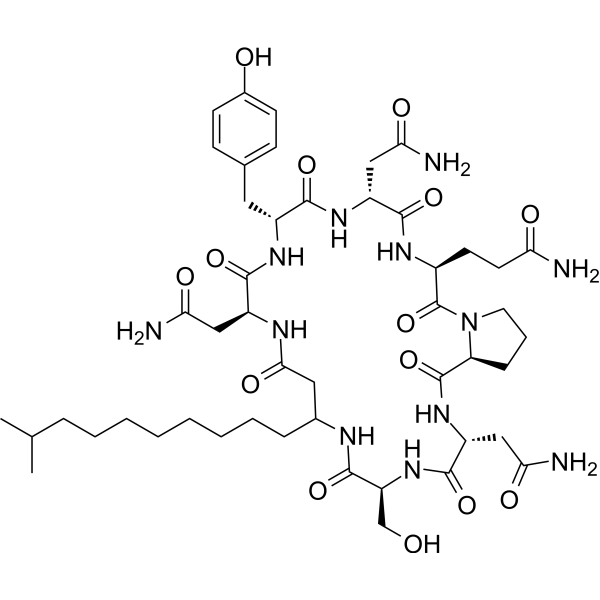
Surfactin
Based on 7 publication(s) in Google Scholar
Surfactin is a potent cyclic lipopeptide biosurfactants consists of four isomers (Surfactin A, B, C and D), which mediates flux of mono-and divalent cations, such as calcium, across lipid bilayer membranes. Surfactin can act as an antimicrobial adjuvant with anti-bacterial, anti-fungal, antimycoplasma and hemolytic effects. Surfactin also has antiviral activity against a variety of enveloped viruses.
Nur für Forschungszwecke. Wir verkaufen nicht an Patienten.
- Reinheit : 98.96%
- CAS. Nr.: 252023-70-4
- Molecular Weight:1025.04(Average)
-
Speicherung:Powder -20°C, 3 years , 4°C, 2 years ; In solvent -80°C, 6 months , -20°C, 1 month


To place orders, for customer services and technical support, please contact: MedChemExpress USA
Tel: 609-228-6898 E-mail: [email protected] [email protected]


-
 Biologische Aktivität
-
Chemical Information
-
Lösungsmittel & Löslichkeit
- Protokoll
- Reinheit & Dokumentation
- Verweise
-
 Help & FAQs


Publications Citing Use of MedChemExpress (MCE) Surfactin
More Customer Validation & Images

-
Microbiological Assay

-
WB

-
IF

-
IP

-
Microbiological Assay

Alle Antibiotic Isoform-spezifische Produkte anzeigen
More

Biologische Aktivität
Beschreibung
IC50 & Target
[3]|
Lipopeptide |
HSV-1 |
HSV-2 |
In Vitro
Surfactin can increase the activity of NSC277174 against avian pathogenic Escherichia coli (APEC) in vitro with antimicrobial assays such as minimum inhibitory concentrations (MIC) and fractional inhibitory concentration (FIC). For APEC O78 strain, the MIC of NSC277174 and Surfactin are 1000 ug/ml and >1mg/ml, respectively[1].
MedChemExpress (MCE) has not independently confirmed the accuracy of these methods. They are for reference only.
In Vivo
MedChemExpress (MCE) has not independently confirmed the accuracy of these methods. They are for reference only.


Chemical Information
-
CAS. Nr. 252023-70-4
-
Appearance Solid
-
Molecular Weight 1025.04(Average)
-
Color White to off-white
-
SMILES
[Surfactin]
-
Structure Classification
-
Initial Source
Bacillus subtilis
-
Versand
Room temperature in continental US; may vary elsewhere.
-
Speicherung
Powder -20°C 3 years 4°C 2 years In solvent -80°C 6 months -20°C 1 month


Publications (7)
-
Journal Impact Factor
-
Most Recent
-
Nat Commun
Reduced fungal protein acetylation mediates the antimicrobial activity of a rhizosphere bacterium against a phytopathogenic fungus. [Abstract]2025 Jul 1;16(1):5644. PMID: 40595600
Surfactin purchased from MedChemExpress. Usage Cited in: Nat Commun. 2025 Jul 1;16(1):5644. [Abstract]
The anti-microbial activity of surfactin on V. dahliae-V592. The dissolution buffer for Surfactin (200 μM) is water. The phenotype was recorded 5 days after culturing on a plate with a diameter of 6 cm. Diameter of the inhibition zone of V. dahliae-V592 cultured on a PDA plate containing buffer (H2O), TG1-2cf, and surfactin.
Surfactin purchased from MedChemExpress. Usage Cited in: Nat Commun. 2025 Jul 1;16(1):5644. [Abstract]
Immunoblotting showing the overall protein lysine acetylation levels in wild-type V592 before and after treated with TG1-2 culture filtrate (left panel) and 200 μM Surfactin (right panel) at 48 h.
Surfactin purchased from MedChemExpress. Usage Cited in: Nat Commun. 2025 Jul 1;16(1):5644. [Abstract]
Fluorescence detection of apoptosis in V592 strains before and after Surfactin (200 μM; 2 days) treatment via FITC-12-dUTP labeling. The experiment was repeated three times and showed similar results.
Surfactin purchased from MedChemExpress. Usage Cited in: Nat Commun. 2025 Jul 1;16(1):5644. [Abstract]
Immunoblotting assay showing the acetylation of Hsp83-Flag in the transgenic strains treated with Surfactin (200 μM) at 48 h. Immunoprecipitation of Hsp83 was performed with Flag-trap beads. One of three independent experiments was shown.
-
Biosens Bioelectron
2022 Nov 15:216:114673. PMID: 36067717 -
Food Microbiol
Composition and activity of antifungal lipopeptides produced by Bacillus spp. in daqu fermentation. [Abstract]2023 May:111:104211. PMID: 36681393
Surfactin purchased from MedChemExpress. Usage Cited in: Food Microbiol. 2023 May:111:104211. [Abstract]
Minimum inhibitory concentration of Surfactin (2.5-2500 mg/L) (yellow bar), fengycin (green bar) and iturin A (blue bar) against filamentous fungi and yeasts. Results were presented as means ± standard deviation of quadruplicate independent experiments.
-
-

Surfactin purchased from MedChemExpress. Usage Cited in: J Mar Sci Eng. 2022, 10(2), 196.
Effect of different concentrations of Surfactin (0.5-10 mg/L; 1-7 days) on the population growth of K. veneficum. The error bars represent the SEs of 3 replicates.

Surfactin purchased from MedChemExpress. Usage Cited in: J Mar Sci Eng. 2022, 10(2), 196.
Effects of different initial concentrations of Surfactin (0.5-10 mg/L) on the chlorophyll fluorescence parameters of K. veneficum during population growth in 6 days.
-
-


Lösungsmittel & Löslichkeit
In Vitro:
H2O : 100 mg/mL (Need ultrasonic)
DMSO : 50 mg/mL (Need ultrasonic; Hygroscopic DMSO has a significant impact on the solubility of product, please use newly opened DMSO)
In Vivo:
Select the appropriate dissolution method based on your experimental animal and administration route.
- For the following dissolution methods, please ensure to first prepare a clear stock solution using an In Vitro approach and then sequentially add co-solvents:
- To ensure reliable experimental results, the clarified stock solution can be appropriately stored based on storage conditions. As for the working solution for In Vivo experiments, it is recommended to prepare freshly and use it on the same day.
- The percentages shown for the solvents indicate their volumetric ratio in the final prepared solution. If precipitation or phase separation occurs during preparation, heat and/or sonication can be used to aid dissolution.
Add each solvent one by one: 10% DMSO 40% PEG300 5% Tween-80 45% Saline
Solubility: ≥ 2.5 mg/mL; Clear solution
This protocol yields a clear solution of ≥ 2.5 mg/mL (saturation unknown).
Taking 1 mL working solution as an example, add 100 μL DMSO stock solution (25.0 mg/mL) to 400 μL PEG300, and mix evenly; then add 50 μL Tween-80 and mix evenly; then add 450 μL Saline to adjust the volume to 1 mL.
Preparation of Saline: Dissolve 0.9 g sodium chloride in ddH₂O and dilute to 100 mL to obtain a clear Saline solution.
Add each solvent one by one: 10% DMSO 90% (20% SBE-β-CD in Saline)
Solubility: ≥ 2.5 mg/mL; Clear solution
This protocol yields a clear solution of ≥ 2.5 mg/mL (saturation unknown).
Taking 1 mL working solution as an example, add 100 μL DMSO stock solution (25.0 mg/mL) to 900 μL 20% SBE-β-CD in Saline, and mix evenly.
Preparation of 20% SBE-β-CD in Saline (4°C, storage for one week): 2 g SBE-β-CD powder is dissolved in 10 mL Saline, completely dissolve until clear.
For the following dissolution methods, please prepare the working solution directly:
It is recommended to prepare fresh solutions and use them promptly within a short period of time.
The percentages shown for the solvents indicate their volumetric ratio in the final prepared solution. If precipitation or phase separation occurs during preparation, heat and/or sonication can be used to aid dissolution.
Add each solvent one by one: PBS
Solubility: 110 mg/mL; Clear solution; Need ultrasonic
In Vivo Dissolution Calculator
Please enter the basic information of animal experiments:
-
-
-
-
Recommended: Prepare an additional quantity of animals to account for potential losses during experiments.
Working solution concentration: 0.22 mg/mL
This product has good water solubility, please refer to the measured solubility data in water/PBS/Saline for details.


Reinheit & Dokumentation
-
Data Sheet (272 KB)
-
SDS (251 KB)
- English - EN (251 KB)
- Français - FR (251 KB)
- Deutsch - DE (251 KB)
- Norwegian - NO (251 KB)
- Español - ES (251 KB)
- Swedish - SV (251 KB)
- Italian - IT (251 KB)
- Korean - KR (251 KB)
- Portuguese - PT (251 KB)
-
Handling Instructions (2659 KB)
Verweise
[1]. Liu J, et al. Sensitization of avian pathogenic Escherichia coli to NSC277174 in vitro and in vivo in the presence of surfactin. PLoS One. 2019 Sep 12;14(9):e0222413. [Content Brief]
[3]. Vollenbroich D, et al. Mechanism of inactivation of enveloped viruses by the biosurfactant surfactin from Bacillus subtilis. Biologicals. 1997 Sep;25(3):289-97. [Content Brief]

Calculators
Konzentration (Stammlösung) × Volumen (Stammlösung) = Konzentration (Ziellösung) × Volumen (Ziellösung)


Surfactin Related Classifications
HY-129555 Related Classifications
 Powered by Bioz