



TAT-GluA2 3Y
Based on 2 publication(s) in Google Scholar
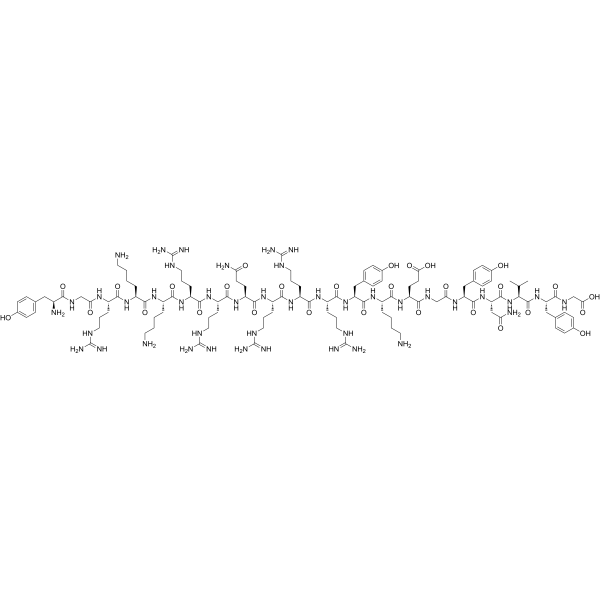
TAT-GluA2 3Y is a blood-brain barrier-permeable AMPA receptor inhibitory peptide that crosses cell membranes via the HIV-1 TAT protein domain. TAT-GluA2 3Y blocks the endocytosis of AMPA receptors, including the internalization of GluA1/GluA2 subunits, by disrupting interactions with the AP2, Brag2 and Syt3-GluA2 complexes, while also inhibiting long-term depression. TAT-GluA2 3Y blocks hypoxia-mediated AMPAR internalization, alleviates A1R-induced persistent synaptic inhibition, and reduces cerebral ischemic volume, neurological deficits and spatial memory deficits. TAT-GluA2 3Y blocks the effect of NLRP3 deficiency on fear generalization, inhibits amphetamine-induced behavioral/neurochemical sensitization, weakens the unconditioned stimulus-conditioned stimulus association of morphine, and promotes the extinction of morphine CPP. TAT-GluA2 3Y can be used in studies related to fear generalization, ischemic stroke, hypoxia, drug addiction and opioid addiction.
For research use only. We do not sell to patients.
- Purity : 99.93%
- CAS No.: 1404188-93-7
- Formula: C115H185N43O29
- Molecular Weight:2633.97
-
Storage:
Please store the product under the recommended conditions in the Certificate of Analysis.

To place orders, for customer services and technical support, please contact: MedChemExpress USA
Tel: 609-228-6898 E-mail: [email protected] [email protected]


-
 Biological Activity
-
Chemical Information
-
Solvent & Solubility
- Protocols
- Purity & Documentation
- References
-
 Help & FAQs


Publications Citing Use of MedChemExpress (MCE) TAT-GluA2 3Y
MoreAll iGluR Isoforms
MoreAll Adenosine Receptor Isoforms
More

Biological Activity
Description
|
AMPA Receptor |
A1R |
In Vitro
Tat-GluA2-3Y (2 μM; 1 h pre-incubation) blocks clathrin-mediated endocytosis, thereby inhibiting A1R agonist- and hypoxia-induced internalization of GluA2 and GluA1 AMPARs, as well as A1R agonist-induced reduction in surface GluA2 and GluA1 AMPAR levels, in primary cultured rat hippocampal neurons[3].
Tat-GluA2-3Y (2 μM; 1 h pre-incubation) prevents A1R agonist-induced GluA2 AMPAR internalization in rat hippocampal slices[3].
The Tat-GluA2-3Y peptide (2 μM) can partially block clathrin-mediated GluA2 internalization, thereby attenuating the persistent synaptic inhibition induced by A1R agonists in the CA3-CA1 synapses of rat hippocampus[3].
MedChemExpress (MCE) has not independently confirmed the accuracy of these methods. They are for reference only.
In Vivo
TAT-GluA2 3Y (5 mg/kg; i.p.; multiple administrations) disrupts the interaction between Syt3 and GluA2, increases the surface expression level of GluA2, inhibits the formation of CP-AMPAR, reduces the cerebral ischemic volume by approximately 40%-50% in male SD rats with ischemic stroke induced by middle cerebral artery occlusion/reperfusion (MCAO/R), improves neurological function, and enhances the recovery of long-term sensorimotor and cognitive functions[2].
TAT-GluA2 3Y (1.5 nM/g; intravenous injection; 5 times (once before each dexamphetamine injection, once every 2 days)) blocks the induction, maintenance and expression of amphetamine-induced behavioral and neurochemical sensitization in male SD rats[4].
TAT-GluA2 3Y (15 pM; bilateral microinjection into the ventral tegmental area (VTA); 5 total injections, one before each d-amphetamine injection, once every 2 days) inhibits the maintenance and expression of amphetamine-induced behavioral sensitization in male SD rats, but does not inhibit its induction[4].
Co-administration of TAT-GluA2 3Y (intravenously injected at a dose of 1.5-2.25 nM/g; administered 1 h prior to each morphine conditioning session) with morphine during the acquisition phase of morphine-conditioned place preference (CPP) promotes rapid extinction of preference, but does not affect the induction, expression, maintenance or reinstatement of CPP[5].
TAT-GluA2 3Y (2.25 nM/g; intravenous injection; 1 hour prior to each food conditioning session) has no effect on the induction, extinction, or reinstatement of food-induced conditioned place preference in rats[5].
MedChemExpress (MCE) has not independently confirmed the accuracy of these methods. They are for reference only.
-
Animal Model:C57BL/6J background NLRP3 knockout (male, 8-10 weeks old)[1]
-
Dosage:4.32 μM/kg
-
Administration:i.p.; single dose
-
Result:Blocked the NLRP3 deprivation effect on fear generalization, as evidenced by a significant reduction in CS- freezing levels compared to untreated NLRP3 KO mice.
Left basal and CS+ freezing levels comparable between treated and untreated groups.
Recovered the hippocampal expression of phosphorylated AMPA receptor 1 at ser831.
Decreased phosphorylated CaMKII levels.
Left phosphorylated PKA levels unchanged.
-
Animal Model:Sprague-Dawley (male, 250-300 g, middle cerebral artery occlusion/reperfusion model)[2]
-
Dosage:5 mg/kg
-
Administration:i.p.; multiple doses (1 h before MCAO/R, 1 h after MCAO/R, 1 h before each behavioral test on days 3, 5, 7, 14, 21, 22, 23, 24, 25, 26, 27 post-MCAO/R)
-
Result:Reduced Syt3-GluA2 co-immunoprecipitation levels in penumbral tissue by ~90% compared with saline controls at 6 h post-MCAO/R.
Reduced ischemic volume to ~17% of total brain volume when administered 1 h before MCAO/R, compared with ~27% in scrambled peptide controls; reduced ischemic volume to ~20% when administered 1 h after MCAO/R.
Reduced mNSS scores to ~5 when administered 1 h before MCAO/R, and ~7 when administered 1 h after MCAO/R, compared with ~12 in scrambled peptide controls at 24 h post-reperfusion.
Increased surface GluA2 protein levels by ~40% in penumbral tissue at 6 h post-MCAO/R, compared with scrambled peptide controls, while intracellular GluA2 levels were reduced by ~40%.
Reduced AMPAR-mediated excitatory postsynaptic current amplitude reduction by Naspm to ~20%, compared with ~50% reduction in scrambled peptide controls.
Increased rotarod test latency to fall to ~220 s by day 21 post-MCAO/R, compared with ~150 s in scrambled peptide controls.
Reduced adhesive removal test contact time to ~10 s, and removal time to ~15 s by day 21 post-MCAO/R, compared with ~30 s and ~40 s, respectively, in scrambled peptide controls.
Reduced Morris water maze escape latency to ~20 s by day 26 post-MCAO/R, compared with ~30 s in scrambled peptide controls; increased platform crossings to ~3 times, compared with ~1 time in scrambled peptide controls.
-
Animal Model:Sprague-Dawley (male, 250-275 g, amphetamine-induced behavioural sensitization model)[4]
-
Dosage:1.5 nM/g
-
Administration:i.v.; 5 times (once before each d-amphetamine injection every second day)
-
Result:Blocked the induction of locomotor sensitization.
Attenuated d-amphetamine-induced dopamine efflux in the NAcc on day 9 to 278% of baseline, compared to 633% on day 1.
Reduced the locomotor response to the d-amphetamine challenge significantly compared to vehicle or scrambled peptide control groups, with no significant difference from drug-naive rats.
Blocked neurochemical sensitization, with d-amphetamine-induced dopamine efflux in the NAcc significantly lower than scrambled peptide control.
-
Animal Model:Sprague-Dawley (male, 250-275 g, amphetamine-induced behavioural sensitization model)[4]
-
Dosage:15 pM
-
Administration:bilateral microinjection into VTA; 5 times (once before each d-amphetamine injection every second day)
-
Result:Did not affect the induction of locomotor sensitization, with significant increases in cumulative 30-min distance travelled from day 1 to day .
Reduced the locomotor response to the d-amphetamine challenge significantly compared to vehicle or scrambled peptide control groups, blocking the maintenance and expression of behavioural sensitization.
-
Animal Model:Sprague-Dawley (male, 220-240 g at arrival, morphine-induced conditioned place preference model)[5]
-
Dosage:1.5 nM/g; 2.25 nM/g
-
Administration:i.v.; 1 h before each morphine conditioning session
-
Result:Had no effect on induction, initial expression, or maintenance of morphine-induced CPP, with rats maintaining a significant preference for the morphine-associated compartment in bi-weekly tests over 8 weeks.
Greatly facilitated extinction: rats treated with 1.5 nmol/g or 2.25 nmol/g failed to display a consistent preference for the morphine-paired compartment across 11 extinction days, whereas saline or scrambled peptide controls maintained preference until days 9 and 11 respectively.
Had no effect on morphine-induced reinstatement of CPP, with all groups showing a significant preference for the morphine-associated compartment during retesting.
-
Animal Model:Sprague-Dawley (male, weight maintained at 90% of standard growth curve, food-induced conditioned place preference model)[5]
-
Dosage:2.25 nM/g
-
Administration:i.v.; 1 h before each food conditioning session
-
Result:Had no effect on induction, extinction, or reinstatement of food-induced CPP.
All groups displayed a significant preference for the food-associated compartment during initial testing, extinguished their preference within 15 days, and showed significant reinstatement after exposure to a Froot Loop, with no group differences detected via two-way ANOVA for any phase.


Chemical Information
-
CAS No. 1404188-93-7
-
Appearance Solid
-
Molecular Weight 2633.97
-
Formula C115H185N43O29
-
Color White to off-white
-
Sequence Shortening
YGRKKRRQRRRYKEGYNVYG
-
Shipping
Room temperature in continental US; may vary elsewhere.
-
Storage
Please store the product under the recommended conditions in the Certificate of Analysis.


Publications (2)
-
Journal Impact Factor
-
Most Recent
-
Nature
2025 May;641(8062):427-437. PMID: 40205038 -
Biochem Biophys Res Commun
AMPA receptor potentiation alleviates NLRP3 knockout-induced fear generalization in mice. [Abstract]2024 Aug 30:722:150074. PMID: 38805785


Solvent & Solubility
In Vitro:
H2O : 100 mg/mL (37.97 mM; Need ultrasonic)
* Note: If you choose water as the stock solution, please dilute it to the working solution, then filter and sterilize it with a 0.22 μm filter before use.
* Note: If you choose water as the stock solution, please dilute it to the working solution, then filter and sterilize it with a 0.22 μm filter before use.
Concentration (start) × Volume (start) = Concentration (final) × Volume (final)
In Vivo:
For the following dissolution methods, please prepare the working solution directly:
It is recommended to prepare fresh solutions and use them promptly within a short period of time.
The percentages shown for the solvents indicate their volumetric ratio in the final prepared solution. If precipitation or phase separation occurs during preparation, heat and/or sonication can be used to aid dissolution.
Add each solvent one by one: PBS
Solubility: 100 mg/mL (37.97 mM); Clear solution; Need ultrasonic


Purity & Documentation
-
Data Sheet (288 KB)
-
SDS (254 KB)
- English - EN (254 KB)
- Français - FR (254 KB)
- Deutsch - DE (254 KB)
- Norwegian - NO (254 KB)
- Español - ES (254 KB)
- Swedish - SV (254 KB)
- Italian - IT (254 KB)
- Korean - KR (254 KB)
- Portuguese - PT (254 KB)
-
Handling Instructions (2659 KB)
References
[1]. Li W, et al. AMPA receptor potentiation alleviates NLRP3 knockout-induced fear generalization in mice. Biochem Biophys Res Commun. 2024;722:150074. [Content Brief]
[2]. Lu H, et al. Synaptotagmin-3 interactions with GluA2 mediate brain damage and impair functional recovery in stroke. Cell Rep. 2023;42(3):112233. [Content Brief]
[3]. Chen Z, et al. Prolonged adenosine A1 receptor activation in hypoxia and pial vessel disruption focal cortical ischemia facilitates clathrin-mediated AMPA receptor endocytosis and long-lasting synaptic inhibition in rat hippocampal CA3-CA1 synapses: differential regulation of GluA2 and GluA1 subunits by p38 MAPK and JNK. J Neurosci. 2014;34(29):9621-9643. [Content Brief]
[4]. Choi FY, et al.Interference with AMPA receptor endocytosis: effects on behavioural and neurochemical correlates of amphetamine sensitization in male rats. J Psychiatry Neurosci. 2014 May;39(3):189-99. [Content Brief]
[5]. Dias C, et al. Facilitated extinction of morphine conditioned place preference with Tat-GluA2(3Y) interference peptide. Behav Brain Res. 2012 Aug 1;233(2):389-97. [Content Brief]


Complete Stock Solution Preparation Table
| Optional Solvent | Concentration Solvent Mass | 1 mg | 5 mg | 10 mg | 25 mg |
|---|---|---|---|---|---|
| H2O | 1 mM | 0.3797 mL | 1.8983 mL | 3.7966 mL | 9.4914 mL |
| 5 mM | 0.0759 mL | 0.3797 mL | 0.7593 mL | 1.8983 mL | |
| 10 mM | 0.0380 mL | 0.1898 mL | 0.3797 mL | 0.9491 mL | |
| 15 mM | 0.0253 mL | 0.1266 mL | 0.2531 mL | 0.6328 mL | |
| 20 mM | 0.0190 mL | 0.0949 mL | 0.1898 mL | 0.4746 mL | |
| 25 mM | 0.0152 mL | 0.0759 mL | 0.1519 mL | 0.3797 mL | |
| 30 mM | 0.0127 mL | 0.0633 mL | 0.1266 mL | 0.3164 mL |
* Note: If you choose water as the stock solution, please dilute it to the working solution, then filter and sterilize it with a 0.22 μm filter before use.


TAT-GluA2 3Y Related Classifications
HY-P2259 Related Classifications
 Powered by Bioz