



Hypericaceae Extract
-
- Cratoxylum cochinchinense (Lour.) Blume (6)
- Hypericum henryi H. Lév. & Vaniot (4)
- Hypericum wightianum Wall. ex Wight & Arn. (4)
- Hypericum beanii N. Robson (3)
- Hypericum patulum Thunb. (3)
- Hypericum sampsonii Hance (3)
- Hypericum uralum Buch.-Ham. & D. Don (3)
- Hypericum acmosepalum N. Robson (2)
- Hypericum elodeoides Choisy (2)
- Hypericum pseudopetiolatum R. Keller (2)
- Cratoxylum formosum subsp. pruniflorum (Kurz) Gogelin (1)
- Cratoxylum maingayi Dyer (1)
- Hypericum ascyron L. (1)
- Hypericum attenuatum Fisch. ex Choisy (1)
- Hypericum brasiliense Choisy (1)
- Hypericum cohaerens N. Robson (1)
- Hypericum elatoides R. Keller (1)
- Hypericum forrestii (Chitt.) N. Robson (1)
- Hypericum geminiflorum Hemsl. (1)
- Hypericum nagasawae Hayata (1)
- Hypericum oblongifolium Choisy (1)
- Hypericum reptans Hook. f. & Thomson ex Dyer (1)
- Psorospermum adamauense Engl. (1)
-
Hypericaceae Extract (47)

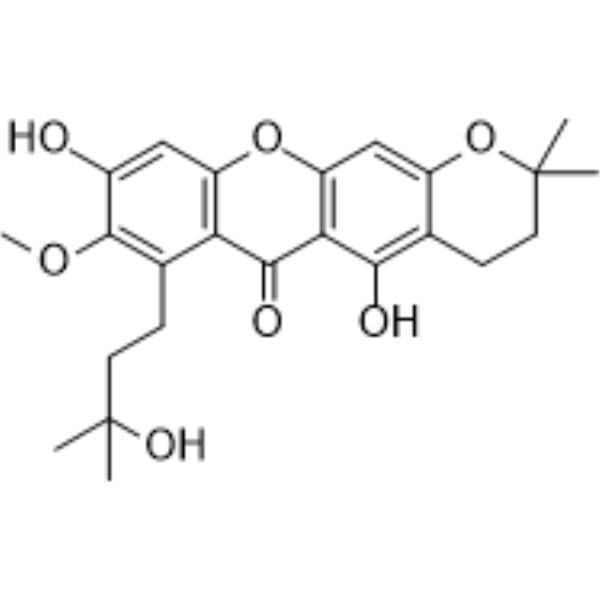
- Formule: C24H28O7
- Masse moléculaire: 428.47
3-Isomangostin hydrate (Compound 17) is an xanthone that can be isolated from Cratoxylum formosum ssp. pruniflorum and exhibits antibacterial activity.

- Formule: C33H42O5
- Masse moléculaire: 518.68
Sampsonione P is an RXRα inhibitor isolated and extracted from Hypericum sampsonii. Sampsonione P inhibits RXRα transcriptional activity and can downregulate the expression of pro-inflammatory proteins such as iNOS and COX-2, thereby exerting anti-inflammatory effects. Sampsonione P has antitumor activity. Sampsonione P can be used for research on inflammatory diseases and cancer.

- Formule: C38H50O5
- Masse moléculaire: 586.80
Uralione E is a naturally occurring polycyclic polyprenylated acylphloroglucinol (PPAP). Uralione E exhibits a protective effect against corticosterone (HY-B1618)-induced damage in PC12 cells. In a free fatty acid (FFA)-induced L02 cell model, Uralione E dose-dependently reduces intracellular lipid accumulation, downregulates the expression of FASN and CD36, and upregulates the expression of ACOX1 and PPARα. Uralione E can be used in studies related to neuronal cell damage, lipid metabolism, and non-alcoholic steatohepatitis.

- Formule: C33H42O6
- Masse moléculaire: 534.69

- Formule: C38H52O7
- Masse moléculaire: 620.82
Uralione D is a neuroprotective agent found in Hypericum uralum and Hypericum kouytchense. Uralione D exhibits cytotoxic activity against gastric cancer cells and protects against Corticosterone (HY-B1618)-induced damage in neuron-like cells. Uralione D is useful for research on depression, multidrug-resistant liver cancer, and gastric cancer.

- Formule: C33H40O4
- Masse moléculaire: 500.68
Hypercohin K is a polycyclic polyprenylated acylphloroglucinol isolated from Hypericum henryi, containing a rare spiro-fused cyclopropane ring in its structure. Hypercohin K exhibits anti-inflammatory, antitumor, and AChE-enhancing activities. Hypercohin K reduces intracellular lipid accumulation by regulating lipid metabolism genes, and can inhibit NO production to exert anti-inflammatory effects. Hypercohin K can be used in research on non-alcoholic steatohepatitis and tumors.

- Formule: C38H48O4
- Masse moléculaire: 568.80
Hypelodin A is a Hypelodin. Hypelodin A can be isolated from H. beanii. Hypelodin A can be used in research on colorectal cancer, breast cancer, and liver cancer.

- Formule: C32H40O4
- Masse moléculaire: 488.66
Hypatulin A is a terpenoid compound found in the leaves of Hypericum patulum. Hypatulin A exhibits antibacterial activity against Bacillus subtilis. Hypatulin A can be used in research related to bacterial infections.

- Formule: C38H48O4
- Masse moléculaire: 568.79
Sampsonione D is a Hypercohone. Sampsonione D is isolated from the aerial parts of Hypericum cohaerens. Sampsonione D inhibits Alpha-glucosidase, with an IC50 of 116.0 μM against yeast Alpha-glucosidase. Sampsonione D is inactive against Acetylcholinesterase. Sampsonione D exhibits no anticancer activity against non-small cell lung cancer, leukemia, breast cancer, or colorectal adenocarcinoma.

- Formule: C38H52O7
- Masse moléculaire: 620.82
Uralione I is a polycyclic polyprenylated acylphloroglucinol (PPAP) found in the whole plant of Hypericum uralum. Uralione I can be used for research on depression.

- Formule: C33H42O5
- Masse moléculaire: 518.68
Sampsonione O is a neuroprotective agent. Sampsonione O is present in Hypericum species. Sampsonione O exerts neuroprotective effects against L-glutamic acid (HY-14608)-induced injury. Sampsonione O can be used for research on neuronal injury[3]4].

- Formule: C38H50O5
- Masse moléculaire: 586.80
Uralodin A is a polycyclic polyprenylated acylphloroglucinol (PPAP). Uralodin A exerts cytotoxic activity through its inhibitory effects on tumor cells. Uralodin A can be used for cancer-related research.

- Formule: C38H50O5
- Masse moléculaire: 586.80
Uralodin B is a naturally occurring polycyclic polyprenylated acylphloroglucinol (PPAP) and is the C (30)-epimer of Uralodin C. It is found in the aerial parts of Hypericum henryi subsp. uraloides. Uralodin B exhibits cytotoxic activity against SGC7901 and HL-60 tumor cells. It is useful for research related to PPAP natural products and tumor cytotoxicity.

- Formule: C35H54O7
- Masse moléculaire: 586.80
Attenuatumione H is a polycyclic polyprenylated acylphloroglucinol compound found in the whole plant of Hypericum attenuatum, and it exhibits antitumor activity. Attenuatumione H exerts cytotoxic effects on liver cancer cells and breast cancer cells. Attenuatumione H shows no significant inhibitory effect on LPS-induced NO production in macrophages and displays no significant cytotoxic activity against osteosarcoma cells. Attenuatumione H can be used in cancer research.

- Formule: C33H42O5
- Masse moléculaire: 518.69
Hyperhenol B is a dearomatized isoprenylated acylphloroglucinol derivative that can be found in Hypericum henryi.


- Formule: C15H12O6
- Masse moléculaire: 288.25
3,8-Dihydroxy-1,2-dimethoxyxanthone is a xanthone compound found in the leaves and stems of Hypericum geminiflorum.

- Formule: C12H12O4
- Masse moléculaire: 220.22
5,7-Dihydroxy-2-isopropylchromone (Compound 9) is a chromone derivative. 5,7-Dihydroxy-2-isopropylchromone can be isolated from the leaves of Hypericum ascyron.

- Formule: C24H26O6
- Masse moléculaire: 410.46
Dulcisxanthone B is an antioxidant agent with free radical scavenging against DPPH (IC50 of 0.39 mM) and lipid peroxidation inhibition (IC50 of 024 μM).

- Formule: C21H22O11
- Masse moléculaire: 450.39
Petiolin G is a natural phenolic compound.



