



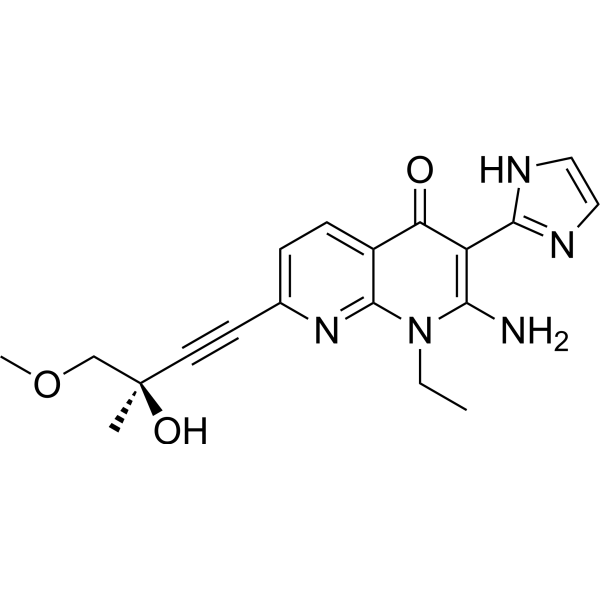
EVT801
EVT801 is an orally active and selective inhibitor of VEGFR-3 (IC50=11 nM), which has antitumor effects. EVT801 inhibits not only VEGF-C-induced human endothelial cell proliferation, but also tumor (lymphatic) angiogenesis in tumor mouse models. EVT801 can reduce tumor hypoxia, immunosuppressive cytokines (CCL4, CCL5) and myeloid derived suppressor cells (MDSC) production. EVT801 has synergistic effect with immune checkpoint therapy (ICT), which improves ICT response rate and has better inhibitory effect on cancer mouse models. EVT801 is a click chemistry reagent, it contains an Alkyne group and can undergo copper-catalyzed azide-alkyne cycloaddition (CuAAc) with molecules containing Azide groups.
Nos produits utilisent uniquement pour la recherche. Nous ne vendons pas aux patients.
- CAS No.: 1412453-70-3
- Formule: C19H21N5O3
- Masse moléculaire:367.40
-
Stockage:
Please store the product under the recommended conditions in the Certificate of Analysis.

To place orders, for customer services and technical support, please contact: MedChemExpress USA
Tel: 609-228-6898 E-mail: [email protected] [email protected]


-
 Activité biologique
-
Chemical Information
- Protocole
- Pureté et documentation
- Références
-
 Help & FAQs


Voir tous les produits spécifiques à Isoform VEGFR
More

Activité biologique
Description
IC50 & Target
[1]|
VEGFR3 11 nM (IC50) |
VEGFR1 396 nM (IC50) |
VEGFR2 130 nM (IC50) |
ERK 13 nM (IC50) |
In Vitro
EVT801 (10 nM-1 μM) dose-dependently inhibits VEGFR-1/2/3 autophosphorylation in HEK293 cells with IC50s of 39 nM (VEGFR-3), 2130 nM (VEGFR-1), 260 nM (VEGFR-2), respectively[1].
EVT801 (1 nM-1 μM) prevents proliferation of VEGFR-3-positive cells, human lymphatic microvascular endothelial cells (hLMVEC) for example. EVT801 inhibits the induction of hLMVECs proliferation dose-dependently with IC50s of 15 nM (VEGF-C), 8 nM (VEGF-D), 155 nM (VEGF-A), respectively[1].
EVT801 (1 μM) inhibits proliferation and tumor growth of VEGFR-3-positive tumor cells[1].
MedChemExpress (MCE) has not independently confirmed the accuracy of these methods. They are for reference only.
-
Cell Line:VEGFR-3-positive cells, human lymphatic microvascular endothelial cells (hLMVEC)
-
Concentration:1 nM-1 μM
-
Incubation Time:
-
Result:Showed a maximum inhibition of 74%, 100%, and 65% against VEGF-C, VEGF-D, VEGF-A induction, respectively.
In Vivo
MedChemExpress (MCE) has not independently confirmed the accuracy of these methods. They are for reference only.
- Human pluripotent stem cell endothelial-cell differentiation
- Vascular/Branching Fractal Analysis
- BrdU Incorporation Assay
- Somatic Cell Culture
- CFSE Dye Dilution Proliferation Assay
- Dye-dilution cell tracking and proliferation staining
- CCK-8/WST-8 Cell Proliferation Assay
- Protocol for Cell Cycle
- Cell Counting-Based Growth Curve Assay
- Colony Formation (Clonogenic) Assay
- Research Protocol for Cancer Immunology
- Cell Viability Determination by MTT Colorimetric Assay
- EdU Incorporation Assay (Click Chemistry-Based DNA Synthesis Measurement)
- Ki-67 Immunostaining Proliferation Assay
- PCNA Immunodetection Proliferation Assay
- Protocol for Cell Counting and Cell Density Analysis
- Endothelial Tube Formation Assay
- MTT Cell Proliferation Assay
- Endothelial Cell Migration/Angiogenic Sprouting Assay
Essai clinique
| NCT Number | Sponsor | Condition | Start Date |
Phase

|
|---|---|---|---|---|
| NCT01329991 | 2011-05 | PHASE1 |


Chemical Information
-
CAS No. 1412453-70-3
-
Masse moléculaire 367.40
-
Formule C19H21N5O3
-
SMILES
O=C1C(C2=NC=CN2)=C(N(C3=NC(C#C[C@@](C)(O)COC)=CC=C31)CC)N
-
Livraison
Room temperature in continental US; may vary elsewhere.
-
Stockage
Please store the product under the recommended conditions in the Certificate of Analysis.


Pureté et documentation
Références

Calculators
Concentration (start) × Volume (start) = Concentration (final) × Volume (final)


EVT801 Related Classifications
HY-152293 Related Classifications
 Powered by Bioz