



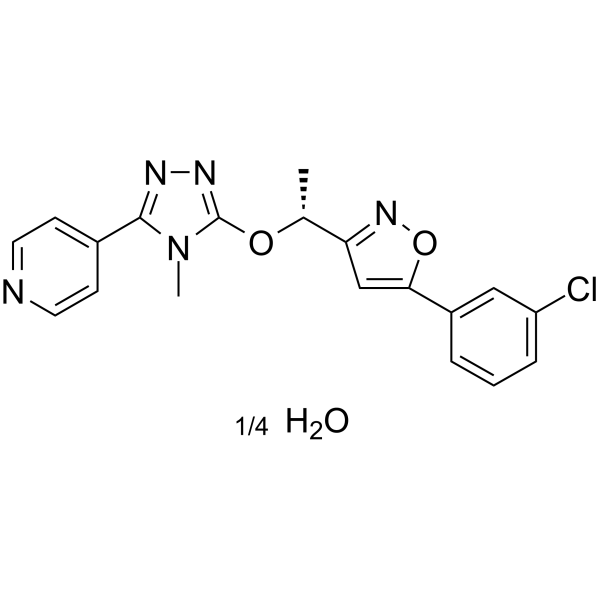
AZD 2066 hydrate
Based on 1 publication(s) in Google Scholar
AZD-2066 hydrate is a selective, orally active and blood-brain barrier-permeating mGluR5 antagonist. AZD 2066 hydrate activates the BDNF/trkB signaling pathway. AZD 2066 hydrate can be used in the research of neuropathic pain, major depressive disorder and gastroesophageal reflux disease.
Nur für Forschungszwecke. Wir verkaufen nicht an Patienten.
- Formel: C19H16ClN5O2.1/4H2O
- Molecular Weight:386.33
-
Speicherung:Powder -20°C, 3 years , 4°C, 2 years ; In solvent -80°C, 6 months , -20°C, 1 month

To place orders, for customer services and technical support, please contact: MedChemExpress USA
Tel: 609-228-6898 E-mail: [email protected] [email protected]


-
 Biologische Aktivität
-
Chemical Information
- Reinheit & Dokumentation
- Verweise
-
 Help & FAQs


Publications Citing Use of MedChemExpress (MCE) AZD 2066 hydrate
MoreAlle Calcium Channel Isoform-spezifische Produkte anzeigen
More

Biologische Aktivität
Beschreibung
IC50 & Target
[1]|
mGluR5 |
In Vitro
AZD 2066 (1-10 μM) hydrate inhibits Ca2+ response, with IC50s of 27.2, 3.56, 96.2, and 380 nM in mGlu5/HEK cells and striatal, hippocampal, and cortical cultures respectively[4].
AZD 2066 (1-10 μM) hydrate inhibits the oscillatory Ca2+ response which induced by bath application of DHPG (HY-12598A), and blocks either DHPG or Quis effects in mGlu5/HEK cells[4].
MedChemExpress (MCE) has not independently confirmed the accuracy of these methods. They are for reference only. .
In Vivo
AZD-2066 (10 µM, perfusion of brain slide) hydrate alleviates dihydroxyphenylglycine (DHPG)-facilitated long-term depression (LTD) expression in chronic social defeat stress (CSDS)-treated mice via BDNF/trkB signaling pathway[5].
AZD-2066 (5 mg/kg, i.p., 2 × 12 h) hydrate alleviates chronic social defeat stress (CSDS)-induced depressive behaviors in mice[5].
MedChemExpress (MCE) has not independently confirmed the accuracy of these methods. They are for reference only.
-
Animal Model:Male Wistar rats (weighing 240-250 g)[2]
-
Dosage:0.03, 0.1, 0.3, 1, 3, 10, 30 mg/kg
-
Administration:P.o. (60 minutes after administration)
-
Result:Caused full and dose-dependent AZD9272-appropriate responding.
-
Animal Model:Depressive model (C57BL/6 mice were subjected to physical defeats that were generated by a CD-1 aggressor for 5 min every day for 10 days)[5]
-
Dosage:5 mg/kg
-
Administration:Intraperitoneal injection (i.p.), 2 × 12 h
-
Result:Increased social interaction ratio.
Reversed time spent in interaction zone.
Increased sucrose preference scores.
Clinical Trial
| NCT Number | Sponsor | Condition | Start Date |
Phase

|
|---|---|---|---|---|
| NCT01329991 | Plexxikon| | 2011-05 | PHASE1 |


Chemical Information
-
Appearance Solid
-
Molecular Weight 386.33
-
Formel C19H16ClN5O2.1/4H2O
-
Color Off-white to light yellow
-
SMILES
CN1C(C2=CC=NC=C2)=NN=C1O[C@@H](C3=NOC(C4=CC(Cl)=CC=C4)=C3)C.O.[1/4]
-
Versand
Room temperature in continental US; may vary elsewhere.
-
Speicherung
Powder -20°C 3 years 4°C 2 years In solvent -80°C 6 months -20°C 1 month


Publications (1)
-
Journal Impact Factor
-
Most Recent
-
ACS Chem Neurosci
Location and Cell-Type-Specific Bias of Metabotropic Glutamate Receptor, mGlu5, Negative Allosteric Modulators. [Abstract]2019 Nov 20;10(11):4558-4570. PMID: 31609579


Reinheit & Dokumentation
-
Data Sheet (275 KB)
-
SDS (252 KB)
- English - EN (252 KB)
- Français - FR (252 KB)
- Deutsch - DE (252 KB)
- Norwegian - NO (252 KB)
- Español - ES (252 KB)
- Swedish - SV (252 KB)
- Italian - IT (252 KB)
- Korean - KR (252 KB)
- Portuguese - PT (252 KB)
-
Handling Instructions (2659 KB)
Verweise
[1]. Kågedal M, et al. A positron emission tomography study in healthy volunteers to estimate mGluR5 receptor occupancy of AZD2066-estimating occupancy in the absence of a reference region. Neuroimage. 2013 Nov 15;82:160-9. [Content Brief]
[2]. Swedberg MD, et al. AZD9272 and AZD2066: selective and highly central nervous system penetrant mGluR5 antagonists characterized by their discriminative effects. J Pharmacol Exp Ther. 2014 Aug;350(2):212-22. [Content Brief]
[3]. Antoniu SA. Discontinued drugs for pulmonary, allergy, gastrointestinal, arthritis (2012). Expert Opin Investig Drugs. 2013 Nov;22(11):1453-64. [Content Brief]
[4]. Jong YI, et al. Location and Cell-Type-Specific Bias of Metabotropic Glutamate Receptor, mGlu5, Negative Allosteric Modulators. ACS Chem Neurosci. 2019 Nov 20;10(11):4558-4570. [Content Brief]
[5]. Jiang X, et al. mGluR5 Facilitates Long-Term Synaptic Depression in a Stress-Induced Depressive Mouse Model. Can J Psychiatry. 2020 May;65(5):347-355. [Content Brief]

Calculators
Konzentration (Stammlösung) × Volumen (Stammlösung) = Konzentration (Ziellösung) × Volumen (Ziellösung)


AZD 2066 hydrate Related Classifications
HY-110255A Related Classifications
 Powered by Bioz