



Lydicamycin
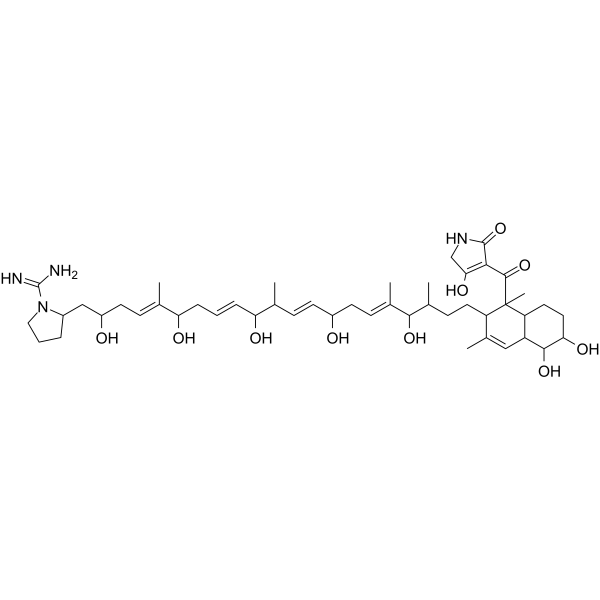
Lydicamycin is an antibiotic isolated from the fermentation broth of an actinomycete strain identified as Streptomyces lydicus. Lydicamycin is active against Gram-positive bacteria and a certain yeast, but inactive against Gram-negative bacteria.
Nur für Forschungszwecke. Wir verkaufen nicht an Patienten.
- CAS. Nr.: 133352-27-9
- Formel: C47H74N4O10
- Molecular Weight:855.11
-
Speicherung:
Please store the product under the recommended conditions in the Certificate of Analysis.

To place orders, for customer services and technical support, please contact: MedChemExpress USA
Tel: 609-228-6898 E-mail: [email protected] [email protected]


-
 Biologische Aktivität
-
Chemical Information
- Protokoll
- Reinheit & Dokumentation
- Verweise
-
 Help & FAQs


-
HY-Y0351
PhenylthioureaPhenoloxidase Inhibitor -

HY-N8296
Saccharocarcin AAntibiotic -

HY-141632
Sphinganine-C17Biomarker -

HY-123347
TPU-0037CAntimicrobial Agent -

HY-N8339
Decatromicin BAntibiotic -

HY-P2656
β-Defensin-4 (human)Antimicrobial Agent -
HY-W012444
Glyceryl 1-monooctanoateAntimicrobial -
HY-122076
A-26771BAntibacterial Agent -

HY-125074
PNU 142300Linezolid Metabolite -

HY-N8256
(–)-MycousnineBacterial Metabolite -

HY-W748000
KocurinAntibacterial Agent -
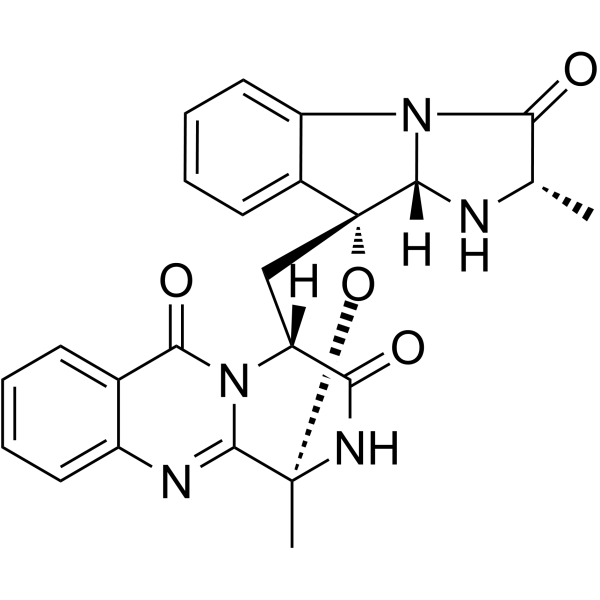
HY-125523
Fumiquinazoline DSecondary Metabolite
Alle Antibiotic Isoform-spezifische Produkte anzeigen
More

Biologische Aktivität
Beschreibung


Chemical Information
-
CAS. Nr. 133352-27-9
-
Molecular Weight 855.11
-
Formel C47H74N4O10
-
SMILES
N=C(N1C(CC(O)C/C=C(C)/C(O)C/C=C/C(O)C(C)/C=C/C(O)C/C=C(C)/C(O)C(C)CCC2C(C)(C(C3=C(O)CNC3=O)=O)C4CCC(O)C(O)C4C=C2C)CCC1)N
-
Versand
Room temperature in continental US; may vary elsewhere.
-
Speicherung
Please store the product under the recommended conditions in the Certificate of Analysis.

Protokoll
-
Gram Staining of Tissue Sections
Gram staining of tissue sections is a histochemical technique used to differentiate Gram-positive and Gram-negative bacteria within histological specimens based on differences in bacterial cell wall structure and dye retention, adapted from classical bacteriological Gram staining into tissue-compatible “histological Gram stain” variants. In tissue applications, modifications of the Brown-Hopps and Brown-Brenn methods are commonly used to improve differentiation of microorganisms embedded within host connective tissue and to reduce overstaining or loss of Gram-negative signal, which are known limitations of earlier approaches. The principle relies on crystal violet-iodine complex retention in Gram-positive organisms and subsequent decolorization and counterstaining steps that allow contrast visualization of Gram-negative organisms against tissue background.


Reinheit & Dokumentation
Verweise

Calculators
Konzentration (Stammlösung) × Volumen (Stammlösung) = Konzentration (Ziellösung) × Volumen (Ziellösung)


Lydicamycin Related Classifications
HY-125414 Related Classifications
 Powered by Bioz