



(S)-Coriolic acid

Based on 1 Customer Validation
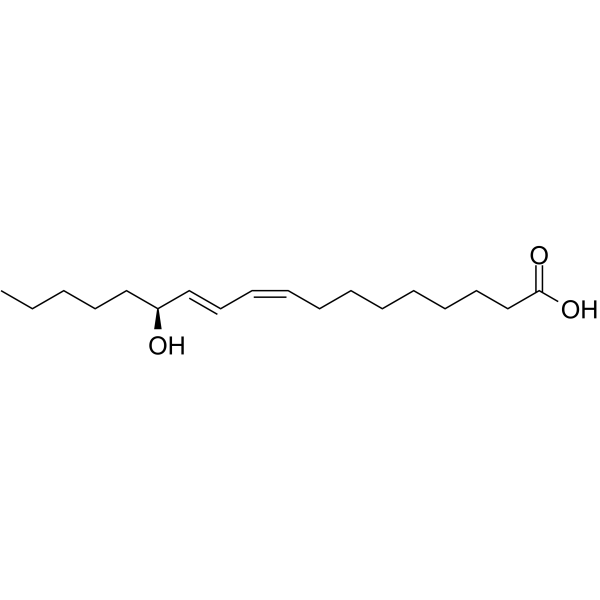
(S)-Coriolic acid (13(S)-HODE), the product of 15-lipoxygenase (15-LOX) metabolism of linoleic acid, functions as the endogenous ligand to activate PPARγ. (S)-Coriolic acid is an important intracellular signal agent and is involved in cell proliferation and differentiation in various biological systems. (S)-Coriolic acid induces mitochondrial dysfunction and airway epithelial injury.
The product specifications provided below refer solely to the active content of (S)-Coriolic acid.
Nur für Forschungszwecke. Wir verkaufen nicht an Patienten.
- Reinheit : 99%
- CAS. Nr.: 29623-28-7
- Formel: C18H32O3
- Molecular Weight:296.44
-
Speicherung:
Solution, -20°C, 2 years

To place orders, for customer services and technical support, please contact: MedChemExpress USA
Tel: 609-228-6898 E-mail: [email protected] [email protected]


-
 Biologische Aktivität
-
Chemical Information
- Protokoll
- Reinheit & Dokumentation
- Verweise
-
 Help & FAQs


-
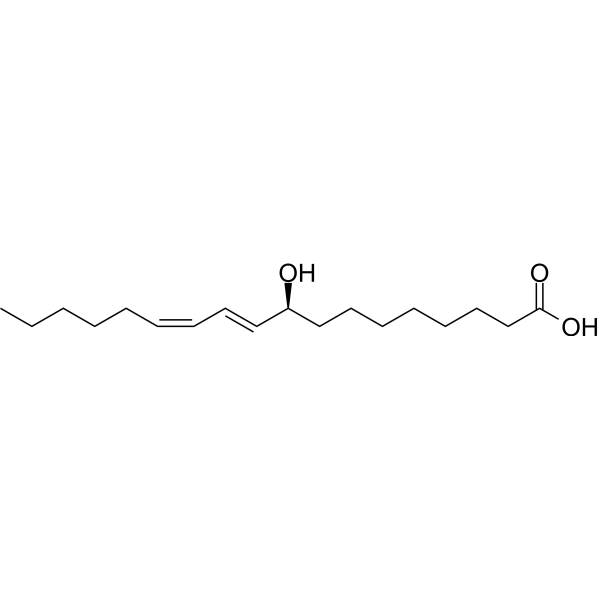
HY-113455
9(S)-HODEmiR-361-3p Modulator -
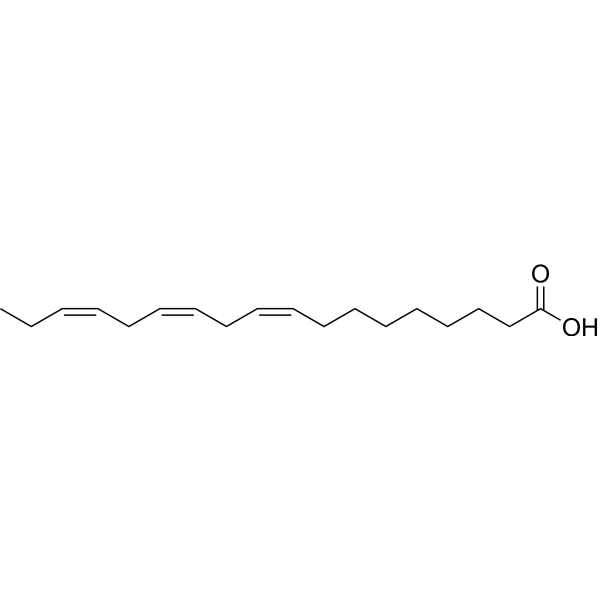
HY-N0728
α-Linolenic acidEssential Fatty Acid -
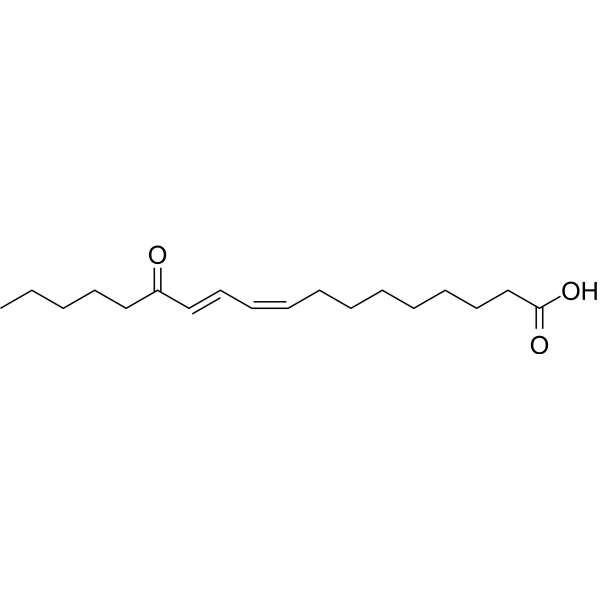
HY-131376
13-Oxo-ODEOctadecadienoic Acid -

HY-118149
9(S)-HpODE -
HY-N11692
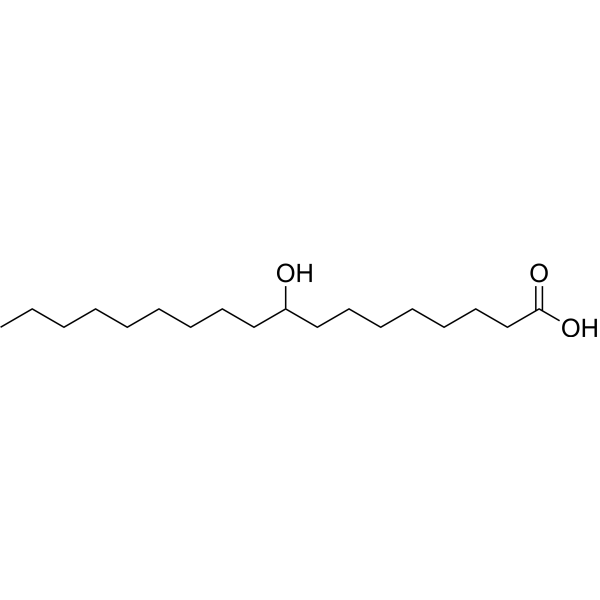
9-Hydroxyoctadecanoic acidHDAC1 Inhibitor -
HY-131116
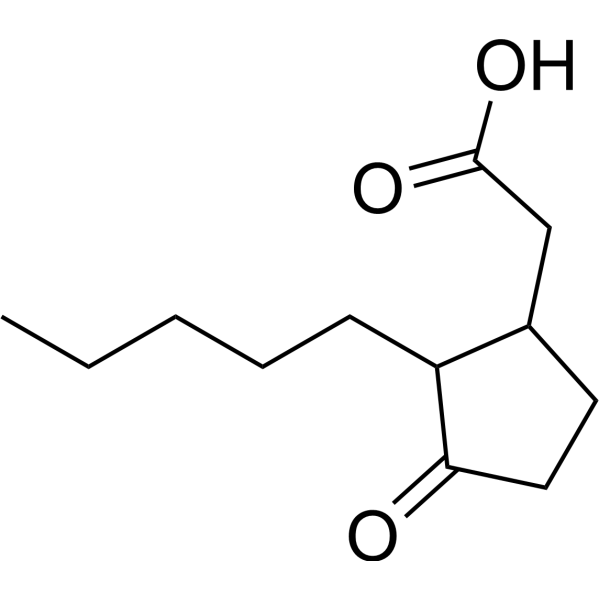
Dihydrojasmonic acidPlant Growth Regulator -
HY-130323
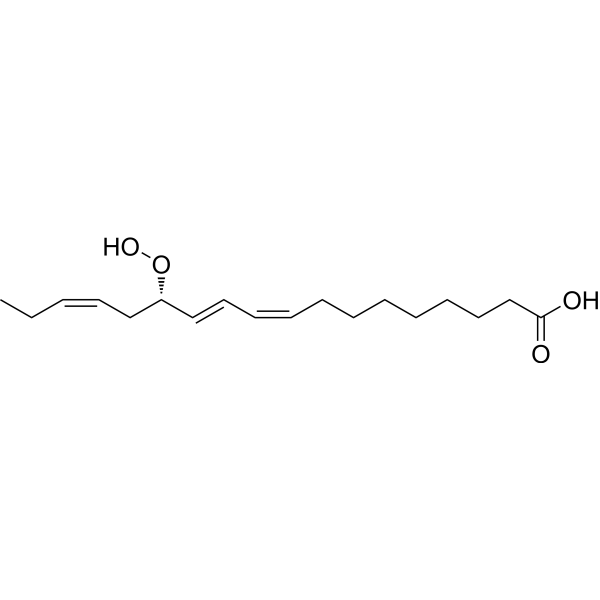
13-HPOTAntibacterial Agent -

HY-145543
9(S)10(S)13(S)-TriHOMEEster Product -
HY-120109
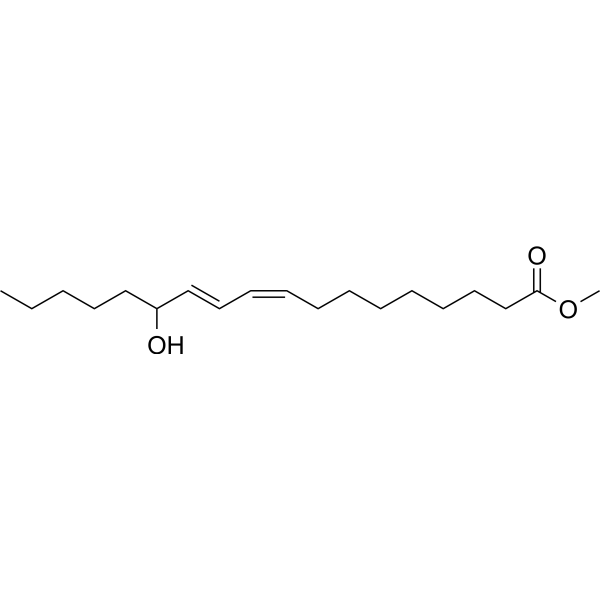
13-HODE methyl esterLinoleic Acid Metabolite -

HY-113490
15-KETE -
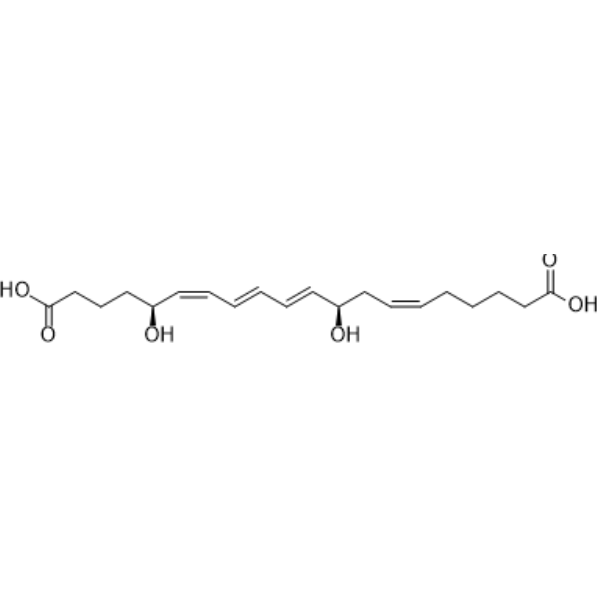
HY-113483
20-Carboxy-Leukotriene B4LTB4 Metabolite -

HY-113509B
15(R)-Lipoxin A4Specialized Pro-resolving Mediator


Biologische Aktivität
Beschreibung
The product specifications provided below refer solely to the active content of (S)-Coriolic acid.
Cellular Effect
|
Cell Line

|
Type | Value | Description | References |
|---|---|---|---|---|
| RBL-1 | IC50 |
82 μM
Compound: 12
|
Inhibition of rat basophilic leukemia-1 (RBL-1) 5-lipoxygenase
Inhibition of rat basophilic leukemia-1 (RBL-1) 5-lipoxygenase
|
[PMID: 3806609] |
In Vitro
(S)-Coriolic acid (25μM) causes mitochondrial structural alterations and injury in bronchial epithelium[2].
(S)-Coriolic acid (30 nM; 6 hours; E-FABP-/- keratinocytes) induces K1 expression through NF-κB activation. (S)-Coriolic acid increases the phosphorylation of IκBαat serine 32, which induces IκB degradation and thereby activates NF-κB. (S)-Coriolic acid also increases the phosphorylation of Ikkinase-bat tyrosine 199, which promotes IκBα phosphorylation and subsequent NF-kB activation[3].
MedChemExpress (MCE) has not independently confirmed the accuracy of these methods. They are for reference only.
In Vivo
MedChemExpress (MCE) has not independently confirmed the accuracy of these methods. They are for reference only.
-
Animal Model:BALB/c mice (6-8 weeks)[2]
-
Dosage:0-0.6 mg per mouse
-
Administration:Intranasally once a day for 3 consecutive days
-
Result:BALB/c mice developed features of mitochondrial dysfunction such as reduction in mitochondrial membrane potential, reduction in complex IV activity in lung mitochondria, and increase in the levels of cytochrome c in lung cytosol.
- BrdU Incorporation Assay
- Somatic Cell Culture
- CFSE Dye Dilution Proliferation Assay
- Dye-dilution cell tracking and proliferation staining
- CCK-8/WST-8 Cell Proliferation Assay
- Protocol for Cell Cycle
- Cell Counting-Based Growth Curve Assay
- Colony Formation (Clonogenic) Assay
- Directly Induced Neuron Culture
- Cell Viability Determination by MTT Colorimetric Assay
- EdU Incorporation Assay (Click Chemistry-Based DNA Synthesis Measurement)
- Ki-67 Immunostaining Proliferation Assay
- PCNA Immunodetection Proliferation Assay
- Protocol for Cell Counting and Cell Density Analysis
- Mitochondrial membrane-potential and mitochondrial mass staining
- MTT Cell Proliferation Assay


Product Details
-
Structure Classification
-
Initial Source


Chemical Information
-
CAS. Nr. 29623-28-7
-
Appearance Liquid
-
Molecular Weight 296.44
-
Formel C18H32O3
-
Color Colorless to light yellow
-
SMILES
CCCCC[C@H](O)/C=C/C=C\CCCCCCCC(O)=O
-
Synonyms
13(S)-HODE
-
Versand
Room temperature in continental US; may vary elsewhere.
-
Speicherung
Solution, -20°C, 2 years
Reinheit & Dokumentation


Verweise
[1]. Mabalirajan U, et al. Linoleic acid metabolite drives severe asthma by causing airway epithelial injury. Sci Rep. 2013;3:1349. [Content Brief]
[2]. Ogawa E, et al. Epidermal FABP (FABP5) regulates keratinocyte differentiation by 13(S)-HODE-mediated activation of the NF-κB signaling pathway. J Invest Dermatol. 2011;131(3):604-612. [Content Brief]
[3]. Yuan H, et al. 15-Lipoxygenases and its metabolites 15(S)-HETE and 13(S)-HODE in the development of non-small cell lung cancer. Thorax. 2010;65(4):321-326. [Content Brief]

Calculators
Konzentration (Stammlösung) × Volumen (Stammlösung) = Konzentration (Ziellösung) × Volumen (Ziellösung)


(S)-Coriolic acid Related Classifications
HY-113884B Related Classifications
 Powered by Bioz