



Dencatistat
Based on 1 publication(s) in Google Scholar
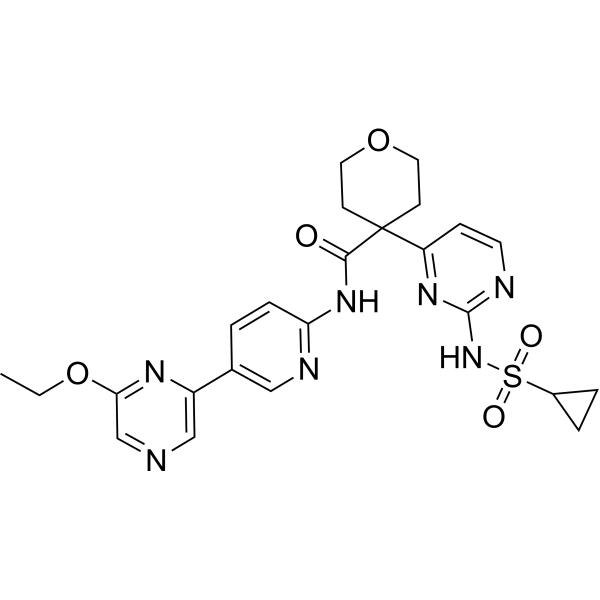
Dencatistat (STP938) is a selective and orally active CTPS1 inhibitor (IC50 = 9.3 nM) that reduces the rate-limiting conversion of UTP to CTP. Dencatistat exhibits more than 1300-fold selectivity for CTPS2. Dencatistat modulates BCL2 family transcripts and cell cycle pathways, and inhibits SARS-CoV-2 replication and interferon-induced Mx expression. Dencatistat has antiproliferative and tumor growth-inhibiting effects in mantle cell lymphoma models. Dencatistat inhibits clonogenic growth, migration, invasion, and xenograft tumor growth in lung adenocarcinoma, with tumor selectivity over normal bronchial epithelial cells. Dencatistat can be used for research on COVID-19, mantle cell lymphoma, essential thrombocythemia, and lung adenocarcinoma.
For research use only. We do not sell to patients.
- Purity : 99.87%
- CAS No.: 2377000-84-3
- Formula: C24H27N7O5S
- Molecular Weight:525.58
-
Storage:Powder -20°C, 3 years ; In solvent -80°C, 6 months , -20°C, 1 month

To place orders, for customer services and technical support, please contact: MedChemExpress USA
Tel: 609-228-6898 E-mail: [email protected] [email protected]


-
 Biological Activity
-
Chemical Information
-
Solvent & Solubility
- Protocols
- Purity & Documentation
- References
-
 Help & FAQs


Publications Citing Use of MedChemExpress (MCE) Dencatistat
MoreAll DNA/RNA Synthesis Isoforms
More

Biological Activity
Description
IC50 & Target
[1]|
CTPS1 9.3 nM (IC50) |
CTPS2 12.62 μM (IC50) |
Cellular Effect
|
Cell Line

|
Type | Value | Description | References |
|---|---|---|---|---|
| A549 | IC50 |
0.643 μM
|
Antiproliferative activity against human A549 lung adenocarcinoma cells assessed as viability reduction after 72 hrs by CCK-8 assay.
Antiproliferative activity against human A549 lung adenocarcinoma cells assessed as viability reduction after 72 hrs by CCK-8 assay.
|
42608454 |
| HCC827 | IC50 |
0.184 μM
|
Antiproliferative activity against human HCC827 lung adenocarcinoma cells assessed as viability reduction after 72 hrs by CCK-8 assay.
Antiproliferative activity against human HCC827 lung adenocarcinoma cells assessed as viability reduction after 72 hrs by CCK-8 assay.
|
42608454 |
| PC-9 | IC50 |
1.223 μM
|
Antiproliferative activity against human PC-9 lung adenocarcinoma cells assessed as viability reduction after 72 hrs by CCK-8 assay.
Antiproliferative activity against human PC-9 lung adenocarcinoma cells assessed as viability reduction after 72 hrs by CCK-8 assay.
|
42608454 |
| NCI-H1299 | IC50 |
2.341 μM
|
Antiproliferative activity against human H1299 lung adenocarcinoma cells assessed as viability reduction after 72 hrs by CCK-8 assay.
Antiproliferative activity against human H1299 lung adenocarcinoma cells assessed as viability reduction after 72 hrs by CCK-8 assay.
|
42608454 |
| BEAS-2B | IC50 |
11.430 μM
|
Cytotoxicity against normal human bronchial epithelial BEAS-2B cells assessed as viability reduction after 72 hrs by CCK-8 assay.
Cytotoxicity against normal human bronchial epithelial BEAS-2B cells assessed as viability reduction after 72 hrs by CCK-8 assay.
|
42608454 |
In Vitro
Dencatistat (72 h) inhibits LUAD cell viability with IC50 values of 0.643 μM in A549, 0.184 μM in HCC827, 1.223 μM in PC-9, and 2.341 μM in H1299, while BEAS-2B is less sensitive (IC50 = 11.430 μM)[3].
Dencatistat (10-14 days) dose-dependently reduces colony formation in A549 and HCC827 cells[3].
Dencatistat (72 h exposure; 24 h migration/invasion incubation) suppresses migration and invasion of A549 and HCC827 cells[3].
Dencatistat (10-1000 nM; 48 h) and EIDD-1931 showed synergistic anti-SARS-CoV-2 activity in Calu-3 cells[1].
Dencatistat (100 nM; 48 h) plus 300 nM EIDD-1931 strongly suppressed SARS-CoV-2 Spike and Nucleocapsid protein accumulation in Vero E6 cells[1].
MedChemExpress (MCE) has not independently confirmed the accuracy of these methods. They are for reference only.
-
Cell Line:A549 and HCC827 LUAD cells
-
Concentration:1×IC50, 5×IC50, and 10×IC50
-
Incubation Time:10-14 days
-
Result:Dose-dependently inhibited clonogenic growth in both A549 and HCC827 cells, with progressively fewer colonies at 1×IC50, 5×IC50, and 10×IC50 compared with vehicle control.
In Vivo
MedChemExpress (MCE) has not independently confirmed the accuracy of these methods. They are for reference only.
-
Animal Model:Golden Syrian (male, 5-7 weeks old, 80-100 g) bearing COVID-19[1]
-
Dosage:50 mg/kg
-
Administration:s.c.; once daily; starting 24 h before infection through day 6 post infection
-
Result:Reduced shed viral RNA in oral swabs and nasal lavage, particularly at 3 and 4 days post infection.
Effects on infectious particle levels in respiratory tract tissues at day 6 were less pronounced than effects on viral RNA shedding.
Addition of molnupiravir did not further reduce detected viral RNA and restored viral RNA production to a moderate extent.
Attenuated COVID-19-like lung pathology and lowered the total lung score compared with untreated infected hamsters.
Lung lesions were significantly reduced compared with untreated infected hamsters.
Alveolar lesions improved in all intervention groups.
Vascular lesions were more pronounced with molnupiravir alone than in untreated infected hamsters; in the combination group, vascular lesions were higher than with monotherapy but lower than in untreated infected hamsters.
Lung Mx1 mRNA was lowest in the monotherapy group.
Mx1 protein immunoreactivity was strongly reduced compared with untreated infected hamsters and was only slightly higher than in uninfected controls; molnupiravir alone and the combination produced Mx1 immunoreactivity comparable to untreated infected hamsters.
Mx1 immunoreactivity was significantly reduced compared with untreated infected hamsters and the combined intervention group.
Weight loss after infection was alleviated by each drug as monotherapy, but less so by the combination.
-
Animal Model:BALB/c nude (male, six-week-old) injected with A549 LUAD cells [3]
-
Dosage:30 mg/kg/day
-
Administration:s.c.; daily; 3 weeks
-
Result:Inhibited tumor growth, with slower tumor growth kinetics and reduced endpoint tumor weight.
Histological analysis showed decreased CTPS1, Ki67, and BCL-2 expression and reduced tumor cell density.
- RNA extraction experimental
- BrdU Incorporation Assay
- Cell migration
- Patient-Derived Orthotopic Xenograft (PDOX)
- Protocol for Cell Cycle
- Cell Viability Determination by MTT Colorimetric Assay
- Flow cytometric DNA-content cell-cycle staining
- Patient-Derived Xenograft (PDX)
- Cell invasion
- Splenic/Portal-Vein Liver Metastasis Xenograft
- Soft Agar Colony Formation Assay
- Subcutaneous Cell-Line-Derived Xenograft
- Orthotopic Cell-Line Xenograft
- Intraperitoneal/Peritoneal Dissemination Xenograft


Chemical Information
-
CAS No. 2377000-84-3
-
Appearance Solid
-
Molecular Weight 525.58
-
Formula C24H27N7O5S
-
Color White to off-white
-
SMILES
O=C(C1(CCOCC1)C2=NC(NS(=O)(C3CC3)=O)=NC=C2)NC4=NC=C(C5=CN=CC(OCC)=N5)C=C4
-
Synonyms
STP938
-
Shipping
Room temperature in continental US; may vary elsewhere.
-
Storage
Powder -20°C 3 years In solvent -80°C 6 months -20°C 1 month


Publications (1)
-
Journal Impact Factor
-
Most Recent


Solvent & Solubility
In Vitro:
DMSO : 11.67 mg/mL (22.20 mM; Need ultrasonic; Hygroscopic DMSO has a significant impact on the solubility of product, please use newly opened DMSO)
Please refer to the solubility information to select the appropriate solvent. Once prepared, please aliquot and store the solution to prevent product inactivation from repeated freeze-thaw cycles.
Storage method and period of stock solution: -80°C, 6 months; -20°C, 1 month. When stored at -80°C, please use it within 6 months. When stored at -20°C, please use it within 1 month.
Concentration (start) × Volume (start) = Concentration (final) × Volume (final)
In Vivo:
Select the appropriate dissolution method based on your experimental animal and administration route.
- For the following dissolution methods, please ensure to first prepare a clear stock solution using an In Vitro approach and then sequentially add co-solvents:
- To ensure reliable experimental results, the clarified stock solution can be appropriately stored based on storage conditions. As for the working solution for In Vivo experiments, it is recommended to prepare freshly and use it on the same day.
- The percentages shown for the solvents indicate their volumetric ratio in the final prepared solution. If precipitation or phase separation occurs during preparation, heat and/or sonication can be used to aid dissolution.
In Vivo Dissolution Calculator
Please enter the basic information of animal experiments:
-
-
-
-
Recommended: Prepare an additional quantity of animals to account for potential losses during experiments.
Please enter your animal formula composition:
-
%DMSO +
Recommended: Keep the proportion of DMSO in working solution below 2% if your animal is weak.
-
%+
-
+%Tween-80 + +
-
%Saline +
The co-solvents required include: DMSO, . All of co-solvents are available by MedChemExpress (MCE). , Tween 80. All of co-solvents are available by MedChemExpress (MCE).
Working solution concentration: 0.22 mg/mL
Method for preparing stock solution: mg drug dissolved in μL DMSO. Stock solution concentration: mg/mL.
1. Take μL DMSO stock solution;
2. Add μL .
μL , mix evenly;
3. Then add μL Tween 80, mix evenly;
4. Then add μL
Please ensure that the stock solution in the first step is dissolved to a clear state, and add co-solvents in sequence. You can use ultrasonic heating (ultrasonic cleaner, recommended frequency 20-40 kHz), vortexing, etc. to assist dissolution.


Purity & Documentation
-
Data Sheet (297 KB)
-
SDS (252 KB)
- English - EN (252 KB)
- Français - FR (252 KB)
- Deutsch - DE (252 KB)
- Norwegian - NO (252 KB)
- Español - ES (252 KB)
- Swedish - SV (252 KB)
- Italian - IT (252 KB)
- Korean - KR (252 KB)
- Portuguese - PT (252 KB)
-
Handling Instructions (2659 KB)
References


Complete Stock Solution Preparation Table
Please refer to the solubility information to select the appropriate solvent. Once prepared, please aliquot and store the solution to prevent product inactivation from repeated freeze-thaw cycles.
Storage method and period of stock solution: -80°C, 6 months; -20°C, 1 month. When stored at -80°C, please use it within 6 months. When stored at -20°C, please use it within 1 month.
| Optional Solvent | Concentration Solvent Mass | 1 mg | 5 mg | 10 mg | 25 mg |
|---|---|---|---|---|---|
| DMSO | 1 mM | 1.9027 mL | 9.5133 mL | 19.0266 mL | 47.5665 mL |
| 5 mM | 0.3805 mL | 1.9027 mL | 3.8053 mL | 9.5133 mL | |
| 10 mM | 0.1903 mL | 0.9513 mL | 1.9027 mL | 4.7566 mL | |
| 15 mM | 0.1268 mL | 0.6342 mL | 1.2684 mL | 3.1711 mL | |
| 20 mM | 0.0951 mL | 0.4757 mL | 0.9513 mL | 2.3783 mL |


Dencatistat Related Classifications
HY-157783 Related Classifications
 Powered by Bioz
Keywords