



Natalizumab
Based on 5 publication(s) in Google Scholar
Natalizumab (AN100226; BG00002) is a humanized monoclonal IgG4 antibody inhibitor that selectively targets α4 integrin (CD49d). It blocks the interaction of integrins such as α4β1 (VLA-4) with vascular cell adhesion molecule VCAM-1, intercellular adhesion molecule ICAM-1, and fibronectin by competitively binding to the α4 subunit. Natalizumab inhibits the adhesion, retention, and transendothelial migration of immune cells (such as CD4+ T cells), reducing the infiltration of inflammatory cells into the central nervous system or lesion sites, thus exerting anti-inflammatory and immunomodulatory activity. Natalizumab is used in the study of relapsing-remitting multiple sclerosis (RRMS) and also has applications in the study of autoimmune or inflammation-related diseases such as Crohn's disease, B-cell lymphoma, and non-infectious uveitis. Natalizumab can also prevent lymphocytes from entering the central nervous system, thereby preventing acute demyelinating relapses.
Nos produits utilisent uniquement pour la recherche. Nous ne vendons pas aux patients.
- Pureté : 99.10%
- CAS No.: 189261-10-7
- Masse moléculaire:146.19 kDa
-
Stockage:
Please store the product under the recommended conditions in the Certificate of Analysis.


To place orders, for customer services and technical support, please contact: MedChemExpress USA
Tel: 609-228-6898 E-mail: [email protected] [email protected]


-
 Activité biologique
-
Chemical Information
- Protocole
- Pureté et documentation
- Références
-
 Help & FAQs


-

HY-P9911
Vedolizumab -

HY-P9984
Etrolizumabβ7 Integrin Inhibitor -

HY-108831A
Natalizumab (Anti-CD49d)Anti-α4 Integrin Monoclonal Antibody -

HY-P9970
InfliximabTNF-α Inhibitor -

HY-P9907
TrastuzumabHER2 Blocking Antibody -

HY-P9913
RituximabCD20 Inhibitor -

HY-P9903
NivolumabPD-1 Inhibitor -
HY-70002
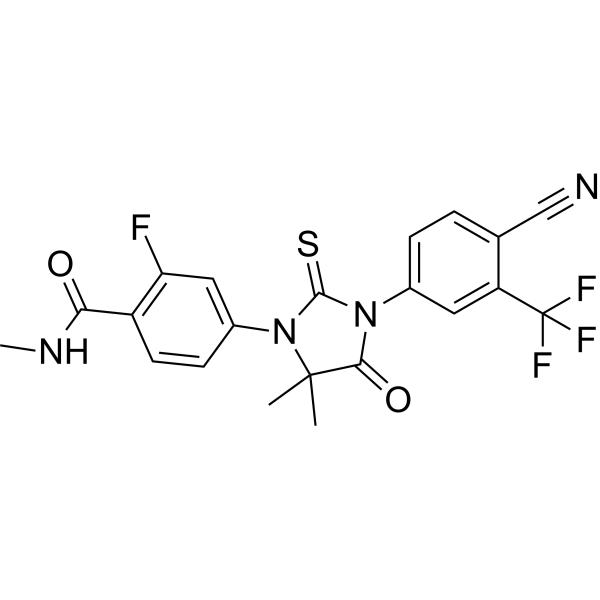
EnzalutamideAndrogen Receptor Antagonist -

HY-P99003
Human IgG4 (S228P) kappa, Isotype ControlIgG4κ Isotype Control -

HY-P9911A
Vedolizumab (anti-α4β7-integrin) -

HY-P99001
Human IgG1 kappa, Isotype ControlIgG1κ Isotype Control -
HY-19569
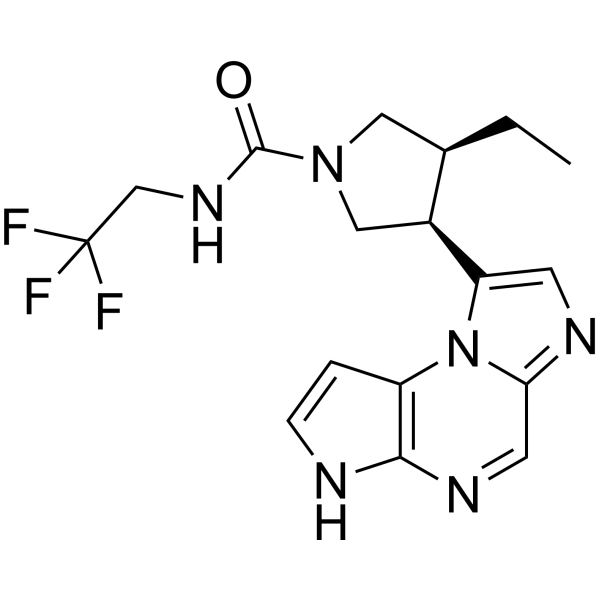
UpadacitinibJAK1 Inhibitor
Publications Citing Use of MedChemExpress (MCE) Natalizumab
More Customer Validation & Images

-
Histological Imaging/Staining

-
IHC

-
IF


Activité biologique
Description
Isotype
Human IgG4 kappa
Recommend Isotype Controls
Species Reactivity
Human
IC50 & Target
|
α4β1 |
Cellular Effect
|
Cell Line

|
Type | Value | Description | References |
|---|---|---|---|---|
| CHO | EC50 |
7 nM
Compound: Senktide
|
Compound was evaluated for concentration-dependent and oscillatory increase in [Ca2+], caused by activation of hNK3 receptors in CHO cells
Compound was evaluated for concentration-dependent and oscillatory increase in [Ca2+], caused by activation of hNK3 receptors in CHO cells
|
[PMID: 9871763] |
| CHO | IC50 |
>10000 nM
Compound: Senktide
|
Displacement of [125I]-BH-SP from NK1 receptor (unknown origin) expressed in CHO cells by scintillation counter
Displacement of [125I]-BH-SP from NK1 receptor (unknown origin) expressed in CHO cells by scintillation counter
|
10.1039/C4MD00514G |
| CHO | IC50 |
>10000 nM
Compound: Senktide
|
Displacement of [125I]-NKA from NK2 receptor (unknown origin) expressed in CHO cells by scintillation counter
Displacement of [125I]-NKA from NK2 receptor (unknown origin) expressed in CHO cells by scintillation counter
|
10.1039/C4MD00514G |
| CHO | IC50 |
0.056 μM
Compound: Senktide
|
Displacement of [125I]His3, MePhe7 from human NK3R expressed in CHO cell membranes by scintillation counting
Displacement of [125I]His3, MePhe7 from human NK3R expressed in CHO cell membranes by scintillation counting
|
[PMID: 25247671] |
| CHO | IC50 |
21 nM
Compound: Senktide
|
Binding affinity towards human Tachykinin receptor 3 stably expressed in CHO cells using [125I][MePhe7]-NKB as radioligand
Binding affinity towards human Tachykinin receptor 3 stably expressed in CHO cells using [125I][MePhe7]-NKB as radioligand
|
10.1016/0960-894X(95)00313-I |
| CHO | IC50 |
29 nM
Compound: Senktide
|
Displacement of ([125I]His3-MePhe7)-NKB from NK3 receptor (unknown origin) expressed in CHO cells by scintillation counter
Displacement of ([125I]His3-MePhe7)-NKB from NK3 receptor (unknown origin) expressed in CHO cells by scintillation counter
|
10.1039/C4MD00514G |
In Vitro
Natalizumab (10 μg/mL, 2 h) reduced the adhesion of VLA-4-positive lymphoma cells (Raji, Karpas-422, etc.) to fibronectin by 75-95% and altered cell adhesion morphology[2].
Natalizumab (10 μg/mL in combination with rituximab) partially overcame the protective effect of bone marrow stromal cells on lymphoma B cells, mitigating resistance to apoptosis induced by Rituximab (HY-P9913) and cytotoxic drugs[2].
Natalizumab (30 μg/mL) slightly upregulated the expression of IL-2, IFN-γ, and IL-17 in activated CD4+ T cells, triggered MAPK/ERK phosphorylation, and downregulated CD49d surface expression[3].
Natalizumab (1 μg/mL) alone could not significantly inhibit the retention of CD4+ T cells or PBMCs in an inflammatory state BBB model (BLEC, HBMEC, etc.), requiring co-inhibition of β2-integrin for complete blockade[1].
Natalizumab (1 μg/mL) was ineffective in inhibiting shear-resistant retention of CD4+ Th1 cells when the molar ratio of ICAM-1 to VCAM-1 was 10:1[1].
MedChemExpress (MCE) has not independently confirmed the accuracy of these methods. They are for reference only. Further protocols information, click here.
In Vivo
Natalizumab (170 μg/mouse; intravenous injection; single dose) only partially and transiently reduced the firm adhesion of human T cells to the activated BBB in a TNF-α-induced acute systemic inflammation model in female SJL mice, significantly reducing T cell rolling along the vessel wall but not affecting capture[4].
Natalizumab (0.625-2.5 mg/mouse; intravitreal injection; single dose; 21-day observation period) showed no functional or structural toxicity to the retina of New Zealand white rabbits at doses of 0.625-1.25 mg, with no significant changes in the amplitude and latency of a-wave and b-wave in electroretinography (ERG), but the 2.5 mg dose caused retinal dysfunction, with significantly reduced a-wave and b-wave amplitudes in ERG, and ultrastructural damage in the outer plexiform layer and inner nuclear layer[5].
MedChemExpress (MCE) has not independently confirmed the accuracy of these methods. They are for reference only.
Essai clinique
| NCT Number | Sponsor | Condition | Start Date |
Phase
|
|---|---|---|---|---|
| NCT01329991 | Plexxikon| | 2011-05 | PHASE1 |
Gene ID
Accession
Conjugated
Unconjugated
Reconsititution
The product can be reconstituted/diluted with sterile PBS or saline.
Format
-
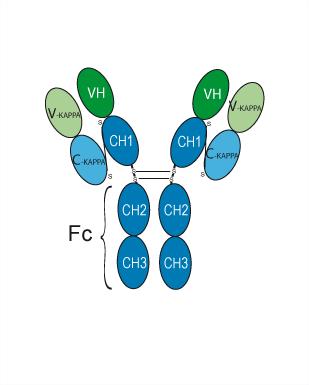
Human IgG4 kappa
Application
ELISA, FACS, Functional assay
Verified Bioactivity
-
 Flow cytometric analysis of 1X10⁶ Jurkat cells with Natalizumab (HY-108831, red). Cells were fixed with 4% paraformaldehyde. Then stained with the primary antibody at 1/200 dilution for an hour at 4℃. Alexa Fluor 488-conjugated AffiniPure Goat Anti-Human IgG H&L (HY-P83776) was used as the secondary antibody at 1/1,000 dilution for 30 minutes at 4℃. Human IgG4 (S228P) kappa Isotype Control (HY-P99003, blue) was used as the isotype control, cells without incubation with primary antibody were used as the unlabeled control (black).


Chemical Information
-
CAS No. 189261-10-7
-
Appearance Liquid
-
Masse moléculaire 146.19 kDa
-
Color Colorless to light yellow
-
SMILES
[Natalizumab]
-
Formulation
Please refer to the lot-specific COA for specific buffer information.
-
Stockage
Please store the product under the recommended conditions in the Certificate of Analysis.


Publications (5)
-
Journal Impact Factor
-
Most Recent
-
-
Mol Med
2024 Apr 22;30(1):54. PMID: 38649802
Natalizumab purchased from MedChemExpress. Usage Cited in: Mol Med. 2024 Apr 22;30(1):54. [Abstract]
Representative immunohistochemical analysis of Rad51 (brown) in lung sections. The control group showed strong positive staining for Rad51 compared to the BLM and BLM + Natalizumab (NTZ: 5 mg/kg) + Anti-Ly6G group (Arrows).
Natalizumab purchased from MedChemExpress. Usage Cited in: Mol Med. 2024 Apr 22;30(1):54. [Abstract]
Natalizumab (NTZ: 5 mg/kg) . Representative images of Rad51 expression in AECs by co-immunofluorescence staining with both Rad51 (green) and PDPN (red).
-
Pharmaceutics
LPX-TI641, a Tim3/4 Agonist, Induces Long-Term Immune Tolerance in Multiple Sclerosis Models. [Abstract]2025 Oct 30;17(11):1402. PMID: 41304740
Natalizumab purchased from MedChemExpress. Usage Cited in: Pharmaceutics. 2025 Oct 30;17(11):1402. [Abstract]
Microscopic imaging (10×) of Luxol Fast Blue staining of brain tissue from EAE mice treated with: (i) LPX-TI641 (Gr 6); (ii) a single dose of natalizumab (100 µg IV every three days for a total of three doses)(Gr 4); or (iii) two doses of natalizumab followed by LPX-TI641 (Gr 5).
-
-

Protocole
-
Cell migration
Cell migration is a method that plays an important role in wound healing, cell differentiation, embryonic development, etc.
-
Research Protocol for Inflammation-related Diseases
The NLRP3 inflammasome is a cytosolic innate immune signaling platform that integrates priming signals and danger-signal activation to promote caspase-1 activation, maturation of IL-1β and IL-18, and gasdermin D-mediated pyroptotic cell death. The core experimental logic is to determine whether inflammatory disease phenotypes are driven by increased NLRP3 expression, ASC-containing inflammasome assembly, caspase-1 cleavage, GSDMD cleavage, and extracellular release of IL-1β/IL-18 rather than by nonspecific cell injury alone. The pathway is strongly linked to inflammation-related disease phenotypes because monosodium urate crystals activate NALP3/NLRP3 inflammasome signaling in gout-like crystal inflammation, cholesterol crystals activate NLRP3 inflammasomes in atherogenesis models, and DSS-induced intestinal inflammation has been reported to involve NLRP3 inflammasome activity. However, experimental colitis studies also show context-dependent protective effects of NLRP3 inflammasome co


Pureté et documentation
-
Fiche technique (263 KB)
-
SDS (251 KB)
- English - EN (251 KB)
- Français - FR (251 KB)
- Deutsch - DE (251 KB)
- Norwegian - NO (251 KB)
- Español - ES (251 KB)
- Swedish - SV (251 KB)
- Italian - IT (251 KB)
- Korean - KR (251 KB)
- Portuguese - PT (251 KB)
-
Inhibitory Antibodies User Guide (603 KB)
Références

Calculators
Concentration (start) × Volume (start) = Concentration (final) × Volume (final)


Natalizumab Related Classifications
HY-108831 Related Classifications
 Powered by Bioz