



Aplitabart

Based on 1 Customer Validation
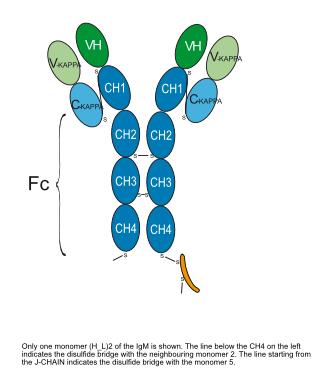
Aplitabart (IGM-8444) is a pentameric IgM death receptor 5 (DR5) agonist antibody with a KD of 85 nM and an apparent affinity of 11 pM. Aplitabart induces DR5 multimerization, thereby triggering cancer cell apoptosis via the extrinsic apoptotic pathway apoptosis. Aplitabart is applicable to cancer-related research such as colorectal cancer and gastric cancer.
Para uso exclusivo en investigación. No vendemos a pacientes.
- Pureza : 97.024%
- No. CAS: 2796349-94-3
- Peso molecular:871.57 kDa
-
Almacenamiento:Shipping with dry ice
Please store the product under the recommended conditions in the Certificate of Analysis.


To place orders, for customer services and technical support, please contact: MedChemExpress USA
Tel: 609-228-6898 E-mail: [email protected] [email protected]


-
 Actividad biológica
-
Chemical Information
- Protocolo
- Pureza y Documentación
- Referencias
-
 Help & FAQs


Ver todos los productos específicos de isoformas TNF Receptor
More

Actividad biológica
Descripciòn
Isotype
Human IgM-kappa_Jchain
Species Reactivity
Human
IC50 & Target
|
DR5 |
In Vitro
IGM-8444 potently binds to Colo205 colorectal cancer cells (EC50 = 170 ng/mL) and H-EMC-SS chondrosarcoma cells (EC50 = 64 ng/mL)[1].
IGM-8444 (24 h) potently induces cytotoxicity in Colo205 colorectal cancer cells (IC50 = 1.1 ng/mL) and H-EMC-SS chondrosarcoma cells (IC50 = 0.32 ng/mL)[1].
IGM-8444 (1 μg/mL; 0.5-6 h) rapidly and potently activates caspase-3/7, caspase-8, and caspase-9 in Colo205 colorectal cancer cells and H-EMC-SS chondrosarcoma cells[1].
Treatment with IGM-8444 (1 μg/mL; 1-6 h) for 6 h induces early apoptosis in 23% of Colo205 colorectal cancer cells and 15% of H-EMC-SS chondrosarcoma cells[1].
IGM-8444 (72 h) exhibits synergistic cytotoxicity with chemotherapeutic agents and ABT-199 (HY-15531) in HCT15 colorectal cancer cells, NCI-H2228 non-small cell lung cancer cells, and MV-411 acute myeloid leukemia cells, with a maximum Bliss score ranging from 16.8 to 53.4[1].
MedChemExpress (MCE) has not independently confirmed the accuracy of these methods. They are for reference only.
-
Cell Line:Colo205 colorectal cancer cells, H-EMC-SS chondrosarcoma cells
-
Concentration:1 μg/mL
-
Incubation Time:1, 3, 6 h
-
Result:Induced early apoptosis in 23% of Colo205 cells and 15% of H-EMC-SS cells after 6 hours of treatment.
Showed significantly more early apoptosis induction than the corresponding anti-DR5 IgG (4% and 2% early apoptotic cells for Colo205 and H-EMC-SS, respectively), which was similar to isotype controls.
In Vivo
IGM-8444 (5 mg/kg; intravenous injection; once every 2 days; 11 doses total) induces 101% tumor growth inhibition (TGI) in NCI-H2122 non-small cell lung cancer xenografts and extends the median event-free survival by 40 days[1].
IGM-8444 (0.3-10 mg/kg; intravenous injection; once every other day) induces potent and sustained tumor regression in the GXF251 gastric cancer PDX model[1].
IGM-8444 (5 mg/kg; intravenous injection; once every other day; 7 doses total) , in combination with irinotecan (HY-16562), 5-FU (HY-90006) or Paclitaxel (HY-B0015), enhances the antitumor efficacy in the Colo205 colorectal cancer xenograft model[1].
IGM-8444 (5 mg/kg; intravenous injection; once every two days; 11 doses total) combined with ABT-199 induces 102% TGI and prolongs survival in mice bearing DOHH-2 non-Hodgkin's lymphoma xenografts[1].
MedChemExpress (MCE) has not independently confirmed the accuracy of these methods. They are for reference only.
-
Animal Model:Crl:NU (Ncr)-Foxn1nu (female, 8-12-weeks-old, subcutaneous implantation of 2×10⁶ Colo205 cells)[1]
-
Dosage:0.3, 1, 3 and 10 mg/kg (tumor growth inhibition); 0.3, 1, 3, 10 and 20 mg/kg (biomarker analysis)
-
Administration:i.v.; every other day; 11 doses (tumor growth inhibition); i.v.; single dose (biomarker analysis)
-
Result:Induced 23%, 29%, 75%, and 84% tumor growth inhibition (TGI) on day 22 at doses of 0.3, 1, 3, and 10 mg/kg, respectively.
Increased serum M30 up to 10-fold and M65 up to 5-fold in a dose-dependent manner 24 hours after single doses.
-
Animal Model:Crl:NU (Ncr)-Foxn1nu (female, 8-12-weeks-old, subcutaneous implantation of 107 NCI-H2122 cells)[1]
-
Dosage:5 mg/kg
-
Administration:i.v.; every other day; 11 doses (tumor growth and survival); i.v.; single dose (biomarker analysis)
-
Result:Induced 101% TGI on day 26, with 5/10 animals achieving a partial response (PR).
Extended median event-free survival by 40 days compared with vehicle.
Significantly elevated cleaved caspase-3 (CC3) staining in tumor tissue 24 hours after a single dose.
-
Animal Model:NMRI nude (female, 5-7-weeks-old, subcutaneous implantation of 3-4 mm GXF251 PDX tumor fragments)[1]
-
Dosage:0.3, 1, 3 and 10 mg/kg (dose-dependent study); 5 mg/kg (fixed dose, different tumor sizes)
-
Administration:i.v.; every other day; 7 doses (fixed dose); i.v.; every other day (dose-dependent study); i.v.; weekly (weekly dosing study)
-
Result:Induced 112% TGI on day 46 at 5 mg/kg every other day for 7 doses, with 8/10 complete responses (CR), 2/10 partial responses (PR), 7/10 event-free animals, and 6/10 tumor-free survivors (TFS) at day 99.
Elevated serum M30 10-fold and M65 6-fold 24 hours post-treatment.
Induced 30%, 55%, 101%, and 99% TGI on day 59 at doses of 0.3, 1, 3, and 10 mg/kg every other day, respectively, with 2/7 tumor-free animals in the 10 mg/kg group at day 100.
Induced 58% and 102% TGI on day 28 with weekly dosing of 1 and 10 mg/kg, respectively.
Induced 112%, 103%, and 101% TGI on day 32 when dosed into tumors with initial volumes of 100, 300, or 500 mm3, respectively.
-
Animal Model:Crl:NU (Ncr)-Foxn1nu (female, 8-12-weeks-old, subcutaneous implantation of 2×10⁶ Colo205 cells)[1]
-
Dosage:5 mg/kg (single agent); 5 mg/kg + 100 mg/kg irinotecan; 5 mg/kg + 100 mg/kg 5-FU; 5 mg/kg + 25 mg/kg paclitaxel
-
Administration:i.v.; every other day; 7 doses (IGM-8444); i.p.; weekly; 3 weeks (Irinotecan, 5-FU); i.v.; every other day; 5 doses (Paclitaxel)
-
Result:Induced 70%-76% TGI as a single agent at 5 mg/kg.
Combination with Irinotecan induced 103% TGI with 2/10 PRs and extended median event-free survival by 42 days compared with vehicle.
Combination with 5-FU induced 104% TGI with 3/10 PRs and 1/10 CR/TFS, without additional toxicity compared with 5-FU alone.
Combination with paclitaxel increased CR rate from 30% (Paclitaxel alone) to 100%, with 8/10 animals tumor-free at day 100 compared with 2/10 in the Paclitaxel-only group.
-
Animal Model:Fox Chase SCID, CB17/Icr-Prkdcscid/IcrIcoCrl (female, 9-weeks-old, subcutaneous implantation of 107 DOHH-2 cells)[1]
-
Dosage:5 mg/kg (single agent); 5 mg/kg + 100 mg/kg ABT-199
-
Administration:i.v.; every other day; 11 doses (IGM-8444); p.o.; daily; 21 days (ABT-199)
-
Result:Induced 45% TGI as a single agent at 5 mg/kg.
Combination with ABT-199 induced 102% TGI with 3/10 PRs and 2/10 CRs.
Significantly extended median event-free survival compared with vehicle or ABT-199 alone.
Ensayo clínico
| NCT Number | Sponsor | Condition | Start Date |
Phase

|
|---|---|---|---|---|
| NCT01329991 | 2011-05 | PHASE1 |
Gene ID
Accession
Conjugated
Unconjugated
Reconsititution
The product can be reconstituted/diluted with sterile PBS or saline.
Format
-
IgM-kappa_Jchain
Aplicación
ELISA, FACS, Functional assay
Verified Bioactivity
-
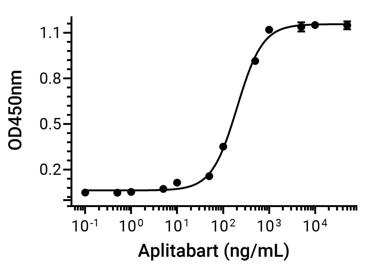 Immobilized TRAIL R2/TNFRSF10B Protein, Human (HY-P72779) can bind Aplitabart. The EC50 for this effect is 201.8 ng/mL.


Chemical Information
-
No. CAS 2796349-94-3
-
Appearance Liquid
-
Peso molecular 871.57 kDa
-
Color Colorless to off-white
-
SMILES
[Aplitabart]
-
Synonyms
IGM-8444
-
Envío
Shipping with dry ice.
-
Formulation
Please refer to the lot-specific COA for specific buffer information.
-
Almacenamiento
Please store the product under the recommended conditions in the Certificate of Analysis.


Pureza y Documentación
-
Ficha de datos (268 KB)
-
SDS (251 KB)
- English - EN (251 KB)
- Français - FR (251 KB)
- Deutsch - DE (251 KB)
- Norwegian - NO (251 KB)
- Español - ES (251 KB)
- Swedish - SV (251 KB)
- Italian - IT (251 KB)
- Korean - KR (251 KB)
- Portuguese - PT (251 KB)
-
Inhibitory Antibodies User Guide (603 KB)
Referencias

Calculators
Concentration (start) × Volume (start) = Concentration (final) × Volume (final)


Aplitabart Related Classifications
HY-P990901 Related Classifications
 Powered by Bioz
Keywords
- Aplitabart
- 2796349-94-3
- IGM-8444
- IGM8444
- IGM 8444
- TNF Receptor
- Apoptosis
- acute myeloid leukemia
- cancer cells
- Death receptor 5
- patient-derived tumor models
- Colo205 colorectal cancer cells
- DR5
- xenograft models
- primary human hepatocytes
- extrinsic apoptotic pathway
- H-EMC-SS chondrosarcoma cells
- Inhibitor
- inhibitor
- inhibit