



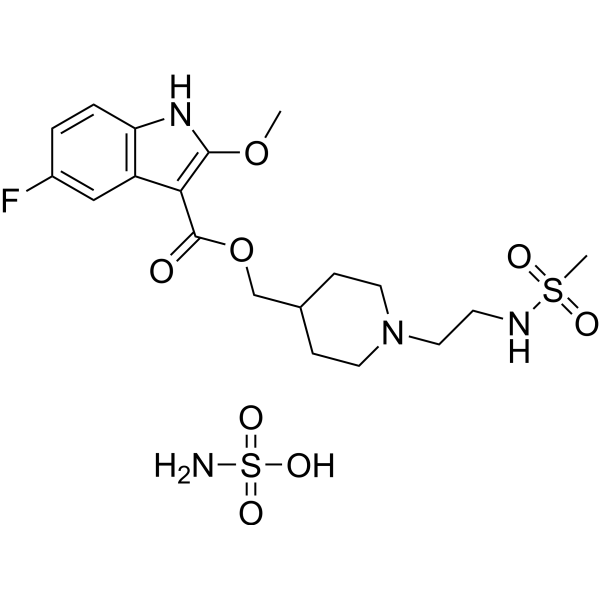
GR125487 sulfamate

Based on 1 Customer Validation
GR125487 is a highly selective 5-HT4 receptor antagonist and acts as an inverse agonist at constitutively active 5-HT4 (a) receptors. GR125487 inhibits adenylyl cyclase/cAMP signaling by blocking the Gs-coupled 5-HT4 receptor. GR125487 is used in research on 5-HT4 receptor function, neuropsychiatric disorders, and gastrointestinal motility.
For research use only. We do not sell to patients.
- Purity : 97%
- CAS No.: 859502-43-5
- Formula: C19H29FN4O8S2
- Molecular Weight:524.58
-
Storage:
Store at room temperature, keep dry and cool.
In solvent -80°C, 1 year , -20°C, 6 months

To place orders, for customer services and technical support, please contact: MedChemExpress USA
Tel: 609-228-6898 E-mail: [email protected] [email protected]


-
 Biological Activity
-
Chemical Information
- Purity & Documentation
- References
-
 Help & FAQs


All 5-HT Receptor Isoforms
More

Biological Activity
Description
IC50 & Target
[1]|
5-HT4 Receptor |
In Vitro
GR125487 sulfamate (5 nM; added 30 min before 100 nM BIMU8 (HY-110094); co-treatment for 4 days) neutralizes the BIMU8-induced increases in total dendritic length and primary dendrite number in GAD65-negative neurons derived from rat hippocampus at embryonic day 18; GR125487 sulfamate alone does not significantly alter dendritic development parameters, supporting that the pro-dendritic effect of BIMU8 depends on 5-HT4 receptor[3].
GR125487 hydrochloride (30 min) binds to 5-HT4 receptor recognition sites with a Ki of 0.19 nM in [3H]GR113808 competition binding assays in porcine caudate membranes; its Ki in 5-HT3 receptor binding assays in NG108-15 cell membranes is 410 nM, demonstrating marked 5-HT4 receptor selectivity[1].
GR125487 hydrochloride (10 μM; 15 min) reduces basal constitutive cAMP production in COS-7 cells expressing human or mouse 5-HT4 (a) receptor and is identified as an inverse agonist; in COS-7 cells expressing mouse 5-HT4 (a) receptor, GR125487 hydrochloride also concentration-dependently inhibits basal constitutive activity and 5-HT-induced cAMP responses, with higher inverse agonist potency than SB207266[2].
MedChemExpress (MCE) has not independently confirmed the accuracy of these methods. They are for reference only. .
-
Cell Line:Rat embryonic hippocampal neurons
-
Concentration:5 nM; 100 nM BIMU8
-
Incubation Time:4 days
-
Result:Neutralized BIMU8-induced increases in total dendritic length and primary dendrite number.
Alone did not significantly alter dendritic-development parameters.
In Vivo
GR125487 antagonizes the maximal-dose-induced duodenal and jejunal prokinetic effects of ML10302 (HY-14441) and SR59768 (HY-14441) at a dose that itself has no significant effect in 5 fasted conscious dogs, supporting the involvement of 5-HT4 receptor in the intestinal prokinetic effects of both compounds[7].
GR125487 (0.3 mg/kg; i.p.; 30 min before Cisplatin (HY-17394)) alone does not significantly inhibit 50 mg/kg Cisplatin-induced emesis in Suncus murinus, but its combination with Granisetron (HY-B0071) (30 mg/kg; p.o.) reduces the number of emetic episodes by approximately 72%; combination with Tropisetron (HY-B0072) does not further enhance the inhibitory effect of Tropisetron, supporting that high-dose Cisplatin-induced emesis involves both 5-HT3 and 5-HT4 receptor[8].
GR125487 sulfamate (1 mg/kg, s.c.; 30 min before morphine) restores the morphine (10 mg/kg, s.c.)-induced decrease in minute ventilation in mice with chronic neuropathic pain induced by nerve ligation, while showing no significant effect on the decrease in respiratory rate or the increase in tidal volume, supporting the involvement of enhanced brainstem 5-HT4a receptor system in the attenuation of morphine-induced respiratory depression under chronic pain conditions[9].
GR125487 sulfamate (1 mg/kg/day; s.c. osmotic minipump; 28 days) blocks Fluoxetine (HY-B0102)-induced anxiolytic-like/antidepressant-like behavioral effects in the Corticosterone (HY-B1618) mouse model, including behavioral endpoints such as EPM, splash, tail-suspension, and novelty-suppressed feeding, indicating that 5-HT4 receptor activation is a critical component of these Fluoxetine behavioral effects[10].
GR125487 sulfamate (1 mg/kg/day; s.c. osmotic minipump; 28 days) partially blocks Fluoxetine-induced increases in Ki-67-positive neural precursors in the hippocampal dentate gyrus and partially blocks DCX-positive newborn neuron maturation-related changes[10].
GR125487 sulfamate (1 mg/kg/day; s.c. osmotic minipump; 28 days) abolishes Fluoxetine-induced increases in dendritic complexity of DCX-positive newborn granule cells, including increased dendritic length and branch intersections[10].
GR125487 sulfamate (1, 3 mg/kg; i.p.; 30 min before Fluvoxamine) blocks the inhibitory effect of Fluvoxamine (30 mg/kg, i.p.) on isolation-induced hyperactivity in isolated mice, supporting the involvement of 5-HT4 receptor in the behavioral effects of Fluvoxamine[11].
GR125487 sulfamate (3 mg/kg, i.p.; administered 30 min before venlafaxine) alone does not block the effect of venlafaxine (HY-B0196) (30 mg/kg; i.p.) in reducing contact-induced hyperactivity, but co-administration with the α2-adrenoceptor antagonist Idazoxan (HY-14561) (0.3 mg/kg) blocks this effect, suggesting that both α2-adrenoceptor and 5-HT4 receptor are involved[11].
GR125487 sulfamate (1 mg/kg; i.p.; once daily; from 3 days before MPTP (HY-W114750) to day 8) prolongs gastrointestinal transit time and aggravates motor bradykinesia in MPTP-induced Parkinson's disease mice[12].
GR125487 sulfamate (1 mg/kg, i.p.; once daily; from 3 days before MPTP to day 8) aggravates MPTP-induced dopaminergic neuronal loss and decreases striatal p-JAK2/JAK2, p-PKA, and p-CREB/CREB, supporting its effect on dopaminergic neuronal survival through inhibition of JAK2/PKA/CREB signaling[12].
GR125487 sulfamate (1 mg/kg, i.p.; once daily; from 3 days before MPTP to day 8) alters the gut microbiota composition in MPTP mice, increases the abundance of bacteria such as Clostridium clostridioforme and Akkermansia muciniphila, and decreases the abundance of bacteria such as Parabacteroides distasonis and Bacteroides fragilis, supporting that the 5-HT4 receptor regulates PD-related neuroinflammation and neurodegenerative processes via gastrointestinal motility/microbiota-gut-brain axis[12].
GR125487 sulfamate (2.5 mg/kg, i.p.; 30 min before Vanillin (HY-N0098) 400 mg/kg) does not significantly reverse the inhibitory effect of Vanillin on seizure-induced mortality in audiogenic seizure-induced mortality in DBA/1 mice, suggesting that the protective effect of Vanillin is not primarily dependent on 5-HT4 receptor[13].
GR125487 sulfamate (1 mg/kg, i.p.; once daily; from 3 days before MPTP to day 8) increases GFAP-positive astrocytes by approximately 45.8% in MPTP mice and further increases striatal TNF-α and IL-1β by approximately 30.2% and 17.6%, respectively, while IL-6 remains unchanged, thereby enhancing neuroinflammation[12].
MedChemExpress (MCE) has not independently confirmed the accuracy of these methods. They are for reference only.
-
Animal Model:Nerve-ligated chronic-pain mouse[9]
-
Dosage:1 mg/kg/day
-
Administration:s.c.; 30 min before morphine
-
Result:Restored the morphine-induced decrease in minute ventilation in nerve-ligated mice.
Did not markedly alter morphine-induced changes in respiratory frequency or tidal volume.
-
Animal Model:Chronic corticosterone model[10]
-
Dosage:1 mg/kg/day
-
Administration:s.c. osmotic minipump; 28 days
-
Result:Blocked fluoxetine-induced anxiolytic-like/antidepressant-like behavioral effects across EPM, splash, tail-suspension and novelty-suppressed-feeding endpoints.
-
Animal Model:Chronic corticosterone model[10]
-
Dosage:1 mg/kg/day
-
Administration:s.c. osmotic minipump; 28 days
-
Result:Partially blocked fluoxetine-induced increases in Ki-67-positive neural precursors and neurogenic/maturation changes in DCX-positive cells.
-
Animal Model:Chronic corticosterone model[10]
-
Dosage:1 mg/kg/day
-
Administration:s.c. osmotic minipump; 28 days
-
Result:Abolished fluoxetine-induced increases in dendritic complexity of DCX-positive newborn granule cells.
-
Animal Model:Isolation-reared mouse[11]
-
Dosage:1, 3 mg/kg
-
Administration:i.p.; 30 min before Fluvoxamine
-
Result:Blocked the suppressive effect of fluvoxamine on encounter-induced hyperactivity.
-
Animal Model:MPTP-induced acute PD mouse[12]
-
Dosage:1 mg/kg
-
Administration:i.p.; once daily from 3 days before MPTP through day 8
-
Result:Prolonged gastrointestinal transit time and aggravated motor bradykinesia.
Exacerbated dopaminergic neuronal loss.
Reduced p-JAK2/JAK2, p-PKA and p-CREB/CREB signaling.
Increased GFAP-positive astrocytes by approximately 45.8%.
Increased striatal TNF-α by approximately 30.2% and IL-1β by approximately 17.6%; IL-6 was not further altered.


Chemical Information
-
CAS No. 859502-43-5
-
Appearance Solid
-
Molecular Weight 524.58
-
Formula C19H29FN4O8S2
-
Color Yellow to brown
-
SMILES
O=C(C1=C(NC2=C1C=C(F)C=C2)OC)OCC3CCN(CC3)CCNS(=O)(C)=O.O=S(O)(N)=O
-
Shipping
Room temperature in continental US; may vary elsewhere.
-
Storage
Store at room temperature, keep dry and cool
In solvent -80°C 1 year -20°C 6 months


Purity & Documentation
-
Data Sheet (298 KB)
-
SDS (252 KB)
- English - EN (252 KB)
- Français - FR (252 KB)
- Deutsch - DE (252 KB)
- Norwegian - NO (252 KB)
- Español - ES (252 KB)
- Swedish - SV (252 KB)
- Italian - IT (252 KB)
- Korean - KR (252 KB)
- Portuguese - PT (252 KB)
-
Handling Instructions (2659 KB)
References

Calculators
Concentration (start) × Volume (start) = Concentration (final) × Volume (final)


GR125487 sulfamate Related Classifications
HY-103146 Related Classifications
 Powered by Bioz