



HDAC4-IN-1

Based on 1 Customer Validation
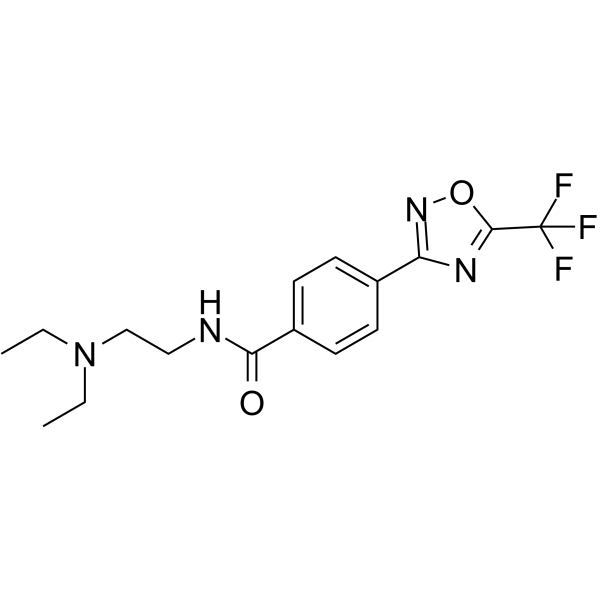
HDAC4-IN-1 (compound 1a) is a class IIa HDACI inhibitor (IC50=0.077 μM). HDAC4-IN-1 can enhance Caspase-induced Apoptosis. HDAC4-IN-1 has anticancer activity. HDAC4-IN-1 can be used in the research of drug combination against cancer.
For research use only. We do not sell to patients.
- Purity : 98.11%
- CAS No.: 1418293-39-6
- Formula: C16H19F3N4O2
- Molecular Weight:356.34
-
Storage:Powder -20°C, 3 years , 4°C, 2 years ; In solvent -80°C, 6 months , -20°C, 1 month

To place orders, for customer services and technical support, please contact: MedChemExpress USA
Tel: 609-228-6898 E-mail: [email protected] [email protected]


-
 Biological Activity
-
Chemical Information
-
Solvent & Solubility
- Protocols
- Purity & Documentation
- References
-
 Help & FAQs




Biological Activity
Description
IC50 & Target
|
HDAC2 6.13 μM (IC50) |
HDAC4 0.012 μM (IC50) |
HDAC6 5.79 μM (IC50) |
HDAC8 4.26 μM (IC50) |
Cellular Effect
|
Cell Line

|
Type | Value | Description | References |
|---|---|---|---|---|
| CAL-27 | IC50 |
22.5 μM
Compound: 1a
|
Antiproliferative activity against human CAL-27 cells without HDAC4 expression assessed as inhibition of cell growth incubated for 72 hrs by MTT assay
Antiproliferative activity against human CAL-27 cells without HDAC4 expression assessed as inhibition of cell growth incubated for 72 hrs by MTT assay
|
[PMID: 37979441] |
| CAL-27 | IC50 |
8.63 μM
Compound: 1a
|
Antiproliferative activity against human CAL-27 cells overexpressing HDAC4 assessed as inhibition of cell growth incubated for 72 hrs by MTT assay
Antiproliferative activity against human CAL-27 cells overexpressing HDAC4 assessed as inhibition of cell growth incubated for 72 hrs by MTT assay
|
[PMID: 37979441] |
| THP-1 | IC50 |
9.24 μM
Compound: 1a
|
Antiproliferative activity against human THP-1 cells assessed as inhibition of cell growth incubated for 72 hrs by MTT assay
Antiproliferative activity against human THP-1 cells assessed as inhibition of cell growth incubated for 72 hrs by MTT assay
|
[PMID: 37979441] |
In Vitro
HDAC4-IN-1 can significantly inhibits class IIa HDAC (IC50=0.077 μM)[1].
HDAC4-IN-1 (100 μM; 72 h) has very low cytotoxicity in THP-1 cells (IC50=9.2 μM), but has a strong synergistic effect in combination with BTZ and enhances the cytotoxic effect of BTZ on cells [1].
HDAC4-IN-1 (5μM; 48 h) combines with BTZ (7.9 nM) can induce Caspase-mediated apoptosis in THP-1 cells[1].
HDAC4-IN-1 (5μM; 24 h) combines with BTZ (7.9 nM) can enhance the expression of p21 protein in THP-1 cells [1].
HDAC4-IN-1 (5μM; 72 h) inhibits cell proliferation in cancer cell line Cal27_HDAC4 [1].
MedChemExpress (MCE) has not independently confirmed the accuracy of these methods. They are for reference only.
-
Cell Line:THP-1
-
Concentration:100 μM
7.9 nM for BTZ -
Incubation Time:72 h
-
Result:Revealed relatively low cytotoxicity than pan and class I inhibitors.
Enhanced the cytotoxic effect of BTZ on cells in combination with BTZ.
-
Cell Line:THP-1
-
Concentration:5 μM
7.9 nM for BTZ -
Incubation Time:48 h
-
Result:Significantly enhanced the activation of caspase 3/7 in combination with BTZ.
-
Cell Line:THP-1
-
Concentration:5 μM
7.9 nM for BTZ -
Incubation Time:24 h
-
Result:Enhanced the protein expression of p21 in combination with BTZ.


Chemical Information
-
CAS No. 1418293-39-6
-
Appearance Solid
-
Molecular Weight 356.34
-
Formula C16H19F3N4O2
-
Color White to off-white
-
SMILES
O=C(NCCN(CC)CC)C1=CC=C(C2=NOC(C(F)(F)F)=N2)C=C1
-
Shipping
Room temperature in continental US; may vary elsewhere.
-
Storage
Powder -20°C 3 years 4°C 2 years In solvent -80°C 6 months -20°C 1 month


Solvent & Solubility
In Vitro:
DMSO : ≥ 104 mg/mL (291.86 mM; Hygroscopic DMSO has a significant impact on the solubility of product, please use newly opened DMSO)
* "≥" means soluble, but saturation unknown.
Please refer to the solubility information to select the appropriate solvent. Once prepared, please aliquot and store the solution to prevent product inactivation from repeated freeze-thaw cycles.
Storage method and period of stock solution: -80°C, 6 months; -20°C, 1 month. When stored at -80°C, please use it within 6 months. When stored at -20°C, please use it within 1 month.
Please refer to the solubility information to select the appropriate solvent. Once prepared, please aliquot and store the solution to prevent product inactivation from repeated freeze-thaw cycles.
Storage method and period of stock solution: -80°C, 6 months; -20°C, 1 month. When stored at -80°C, please use it within 6 months. When stored at -20°C, please use it within 1 month.
Concentration (start) × Volume (start) = Concentration (final) × Volume (final)


Purity & Documentation
-
Data Sheet (271 KB)
-
SDS (254 KB)
- English - EN (254 KB)
- Français - FR (254 KB)
- Deutsch - DE (254 KB)
- Norwegian - NO (254 KB)
- Español - ES (254 KB)
- Swedish - SV (254 KB)
- Italian - IT (254 KB)
- Korean - KR (254 KB)
- Portuguese - PT (254 KB)
-
Handling Instructions (2659 KB)
References


Complete Stock Solution Preparation Table
Please refer to the solubility information to select the appropriate solvent. Once prepared, please aliquot and store the solution to prevent product inactivation from repeated freeze-thaw cycles.
Storage method and period of stock solution: -80°C, 6 months; -20°C, 1 month. When stored at -80°C, please use it within 6 months. When stored at -20°C, please use it within 1 month.
| Optional Solvent | Concentration Solvent Mass | 1 mg | 5 mg | 10 mg | 25 mg |
|---|---|---|---|---|---|
| DMSO | 1 mM | 2.8063 mL | 14.0315 mL | 28.0631 mL | 70.1577 mL |
| 5 mM | 0.5613 mL | 2.8063 mL | 5.6126 mL | 14.0315 mL | |
| 10 mM | 0.2806 mL | 1.4032 mL | 2.8063 mL | 7.0158 mL | |
| 15 mM | 0.1871 mL | 0.9354 mL | 1.8709 mL | 4.6772 mL | |
| 20 mM | 0.1403 mL | 0.7016 mL | 1.4032 mL | 3.5079 mL | |
| 25 mM | 0.1123 mL | 0.5613 mL | 1.1225 mL | 2.8063 mL | |
| 30 mM | 0.0935 mL | 0.4677 mL | 0.9354 mL | 2.3386 mL | |
| 40 mM | 0.0702 mL | 0.3508 mL | 0.7016 mL | 1.7539 mL | |
| 50 mM | 0.0561 mL | 0.2806 mL | 0.5613 mL | 1.4032 mL | |
| 60 mM | 0.0468 mL | 0.2339 mL | 0.4677 mL | 1.1693 mL | |
| 80 mM | 0.0351 mL | 0.1754 mL | 0.3508 mL | 0.8770 mL | |
| 100 mM | 0.0281 mL | 0.1403 mL | 0.2806 mL | 0.7016 mL |


HDAC4-IN-1 Related Classifications
HY-149721 Related Classifications
 Powered by Bioz