



U7D-1

Based on 1 Customer Validation
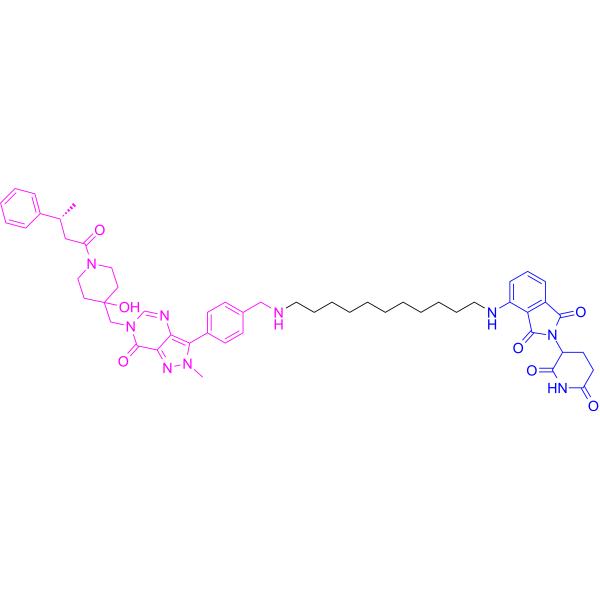
U7D-1 is a USP7 PROTAC degrader that induces selective proteasomal degradation of USP7. U7D-1 destabilizes and downregulates the expression of variant PRC1 complex subunits PCGF1, RING1A and PCGF6, and also slightly reduces the protein level of KDM2B. U7D-1 decreases cell viability, arrests neuroblastoma cells at the G0/G1 cell cycle phase, and downregulates the expression of target genes of PAX3::FOXO1 in FP-RMS cells. U7D-1 increases the level of cleaved PARP in FP-RMS cells, induces cell apoptosis, and upregulates the expression of muscle differentiation markers MYH1 and MYF5. U7D-1 inhibits the growth and proliferation of p53 wild-type and mutant cancer cells, and regulates the apoptosis pathway and E2F pathway. U7D-1 is applicable to studies on neuroblastoma, fusion-positive rhabdomyosarcoma, p53-mutant cancers and cancer-related research.
(Pink: USP7 ligand (HY-49319); Blue: Cereblon ligand (HY-103596); Black: linker).
For research use only. We do not sell to patients.
- Purity : 99.68%
- CAS No.: 3094177-94-0
- Formula: C53H65N9O7
- Molecular Weight:940.14
-
Storage:Powder -20°C, 3 years , 4°C, 2 years ; In solvent -80°C, 6 months , -20°C, 1 month

To place orders, for customer services and technical support, please contact: MedChemExpress USA
Tel: 609-228-6898 E-mail: [email protected] [email protected]


-
 Biological Activity
-
Chemical Information
-
Solvent & Solubility
- Protocols
- Purity & Documentation
- References
-
 Help & FAQs


All PROTACs Isoforms
More

Biological Activity
Description
|
USP7 |
Cellular Effect
|
Cell Line

|
Type | Value | Description | References |
|---|---|---|---|---|
| JeKo-1 | IC50 |
1034 nM
Compound: 26; U7D-1
|
Antiproliferative activity against human JeKo-1 cells harbouring p53 mutant
Antiproliferative activity against human JeKo-1 cells harbouring p53 mutant
|
[PMID: 36306471] |
In Vitro
U7D-1 (0.1-10 μM, 0-500 nM, 1 μM; 0-24 h, 20 h following 2 h pre-treatment) induces dose- and time-dependent, CRBN-, neddylation-, and proteasome-dependent USP7 degradation in RS4;11 cells with a DC50 of 33 nM[3].
U7D-1 exhibits high proteome-wide selectivity for USP7 degradation in RS4;11 cells[3].
U7D-1 (79.4 nM-4948.0 nM, 0.1-1 μM, 1 μM; 3 days, 24 h, 0-24 h) inhibits growth of p53 wild-type OCI-ly10, RS4;11, MV4;11, Reh, and MOLT4 cells with IC50 values from 79.4 nM to 4948.0 nM, and this activity is not completely p53-dependent, as it remains effective in p53-knockdown RS4;11 shP53 cells[3].
U7D-1 (1 μM; 24 h, 0-72 h) exerts antiproliferative activity in p53 mutant Jeko-1 cells by triggering apoptotic and E2F pathway changes, including up-regulation of apoptotic genes and time-dependent cleavage of caspase-3[3].
U7D-1 efficiently degrades USP7 with a DC50 of 33 nM and significantly inhibits the proliferation of both p53 wild-type and mutant cancer cells[4].
U7D-1 efficiently degrades USP7 (DC50 = 33 nM) and exerts potent anti-proliferative activity against p53 mutant Jeko-1 (IC50 = 1034.9 nM) and Mino (IC50 = 1175.3 nM) cancer cells by regulating USP7's non-enzymatic functional regions[5].
MedChemExpress (MCE) has not independently confirmed the accuracy of these methods. They are for reference only.
-
Cell Line:RS4;11 human leukemia cells
-
Concentration:0.1-10 μM (dose-response); 0-500 nM (dose-response); 1 μM (time-course); 1 μM (inhibitor pre-treatment)
-
Incubation Time:24 h (dose-response); 0-24 h (time-course); 20 h (inhibitor pre-treatment, following 2 h pre-treatment with inhibitors)
-
Result:Reduced USP7 protein levels by 83.2% at 1 μM after 24 h.
Induced dose-dependent USP7 degradation with a DC50 value of 33 nM.
Initiated USP7 degradation after 4 h of exposure, with increased effectiveness after 8 h.
Had its induced USP7 degradation rescued by pre-treatment with MLN4924, PS341, PR171, lenalidomide, or pomalidomide.
-
Cell Line:p53 wild-type human leukemia cell lines (OCI-ly10, RS4;11, MV4;11, Reh, MOLT4), p53-knockdown RS4;11 (RS4;11 shP53) cells
-
Concentration:79.4 nM (OCI-ly10); 227.0 nM (RS4;11); 830.3 nM (MV4;11); 1367.2 nM (Reh); 4948.0 nM (MOLT4); 0.1-1 μM (caspase-3/7 activity assay); 1 μM (immunoblot assay)
-
Incubation Time:3 days (cell growth inhibition); 24 h (caspase-3/7 activity assay); 0-24 h (immunoblot assay)
-
Result:Exhibited anti-proliferative activity in all tested p53 wild-type cell lines, with IC50 values ranging from 79.4 nM to 4948.0 nM.
Was more potent than USP7 inhibitor compound 4 in Reh and MOLT4 cells.
Upregulated p53 and p21 protein levels in a time-dependent manner in RS4;11 cells.
Induced caspase-3/7 activation in RS4;11 cells.
Retained cell growth inhibitory activity in p53-knockdown RS4;11 shP53 cells, whereas compound 4 was completely inactive in these cells.
-
Cell Line:p53 mutant human cancer cell lines (Jeko-1, Mino, RPMI-8226, Jurkat, SU-DHL-6, CCRF-CEM), CRBN-knockout Jeko-1 (Jeko-1 CRBN KO) cells
-
Concentration:1034.9 nM (Jeko-1, 3 days); 1175.3 nM (Mino); 1860.6 nM (RPMI-8226); 6077.6 nM (Jurkat); 9078.0 nM (SU-DHL-6); 10675.0 nM (CCRF-CEM); 53.5 nM (Jeko-1, 7 days); 727 nM (Jeko-1 CRBN KO, 7 days); 0.1-10 μM (immunoblot assay)
-
Incubation Time:3 days (cell growth inhibition for most cell lines); 7 days (cell growth inhibition for Jeko-1 and Jeko-1 CRBN KO); 24 h (immunoblot assay)
-
Result:Exhibited potent cell growth inhibition in all tested p53 mutant cell lines, with IC50 values ranging from 1034.9 nM to 10675.0 nM, whereas USP7 inhibitor compound 4 showed no activity.
Had an IC50 of 53.5 nM over 7 days in Jeko-1 cells, with 13-fold reduced potency (IC50 = 727 nM) in Jeko-1 CRBN KO cells.
Had its mediated USP7 degradation reduced in Jeko-1 CRBN KO cells.
- RNA extraction experimental
- Western Blot
- Mammalian live/dead viability and cytotoxicity staining
- Annexin V plus membrane-impermeant dye apoptosis staining
- BrdU Incorporation Assay
- CCK-8/WST-8 Cell Proliferation Assay
- Protocol for Cell Cycle
- Cell Viability Determination by MTT Colorimetric Assay
- Detection of Apoptosis
- TUNEL staining for apoptotic DNA fragmentation
- Cell Cytotoxicity Assay
- Flow cytometric DNA-content cell-cycle staining
- C2C12 myoblast-to-myotube differentiation
- Apoptosis Solutions
- MTT Cell Proliferation Assay


Chemical Information
-
CAS No. 3094177-94-0
-
Appearance Solid
-
Molecular Weight 940.14
-
Formula C53H65N9O7
-
Color White to light yellow
-
SMILES
O=C1N(C(CC2)C(NC2=O)=O)C(C3=C1C=CC=C3NCCCCCCCCCCCNCC4=CC=C(C5=C(C6=NN5C)N=CN(CC7(O)CCN(C(C[C@H](C8=CC=CC=C8)C)=O)CC7)C6=O)C=C4)=O
-
Shipping
Room temperature in continental US; may vary elsewhere.
-
Storage
Powder -20°C 3 years 4°C 2 years In solvent -80°C 6 months -20°C 1 month


Solvent & Solubility
In Vitro:
DMSO : 100 mg/mL (106.37 mM; Need ultrasonic; Hygroscopic DMSO has a significant impact on the solubility of product, please use newly opened DMSO)
Please refer to the solubility information to select the appropriate solvent. Once prepared, please aliquot and store the solution to prevent product inactivation from repeated freeze-thaw cycles.
Storage method and period of stock solution: -80°C, 6 months; -20°C, 1 month. When stored at -80°C, please use it within 6 months. When stored at -20°C, please use it within 1 month.
Please refer to the solubility information to select the appropriate solvent. Once prepared, please aliquot and store the solution to prevent product inactivation from repeated freeze-thaw cycles.
Storage method and period of stock solution: -80°C, 6 months; -20°C, 1 month. When stored at -80°C, please use it within 6 months. When stored at -20°C, please use it within 1 month.
Concentration (start) × Volume (start) = Concentration (final) × Volume (final)
In Vivo:
Select the appropriate dissolution method based on your experimental animal and administration route.
- For the following dissolution methods, please ensure to first prepare a clear stock solution using an In Vitro approach and then sequentially add co-solvents:
- To ensure reliable experimental results, the clarified stock solution can be appropriately stored based on storage conditions. As for the working solution for In Vivo experiments, it is recommended to prepare freshly and use it on the same day.
- The percentages shown for the solvents indicate their volumetric ratio in the final prepared solution. If precipitation or phase separation occurs during preparation, heat and/or sonication can be used to aid dissolution.
Add each solvent one by one: 10% DMSO 40% PEG300 5% Tween-80 45% Saline
Solubility: ≥ 2.5 mg/mL (2.66 mM); Clear solution
This protocol yields a clear solution of ≥ 2.5 mg/mL (saturation unknown).
Taking 1 mL working solution as an example, add 100 μL DMSO stock solution (25.0 mg/mL) to 400 μL PEG300, and mix evenly; then add 50 μL Tween-80 and mix evenly; then add 450 μL Saline to adjust the volume to 1 mL.
Preparation of Saline: Dissolve 0.9 g sodium chloride in ddH₂O and dilute to 100 mL to obtain a clear Saline solution.
Add each solvent one by one: 10% DMSO 90% (20% SBE-β-CD in Saline)
Solubility: ≥ 2.5 mg/mL (2.66 mM); Clear solution
This protocol yields a clear solution of ≥ 2.5 mg/mL (saturation unknown).
Taking 1 mL working solution as an example, add 100 μL DMSO stock solution (25.0 mg/mL) to 900 μL 20% SBE-β-CD in Saline, and mix evenly.
Preparation of 20% SBE-β-CD in Saline (4°C, storage for one week): 2 g SBE-β-CD powder is dissolved in 10 mL Saline, completely dissolve until clear.
In Vivo Dissolution Calculator
Please enter the basic information of animal experiments:
-
-
-
-
Recommended: Prepare an additional quantity of animals to account for potential losses during experiments.
Please enter your animal formula composition:
-
%DMSO +
Recommended: Keep the proportion of DMSO in working solution below 2% if your animal is weak.
-
%+
-
+%Tween-80 + +
-
%Saline +
The co-solvents required include: DMSO, . All of co-solvents are available by MedChemExpress (MCE). , Tween 80. All of co-solvents are available by MedChemExpress (MCE).
Working solution concentration: 0.22 mg/mL
Method for preparing stock solution: mg drug dissolved in μL DMSO. Stock solution concentration: mg/mL.
1. Take μL DMSO stock solution;
2. Add μL .
μL , mix evenly;
3. Then add μL Tween 80, mix evenly;
4. Then add μL
Please ensure that the stock solution in the first step is dissolved to a clear state, and add co-solvents in sequence. You can use ultrasonic heating (ultrasonic cleaner, recommended frequency 20-40 kHz), vortexing, etc. to assist dissolution.


Purity & Documentation
-
Data Sheet (278 KB)
-
SDS (254 KB)
- English - EN (254 KB)
- Français - FR (254 KB)
- Deutsch - DE (254 KB)
- Norwegian - NO (254 KB)
- Español - ES (254 KB)
- Swedish - SV (254 KB)
- Italian - IT (254 KB)
- Korean - KR (254 KB)
- Portuguese - PT (254 KB)
-
Handling Instructions (2659 KB)
References
[1]. Cmarik EA, et al. Inhibition of USP7 Destabilizes the Noncanonical PRC1.1 Complex and Induces Neuroblastoma Differentiation. Molecular cancer research : MCR. 2026 Jul 02;24(7):555-575. [Content Brief]
[3]. Pei Y, et al. Discovery of a Potent and Selective Degrader for USP7. Angewandte Chemie (International ed. in English). 2022 Aug 15;61(33):e202204395. [Content Brief]
[4]. Dai XJ, et al. Degraders in epigenetic therapy: PROTACs and beyond. Theranostics. 2024;14(4):1464-1499. [Content Brief]
[5]. Sun D, et al. Blocking Non-enzymatic Functions by PROTAC-Mediated Targeted Protein Degradation. Journal of medicinal chemistry. 2022 Nov 10;65(21):14276-14288. [Content Brief]


Complete Stock Solution Preparation Table
Please refer to the solubility information to select the appropriate solvent. Once prepared, please aliquot and store the solution to prevent product inactivation from repeated freeze-thaw cycles.
Storage method and period of stock solution: -80°C, 6 months; -20°C, 1 month. When stored at -80°C, please use it within 6 months. When stored at -20°C, please use it within 1 month.
| Optional Solvent | Concentration Solvent Mass | 1 mg | 5 mg | 10 mg | 25 mg |
|---|---|---|---|---|---|
| DMSO | 1 mM | 1.0637 mL | 5.3184 mL | 10.6367 mL | 26.5918 mL |
| 5 mM | 0.2127 mL | 1.0637 mL | 2.1273 mL | 5.3184 mL | |
| 10 mM | 0.1064 mL | 0.5318 mL | 1.0637 mL | 2.6592 mL | |
| 15 mM | 0.0709 mL | 0.3546 mL | 0.7091 mL | 1.7728 mL | |
| 20 mM | 0.0532 mL | 0.2659 mL | 0.5318 mL | 1.3296 mL | |
| 25 mM | 0.0425 mL | 0.2127 mL | 0.4255 mL | 1.0637 mL | |
| 30 mM | 0.0355 mL | 0.1773 mL | 0.3546 mL | 0.8864 mL | |
| 40 mM | 0.0266 mL | 0.1330 mL | 0.2659 mL | 0.6648 mL | |
| 50 mM | 0.0213 mL | 0.1064 mL | 0.2127 mL | 0.5318 mL | |
| 60 mM | 0.0177 mL | 0.0886 mL | 0.1773 mL | 0.4432 mL | |
| 80 mM | 0.0133 mL | 0.0665 mL | 0.1330 mL | 0.3324 mL | |
| 100 mM | 0.0106 mL | 0.0532 mL | 0.1064 mL | 0.2659 mL |


U7D-1 Related Classifications
HY-148369 Related Classifications
 Powered by Bioz